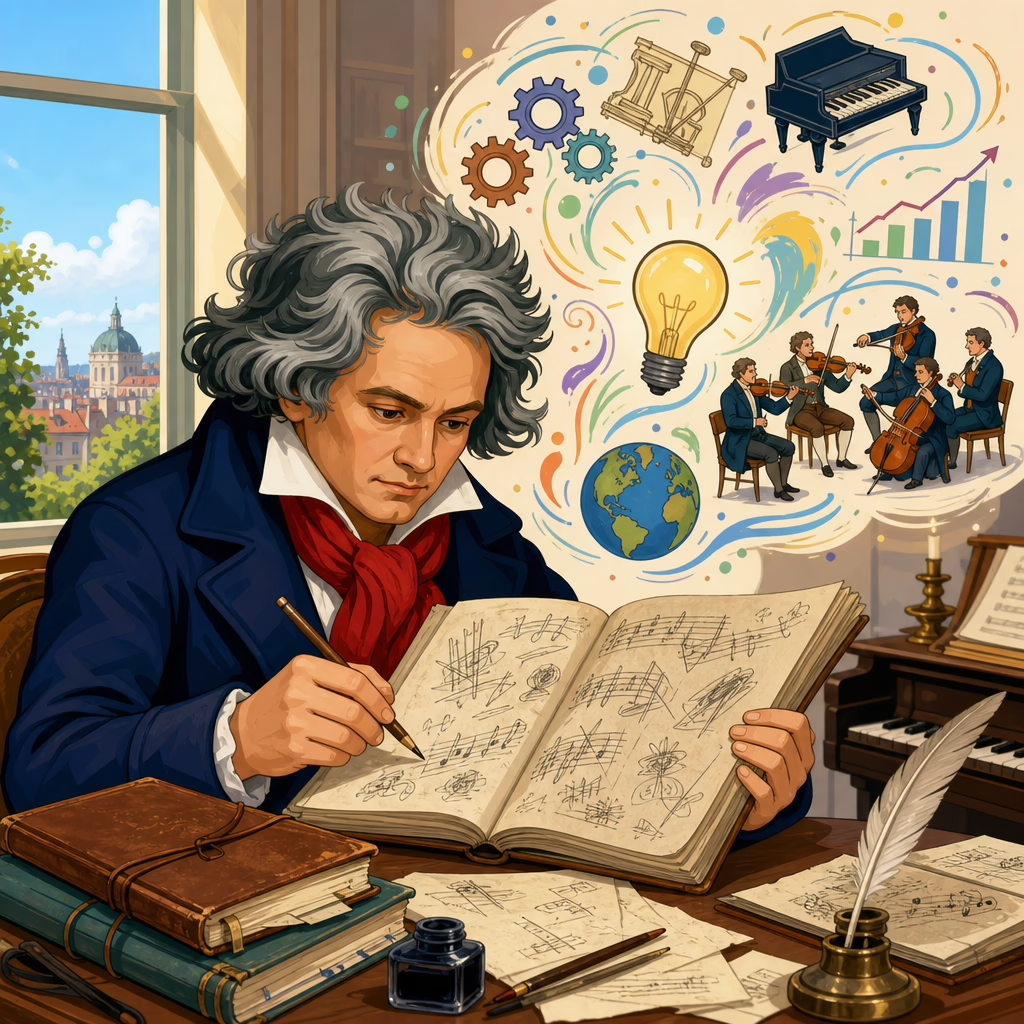
Why Beethoven’s Sketchbooks Matter to Innovation History
Beethoven’s sketchbooks matter to innovation history because they preserve the working record of how a transformative mind turned raw musical fragments into finished works that changed cultural expectations. In innovation history, a sketchbook is more than a notebook. It is evidence of process: failed trials, revised assumptions, alternate pathways, and the steady conversion of possibility into form. Beethoven’s sketchbooks let historians observe that process with unusual clarity. Rather than leaving only polished masterpieces, he left pages crowded with motifs, harmonic tests, rhythmic permutations, text reminders, and structural plans. That archive matters because innovation is often misunderstood as sudden inspiration. Beethoven shows the opposite. His notebooks reveal that originality frequently emerges through iteration, constraint, selection, and relentless reworking.
I have spent years reading music historians, comparing facsimiles, and following themes from draft to published score, and the same conclusion keeps returning: Beethoven’s genius becomes more impressive, not less, when you see how hard he worked ideas. The sketchbooks are central to that understanding. They document composition as a design activity, not a mystical event. For historians of science, technology, business, and art, that distinction is crucial. When people ask how breakthrough creators operate, Beethoven offers primary-source proof that innovation depends on experimentation and recordkeeping. His manuscripts give a rare time-lapse view of creative development at the highest level.
These documents also matter because they survived across multiple periods of his career, allowing scholars to trace continuity and change. We can see recurring habits: short cells expanded into large forms, contrasting options placed side by side, and abandoned solutions that later reappear in altered contexts. We also see practical realities. Beethoven used pocket sketchbooks while walking, desk books for sustained work, and loose leaves for larger planning. This diversity shows that innovation does not happen in one setting. It moves between capture, reflection, testing, and synthesis. That pattern is familiar to modern product teams, researchers, and inventors, which is why Beethoven’s sketchbooks belong in innovation history, not only music history.
Most importantly, the sketchbooks answer a basic question directly: why do they matter? They matter because they are among the best surviving records of iterative creativity in any field. They show how novelty is built, evaluated, and refined over time. They prove that revision is not evidence of weakness but the mechanism of excellence.
What Beethoven’s Sketchbooks Actually Contain
Beethoven’s sketchbooks are not neat diaries. They are working documents filled with melodic germs, bass lines, counterpoint studies, harmonic sequences, rhythmic variants, text annotations, and reminders about orchestration or formal placement. Some pages look chaotic because they were tools, not display objects. A single opening idea might appear in several altered states: compressed, transposed, reharmonized, shifted metrically, or broken into smaller units. That density is precisely what makes the books historically valuable. They preserve decision points.
Scholars usually distinguish among pocket sketchbooks, miscellany books, and more sustained drafting books. Pocket books captured ideas quickly, often outside the home. Larger books supported extended development, where Beethoven compared possibilities and worked them toward coherent structures. The physical format matters because it reveals stages in his process. First came capture, then manipulation, then architectural integration. In modern terms, he moved from ideation to prototyping to system design.
The content also disproves the lazy stereotype that great artists simply hear complete works internally and write them down. Beethoven certainly possessed extraordinary internal hearing, but the sketchbooks show him testing alternatives constantly. A cadence may be delayed by several measures in one draft, tightened in another, and then transformed entirely in the final score. A motive may begin as accompaniment material, then become structural. This is not transcription of inspiration. It is engineering through sound.
Why Historians Treat the Sketchbooks as Innovation Evidence
Innovation history depends on records that reveal how new ideas emerge. In technology, those records might be laboratory notebooks, patent drafts, prototype logs, or version histories. In Beethoven’s case, the sketchbooks serve a similar function. They let historians reconstruct not just what he created, but how he arrived there. That difference is everything. Finished scores show outcomes. Sketchbooks show pathways, detours, and rejected models.
Consider how rarely this kind of evidence survives for any major creator before the modern era. Many artists destroyed drafts or left too little material to trace development. Beethoven preserved enough for scholars to identify patterns of method. He repeatedly began with small motivic units rather than extended melodies, then generated scale through transformation. That compositional habit parallels later innovation models in which robust systems grow from modular components. The principle is simple: if the core unit is flexible, the final structure can evolve without collapsing.
Historians also value the sketchbooks because they provide temporal depth. By comparing notebooks across years, one can see how Beethoven’s methods adapted under pressure, especially as his hearing loss advanced. He increasingly relied on internal conceptualization and written experimentation. That makes the documents doubly important. They show not only invention, but adaptation of process when ordinary feedback channels became unreliable. In innovation studies, process adaptation under constraint is one of the clearest markers of resilient creativity.
Anyone studying breakthrough work should also read Beethoven in relation to large-scale form. His notebooks demonstrate that radical outcomes are often built through conservative tools used inventively: repetition, variation, recombination, compression, and contrast. If you want broader context on how those methods affected orchestral form, the main guide on how Beethoven reinvented the symphony complements this focused discussion of the notebooks themselves.
What the Sketchbooks Reveal About Iteration
The most important lesson in Beethoven’s sketchbooks is that iteration is not cleanup at the end. It is the core engine of invention from the very beginning. Beethoven returns to tiny fragments repeatedly, asking new questions each time. Can this interval carry more tension? Can this rhythm propel a transition? Can this pattern support development rather than merely statement? Those are innovation questions. They treat an initial idea as a platform, not a product.
A well-known example comes from the opening idea of the Third Symphony, where energy and directional force arise not from decorative abundance but from the consequences of compact material. In sketches related to major works, Beethoven often tries neighboring solutions before committing. The surviving pages reveal alternatives that are competent, sometimes excellent, yet not chosen. That matters because it shows selection discipline. Innovation is not just generating many options. It is recognizing which option can bear long-term structural weight.
Another recurring feature is delayed resolution. Beethoven often intensifies impact by withholding a stable answer until the surrounding material has raised the stakes. In sketches, you can watch him feel toward that timing. He experiments with phrase length, registral placement, and harmonic pacing until the arrival lands with inevitability. Product designers would call this user experience calibration. Scientists would call it optimization under constraints. Beethoven simply did it with extraordinary rigor.
| Sketchbook pattern | What Beethoven was doing | Innovation lesson |
|---|---|---|
| Motivic fragmentation | Breaking a theme into small reusable cells | Start with modular units that can scale |
| Variant comparison | Testing multiple rhythmic or harmonic options | Generate alternatives before choosing |
| Structural mapping | Placing material within a larger formal plan | Evaluate ideas in system context, not alone |
| Revision under constraint | Reworking passages despite hearing loss and deadlines | Constraints can sharpen method and focus |
| Reuse and transformation | Returning to earlier ideas in altered form | Innovation often comes from recombination, not novelty from nothing |
Constraint, Deafness, and Process Design
Beethoven’s sketchbooks matter even more when viewed alongside his worsening deafness. It is tempting to turn that fact into mythology, but the real historical significance is practical. As auditory feedback became more limited, Beethoven relied heavily on written externalization. The page became a cognitive workspace where ideas could be stored, manipulated, and evaluated. In modern innovation language, he built a compensatory system. He did not wait for ideal conditions. He redesigned process around changing capability.
This adaptation helps explain why the sketchbooks are so rich. They were not incidental leftovers. They were integral tools. By writing, revising, and comparing, Beethoven created a durable environment for thought. That environment reduced dependence on memory alone and made complex multi-stage development possible. Anyone who has managed difficult design work recognizes the advantage. When a problem exceeds what working memory can hold, external notes become part of the thinking apparatus.
There is also a broader lesson here about accessibility and innovation. Constraint does not automatically produce genius, and it would be inaccurate to romanticize suffering. Yet history repeatedly shows that limitations can force explicit methods. Beethoven’s sketchbooks capture such a method in action. They show a creator making cognition visible so that large structures could still be built under intense personal difficulty. For historians, that is invaluable evidence of process resilience.
From Musical Drafts to General Innovation Principles
Why should business leaders, technologists, or historians outside music care about Beethoven’s sketchbooks? Because the notebooks illustrate general principles that appear in many domains. First, breakthrough work usually begins with rough fragments rather than complete solutions. Second, repeated revision is productive when it is directed by criteria. Third, documentation is not bureaucracy when it helps preserve options and expose patterns. Fourth, the final elegance of an invention often conceals a long period of disorder underneath.
I often compare Beethoven’s notebooks to laboratory records or software version control, not because music and engineering are identical, but because the underlying logic aligns. In each case, progress depends on preserving traces of thought. Without those traces, teams overestimate spontaneity and underestimate process. Beethoven’s pages correct that error. They show that high originality can coexist with discipline, and that systematic revision does not dilute vision. It clarifies vision.
The sketchbooks also support a more accurate account of creativity for students. Too many learners assume that difficulty means they lack talent. Beethoven demonstrates the opposite. Friction, restarts, and discarded drafts are normal. The existence of numerous alternatives behind a masterpiece is not embarrassing. It is the historical record of serious work. That is one reason these notebooks continue to matter far beyond nineteenth-century music studies.
How Scholars Use the Sketchbooks Today
Modern Beethoven scholarship draws on source criticism, paper studies, watermark analysis, dating methods, thematic catalogs, and digital archives to interpret the sketchbooks responsibly. Editors compare layers of drafting to establish chronology. Analysts trace motives across notebooks and finished scores. Performers consult the findings to better understand accentuation, pacing, articulation, and structural tension. The sketchbooks are therefore not museum curiosities. They remain active research instruments.
Projects associated with major archives and scholarly editions have made access far better than it was a generation ago. Facsimiles, critical commentaries, and searchable databases allow researchers to test claims against primary material. That transparency matters. It prevents romantic overreading and grounds interpretation in evidence. For innovation history, this is essential because the value of the sketchbooks lies in what can be demonstrated, not merely admired.
There are limits, of course. Not every page can be dated with certainty, and not every surviving draft reveals a complete chain from idea to finished work. Some notebooks are fragmentary. Some links remain inferential. But those limitations do not weaken the main conclusion. Even with gaps, Beethoven’s sketchbooks constitute one of the richest surviving archives of iterative creation anywhere in cultural history.
Beethoven’s sketchbooks matter to innovation history because they turn creativity from legend into evidence. They show that revolutionary results can grow from small fragments, patient revision, and disciplined comparison. They show that documentation is not the enemy of originality but one of its strongest supports. They show that constraints, including profound personal ones, can lead creators to develop more explicit and resilient methods. Most of all, they let us watch innovation happen instead of guessing after the fact.
That is the lasting benefit of these notebooks. They help historians, artists, teachers, and builders of every kind understand that excellence is usually constructed through process. Beethoven did not become less extraordinary when his drafts survived. He became more instructive. The sketchbooks reveal a mind willing to test, discard, return, and refine until an idea achieved full force. In an age that still worships the myth of instant genius, that lesson is corrective and practical.
If you want a sharper understanding of how major breakthroughs are actually made, study Beethoven’s sketchbooks closely. They remain one of history’s clearest records of innovation at work.
Frequently Asked Questions
Why do Beethoven’s sketchbooks matter to innovation history, not just music history?
Beethoven’s sketchbooks matter to innovation history because they document innovation as a lived process rather than a polished result. In music history, they help scholars trace the development of specific works. In innovation history, their value is even broader: they show how a major creator moved from rough fragments and incomplete ideas to finished forms that reshaped expectations in his field. That is exactly the kind of evidence historians look for when studying how breakthroughs actually happen.
What makes the sketchbooks especially important is that they preserve experimentation. They contain discarded motifs, rewritten passages, structural alternatives, and visible hesitation. Instead of presenting genius as sudden inspiration, they reveal repeated testing, revision, and refinement. That makes them comparable to laboratory notebooks, engineering drafts, or design prototypes in other domains. They show that innovation often depends on persistence, recombination, and critical self-editing, not simply originality in a single dramatic moment.
They also help historians challenge myths. Cultural memory often prefers stories in which revolutionary achievements appear fully formed. Beethoven’s sketchbooks offer direct evidence against that idea. They demonstrate that even one of history’s most transformative composers worked through uncertainty, explored multiple pathways, and changed course along the way. For anyone trying to understand the history of innovation across disciplines, that is invaluable evidence.
What do Beethoven’s sketchbooks reveal about the creative process?
They reveal that creativity is iterative, structured, and often surprisingly messy. In the sketchbooks, ideas rarely arrive as complete masterpieces. Instead, historians see small rhythmic cells, melodic fragments, harmonic experiments, formal plans, and repeated returns to the same problem. Beethoven often took a modest musical idea and tested how far it could be developed, transformed, expanded, or recontextualized. That working record shows creativity as active problem-solving.
The sketchbooks also reveal the importance of revision. Beethoven did not simply record inspiration; he interrogated it. He compared options, crossed things out, altered proportions, and reconsidered transitions and endings. That matters because it shows that the act of judging an idea is as important as generating one. Innovation history depends on this distinction. A breakthrough is rarely just the first thought; it is often the result of selecting, reshaping, and strengthening ideas over time.
Just as importantly, the sketchbooks show continuity between failure and success. Abandoned attempts were not wasted effort. They often served as stepping stones toward stronger solutions. In modern terms, the sketchbooks reveal prototyping, iteration, and learning through revision. They make the creative process visible in a way that finished scores alone never could.
How do Beethoven’s sketchbooks challenge the myth of lone, effortless genius?
They challenge that myth by providing concrete proof that extraordinary achievement usually involves labor, uncertainty, and revision. Beethoven is often treated as a symbol of transcendent genius, but the sketchbooks complicate that image in the most productive way. They show that his most powerful works did not simply appear complete in a burst of inspiration. They emerged through trial, comparison, rejection, and sustained effort.
This does not diminish Beethoven’s brilliance. In fact, it clarifies what his brilliance consisted of. His greatness was not only in having ideas, but in developing them rigorously. He could recognize potential in fragments, remain committed to difficult problems, and shape raw material into something enduring. That is a more historically useful model of genius because it connects exceptional outcomes to observable practices rather than mystery.
For innovation history, this is essential. If transformative work is explained only as innate talent, then there is little to analyze. But if it can be traced through notes, revisions, and decisions, then historians can study how innovation functions. Beethoven’s sketchbooks therefore replace a romantic legend with evidence. They show that breakthrough creation is not less remarkable when it is laborious; it is more understandable, and in many ways more impressive.
In what ways are Beethoven’s sketchbooks similar to notebooks used by inventors, scientists, or designers?
Beethoven’s sketchbooks resemble the working documents of inventors, scientists, and designers because they capture development in progress. Across fields, notebooks matter because they preserve early concepts, failed attempts, alternate models, and gradual refinement. Beethoven’s pages serve the same function. They are not merely records of what he finished; they are records of what he tried, questioned, revised, and abandoned.
That makes them especially valuable for comparative innovation history. A scientist’s lab notebook may show hypotheses tested and rejected. An engineer’s draftbook may reveal multiple structural solutions before a final design. A designer’s sketchpad may document variations before a successful form emerges. Beethoven’s sketchbooks do something closely parallel in musical terms. They show a creator moving through options, identifying weaknesses, and strengthening an idea until it can sustain a larger structure.
The comparison also helps modern readers understand why these documents matter beyond the arts. Innovation is often treated as domain-specific, but the underlying habits can be surprisingly similar across disciplines: iteration, attention to constraints, strategic revision, and the ability to develop a small insight into a larger system. Beethoven’s sketchbooks are compelling because they allow historians to study those habits in one of the clearest surviving records from any creative field.
Why are sketchbooks such powerful historical evidence for understanding how major breakthroughs happen?
Sketchbooks are powerful historical evidence because they preserve process, and process is usually the first thing lost when success is remembered. Finished works tend to hide the path that produced them. They present coherence, resolution, and authority. Sketchbooks restore the missing middle. They show uncertainty before certainty, alternatives before selection, and fragments before final form. For historians, that is a rare and valuable kind of evidence.
In Beethoven’s case, the power of the sketchbooks comes from both their detail and their proximity to creation. They were not retrospective explanations written long after the fact. They were part of the work itself. That means they capture decisions near the moment they were made. Historians can therefore observe not just what Beethoven created, but how he thought through compositional problems, how long certain ideas took to mature, and how radically works could change before reaching their final shape.
More broadly, these documents matter because they help explain innovation without reducing it to myth. They show that major breakthroughs are often cumulative. They emerge from repeated engagement with difficult material, from the willingness to explore alternate routes, and from the discipline to refine rather than settle too early. Beethoven’s sketchbooks are powerful not only because they illuminate one composer’s method, but because they offer a model for understanding innovation itself: as a process of making, testing, revising, and gradually transforming possibility into form.