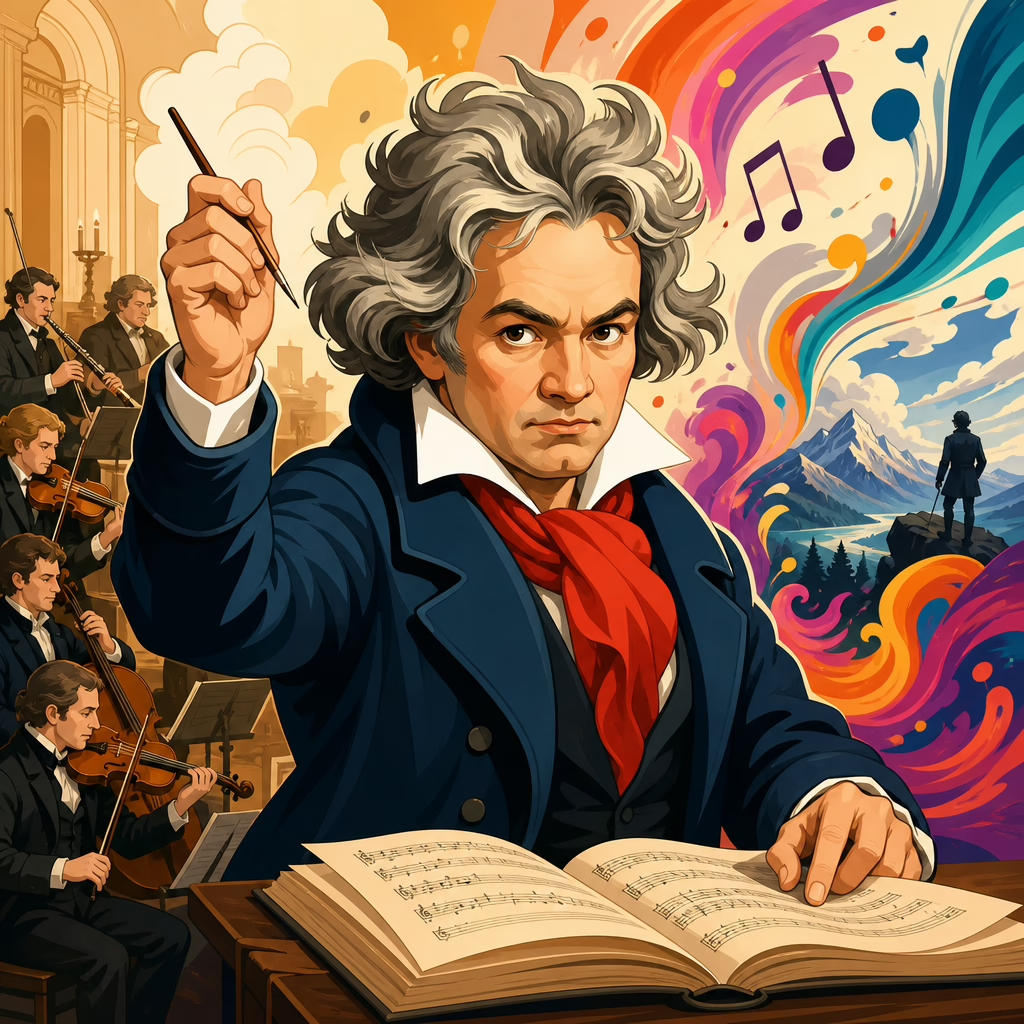
How Beethoven Reinvented the Symphony
Ludwig van Beethoven did not merely compose symphonies; he redefined what a symphony could express, how it could be structured, and why it mattered to listeners, performers, and later composers. When people ask how Beethoven reinvented the symphony, they are really asking how one musician transformed an established eighteenth-century orchestral genre into a dramatic, expansive, and intellectually ambitious art form. A symphony, in the classical sense inherited from Joseph Haydn and Wolfgang Amadeus Mozart, was a multi-movement work for orchestra built on balance, formal clarity, motivic logic, and courtly or public entertainment values. Beethoven retained those foundations, but he altered their scale, emotional range, rhythmic force, harmonic daring, and social purpose so decisively that the history of the symphony is often divided into before Beethoven and after Beethoven.
That claim is not empty hero worship. In practical terms, Beethoven lengthened movements, intensified thematic development, expanded orchestration, sharpened contrasts, and made the inner logic of a few musical ideas carry unprecedented expressive weight. He treated the orchestra less as a polite ensemble and more as a vehicle for struggle, transformation, and revelation. He also changed audience expectations. After Beethoven, a symphony was no longer assumed to be refined background for aristocratic culture; it could be a public statement, a philosophical argument, a personal testimony, even a civic ritual. Those shifts explain why his nine symphonies remain central to concert life and why writers, conductors, and composers still return to them whenever they discuss innovation.
In working with Beethoven’s scores, rehearsing passages, and comparing drafts with finished versions, one lesson becomes clear: his originality was rarely a matter of abandoning tradition outright. He reinvented the symphony from within. He knew sonata form, variation procedure, counterpoint, phrase rhythm, and orchestral convention in exact detail, and because he mastered those systems, he could stretch them without breaking coherence. That is why his music sounds radical yet inevitable. Even his boldest gestures usually grow from disciplined control of motive, harmony, and large-scale proportion.
This broad view matters because Beethoven’s innovations are often reduced to a few famous examples: the opening fate motive of the Fifth, the choral finale of the Ninth, the sheer scale of the Eroica. Those moments are important, but they make the deepest sense only when placed in a larger pattern. Beethoven changed the meaning of first movements, the dramatic function of slow introductions, the role of scherzos, the architecture of finales, the treatment of brass and winds, and the relationship between the individual and the collective voice in orchestral music. He also responded to political upheaval, Enlightenment ideals, changing patronage systems, and his own growing deafness, all of which affected the shape and ambition of his symphonic thinking. To understand Beethoven and innovation, then, is to see not isolated breakthroughs but a sustained reimagining of musical form across his entire career.
For readers who want a clear roadmap, this article examines the symphonic world Beethoven inherited, the technical methods he transformed, the distinct achievements of major symphonies, the orchestral and formal devices that made his work unprecedented, and the legacy that followed. It also includes a table of contents because Beethoven’s influence reaches across many connected topics, including style, structure, performance practice, reception history, and a few important miscellaneous issues that often get overlooked. By the end, the answer to how Beethoven reinvented the symphony will be specific: he expanded its dimensions, deepened its argument, raised its expressive stakes, and made it the most prestigious instrumental genre of the nineteenth century.
Table of Contents
| Section | Focus |
|---|---|
| The Symphonic Model Beethoven Inherited | Haydn, Mozart, and late eighteenth-century norms |
| Beethoven’s Early Symphonies | Innovation within classical balance |
| The Eroica Breakthrough | Scale, heroism, development, and funeral rhetoric |
| Rhythm, Motive, and Organic Unity | How small ideas generate large structures |
| Middle-Period Reinvention | Fifth, Sixth, and Seventh Symphonies |
| Orchestration and Sonic Expansion | Winds, brass, percussion, and texture |
| The Ninth Symphony and Beyond | Voices, philosophy, and the redefinition of finale form |
| Miscellaneous Innovations and Lasting Legacy | Reception, performance, politics, and influence |
The Symphonic Model Beethoven Inherited
Before Beethoven could transform the symphony, he had to inherit one. By the 1790s, the genre had already reached impressive maturity through the work of Haydn and Mozart. A standard symphony usually contained four movements: a fast opening movement, often in sonata form; a slower lyrical movement; a minuet and trio; and a fast finale, commonly in sonata or rondo form. Orchestras were smaller than modern ensembles, string sections dominated the texture, and winds often doubled or colored rather than continuously led. Public concerts existed, but many performances still depended on courts, noble patrons, or subscription series. In that environment, the symphony was respected, but it was not yet the central monument of instrumental art that it would become in the nineteenth century.
Haydn contributed the basic grammar Beethoven would intensify: monothematic procedures, motivic economy, wit, dynamic surprise, and highly disciplined sonata design. Mozart added deeper lyricism, richer chromatic expression, and more integrated orchestral dialogue, especially among woodwinds. Beethoven studied both closely. His First Symphony in C major, premiered in 1800, proves that he understood the classical model completely. Yet even there, he signals impatience with convention. The work begins not with a straightforward C-major affirmation but with a harmonically teasing introduction that circles around the tonic before landing. That may sound modest today, but to early listeners it announced a composer who would not simply provide expected openings on demand.
The difference between inheritance and reinvention is crucial. Beethoven did not reject structure. He relied on it. Sonata form, for example, gave him a way to present thematic materials, destabilize them through development, and create dramatic return through recapitulation. What changed in his hands was the level of pressure inside the form. Expositions became more charged, transitions more conflict-ridden, developments more exploratory, codas more consequential. In many earlier symphonies, a coda wraps up. In Beethoven, a coda can become a second development, a fresh battlefield where the movement’s deepest tensions are tested again. That single shift helps explain why his first movements can feel like narratives rather than elegant designs.
Another inherited norm was social decorum. Classical symphonies often balanced charm, contrast, and proportion in ways suited to cultivated audiences. Beethoven increasingly pushed the genre toward public significance. The concert hall became a place for concentrated listening and moral seriousness. This did not happen overnight, nor was Beethoven alone in the change, but he accelerated it. From my experience following reception history, the point is not that earlier symphonies lacked depth; it is that Beethoven made depth unavoidable. He invited audiences to hear orchestral music as argument, struggle, memory, celebration, and historical event.
Beethoven’s Early Symphonies: Innovation Within Classical Balance
The First and Second Symphonies are sometimes overshadowed by later works, but they are essential to understanding Beethoven and innovation. They show him testing boundaries while still writing inside recognizable classical proportions. The First Symphony preserves the four-movement plan and much of the elegance associated with Haydn and Mozart, yet the accents are sharper, the sforzandos more disruptive, the wind writing more independent, and the handling of harmony more provocative. Its menuet is fast enough in spirit to point toward the scherzo, the movement type Beethoven would eventually use to replace the older courtly dance. The change matters because a scherzo is not simply a quicker minuet; it introduces volatility, humor, drive, and a different physical energy into the symphonic cycle.
The Second Symphony, completed in 1802, goes further. This was the year of the Heiligenstadt Testament, Beethoven’s anguished document confronting his worsening hearing loss. The symphony itself is not autobiographical in any simplistic way, but it shows extraordinary force and breadth. The slow introduction to the first movement is expansive and theatrically charged. The Larghetto unfolds with uncommon generosity. The scherzo is explicitly labeled as such, confirming Beethoven’s departure from the minuet tradition. Most striking is the finale, whose opening figure sounds almost like a comic hiccup transformed into symphonic propulsion. That kind of material would have seemed eccentric in lesser hands, but Beethoven turns it into a coherent, exhilarating argument.
What these early symphonies reveal is Beethoven’s method of reinvention: intensify function rather than discard it. Introductions become more than formal preliminaries; they create suspense and tonal ambiguity. Middle movements become broader expressive spaces. Dance movements lose aristocratic poise and gain kinetic unpredictability. Finales cease to be lightweight afterthoughts and begin competing with first movements in weight and imagination. These developments prepared listeners for the radical step of the Third Symphony, where expansion became impossible to miss.
The Eroica Breakthrough
The Symphony No. 3 in E-flat major, Op. 55, known as the Eroica, marks the decisive turning point in symphonic history. Premiered privately in 1804 and publicly in 1805, it nearly doubled the expected scale of a symphony and changed the genre’s emotional and intellectual horizon. The first movement alone, with its massive development, disruptive dissonances, and extended coda, challenged conventional listening habits. Where an earlier symphonic movement might delight through proportion, the Eroica compels through process. Themes are not simply presented and returned; they are tested, fragmented, recombined, and made to evolve under pressure.
The work’s original association with Napoleon Bonaparte, later withdrawn by Beethoven when Napoleon crowned himself emperor, has encouraged heroic readings for two centuries. Some of those readings are overstated, but the symphony unmistakably engages ideas of grandeur, conflict, sacrifice, and renewal. The second movement, a funeral march, was unprecedented in its centrality and severity. Funeral marches had appeared before, but not with this kind of scale and structural consequence inside a symphony. The movement transforms private mourning into public ceremony. Its contrapuntal episodes, stark processional rhythm, and tragic climaxes give the symphony a political and existential dimension that earlier orchestral works rarely sustained.
The scherzo and finale continue the reinvention. The scherzo replaces courtly dance with quicksilver momentum, rhythmic stealth, and explosive horn writing. The finale, built on a theme Beethoven had used in earlier works including The Creatures of Prometheus, is a set of variations that also behaves like a cumulative dramatic finale. This is another Beethoven hallmark: formal categories remain visible, but they are absorbed into larger expressive purposes. Variation form becomes narrative. Coda becomes culmination. Horn calls become symbolic signals of space, risk, and triumph.
When I compare audience accounts from the early nineteenth century with modern reactions, one continuity stands out: the Eroica still feels like an event. Its innovation is not only in length. Plenty of long works are merely extended. Beethoven’s achievement is that every enlargement serves a heightened conception of symphonic meaning. After the Eroica, composers had to confront a new benchmark. To write a symphony was now to engage a genre capable of tragic depth, monumental architecture, and public seriousness on a scale previously associated more with opera or sacred music than with instrumental concert works.
Rhythm, Motive, and Organic Unity
If one principle explains Beethoven’s symphonic power better than any other, it is his ability to build enormous structures from compact motives. A motive is a short musical idea, often just a few notes with a distinct rhythm or contour. Beethoven did not invent motivic work, but he made it the engine of symphonic drama. The opening of the Fifth Symphony is the obvious example: three short notes and one long note. What matters is not the slogan-like recognizability of the figure but Beethoven’s relentless transformation of it. It appears in different keys, registers, textures, and emotional states, binding the movement together with uncommon force.
This technique is often described as organic unity, meaning that the whole composition grows from germinal material rather than from a string of contrasting episodes loosely assembled. Beethoven’s developments feel compelling because they are both surprising and necessary. He can wring pathos, menace, urgency, and triumph from the same basic cell. In rehearsal, this is where performers learn that Beethoven is unforgiving: rhythm must be exact, accents must mean something, and phrase direction must connect local detail to long-range architecture. If those elements are softened, the music loses its tensile strength.
Rhythm is equally central. Beethoven uses syncopation, offbeat accents, pedal points, repeated notes, and abrupt silences to create momentum and instability. These features are not decorative. They generate energy that listeners perceive almost physically. The Seventh Symphony is often called the “apotheosis of the dance,” a phrase associated with Richard Wagner, because rhythmic drive governs the entire work. Yet even in the Fifth, where motive usually gets the attention, rhythm is what turns the motive into fate-like insistence. Beethoven’s capacity to make rhythm structural, not merely surface-level, was one of his most influential innovations.
His treatment of transitions also deserves emphasis. In many pre-Beethoven symphonies, themes can feel clearly separated into blocks. Beethoven often turns the spaces between themes into zones of struggle, modulation, and acceleration. The transition is no longer a corridor but a dramatic process. Likewise, recapitulations do more than fulfill expectation; they arrive transformed by what has happened in the development. This is why Beethoven’s forms feel teleological, directed toward goals. The music is going somewhere, and each motive contributes to that destination.
Middle-Period Reinvention: Fifth, Sixth, and Seventh Symphonies
The Fifth, Sixth, and Seventh Symphonies show Beethoven reinventing the symphony along three different axes at once: concentrated dramatic unity, programmatic representation, and rhythmic intoxication. The Fifth Symphony in C minor, premiered in 1808, remains one of the clearest demonstrations of long-range cyclic integration in orchestral music. Its famous opening motive saturates the first movement, but the deeper innovation lies in the work’s trajectory from C minor to C major, from tension to release, from compression to expansion. The bridge from the third movement to the finale is especially revolutionary: a mysterious transition grows over a sustained span until the full orchestra bursts into the C-major finale with trombones, contrabassoon, and piccolo. The arrival feels earned because Beethoven makes the entire symphony into a journey.
The Sixth Symphony, the Pastoral, premiered on the same program, proves that reinvention did not mean one fixed heroic style. Beethoven gave each movement a descriptive title, depicting scenes such as arrival in the countryside, a brook scene, a peasant gathering, a storm, and a shepherd’s song after the storm. He insisted that the work was “more the expression of feeling than painting,” and that distinction is important. The symphony does not imitate nature in a naive way; it translates human responses to nature into musical form. Bird calls appear in the second movement, and the storm movement uses tremolos, timpani, and rapid figuration vividly, but the real innovation is structural continuity. The last three movements run together, creating a dramatic arc from rustic festivity through disruption to gratitude. In other words, Beethoven expands the symphony’s narrative possibilities without sacrificing coherence.
The Seventh Symphony, first performed in 1813, channels innovation through pulse. The long introduction to the first movement sets up harmonic suspense, but once the Vivace begins, rhythmic patterns dominate nearly every layer. The famous Allegretto second movement builds from a repeating rhythmic tread that supports variation, counterpoint, and accumulating intensity. The scherzo alternates explosive speed with a slower trio whose returns create architectural balance, while the finale drives forward with near-manic propulsion. Here Beethoven shows that a symphony can be unified not only through motive or program but through kinetic force itself.
These three works also reveal Beethoven’s flexibility in handling emotional range. The Fifth is often read as struggle and victory, the Sixth as contemplation and renewal, the Seventh as rhythmic ecstasy. Those shorthand labels are useful but incomplete. Each symphony contains contrast, ambiguity, and carefully managed proportion. Beethoven’s innovation lies partly in refusing to let the genre settle into one emotional role. The symphony can be tragic, pastoral, festive, spiritual, public, intimate, or all of these in one cycle, provided the musical logic is strong enough to hold them together.
Orchestration and Sonic Expansion
Beethoven’s reinvention of the symphony was not only structural; it was sonic. He inherited a classical orchestra but increasingly treated it as a field of contrasting colors and massed energies. Contrary to a common myth, Beethoven was not a consistently lush orchestrator in the later Romantic sense. He often wrote with toughness, clarity, and functional directness. But precisely because his orchestration is purposeful, its innovations count. He expands instrumental roles at moments of maximum structural significance. The trombones, piccolo, and contrabassoon in the Fifth Symphony’s finale are a famous example. They do not appear merely to thicken texture; they mark a decisive widening of the sound world at the point of victory.
Woodwinds become more independent in Beethoven’s symphonies than they often were in earlier models. Oboes, clarinets, bassoons, and flutes comment on themes, initiate ideas, color transitions, and shape emotional character. Think of the oboe cadenza-like interruption in the first movement of the Fifth Symphony, a fleeting but unforgettable suspension of momentum, or the bird-call writing in the Pastoral. Horns are equally important. Beethoven exploits their heroic associations, their hunting connotations, and their capacity for resonance across harmonic space. The Eroica scherzo’s horn trio is one of the canonical examples of horn writing changing the emotional temperature of an entire movement.
String writing also evolves. Beethoven pushes unison attack, tremolo, repeated-note drive, and registral contrast to intensify orchestral rhetoric. Timpani, once largely supportive of tonic-dominant harmony, gain dramatic agency through rhythmic insistence and dynamic force. Texture becomes more stratified: instead of the strings carrying nearly everything while winds color from above, Beethoven often sets groups in dialogue or opposition. Those changes helped establish the orchestra as a medium capable of public drama on symphonic terms.
Performance practice makes these innovations even clearer. On period instruments, Beethoven’s balances can sound sharper, brass more pungent, timpani more cutting, and tempos more volatile than in older plush symphonic traditions. Modern orchestras, informed by historical research, increasingly restore that edge. The result is not antiquarianism. It is a reminder that Beethoven’s orchestral writing was designed to project profile, tension, and contrast. Reinvention happened through sound as much as through form.
The Ninth Symphony and the Redefinition of the Finale
No discussion of how Beethoven reinvented the symphony can avoid the Ninth Symphony in D minor, Op. 125, first performed in 1824. Its fame can obscure its technical daring, but the work remains one of the boldest acts of genre transformation in Western music. The first three movements already stretch symphonic argument to a vast scale: an opening movement of elemental instability, a scherzo of fierce rhythmic energy placed second rather than third, and a slow movement that unfolds as a profound double-variation meditation. Then comes the finale, which breaks with expectation so dramatically that it effectively announces a new concept of what a symphonic ending may be.
The finale begins with dissonant outbursts and recalls material from earlier movements, almost as if the symphony is reviewing and rejecting its own past. Cellos and basses then introduce the “Ode to Joy” theme instrumentally before soloists and chorus enter on Friedrich Schiller’s text celebrating human brotherhood. Beethoven did not simply add voices to an orchestral form. He designed a finale in which instrumental memory, variation, march episodes, fugato writing, and vocal proclamation interact as parts of one immense synthesis. The result is not an oratorio appended to a symphony. It is a symphony whose final movement redefines the genre’s horizon by integrating vocal and instrumental discourse.
This was revolutionary for several reasons. First, it made explicit the idea that a symphony could address universal ethical or philosophical themes. Second, it forced later composers to decide whether to emulate, avoid, or somehow answer Beethoven’s example. Brahms delayed his First Symphony for years partly because the shadow of Beethoven’s Ninth was so daunting. Mahler later embraced the notion that a symphony should contain the world, but that ambition becomes thinkable partly because Beethoven had already expanded the form’s claims. Third, the Ninth changed the ceremonial role of the symphony. Its finale became suited not just to concert appreciation but to collective occasion, political symbolism, and transnational cultural memory.
There are tradeoffs, of course. Some critics from Beethoven’s time to the present have felt that the vocal finale disrupts symphonic purity or that its monumental aspirations risk rhetorical excess. Those objections are worth acknowledging. Yet even critics who resist aspects of the Ninth usually grant that it altered the possibilities of the genre permanently. That is the standard by which reinvention should be judged: not universal agreement, but irreversible expansion of what artists can imagine.
Miscellaneous Innovations, Reception, and Lasting Legacy
A comprehensive pillar page on Beethoven and innovation should also cover several miscellaneous topics that shape the full picture. One is deafness. Beethoven’s hearing loss did not automatically cause innovation, and simplistic narratives of suffering producing genius should be avoided. Still, deafness changed his working methods, social life, and relationship to sound. He relied increasingly on inner hearing, sketchbooks, and conceptual control. In the symphonies, this may have encouraged greater concentration on structural audibility: motives, rhythm, harmonic direction, and registral contrast are often exceptionally clear even when the expressive goals are vast.
Another issue is patronage and the public sphere. Beethoven worked at a historical moment when aristocratic support still mattered, yet public concerts, publishing, and a broader bourgeois audience were becoming more influential. His symphonies helped elevate the prestige of subscription concerts and canon formation. Works were not just new entertainment; they were repeated, studied, debated, and eventually treated as cultural monuments. That shift is part of his innovation because genres are shaped not only by notes on the page but by listening institutions around them.
Reception history also shows that Beethoven’s impact was uneven and evolving. Early listeners often found the Eroica too long, the Fifth too severe, the Seventh too extreme, or the Ninth too strange. Over time, the same features came to define symphonic greatness. This tells us something important: innovation is often first experienced as excess. Beethoven repeatedly pushed against the threshold of what trained listeners considered acceptable, then changed that threshold. Later composers inherited both his techniques and the burden of responding to them. Schubert expanded lyrical scale; Berlioz intensified programmatic and orchestral imagination; Brahms absorbed motivic rigor; Bruckner monumentalized architecture; Mahler broadened emotional and sonic scope. None of these paths is identical, but all move through Beethoven’s redefinition of the symphony.
Finally, Beethoven’s symphonies remain living works because they are not museum objects. Conductors still debate metronome markings, repeats, articulation, vibrato, antiphonal violins, brass balance, and chorus size in the Ninth. Scholars still examine sketch materials to understand his revisions. Performers still discover that the scores demand both discipline and risk. Listeners still recognize that these works can meet different historical moments without losing identity. That durability is the strongest evidence of reinvention. Beethoven did not merely modernize an existing form for his own era. He created a model of symphonic thinking flexible enough to challenge every era after him.
Beethoven reinvented the symphony by transforming its scale, deepening its expressive range, tightening its motivic logic, broadening its orchestral color, and raising its cultural ambition. He inherited a mature classical genre from Haydn and Mozart, but he intensified every major component: first movements became dramatic arguments, scherzos replaced minuets with volatile energy, codas became structural battlegrounds, finales carried unprecedented weight, and orchestration gained new power at decisive moments. From the early experiments of the First and Second Symphonies to the breakthrough of the Eroica, from the organic unity of the Fifth to the narrative and sonic imagination of the Sixth and Seventh, and from the visionary choral synthesis of the Ninth to the broad legacy that followed, Beethoven reshaped not just how symphonies sound but what audiences expect them to mean.
The main benefit of understanding this history is clarity. Beethoven’s reputation can seem so immense that it turns abstract, but his innovation is concrete. It lives in harmonic delays that sharpen arrival, in motives that generate entire movements, in transitions that become drama, in wind and brass writing that signals structural change, and in finales that resolve not just themes but ideas. These are practical musical decisions with far-reaching consequences. They explain why the symphony became the prestige genre of nineteenth-century concert culture and why later composers measured themselves against Beethoven whether they followed him, resisted him, or tried to escape his example.
If you want to go further, the best next step is simple: listen in sequence to the First, Third, Fifth, Sixth, Seventh, and Ninth Symphonies while following a score or detailed listening guide. The reinvention becomes unmistakable when heard across the arc of Beethoven’s career. That progression shows innovation as Beethoven actually practiced it: not as novelty for its own sake, but as disciplined, daring expansion of form, sound, and meaning.
Frequently Asked Questions
How did Beethoven change the symphony compared with Haydn and Mozart?
Beethoven inherited the symphony from Haydn and Mozart, but he expanded nearly every part of it. In the late eighteenth century, the symphony was already a respected orchestral form, usually built in four movements with clear balance, elegance, and formal logic. Beethoven kept those foundations, yet he pushed them toward greater emotional intensity, larger scale, and stronger dramatic purpose. His symphonies do not simply present attractive themes and orderly development; they create conflict, tension, and transformation in ways that feel almost theatrical.
One major change was his treatment of musical structure. Beethoven made first movements more dynamic and argumentative, often building entire spans of music from small motifs rather than relying only on long, graceful melodies. He also enlarged development sections, increased the sense of struggle between keys and themes, and made codas feel like essential climactic events rather than polite conclusions. In addition, he strengthened the relationships between movements so that a symphony could feel like a unified journey instead of a sequence of separate pieces.
He also changed the expressive range of the genre. Earlier symphonies could be lively, serious, witty, or noble, but Beethoven gave the form a new level of psychological depth and public significance. His works can suggest heroism, crisis, mourning, rustic joy, spiritual searching, and collective triumph. That broader expressive ambition helped listeners hear the symphony not just as entertainment for the concert hall or court, but as a major artistic statement capable of engaging with human experience on a profound level.
Why is Beethoven’s Third Symphony, the “Eroica,” considered such a turning point?
The “Eroica” is often seen as the moment when Beethoven unmistakably reinvented the symphony because it announced a new scale, a new seriousness, and a new conception of what orchestral music could do. At the time of its premiere, audiences and musicians were struck by its length, complexity, and force. It was far larger and more demanding than most symphonies that came before it, and it treated the form as a space for sustained drama rather than elegant proportion alone.
The first movement is especially important because it expands sonata form into a vast field of conflict and development. Beethoven takes relatively simple material and subjects it to intense transformation, building a sense of struggle that unfolds over a long span. The second movement, a funeral march, was also revolutionary in context. To place a movement of such weight and tragic dignity at the center of a symphony signaled that this genre could address themes of loss, memory, and public mourning in a way previously associated more with opera, sacred music, or ceremonial works.
The later movements confirm the symphony’s larger vision. The scherzo brings nervous energy and propulsion, while the finale uses variation techniques to create a conclusion that is both intellectually rigorous and triumphant. Taken as a whole, the “Eroica” transformed the symphony into a vehicle for heroic narrative and philosophical depth. Even without a fixed story, it gives the impression of ordeal, renewal, and greatness achieved through struggle. That model shaped the entire nineteenth century, influencing composers from Berlioz and Brahms to Mahler.
In what ways did Beethoven make symphonies more dramatic and emotionally powerful?
Beethoven increased the drama of the symphony by treating musical ideas as active forces in conflict with one another. Instead of presenting themes as decorative or self-contained melodies, he often built movements from compact rhythmic or intervallic cells that could be repeated, fragmented, interrupted, and transformed. This creates a strong sense of momentum. The famous opening of the Fifth Symphony is a perfect example: a tiny rhythmic figure becomes the engine for an entire musical argument, generating tension from the first bars and sustaining it across multiple movements.
He also heightened emotional impact through contrast. Beethoven was a master of abrupt changes in dynamics, texture, register, and orchestral color. He could move from near-silence to overwhelming force, from lyrical intimacy to public declaration, from stern discipline to ecstatic release. These contrasts make the listener feel that the music is not merely unfolding but wrestling with obstacles. His use of rhythm is equally important. Persistent rhythmic drive gives many of his symphonies a sense of inevitability, as though they are pressing toward a goal that must be reached.
Another crucial innovation was his long-range sense of resolution. In Beethoven, endings are often earned rather than simply delivered. He builds suspense over large spans of time, delays expected cadences, revisits key motives, and constructs codas that function like final acts in a drama. This means the emotional effect of a movement depends not only on its themes but on the way its entire course is shaped. Listeners experience journey, conflict, and arrival. That deeper narrative logic is one reason Beethoven’s symphonies still feel so powerful and modern.
Did Beethoven change the orchestra itself when he reinvented the symphony?
Yes, although Beethoven did not invent the modern orchestra by himself, he significantly expanded its role, color, and expressive potential within the symphony. Compared with many earlier classical symphonies, his works often require more forceful brass writing, more independent wind parts, and greater overall weight from the ensemble. He used the orchestra less as a polite blend of sections and more as a dramatic body capable of contrast, confrontation, and sonic grandeur.
His orchestration is important not because it is always lush in the later Romantic sense, but because it is purposeful and structural. Winds are not merely decorative fillers; they often have thematic significance and contribute directly to the argument of the music. Brass and timpani can intensify moments of public grandeur or crisis. Strings still carry much of the symphonic fabric, but Beethoven uses the full ensemble to articulate large formal events, build climaxes, and sharpen emotional character. The result is a more muscular and rhetorically powerful orchestral language.
His Ninth Symphony represents the most famous extension of the genre’s performing forces, since it introduces vocal soloists and chorus into what had traditionally been a purely instrumental form. That decision was radical not just because of the added forces, but because it reimagined the symphony as a medium that could embrace universal human ideas through text as well as sound. More broadly, Beethoven’s orchestral thinking encouraged later composers to view the symphony as a place for innovation in sonority, scale, and expressive reach.
Why does Beethoven’s reinvention of the symphony still matter today?
Beethoven’s influence still matters because he changed the expectations surrounding the symphony so completely that later composers had to respond to him, whether by following his example, revising it, or resisting it. After Beethoven, the symphony could no longer be understood only as a refined classical form for agreeable orchestral writing. It had become a major cultural statement, one associated with seriousness, originality, and large-scale artistic ambition. That shift shaped the careers and works of Schubert, Mendelssohn, Schumann, Brahms, Bruckner, Tchaikovsky, Mahler, and many others.
His legacy also matters because he established a new idea of musical meaning. Beethoven demonstrated that instrumental music, without scenery or characters, could suggest struggle, memory, victory, community, and transcendence. He strengthened the belief that a symphony could embody an inner journey or a public vision. This helped elevate absolute music in the nineteenth century and beyond, giving composers a model for how purely orchestral works could carry emotional and intellectual weight equal to literature, drama, or philosophy.
For modern listeners, Beethoven remains central because his symphonies still communicate directly. Their energy, clarity, tension, and release are immediately compelling, even to audiences without technical training. At the same time, the more closely one studies them, the more their craftsmanship becomes apparent. That combination of accessibility and depth is rare. Beethoven reinvented the symphony not simply by making it bigger, but by making it matter more deeply. He turned it into a form through which composers could confront the largest questions of art, expression, and human possibility.