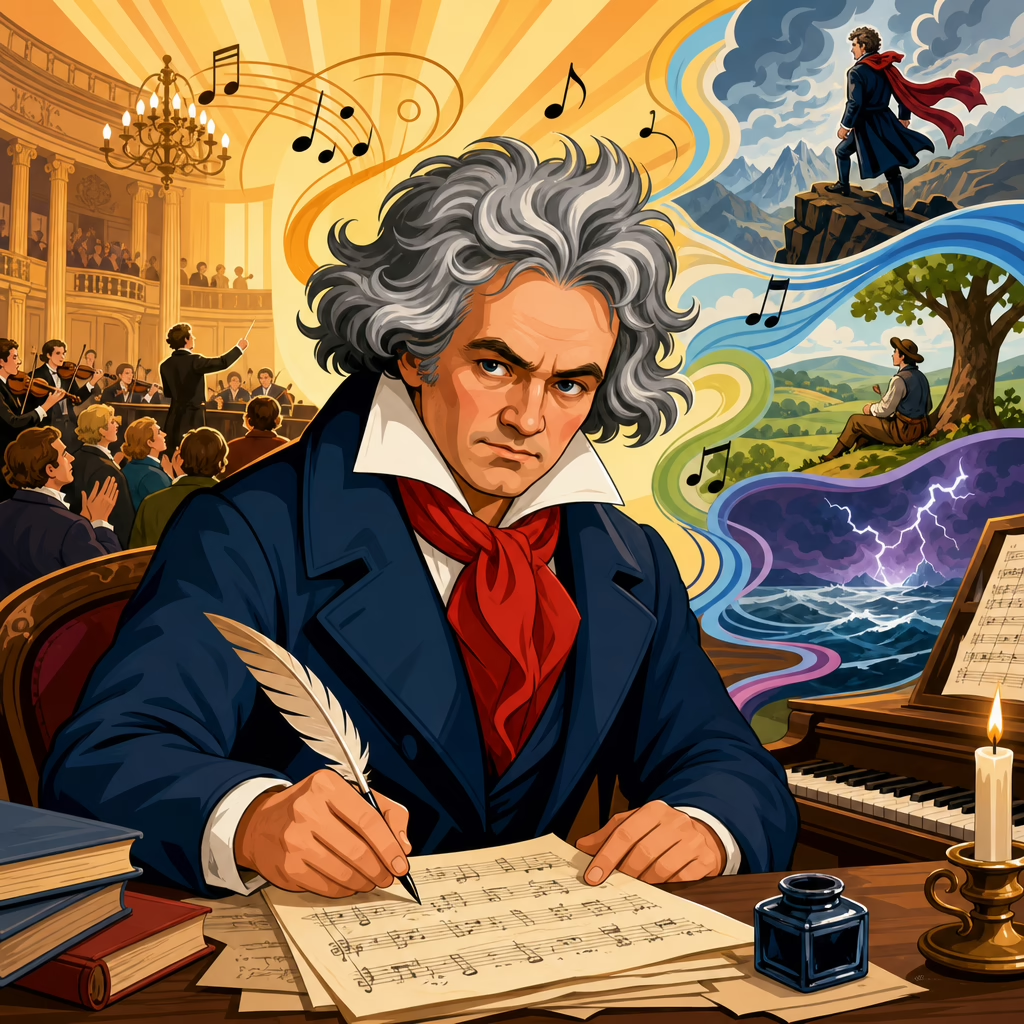
Beethoven and the Rise of the Signature Work
Beethoven and the rise of the signature work are inseparable because his career helped redefine what a major composition could mean for a composer, for audiences, and for cultural memory. A signature work is the piece most powerfully identified with its creator, the composition that condenses a public image into sound and becomes shorthand for an artistic achievement. Before Beethoven, European composers certainly had admired and popular works, yet the idea that one monumental composition could stand as a lifelong emblem was less firmly established. In the late eighteenth century, music circulated through patronage, court employment, church service, and local performance networks; works were often valued within occasions rather than as permanent personal brands. Beethoven changed that landscape by composing pieces that demanded repeated listening, invited critical interpretation, and projected a singular authorial presence.
This shift matters because it altered the economics and prestige of composition. It also changed listening habits. When I examine concert programming from the early nineteenth century, the pattern is unmistakable: Beethoven’s works were not just performed, they were revisited as events. The Eroica Symphony, the Fifth Symphony, the Ninth Symphony, the Appassionata Sonata, and Fidelio each came to symbolize something larger than themselves. They were treated as defining statements. In practical terms, that meant publishers marketed them aggressively, critics wrote about them as milestones, and musicians built reputations through performing them. The signature work became a cultural anchor, and Beethoven was central to that transformation because he fused formal innovation, biographical drama, and public ambition into compositions that seemed to declare, unmistakably, this is Beethoven.
To understand the rise of the signature work, it is important to define three linked ideas: authorship, canon, and repeatability. Authorship means the audience hears the piece as an expression of an identifiable artistic personality rather than merely competent craftsmanship. Canon means a work survives beyond its premiere and enters a hierarchy of essential repertory. Repeatability means the work sustains meaning over many performances, in different places, before different listeners. Beethoven excelled in all three areas. His music was structurally memorable, emotionally legible even when complex, and bold enough to generate debate. That combination made his compositions ideal candidates for becoming symbolic masterworks, not just successful premieres.
Why Beethoven Could Create Signature Works
Beethoven’s historical position gave him unusual leverage. He inherited the formal clarity of Haydn and Mozart, yet he worked during a period when public concerts, music publishing, and criticism were expanding. Vienna around 1800 still depended on aristocratic patronage, but it also rewarded visibility in a broader marketplace. Beethoven understood both systems. In my experience studying his publication strategies and dedications, he consistently sought prestige from noble supporters while composing with a wider future audience in mind. That dual orientation mattered because a signature work requires both initial support and long afterlife.
His personal brand, to use a modern term carefully, was unusually coherent. Contemporaries increasingly viewed him as independent, uncompromising, and heroic in temperament. That image was not accidental. It was reinforced by reports of his improvisational power, his refusal to behave like a compliant servant, and later by the well-known narrative of composing under the pressure of deafness. A signature work thrives when listeners believe the composition reflects the whole person behind it. Beethoven’s public identity made that belief easy to sustain.
Equally important was scale. Beethoven expanded duration, dynamic contrast, motivic concentration, and rhetorical intensity in ways that made individual pieces stand apart from ordinary repertory. The opening motif of the Fifth Symphony is the clearest example. Four notes become an entire dramatic argument. Listeners do not need technical training to recognize it, yet analysts can spend pages tracing its transformations. That balance between immediate recognizability and deep structural richness is one hallmark of a signature work. It is famous quickly, but it also repays generations of scrutiny.
The Eroica and the New Model of Monumentality
If one work announced the new possibility most forcefully, it was the Symphony No. 3 in E-flat major, Op. 55, the Eroica. At nearly twice the scope expected from many earlier symphonies, it presented itself as a public statement rather than elegant entertainment. The first movement alone enlarged symphonic architecture through vast development, destabilizing harmonic turns, and a sense of struggle that felt unprecedented in this genre. The Funeral March then deepened the claim by introducing political and moral resonance. Audiences did not simply hear a well-made symphony; they encountered a composition that demanded interpretation.
The Eroica became a signature work not because everyone instantly loved it but because it forced the culture to respond. Early listeners often found it bafflingly long or difficult. That resistance is significant. Signature works are frequently disruptive before they become canonical. Beethoven’s achievement was to make difficulty productive. Critics, performers, and listeners had to ask what the work meant and why it was so large. Those questions helped build the modern prestige economy around serious music.
Its dedication history also reinforced its identity. Beethoven’s initial admiration for Napoleon, followed by disillusionment when Napoleon crowned himself emperor, gave the symphony a story of heroic ideals betrayed. Whether every retelling captures the full nuance is less important than the effect: the piece acquired an interpretive frame in which biography, politics, and aesthetics fused. That is exactly how signature works gain traction. They come with narratives that make them memorable and discussable.
For readers wanting the larger symphonic context, this focused discussion connects naturally with the broader pillar guide on how Beethoven transformed the genre: how Beethoven reinvented the symphony. The Eroica is the turning point where a symphony begins to act like a public monument to its creator.
The Fifth Symphony and the Power of Musical Identity
The Fifth Symphony offers perhaps the purest case of a signature work because its identity is instantly communicable. The famous short-short-short-long opening is one of the most recognized gestures in Western music. Recognition alone, however, does not explain its status. Many catchy themes become popular without becoming definitive. The Fifth became definitive because the entire symphony seems generated from its opening cell, creating a rare fusion of memorability and coherence. Beethoven turned a concise motif into a total dramatic world.
In rehearsal rooms and classrooms, I have seen how this symphony teaches listeners to hear structure. The opening idea appears in varied forms across movements, while the overall trajectory from C minor to C major presents an audible journey from tension to triumph. That narrative has often been simplified, but the basic perception is valid: the work feels inevitable. Signature works usually create that impression of necessity, as though no note could be otherwise and the piece had to exist.
The Fifth also benefited from timing. By the nineteenth century, repeated public performance was becoming central to musical life. A work with a sharply distinctive opening and strong internal logic was ideal for repertory circulation. It could be remembered after one hearing and admired more deeply after ten. Publishers, conductors, and critics all had practical reasons to promote such a piece. Beethoven supplied not only artistic innovation but repertory durability.
| Work | What made it distinctive | Why it became a signature work |
|---|---|---|
| Eroica Symphony | Expanded scale, heroic rhetoric, funeral march, radical development | Redefined the symphony as a monumental personal statement |
| Fifth Symphony | Unforgettable opening motif and unified motivic design | Created an instantly recognizable musical identity |
| Ninth Symphony | Choral finale, philosophical reach, extreme formal ambition | Became a cultural emblem far beyond the concert hall |
| Appassionata Sonata | Volcanic pianism, compressed drama, intense contrast | Embodied Beethoven’s image at the keyboard |
The Ninth Symphony as Cultural Emblem
The Ninth Symphony shows the signature work at its largest possible scale. By adding vocal soloists and chorus in the finale, Beethoven crossed a boundary that many listeners had considered foundational to the symphony. The result was not novelty for its own sake. The choral ending solved a problem the earlier movements create: how to move from conflict toward an explicitly human statement of solidarity. The “Ode to Joy” theme is simple enough to remember immediately, but its placement within a vast formal architecture gives it exceptional force.
This work became more than a signature piece; it became a public symbol repeatedly used for political, ceremonial, and humanitarian purposes. That broad adoption can obscure the score’s complexity, but it confirms the point. A signature work does not stay confined to specialist appreciation. It enters collective consciousness. Beethoven’s Ninth did so because it combined a clear melodic emblem with extraordinary ambition and a message audiences could repurpose.
There are tradeoffs here. Once a work becomes symbolic, it risks flattening the composer into a single idea. The Ninth can be reduced to “joy” in ways that ignore its tensions, dissonances, and formal challenges. Yet even that reduction demonstrates how powerfully the piece functions as cultural shorthand. Beethoven made works that could survive simplification without losing their authority. Few composers have managed that balance so effectively.
The Piano Sonata and the Signature Work in Intimate Form
Signature works are not limited to public genres. Beethoven’s piano sonatas show how a composition for a single performer can become emblematic. The Appassionata, Op. 57, is a prime example. It projects concentrated violence, suspense, and propulsion without requiring orchestra, chorus, or theatrical staging. Pianists treat it as a summit because it combines technical demands with interpretive danger: too much pedal, and the texture muddies; too much speed, and the architecture collapses; too little volatility, and the piece loses its character.
The Moonlight Sonata offers another route to signature status. Its popularity has sometimes led critics to underrate it, but that reaction misunderstands how signature works function. The first movement became famous because it created a new listening situation: inward, suspended, atmospheric, immediately graspable. Beethoven did not need only grand public statements to form his image. He also wrote pieces that entered domestic music-making and amateur imagination. That widened his reach and strengthened the association between composer and emblematic composition.
In practical musical culture, these sonatas mattered because they circulated through print and performance more flexibly than symphonies. A household with a piano could encounter Beethoven directly. That intimacy helped turn certain works into personal possessions for listeners, not just concert experiences. Signature status grows when audiences can internalize a piece repeatedly in their own spaces.
How Reception, Publishing, and Performance Locked In the Pattern
Beethoven did not create the signature work alone; institutions around him amplified it. Publishers increasingly issued opus numbers and marketed major compositions as serious artistic products. Critics in journals framed new works as milestones. Public concerts programmed Beethoven not merely as novelty but as repertoire worth revisiting. Conservatories and virtuosi later cemented this hierarchy by treating specific pieces as tests of artistic seriousness. I have traced this pattern in nineteenth-century criticism, where “the Beethoven work” often means a composition already carrying exemplary weight before the reviewer begins.
Performance practice also played a decisive role. Conductors such as Felix Mendelssohn and later Hans von Bülow approached Beethoven as canonical, encouraging disciplined rehearsal and historical prestige. Once orchestras and pianists used certain Beethoven pieces to demonstrate excellence, those works acquired a self-reinforcing authority. Audiences expected to hear them; institutions expected to present them; musicians expected to master them. That cycle is the infrastructure of the signature work.
The larger consequence was a durable model for later composers. Berlioz with the Symphonie fantastique, Wagner with Tristan und Isolde, Tchaikovsky with the Pathétique, and Stravinsky with The Rite of Spring all benefited from a world in which a defining composition could organize an artistic reputation. Beethoven did not invent memorable music, but he decisively strengthened the modern expectation that one monumental work can stand at the center of a composer’s public identity.
Beethoven’s real innovation was not simply writing famous pieces. It was showing how a composition could become a durable emblem of authorship, ambition, and cultural meaning. The Eroica established the monumental model, the Fifth demonstrated the power of concentrated musical identity, the Ninth achieved symbolic reach on a civilizational scale, and the sonatas proved that intimate forms could also become signature works. Across these examples, the same pattern holds: distinctive materials, large expressive stakes, repeat performance, and a public narrative strong enough to attach the work permanently to the composer.
That pattern still shapes how music is taught, marketed, programmed, and remembered. When modern audiences think of a composer through one defining masterpiece, they are participating in a culture Beethoven helped create. His works invited listeners to hear composition as personal declaration and historical event at once. That is why the subject remains important. It explains not only Beethoven’s fame but also a lasting transformation in the meaning of artistic reputation.
If you want to understand Beethoven’s innovation more clearly, start by listening again to one of these defining works with this question in mind: what makes it impossible to confuse with anyone else? The answer is the signature work, and Beethoven made it central to musical modernity.
Frequently Asked Questions
What does “signature work” mean, and why is Beethoven so important to the idea?
A signature work is the composition most closely tied to a creator’s public identity—the piece that seems to summarize who that artist is for listeners, critics, and later generations. It is more than a popular success. A signature work becomes symbolic. It carries cultural meaning, shapes reputation, and often stands as a shorthand for an entire career. When people think of Beethoven, for example, they often immediately think of works such as the Fifth Symphony, the Ninth Symphony, or the “Moonlight” Sonata. Those pieces do not simply represent isolated achievements; they embody the larger image of Beethoven as revolutionary, dramatic, heroic, and transformative.
Beethoven matters because his career helped solidify the modern belief that a composer could be remembered through a handful of monumental works that transcend their original moment. Earlier composers certainly wrote admired masterpieces, and some pieces circulated widely, but Beethoven intensified the connection between a single composition and a lasting artistic identity. His music was increasingly treated not as courtly entertainment or functional occasion music, but as art with historical weight. Audiences, publishers, and critics began to hear certain Beethoven works as cultural events and artistic statements. In that environment, the “signature work” was no longer merely a favorite piece; it became a lasting public monument in sound.
Did composers before Beethoven have famous pieces, or was this idea entirely new?
Composers before Beethoven absolutely had famous and beloved works. Opera arias, sacred music, instrumental pieces, and theatrical compositions often circulated widely and could make a composer well known. Handel, Mozart, Haydn, and others all produced works that were admired in their own lifetimes and beyond. So the rise of the signature work was not about Beethoven inventing fame from nothing. The real shift was in how fame was organized and remembered.
Before Beethoven, a composer’s reputation was often spread across genres, patrons, performances, and practical output. Music functioned within churches, courts, theaters, salons, and civic ceremonies. A successful piece might be treasured, but it did not always define the composer as a singular historical genius in the modern sense. Beethoven emerged at a moment when ideas about authorship, originality, and artistic seriousness were changing. His works were increasingly presented as expressions of individual vision rather than simply as excellent examples of a genre or service to an occasion.
That difference matters. With Beethoven, certain compositions came to seem definitive, almost inseparable from his myth. The Fifth Symphony was not just a successful symphony; it became a public image of Beethovenian struggle and triumph. The Ninth became more than a choral symphony; it became a symbol of universality, idealism, and cultural ambition. In that sense, Beethoven did not create the existence of famous works, but he helped establish the modern framework in which one monumental composition could dominate artistic memory.
Which Beethoven works are most often considered his signature works, and why?
The most common candidates are the Fifth Symphony, the Ninth Symphony, and the “Moonlight” Sonata, though the “Eroica” Symphony also deserves a central place in the discussion. Each of these works became iconic for slightly different reasons, and together they show how signature status can develop through musical power, public reception, and cultural storytelling.
The Fifth Symphony is perhaps the clearest example because it is instantly recognizable and dramatically concentrated. Its opening motif has become one of the most famous gestures in Western music. Over time, listeners and writers attached broad meanings to it—fate, struggle, determination, victory—which aligned perfectly with the emerging image of Beethoven as a heroic artist overcoming adversity. Its fame rests not only on popularity but on symbolic clarity.
The Ninth Symphony represents signature status on a larger scale. With its vast structure, emotional range, and final choral setting of Schiller’s “Ode to Joy,” it came to symbolize artistic ambition pushed to its limits. It has repeatedly been used in political, ceremonial, and global contexts, which expanded its meaning far beyond the concert hall. That kind of public afterlife is a hallmark of a true signature work: it becomes part of collective memory.
The “Moonlight” Sonata occupies a somewhat different space. It is one of Beethoven’s most famous works among general listeners because of its immediate emotional atmosphere and extraordinary accessibility in cultural memory. Although its nickname was added later, the piece became central to Beethoven’s popular image, showing that signature status can emerge not only from grand historical claims but also from intimate emotional identification.
The “Eroica” Symphony is especially important for scholars because it marks a turning point in what a symphony could be. Its scale, expressive daring, and sense of historical significance made it a model for Beethoven’s artistic self-definition. Even when it is less instantly recognizable to broad audiences than the Fifth, it remains one of the strongest examples of Beethoven shaping the idea that a single work can announce a new artistic era.
How did Beethoven’s public image help turn certain compositions into signature works?
Beethoven’s public image was crucial. He was increasingly seen not just as a skilled composer but as an independent, uncompromising, almost prophetic artist. That image was powerful in an age that was beginning to celebrate originality, interior depth, and creative struggle. His biography—especially the story of composing while coping with hearing loss—made his music feel inseparable from personal destiny. As a result, audiences did not hear his major works only as elegant musical constructions; they heard them as embodiments of character.
This is one reason certain compositions rose above the rest in public imagination. A signature work needs a story around it, and Beethoven’s works attracted stories naturally. The Fifth Symphony invited narratives of confrontation and victory. The Ninth suggested spiritual and human universality. The late works inspired awe as documents of depth and transcendence. Publishers, critics, concert institutions, and later music historians all helped reinforce these meanings. Repeated performance and commentary turned selected pieces into cultural touchstones.
In other words, signature works are never created by music alone. They are created by an interaction between composition, reception, myth, and memory. Beethoven’s image as the model of the serious composer gave his works unusual symbolic power. Because the culture around him was ready to see music as a site of genius and revelation, certain Beethoven pieces became more than compositions—they became legends attached to a name.
Why does Beethoven’s role in the rise of the signature work still matter today?
It still matters because modern musical culture continues to organize itself around signature works. When composers, performers, and even entire genres are introduced to broad audiences, they are often represented through one emblematic piece. Concert programming, recordings, streaming playlists, film soundtracks, and educational materials all rely on this logic. Beethoven helped make that way of hearing feel natural: the idea that one work can stand for an artist, a style, an era, or even a philosophy of art.
His influence also shaped the classical canon. Once certain compositions were treated as definitive monuments, they gained extraordinary staying power. They were performed repeatedly, written about extensively, and elevated in institutions such as conservatories and symphony halls. That process affected not only Beethoven’s legacy but also the standards by which later composers were judged. To have a “great work” was increasingly to have a work that could anchor reputation historically, not merely please an audience temporarily.
At the same time, Beethoven’s example invites a useful critical question. While signature works can focus attention and help preserve artistic memory, they can also narrow it. Reducing Beethoven to only the Fifth, the Ninth, or the “Moonlight” risks flattening a vast and varied body of work. So his legacy is double-edged: he helped elevate composition to a new level of cultural seriousness, but he also contributed to a system that can oversimplify artists through a few endlessly repeated masterpieces. That tension remains central to how we listen, remember, and build cultural history today.