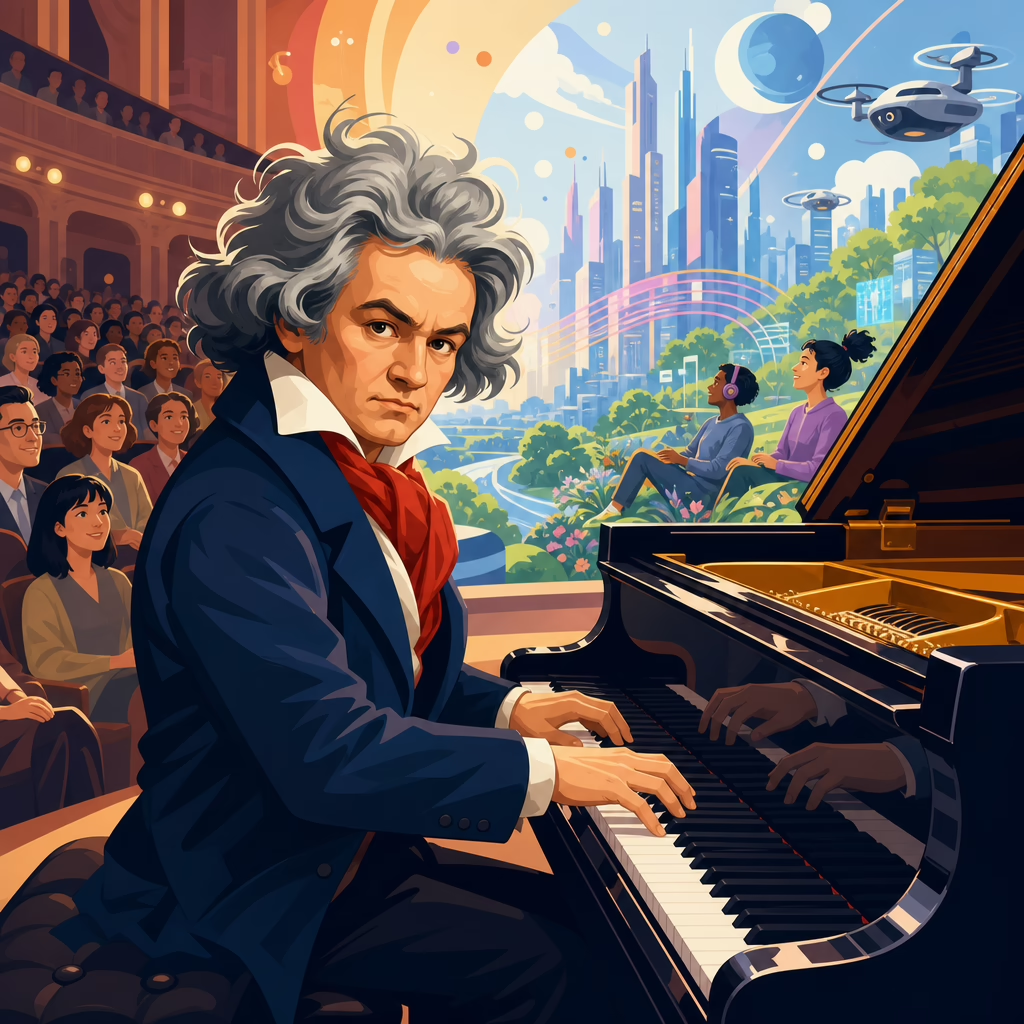
Beethoven and the Future of the Piano Recital
Beethoven still defines the piano recital because he transformed what a solo keyboard performance could communicate, how it could be structured, and what audiences expect to feel when one artist walks onstage alone. In this context, a piano recital means more than an evening of piano music; it is a curated public statement built from repertoire, instrument, room, and listening culture. The future of the piano recital therefore cannot be discussed without understanding Beethoven’s role in reshaping pianism from elegant entertainment into a serious, dramatic, intellectually charged art form. I have seen this directly in recital programming meetings, in conservatory studios, and in halls where the same Beethoven sonata can attract both devoted subscribers and first-time listeners because it promises struggle, architecture, intimacy, and release. His music matters not simply because it is canonical, but because it remains a practical testing ground for every major question facing recital life now: attention span, authenticity, historical awareness, programming innovation, instrument choice, and the relationship between tradition and risk. When pianists, presenters, and educators ask how to keep the recital format alive, they are usually asking how to preserve seriousness without becoming rigid, and how to create accessibility without flattening complexity. Beethoven is central to that challenge because his keyboard works reward deep listening while also offering instantly legible drama. They can anchor a conventional sonata evening, a mixed-media event, a lecture-recital, or a digitally streamed performance. That flexibility is why Beethoven belongs not only to recital history but also to its future.
Why Beethoven remains the recital’s central stress test
Beethoven remains the central stress test for pianists because his sonatas expose nearly every dimension of musicianship at once. Technique alone is not enough. A performer must balance structure and spontaneity, rhythmic rigor and rhetorical freedom, singing tone and percussive bite. In a Mozart recital, elegance may carry a player a long way; in Chopin, color and line may dominate. In Beethoven, weaknesses are harder to hide because the music is built on argument. The opening of the “Pathétique” Sonata, Op. 13, demands control of gesture, pacing, voicing, and harmonic tension within seconds. The first movement of the “Waldstein,” Op. 53, asks for motoric energy without bluntness. The “Hammerklavier,” Op. 106, is still a benchmark not because it is famously difficult, but because its scale forces the pianist to think like an architect.
That is exactly why Beethoven keeps resurfacing when recital presenters try to define artistic seriousness for contemporary audiences. His sonatas and variation sets are familiar enough to draw listeners, yet complex enough to reward repeat attendance. A pianist can build an entire season around late Beethoven and still discover new balances of tempo, pedaling, articulation, and long-range proportion. This durability supports the recital economy. Canonical works lower audience uncertainty, but Beethoven’s unpredictability within the canon keeps the experience alive. The result is unusually useful repertoire: known pieces that do not become routine if performed with insight.
Beethoven also remains central because he sits at the hinge between domestic keyboard culture and the modern concert stage. He inherited the salon, the teaching studio, and aristocratic patronage, yet his music points toward the public, large-scale, psychologically charged recital tradition that later flourished in Liszt, Clara Schumann, and twentieth-century virtuoso culture. That historical position makes him invaluable when rethinking recital format now. He is neither too distant from present practice nor too bound to one performance ideology. Historically informed performers, modern concert grand specialists, and interdisciplinary curators can all make credible claims on Beethoven, which is rare.
How Beethoven changed the meaning of a solo piano performance
Before Beethoven, keyboard performance in public certainly existed, but the later idea of the recital as a high-stakes artistic journey had not yet solidified. Beethoven accelerated that shift by writing piano works that demanded sustained concentration from player and audience alike. The sonata became not just a vehicle for pleasing themes but a site of conflict, experimentation, and philosophical weight. His slow introductions, abrupt silences, obsessive rhythmic cells, remote key relations, and expanded codas taught listeners that a piano piece could unfold like a drama of thought. That expectation still shapes recital programming today.
Consider the late sonatas Opp. 109, 110, and 111. These works no longer behave like polite social music. They compress fugue, variation, aria, dance impulse, and visionary stillness into forms that challenge the listener’s sense of time. When a pianist closes a recital with Op. 111, the Arietta variations often create the same aftereffect as a symphonic finale: the audience leaves in altered silence, not merely satisfied by display. That altered silence is one of Beethoven’s lasting gifts to recital culture. He showed that a single pianist could create a communal experience as profound as chamber or orchestral music.
His influence extends to performer identity as well. The Beethoven recital requires the pianist to become interpreter, historian, colorist, and dramatist. This multi-role expectation defines the best recital practice now. Audiences increasingly want context, whether through spoken introductions, program notes, or digital supplements, but they still expect the playing itself to carry intellectual authority. Beethoven’s works invite that blend of scholarship and immediacy. They practically ask, what does this accent mean, why this trilled transition, why this shocking sforzando, why this fugue after collapse? A future-oriented recital culture benefits from music that prompts real questions, and Beethoven does this more reliably than almost any composer.
Programming the future recital around Beethoven
The future of the piano recital will not be secured by playing Beethoven more often in the same old way. It will be secured by programming Beethoven more intelligently. In practice, that means pairing his works with repertoire that clarifies their radicalism, their lyricism, or their continuing relevance. A presenter might place Op. 110 beside Ligeti Etudes to highlight rhythmic imagination and physical risk, or combine the “Tempest” Sonata, Op. 31 No. 2, with music by George Crumb to explore resonance and theatrical space. Another effective approach pairs Beethoven variations with contemporary sets that reveal continuity in transformation technique.
Programming also benefits from scale awareness. Not every Beethoven recital must revolve around the largest sonatas. Some of the most successful evenings I have seen used shorter forms strategically: a bagatelle set, Op. 126, can open a recital with concentration rather than bombast; the Eroica Variations, Op. 35, can anchor a second half without requiring the audience to absorb another vast sonata cycle. This matters because modern listeners do not necessarily resist depth; they resist monotony of pacing. Beethoven offers enough variety to solve that problem if programmers avoid treating him as a monument that can only be approached in blocks of granite.
For readers interested in how Beethoven’s formal thinking changed large-scale listening beyond the keyboard, the broader orchestral context is explored in this guide on how Beethoven reinvented the symphony. That wider perspective helps explain why his piano works still function so powerfully in recital: they often think with symphonic breadth while speaking through one instrument. A strong future recital will use that breadth creatively, mixing familiar masterworks with framing choices that sharpen listening instead of diluting it.
| Programming goal | Beethoven work | Effective pairing | Why it works |
|---|---|---|---|
| Show formal innovation | Sonata Op. 111 | Thomas Adès, Traced Overhead | Both stretch continuity and redefine closure |
| Balance accessibility and depth | Bagatelles Op. 126 | Schumann, Arabeske | Compact lyric forms create immediacy without superficiality |
| Highlight rhythmic drive | Waldstein Sonata Op. 53 | Ligeti Etudes selections | Listeners hear propulsion as a cross-century idea |
| Explore variation as narrative | Eroica Variations Op. 35 | Frederic Rzewski variations excerpts | Transformation becomes the evening’s central story |
Instruments, acoustics, and the question of authenticity
No discussion of Beethoven and the future of the piano recital is complete without addressing instruments. Beethoven wrote across a period of rapid piano development, from lighter Viennese actions toward more robust instruments with expanded range and sustaining power. As a result, performers today face a genuine interpretive choice: play Beethoven on period instruments or replicas, on a modern concert grand, or in some hybrid curatorial model. This is not a culture-war question if handled honestly. Each option reveals truths and conceals others.
On a fortepiano, textures often become clearer, bass lines speak with less blur, and dynamic contrasts feel tied to touch rather than pedal mass. Fast passagework in Op. 109 can shimmer with transparency, and accents can sound startling without heaviness. Audiences who hear late Beethoven on a fine Paul McNulty replica or a restored early nineteenth-century instrument often realize that some familiar problems on a Steinway are partly instrument problems: over-legato textures, congested middle registers, and overblown climaxes. Historically grounded performance can therefore revitalize recital listening by making the repertoire sound newly dangerous and conversational.
Yet the modern grand also has legitimate authority. Beethoven’s visionary scale, especially in works like Op. 106 and Op. 111, gains a sustaining horizon on a Hamburg Steinway, Fazioli, or Bösendorfer that many listeners find compelling in larger halls. The modern instrument supports broader dynamic arcs and can project structural lines more clearly in spaces built for two thousand people rather than two hundred. The key is not pretending one instrument solves everything. The future recital will likely be richer when presenters name the choice explicitly: this performance uses a fortepiano to illuminate articulation, or a modern grand to explore massed sonority in a contemporary hall. Audiences respond well when the artistic reasoning is concrete.
Digital recital culture and Beethoven’s surprising adaptability
The future of the piano recital is partly digital, and Beethoven adapts to that environment better than skeptics assume. During streamed performance seasons, one lesson became obvious: not every repertoire survives the camera equally well. Beethoven often does because his music generates visible structure. Viewers can sense returns, disruptions, and transformations even through headphones, especially when audio capture is competent and the visual direction is restrained. A close camera on hand distribution during the fugue of Op. 110 or the trills of Op. 111 can actually deepen comprehension if it supports, rather than distracts from, the musical line.
Digital formats also allow richer framing. Short pre-concert videos, annotated listening guides, and split-format lecture-recitals can lower the barrier to entry for audiences who find Beethoven intimidating. The strongest examples do not simplify the music into sentiment or biography. Instead, they point to concrete listening markers: notice the left-hand tremor under the melody, the return of the opening motif in altered harmony, the way silence functions like punctuation. When that guidance is precise, audience retention improves because listeners have something to follow.
There are limits. Compressed audio can flatten Beethoven’s dynamic extremes, and domestic listening environments reduce the physical impact of resonance and silence. Still, digital recital culture is not merely a lesser substitute for the hall. It is a complementary channel that can widen the audience funnel, especially for younger listeners who first encounter Beethoven through clips, podcasts, and educational social video. The future recital model should treat digital Beethoven not as marketing leftovers, but as a serious interpretive medium with its own production standards.
What audiences want now, and why Beethoven can still meet the need
Current recital audiences want clarity of purpose. They do not need every performance to be explained, but they want to understand why this music is being played, in this order, by this artist, in this room, tonight. Beethoven meets that need because his works carry built-in stakes. They are about tension, motion, resistance, fracture, and transcendence in ways that even non-specialists can perceive. A newcomer may not identify sonata deformation or delayed recapitulation, but they can hear instability and arrival. That legibility is invaluable in a crowded cultural market.
At the same time, Beethoven rewards expert listening at the highest level. Analysts can debate pedal in the first movement of Op. 106, the tempo relations of Op. 31 No. 3, or the fugue subject shaping in Op. 110 without exhausting the repertoire. This dual address is rare. It means Beethoven can serve as a bridge composer in future recital strategy: one who welcomes first encounters while sustaining the loyalty of highly informed audiences. Presenters need exactly that kind of repertoire if they hope to balance education, ticket sales, and artistic distinction.
The most promising future is not a museum recital in which Beethoven is treated as untouchable, nor a novelty-driven event in which he is reduced to branding. It is a recital culture that uses Beethoven as a living measure of seriousness, imagination, and communication. Pianists should program him with intention, choose instruments with reasons, frame performances with specificity, and trust listeners with complexity. If you want to understand where the piano recital is going, follow the artists who make Beethoven feel necessary rather than obligatory, then listen for the silence after the final chord.
Frequently Asked Questions
Why is Beethoven still so central to the idea of the modern piano recital?
Beethoven remains central because he fundamentally expanded the expressive, structural, and cultural possibilities of solo keyboard performance. Before him, keyboard music was often heard within courtly, domestic, or mixed-program settings, but Beethoven helped establish the idea that a single pianist at a single instrument could sustain a serious public event with artistic and emotional depth. His sonatas in particular do more than present attractive musical ideas; they create dramatic journeys, philosophical tension, contrasts of scale, and a sense of narrative continuity that audiences still associate with the recital experience.
He also changed expectations around what listeners should bring to a performance. A Beethoven recital invites concentration, patience, memory, and emotional openness. Audiences are not simply entertained by a sequence of pleasant pieces; they are asked to engage with struggle, wit, intimacy, defiance, and resolution. That model still shapes the best recital programming today. When pianists build an evening around transformation, contrast, architecture, and psychological depth, they are often working within a framework Beethoven helped define. In that sense, his importance is not just historical. He still provides the template for what a recital can mean.
How did Beethoven change what a solo piano performance could communicate?
Beethoven showed that piano music could communicate with the force and complexity often associated with symphonic or operatic art. In his hands, the piano became a medium for argument, confrontation, lyric introspection, spiritual reflection, and even public declaration. His music does not treat the instrument as merely decorative or elegant. It treats it as capable of speaking in multiple registers at once: intimate and monumental, spontaneous and rigorously constructed, deeply personal yet publicly compelling.
This matters for the future of the recital because modern pianists still rely on that expanded communicative range. A recital shaped by Beethoven’s legacy is not just about technical excellence or stylistic correctness. It is about making the instrument feel alive as a vehicle for human thought and feeling. His works ask performers to project long-range structure while also delivering moment-to-moment urgency. They require tonal imagination, rhetorical command, and the ability to create the impression that music is unfolding as lived experience. That expectation now extends well beyond Beethoven interpretation. Even when performers play contemporary, experimental, or cross-cultural repertoire, the idea that a solo pianist can hold a room through profound communication owes a great deal to Beethoven.
What does Beethoven’s influence mean for the future of recital programming?
Beethoven’s influence means that programming is rarely neutral. One of his enduring legacies is the notion that a recital can be a curated statement rather than a random assortment of pieces. His music encourages pianists and presenters to think in terms of scale, contrast, progression, and meaning across an entire evening. A successful recital often has an inner logic: perhaps it moves from clarity to complexity, from private reflection to public energy, or from historical roots to contemporary response. That approach reflects Beethoven’s impact on how listeners perceive form not only within a sonata, but across a full concert.
For the future, this opens several possibilities. Pianists may continue to place Beethoven at the center of programs, but they may also use him as a point of dialogue with other composers, periods, and traditions. A recital might pair Beethoven with living composers who challenge inherited forms, with earlier keyboard music that highlights what he changed, or with later works that extend his dramatic and structural ambitions. In each case, the recital becomes an act of interpretation at the program level. The future of recital programming will likely favor this kind of intentional design, and Beethoven remains one of the strongest models for how repertoire can create a compelling public argument.
Does the future of the piano recital depend on continuing to perform Beethoven, or on rethinking him?
The future depends on both. Continuing to perform Beethoven matters because his works remain among the clearest demonstrations of what a piano recital can achieve in terms of expressive depth, formal breadth, and audience engagement. They still challenge performers at the highest level and still reward attentive listening. Removing Beethoven altogether would not make the recital more forward-looking; it would risk severing the tradition from one of its most formative sources.
At the same time, rethinking Beethoven is essential. Every generation has to ask not only how to preserve his music, but how to hear it freshly. That can involve historical performance practice, new instruments, new venue types, more diverse programming contexts, or new interpretive priorities. It can also mean questioning old habits of reverence that sometimes make recital culture feel rigid or exclusionary. Beethoven’s music is durable enough to survive reexamination. In fact, the spirit of experimentation, risk, and reinvention is deeply Beethovenian. A healthy recital future will not treat him as a museum object. It will treat him as a living force whose music can still provoke new ideas about sound, attention, space, and artistic meaning.
How do instrument, venue, and audience culture connect Beethoven to the future of the piano recital?
They connect directly, because a piano recital is never just the printed score brought to life. It is shaped by the instrument’s action and color, the acoustics and size of the room, the visual and social atmosphere of the event, and the expectations listeners bring with them. Beethoven stands at the center of this conversation because his music emerged during a period when the piano itself was developing rapidly, and his demands often pushed instruments and performers toward greater power, subtlety, and range. His keyboard writing reminds us that recital culture evolves alongside technology, architecture, and listening habits.
That insight is crucial for the future. A Beethoven sonata played on a modern concert grand in a large hall creates one kind of public experience; the same work on a historical instrument in an intimate room creates another. Neither is automatically superior. What matters is recognizing that the recital is an ecosystem. If the future includes smaller venues, alternative concert formats, digital broadcasts, spoken introductions, or more flexible audience etiquette, Beethoven’s role does not disappear. Instead, his music becomes a testing ground for how enduring repertoire can adapt to changing conditions. His legacy teaches that the recital is not fixed. It is a living form built from repertoire, instrument, room, and listening culture working together.