Why Beethoven Changed the Job of the Conductor
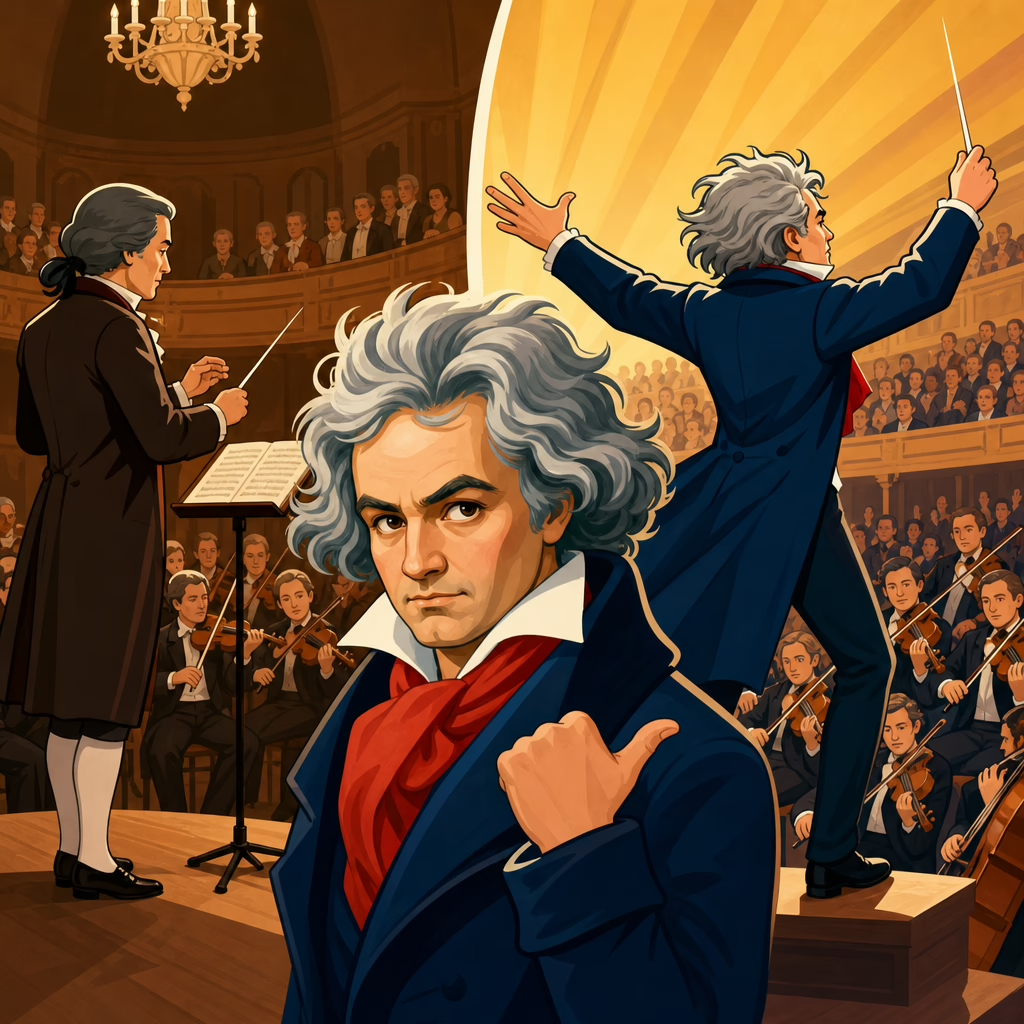
Before Beethoven, the person leading an orchestra usually kept time, cued entrances, and managed practical coordination; after Beethoven, the conductor’s job increasingly required architectural control, interpretive authority, and the ability to unify large forces across long, volatile musical spans. That shift did not happen because Beethoven invented conducting outright. It happened because his symphonies, overtures, and choral-orchestral works demanded a level of precision, balance, rehearsal planning, and expressive judgment that older leadership methods could no longer guarantee. When musicians ask why Beethoven changed the job of the conductor, the clearest answer is simple: he wrote music that could not be held together by routine time-beating alone.
In late eighteenth-century practice, orchestras were often directed from the keyboard by a harpsichordist or fortepianist, or by the first violinist, sometimes called the leader. Dedicated baton conductors existed only gradually and unevenly across Europe. In many courts and theaters, ensemble leadership was a shared craft rather than a separate profession. That model worked reasonably well for smaller orchestras, clearer phrase structures, and repertory built on regular patterns. Beethoven inherited that world, but he stretched nearly every variable inside it: dynamic range, instrumental color, rhythmic disruption, motivic development, formal scale, and emotional extremity. As those demands expanded, leadership had to expand too.
The reason this matters is not merely historical. Modern orchestral conducting still rests on problems Beethoven intensified: how to maintain pulse through silence, how to project structure across forty minutes, how to balance winds against strings in thick textures, and how to coordinate players when the most important information is not the beat but the shape of a crescendo or the timing of a harmonic arrival. In rehearsals, I have seen Beethoven expose every weak habit in an ensemble. If the group only follows the bar line, the music sounds square. If the conductor only emotes, attacks smear and internal lines vanish. Beethoven sits exactly at the point where conducting becomes both technical and interpretive labor.
What orchestral leadership looked like before Beethoven
To understand Beethoven’s impact, it helps to define the earlier baseline. In Haydn and Mozart performances, direction often came from within the ensemble. The concertmaster could signal bowings, breathing, and starts. A keyboard player could realize continuo, reinforce harmony, and steer tempo. The music itself frequently supported this arrangement. Phrases were more symmetrical, orchestral forces were usually smaller, and continuity often depended on convention as much as on explicit centralized control. Rehearsal time in many institutions was limited, so players relied on shared style knowledge.
None of this means earlier music was easy or that conductors were unnecessary. It means the role had different priorities. Leadership emphasized order, practical coordination, and faithful execution of known idioms. A separate conductor standing in front of the orchestra as a dominant interpretive figure was not yet standard. Even where a leader used a staff or baton, the task was closer to organizing than to sculpting every layer of sonority. Beethoven encountered this transitional practice and pushed it beyond its comfortable limits.
His timing in music history mattered. Around 1800, public concerts expanded, orchestras grew, and repertory became less tied to immediate utility and more tied to repeat performance. At the same time, Beethoven’s growing prestige encouraged close attention to the written score as a text carrying the composer’s will. That combination elevated the need for someone to translate notation into a coherent public event. The conductor became, increasingly, the person responsible for making the score audible as structure, not just as sound.
Why Beethoven’s scores demanded new kinds of control
Beethoven changed the conductor’s job because his scores concentrated risk. Sudden sforzandi, abrupt silences, destabilizing syncopations, offbeat accents, and hairpin dynamics cannot be managed casually. They require a leader who can prepare attacks before they happen and communicate character with economy. In the first movement of the Eroica Symphony, the opening two chords are not generic downbeats; they establish weight, width, and rhetorical force immediately. A merely functional leader can start them. A true conductor has to define their meaning for the entire orchestra in the first second.
Scale was equally transformative. Beethoven’s movements often unfold through long-range tension rather than decorative sequence. The Fifth Symphony is a familiar example, but familiarity can hide its difficulty. Its famous four-note motive is easy to recognize, yet hard to pace. The conductor must control tempo relationships, dynamic plateaus, and cumulative energy so that repetition sounds developmental, not mechanical. If the opening is overdramatized, the recapitulation has nowhere to go. If transitions are undercharged, the architecture collapses.
Texture also became a conducting problem. Beethoven gave winds more structural importance than many earlier composers had. Inner voices carry motive, harmony, and color, not just background filling. Brass and timpani can transform the drama rather than simply reinforce cadence points. That means balance decisions matter bar by bar. In rehearsal, Beethoven often forces conductors to choose between literal volume and audible function. A horn marked strongly must still fit the line around it. A bass figure must speak without clogging articulation. These are not abstract choices; they determine whether listeners hear argument or noise.
For readers exploring the larger context of his orchestral breakthroughs, the main guide at how Beethoven reinvented the symphony provides the broader frame. The focused point here is narrower: once Beethoven made the symphony this structurally demanding, someone had to oversee not just execution but continuity, proportion, and dramatic intelligibility.
Specific Beethoven challenges that shaped modern conducting
Several recurring Beethoven traits directly enlarged the conductor’s responsibility. The first is rhythmic ambiguity. Beethoven loves syncopation, displaced accents, and patterns that fight the meter. In the opening of the Seventh Symphony’s first movement introduction and vivace, the ensemble must feel both strict pulse and elastic lift. Players cannot simply count; they must share a physical sense of propulsion. The conductor’s beat pattern helps, but more important is the collective cueing of weight and release.
The second trait is extreme dynamic contrast. Beethoven uses subito piano, explosive forte, and sustained crescendos as structural events. These effects are not ornamental. In the Fifth and Ninth Symphonies, dynamics articulate form and expectation. Conductors therefore have to plan volume hierarchically. Not every forte can be maximal, or the work loses perspective. The rehearsal task becomes calibration: deciding which climaxes are local, which are structural, and how much reserve the ensemble needs for later peaks.
The third trait is transition management. Beethoven often turns a bridge passage into the engine of the movement. The funeral march of the Eroica, for instance, demands control of breath, pacing, and harmonic gravity across long spans where surface motion is restrained. In those pages, a conductor must prevent sagging without imposing artificial speed. The players need a visible sense of line that reaches beyond the bar.
| Beethoven challenge | Why it changed conducting | Example |
|---|---|---|
| Rhythmic displacement | Required clearer cueing and shared subdivision | Seventh Symphony, Vivace |
| Sudden dynamic shifts | Forced conductors to shape hierarchy, not just loudness | Fifth Symphony, first movement |
| Long formal spans | Made pacing and structural memory central duties | Eroica Symphony, first movement |
| Independent winds and brass | Turned balance into a constant interpretive task | Pastoral Symphony storm scene |
| Choral-orchestral integration | Expanded coordination across mixed forces | Ninth Symphony finale |
The fourth trait is the integration of large and mixed ensembles. The Ninth Symphony finale is the obvious case. Instrumental recitative, soloists, chorus, Turkish-style percussion, and symphonic argument all coexist. This is far beyond the old model of a leader simply indicating tempo. The conductor must manage multiple sight lines, diction, breathing, orchestral transparency, and sectional transitions while preserving formal inevitability. Even experienced ensembles feel instantly whether leadership is secure in this piece.
From timekeeper to interpreter: Beethoven and the rise of authority
As Beethoven’s works entered the repertory, the person on the podium increasingly became accountable for interpretation. That did not mean freedom without limits. In fact, Beethoven’s scores often push in the opposite direction: they ask for fidelity to increasingly specific markings. He wrote detailed dynamics, articulations, tempo indications, and character contrasts. The conductor’s authority grew because obedience to the score was no longer simple. To realize written detail consistently across a large ensemble, one musician had to make binding decisions about tempo relationships, bow distribution, articulation length, and orchestral balance.
This tension between textual fidelity and interpretive agency remains central to Beethoven performance. Consider metronome markings. Beethoven’s numbers have provoked debate for two centuries. Some seem startlingly fast to later traditions. A conductor cannot avoid the question. Should the marking be taken literally, adjusted for acoustics and instruments, or treated as evidence of desired energy rather than fixed speed? That is a modern conducting problem born directly from Beethoven’s insistence that tempo is expressive substance, not a loose convention.
Rehearsal practice changed as well. Beethoven’s music rewards sectional work, precision drilling, and detailed discussion of articulation. In my experience, one poorly coordinated sforzando pattern can blur an entire paragraph of Beethoven because the rhetoric depends on unanimity. Conductors learned to rehearse not just notes but grammar: where a phrase leans, where harmony darkens, where accompaniment becomes thematic. That approach, common now, became necessary partly because Beethoven wrote orchestral music that behaves like argument. Every accent can be evidence.
The long-term legacy for nineteenth-century and modern conductors
Beethoven did not create the fully modern conductor alone, but he accelerated the profession’s emergence more than any single symphonist before Berlioz and Wagner. By the mid-nineteenth century, figures such as Mendelssohn, Spohr, and later Hans von Bülow approached Beethoven as repertory requiring disciplined rehearsal and coherent concept. Felix Mendelssohn’s 1835 Leipzig performances and the Gewandhaus tradition helped establish the idea that Beethoven should be prepared with textual seriousness and structural clarity. That expectation shaped institutions, not just individual performances.
It also influenced baton technique. Clear preparatory gestures, left-hand dynamic control, sectional cueing, and management of fermatas became more consequential in Beethoven than in much earlier repertory. The conductor’s body had to communicate pulse and architecture simultaneously. Later pedagogical systems, including those codified in conservatory training, treat these skills as standard. Their necessity becomes obvious the moment an ensemble tackles Beethoven at a high level.
Most important, Beethoven altered what audiences expected from orchestral leadership. Listeners came to hear not only a composition, but a realization of that composition’s inner logic. Different conductors could reveal different truths: Toscanini’s tensile clarity, Furtwängler’s elastic monumentality, Harnoncourt’s rhetorical edge, Gardiner’s rhythmic bite. Those traditions disagree sharply, yet all assume that Beethoven demands an organizing musical intelligence standing before the orchestra. That assumption is now so normal that it is easy to forget how historically new it once was.
Beethoven changed the job of the conductor by making orchestral leadership answerable to structure, precision, and meaning all at once. Before him, ensemble direction could often remain embedded within performance practice; after him, the growing repertory required a specialist capable of coordinating complexity and projecting form over time. His music demanded sharper rehearsal methods, stronger cueing, more sophisticated balance, and principled decisions about tempo, articulation, and climax. In practical terms, Beethoven turned conducting from a mainly logistical role into a central musical profession.
That is why the question still matters. Every modern conductor who shapes a long crescendo, clarifies syncopation, balances winds against strings, or plans a symphonic arc across multiple movements is solving a Beethoven problem, even outside Beethoven’s music. His works exposed the limits of older leadership models and established the expectation that great orchestral music needs a visible, accountable interpreter. If you want to understand why the conductor stands where they do today, start with Beethoven’s scores and watch how quickly mere time-beating stops being enough.
Frequently Asked Questions
Did Beethoven actually invent the modern conductor?
No. Beethoven did not invent conducting, and he was not the first musician to stand in front of an ensemble and direct it. Before his time, orchestras were commonly led by a first violinist, a keyboard player, or another practical musical leader whose main responsibilities were to keep everyone together, signal entrances, and coordinate tempo changes. In that earlier system, leadership was often built into performance itself rather than separated into a specialized, independent profession.
What changed with Beethoven was the scale and complexity of what orchestral leadership needed to accomplish. His music placed much greater pressure on ensemble precision, structural clarity, dynamic control, and long-range pacing. A leader could no longer function as a mere timekeeper. Beethoven’s symphonies and overtures required someone to shape large musical spans, control transitions, balance instrumental sections, and sustain momentum across movements that were dramatically charged and architecturally ambitious.
So the modern conductor did not appear because Beethoven suddenly created a new job title. Instead, Beethoven accelerated a historical shift. His works exposed the limitations of older, more informal methods of direction and made clearer the need for a single interpretive authority who could unify the orchestra. In that sense, Beethoven did not invent the conductor, but he decisively helped create the conditions that made the modern conductor necessary.
Why did Beethoven’s music make the conductor’s role more important?
Beethoven’s music made the conductor’s role more important because it demanded far more than basic coordination. Earlier orchestral music often allowed leadership to remain relatively functional: keep the beat steady, cue important entrances, and maintain order. Beethoven’s scores, by contrast, asked performers to navigate abrupt contrasts, powerful crescendos, tightly argued motivic development, unpredictable accents, large orchestral sonorities, and musical structures that depended on sustained tension over long durations.
That meant the person leading the ensemble had to think on multiple levels at once. Tempo was no longer just a matter of speed; it became part of the work’s dramatic logic. Balance was no longer a simple practical concern; it became essential to making inner lines, harmonic turns, and rhythmic motives audible. Rehearsal also changed in importance. Beethoven’s music could not simply be played through and expected to cohere. It had to be prepared with attention to detail, sectional interaction, and the cumulative shape of the whole piece.
In practical terms, Beethoven increased the need for unified interpretation. If one section treated a passage as lyrical while another treated it as martial, the music could lose its force. If transitions were under-shaped, the architecture could collapse. If climaxes arrived too early or too heavily, the larger form could feel unbalanced. The conductor therefore became increasingly central not just to execution, but to meaning. Beethoven’s music helped turn conducting from a coordinating function into an artistic one.
How were conductors different before and after Beethoven?
Before Beethoven, the ensemble leader was usually closer to what we might call a practical organizer. The role centered on maintaining pulse, giving cues, and ensuring that musicians started and stopped together. Leadership often came from within the ensemble itself, especially from the concertmaster or a keyboard continuo player. In many cases, this arrangement worked well because the repertory was lighter in orchestral weight, more regular in phrase structure, and less dependent on massive long-range dramatic design.
After Beethoven, the role increasingly expanded into something much broader and more specialized. Conductors were expected not only to coordinate but also to interpret. They had to understand how an entire symphonic movement was built, how one section prepared the next, how dynamic levels affected dramatic narrative, and how tempo relationships could either support or weaken the coherence of the piece. The leader’s authority gradually became more centralized because the music itself required greater unity of conception.
This is one of the most important historical differences. The pre-Beethoven leader mainly managed immediate musical events. The post-Beethoven conductor increasingly shaped the total experience of the work. That included planning rehearsals, deciding how forcefully to articulate rhythm, controlling orchestral color, managing balance between winds, strings, brass, and percussion, and guiding performers through long spans of tension and release. In short, the job shifted from local coordination to architectural command.
Which Beethoven works best show this change in the conductor’s job?
Several Beethoven works illustrate this transformation especially clearly. The symphonies are the most obvious examples, particularly the Third, Fifth, Seventh, and Ninth. The “Eroica” Symphony expanded symphonic scale and raised the stakes of formal coherence. Its length, intensity, and structural breadth make leadership a matter of long-range strategy, not just beat patterns. The Fifth Symphony, with its relentless motivic concentration and cumulative dramatic energy, demands exceptional control of pacing, articulation, and tension across the entire work.
The Seventh Symphony shows a different side of the challenge. Its rhythmic drive can easily become monotonous or chaotic if not carefully shaped. A strong conductor must manage propulsion without sacrificing clarity, and excitement without losing formal direction. Then there is the Ninth Symphony, one of the clearest demonstrations of why the conductor’s role had to evolve. Its combination of vast orchestral writing, vocal soloists, chorus, and monumental structure creates coordination problems on a scale far beyond routine leadership. To hold that piece together requires command of tempo, balance, entrances, text setting, orchestral color, and overarching dramatic vision.
Beethoven’s overtures also matter here. Works such as the “Egmont” and “Coriolan” overtures compress dramatic extremes into shorter spans, forcing the leader to control sudden shifts of mood, attack, and sonority with precision. These pieces show that the issue was not only length, but volatility and concentration. Across Beethoven’s orchestral output, the recurring lesson is the same: the music asks for a leader who can unify complexity into a convincing whole.
How did Beethoven influence the long-term evolution of conducting as a profession?
Beethoven’s influence on conducting was profound because his music helped redefine what orchestral leadership was for. Once ensembles increasingly performed works that required deeper rehearsal, stricter unity, and stronger interpretive direction, the idea of the conductor as a distinct artistic professional became much more plausible and eventually much more necessary. Beethoven did not complete that process by himself, but he gave it enormous momentum.
In the decades after him, conductors were expected to bring coherence to repertory that was larger in scale, more emotionally volatile, and more structurally demanding. This encouraged the rise of the conductor as a central public figure: someone responsible not only for keeping order, but for revealing the meaning of a score. The profession gradually absorbed responsibilities that are now taken for granted, including detailed rehearsal planning, interpretive decision-making, orchestral balance control, and stewardship of a work’s dramatic architecture.
Just as importantly, Beethoven helped shape expectations among listeners as well as musicians. Audiences came to hear symphonic works as serious artistic statements whose success depended on unity, power, and expressive depth. That raised the value of a conductor capable of delivering a compelling interpretation rather than a merely correct performance. Later nineteenth-century conducting culture, with its emphasis on authority, fidelity to the score, and large-scale musical vision, owes a great deal to the challenges Beethoven’s music placed before orchestras. His legacy, therefore, lies not in inventing the conductor’s baton, but in transforming the musical environment so that the conductor’s modern artistic role could fully emerge.