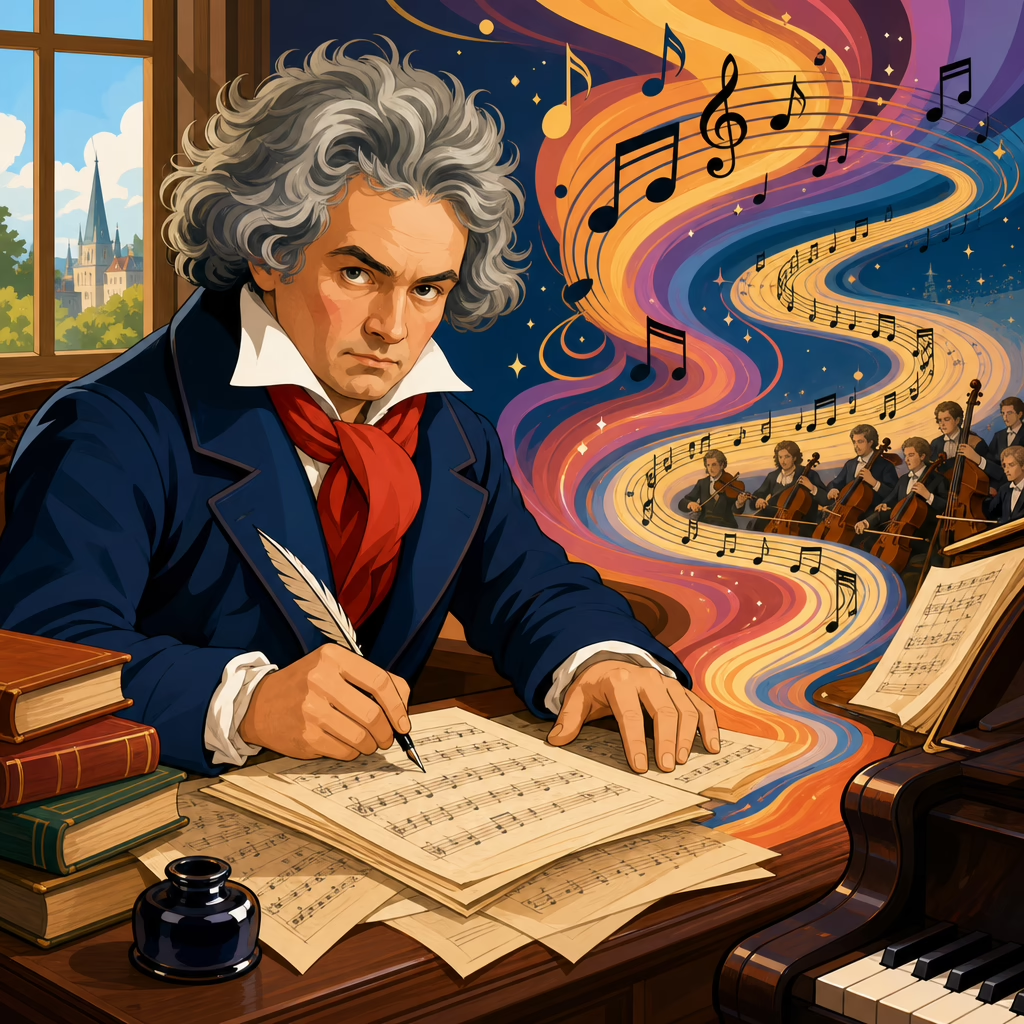
Beethoven and the Birth of the Long Coda
Beethoven transformed the coda from a brief closing gesture into a structural event, and that change altered the course of Western music. In Classical practice, a coda usually confirmed the home key, rounded off lingering tension, and gave audiences a clear sense that the movement was ending. Haydn and Mozart could be witty, expansive, and unpredictable in their endings, yet the coda generally remained subordinate to the larger sonata design. Beethoven recognized that this supposedly secondary space could carry fresh drama, reopen conflict, and even function like a second development. When musicians speak of the “long coda,” they usually mean exactly this Beethovenian move: a closing section that is long not merely by duration, but by thematic weight, harmonic ambition, and rhetorical force.
The subject matters because the long coda reveals Beethoven’s innovation at the level of form itself. He did not invent codas, and he did not simply make endings louder. He changed listeners’ expectations about where musical argument could happen. A movement that seemed complete could suddenly gather momentum, test motives under pressure, intensify rhythm, and delay finality until the last possible moment. I have seen this shift become unmistakable when comparing score readings with rehearsals: players often enter the recapitulation assuming the destination is now in view, only to discover that Beethoven has saved some of the movement’s hardest work for the end. The coda becomes a place of proof. Themes are not merely restated there; they are judged, consolidated, and transformed.
Understanding Beethoven and the birth of the long coda also clarifies a larger historical transition from late eighteenth-century balance to early nineteenth-century expansion. The issue is not length alone. Some pre-Beethoven endings run on pleasantly, and some Beethoven codas are concise. What changes is function. In Beethoven, the coda can become the final arena in which tonal stability is earned rather than assumed. That is why the topic remains central for conductors, analysts, performers, and listeners: it explains how Beethoven made endings feel inevitable only after making them feel uncertain.
What a coda was before Beethoven changed it
In textbook terms, a coda is the closing passage that follows the main formal obligations of a movement, often after the recapitulation in sonata form. In practice, eighteenth-century composers used codas flexibly, but they usually treated them as appendices, not as engines of new argument. A standard Classical sonata movement presents themes in an exposition, destabilizes them in a development, and restores order in a recapitulation. Once that restoration occurs, the coda’s task is often confirmatory: prolong cadences, repeat the tonic, supply brilliance, and settle the pulse of expectation.
Haydn offers many endings that are ingenious, even disruptive, yet his codas commonly preserve a clear hierarchy. Mozart, especially in mature concertos and symphonies, can broaden the closing span and add emotional resonance, but he usually does not make the coda rival the development in structural consequence. The listener feels closure arriving from the recapitulation onward. Beethoven inherited this norm thoroughly. His earliest works show how completely he understood Classical proportion, which makes his later departures easier to measure. The “birth” of the long coda was not a rejection of form by someone who lacked discipline. It was a calculated expansion by a composer who knew exactly which formal expectations he was bending.
That distinction matters. If the coda merely becomes longer, the result may be decorative inflation. Beethoven’s achievement lies in giving the coda necessity. The ending does not feel extended because the composer cannot stop; it feels extended because the movement has not yet exhausted its implications. Analysts often describe certain Beethoven codas as “second developments,” and the phrase is useful so long as it is not taken too literally. These codas do not simply repeat developmental procedures. They gather what the development and recapitulation could not settle, then force the issue in the tonic’s shadow.
How Beethoven turned the coda into a second battlefield
Beethoven’s codas become long when he treats closure as a problem rather than a formality. He often reaches the end of the recapitulation with enough tonal order to satisfy convention, then deliberately undermines the sense of completion through rhythmic insistence, fragmentation of motive, deceptive pauses, sudden dynamic shifts, or renewed harmonic pressure. The listener experiences a paradox: the music is in the right key, yet it does not sound finished. That gap between tonal correctness and rhetorical finality is where the long coda comes alive.
A useful example is the first movement of the “Eroica” Symphony. By the time the recapitulation has done its work, one could imagine a forceful Classical ending. Instead, Beethoven launches a coda of exceptional scale and energy. It revisits motivic conflict, strains through harmonic turbulence, and projects an almost developmental urgency. In rehearsal, this is where ensembles discover that endurance is not just physical but structural. The players must sustain the sense that the movement is still becoming itself. The coda does not merely crown the argument; it completes unfinished business that the recapitulation could only reopen.
The Fifth Symphony’s first movement offers another model. Its coda does not simply hammer out victory. It intensifies the famous short-short-short-long motive through obsessive repetition and orchestral accumulation, turning familiar material into a final demonstration of inevitability. The effect is cumulative because Beethoven understands proportion. He lets the recapitulation create expectation, then uses the coda to exceed it. This is why later composers learned from him not just to prolong endings but to make them the site of maximal rhetorical concentration.
Several recurring techniques help explain how Beethoven built long codas:
| Technique | How Beethoven uses it | Why it matters |
|---|---|---|
| Motivic fragmentation | Breaks themes into small cells and repeats them under pressure | Keeps the ending active instead of ceremonial |
| Dominant prolongation | Extends tension even after recapitulatory return | Delays true closure and enlarges expectation |
| Dynamic contrast | Moves abruptly between hushed suspense and forceful affirmation | Makes the coda dramatic rather than routine |
| Textural thickening | Adds orchestral weight, counterpoint, or registral expansion | Signals that the ending carries structural importance |
| Cadential interruption | Approaches closure, then diverts or restarts momentum | Turns finality into a contested process |
These are not random devices. They are coordinated strategies that let the coda absorb functions previously reserved for development. Beethoven thereby changes formal psychology: the recapitulation no longer guarantees arrival, and the end of the movement becomes a place where meaning is tested under maximum tension.
Case studies: from the “Pathétique” to the “Eroica”
The long coda emerges gradually in Beethoven, and tracing that emergence through specific works shows how intentional the process was. The first movement of the “Pathétique” Sonata, Op. 13, already points forward. After the recapitulation, Beethoven does not settle for a polite close. He intensifies the tragic rhetoric through emphatic cadential work and forceful recollection of earlier tensions. The scale is not yet as radical as in the middle-period symphonies, but the coda clearly carries expressive burden. It confirms that the sonata’s emotional world cannot be dismissed with a few tonic chords.
In the first movement of the Piano Sonata in C minor, Op. 10 No. 1, the coda likewise does more than sign off. Beethoven uses compressed motives and kinetic rhythm to sharpen the movement’s underlying severity. In performance, this is where pianists often reveal whether they understand the ending as syntax or as drama. If the coda is treated as merely louder recapitulation, the movement shrinks. If it is played as the final stage of argument, the architecture snaps into focus.
The breakthrough becomes harder to miss in the Symphony No. 3, the “Eroica.” Here the coda is so expansive and consequential that it changes the listener’s map of the form. Scholars have long noted its developmental character, but the key point is experiential: the movement feels as though it discovers a final reserve of thought after seeming to have concluded. That sensation is central to Beethoven’s innovation. He trains the ear to distrust premature closure. For readers interested in the broader formal context of this innovation, the main guide at how Beethoven reinvented the symphony provides a useful overview, but the long coda is one of the clearest places where that reinvention becomes audible.
The Fifth Symphony confirms that the “Eroica” was not a one-off experiment. Its first movement coda is concise compared with “Eroica,” yet still monumental in function. Rather than introducing entirely new ideas, Beethoven drives the movement’s core motive into a final state of compressed certainty. This is a crucial point: a long coda does not require new themes. It requires a new understanding of what closing can do. Beethoven proves that the ending may derive its force from obsessive return, not novelty.
Why long codas changed listening, performance, and composition
Once Beethoven made the coda structurally consequential, listeners could no longer treat the end of a sonata movement as a polite tapering-off. The closing span became something to follow with the same alertness given to exposition and development. That shift affected concert culture. Audiences accustomed to clearer formal boundaries encountered endings that felt like renewed struggle. The emotional result was stronger suspense, but the intellectual result was equally important: closure became something earned through process.
Performers had to adapt as well. Conductors cannot simply broaden tempo and increase volume at every Beethoven ending. A long coda works only if its internal argument remains legible. Pacing, articulation, and dynamic terracing must preserve the sense of unfolding necessity. I have heard excellent performances fail because the recapitulation was made so final that the coda sounded redundant. The best interpreters leave just enough unresolved energy for the coda to justify its existence, then shape its stages with the same precision they would give a development section.
Composers after Beethoven absorbed the lesson quickly. Schubert, Brahms, Bruckner, and Mahler all inherit the idea that an ending can be a place of revelation, consolidation, or struggle rather than simple punctuation. Brahms in particular learned how to make codas feel retrospective and inevitable at once, while Bruckner expanded the symphonic coda into a cathedral-like culmination. None of these later practices can be understood fully without Beethoven’s precedent. He normalized the concept that the final pages may contain the movement’s most decisive thinking.
There are, however, limits to the idea. Not every Beethoven coda is long, and not every large ending in later music is Beethovenian in function. Sometimes a coda is expansive because of variation technique, ceremonial rhetoric, or genre convention. Precision matters. The phrase “birth of the long coda” names a historical turn in structural purpose, not a simple increase in page count. That is why the topic still rewards close reading of scores: Beethoven’s real innovation lies in how endings think.
What the long coda tells us about Beethoven’s method
Beethoven’s long codas show a composer who treated form as dynamic argument rather than fixed template. He did not abolish sonata form; he intensified its logic until the old boundaries became permeable. The coda became long because the musical idea demanded one more proving ground. That approach reflects a broader Beethovenian habit: taking inherited procedures seriously enough to test their limits from within. Instead of discarding convention, he used convention as resistance against which invention could push.
For analysts, the long coda offers a precise lens on Beethoven’s craftsmanship. For performers, it demands pacing and structural hearing. For listeners, it explains why so many Beethoven endings feel less like conclusions than like verdicts. The movement does not simply stop after saying what it meant; it reaches a point where nothing further can be contested. That difference is the essence of Beethoven’s achievement in this area.
The key takeaway is simple. Beethoven gave the coda work to do. By turning the end of a movement into a final arena of tension, confirmation, and transformation, he created the long coda as a major force in musical form. Listen again to the “Pathétique,” the “Eroica,” or the Fifth Symphony with that in mind, and the ending will no longer sound like an appendix. It will sound like the place where Beethoven wins the argument. If you want to understand his innovation in the clearest possible terms, start at the end.
Frequently Asked Questions
What does it mean to say Beethoven transformed the coda into a structural event?
In earlier Classical practice, the coda usually functioned as a closing space. After the main tonal and thematic work of a movement had been completed, the coda would confirm the home key, ease any remaining tension, and provide a satisfying sense of finality. It mattered, of course, but it was generally understood as secondary to the exposition, development, and recapitulation. Beethoven changed that hierarchy. Instead of treating the coda as a polite farewell, he often made it feel like a final act in the drama, a place where the movement’s deepest conflicts could be intensified, reconsidered, and finally resolved on a larger scale.
That is why scholars often describe Beethoven’s codas as “structural events” rather than decorative endings. In his hands, the coda could introduce fresh momentum, prolong suspense, revisit earlier motives in a new light, and even create the impression of an additional developmental section after listeners might have assumed the movement was already complete. Rather than simply sealing the form, Beethoven used the coda to redefine how the form was experienced in time. Audiences were no longer hearing an ending that merely confirmed what they already knew; they were hearing an ending that continued to think, argue, and transform material until the very last bars.
How were Beethoven’s codas different from those of Haydn and Mozart?
Haydn and Mozart were far more inventive at endings than a simplified textbook account sometimes suggests. Both composers could write codas that were witty, expansive, surprising, or rhetorically powerful. Haydn in particular loved to play with expectation, and Mozart could bring extraordinary emotional weight to a final passage. Even so, in the standard Classical balance of sonata form, the coda usually remained subordinate. It rounded off what the movement had already established rather than reopening the argument on a larger scale.
Beethoven inherited that tradition but pushed it decisively further. His codas often feel less like appendices and more like necessary culminations. He could take a short motive that had driven the movement from the beginning and unleash it with new force at the end, creating a heightened sense of inevitability. He could also expand the coda so much that it acquires its own trajectory, complete with renewed conflict, fresh harmonic tension, and a delayed but hard-won conclusion. In practical listening terms, a Haydn or Mozart coda often confirms arrival, while a Beethoven coda frequently makes listeners realize that arrival itself is still being contested. That shift in scale, weight, and dramatic purpose is what marks Beethoven’s breakthrough.
Why did the long coda matter so much for the history of Western music?
The long coda mattered because it changed composers’ assumptions about what musical form could do. Once Beethoven demonstrated that an ending could carry major structural and expressive weight, later composers were free to think of form less as a fixed sequence of compartments and more as a living process. The coda no longer had to be a brief sign-off. It could serve as a space for retrospection, intensification, synthesis, or even transcendence. That single change had consequences far beyond the mechanics of sonata form.
In the nineteenth century, Beethoven’s example encouraged composers to make conclusions more expansive and more psychologically charged. The ending of a movement could now be the place where the true meaning of everything before it became clear. This affected not only symphonies and sonatas but also overtures, chamber music, and eventually large-scale Romantic works in which endings became monumental experiences in their own right. More broadly, Beethoven’s codas contributed to a new sense of musical time: instead of moving neatly from beginning to middle to end, a movement could save its most decisive statement for the final stretch. That reimagining of closure helped shape the ambitions of later composers from Schubert and Brahms to Bruckner and Mahler.
Can you hear Beethoven’s long coda as an extension of the development section?
Very often, yes, and that is one reason Beethoven’s codas feel so revolutionary. In Classical sonata form, the development section is traditionally where themes are fragmented, harmonies become unstable, and dramatic conflict intensifies. The recapitulation then restores order by bringing material back in the home key. In many Beethoven movements, however, the return of the recapitulation does not fully settle the movement’s tensions. When the coda arrives, it may behave less like a routine closing tag and more like a renewed developmental arena, one that revisits motives, drives sequences forward, and delays closure until the argument has reached a more convincing endpoint.
That does not mean the coda simply repeats the development. Its role is different. The development explores possibilities; the Beethovenian coda often judges them, consolidates them, and pushes them toward final consequence. It can feel like a second wave of thought after the apparent conclusion, as if the music were refusing to stop before it has fully earned its ending. This is why listeners frequently experience these codas as both surprising and necessary. They arrive after the expected formal landmarks have been passed, yet they reveal that the movement’s deepest logic was always pointing toward one last, decisive expansion.
What should listeners pay attention to when hearing a Beethoven coda?
A good first step is to notice whether the music seems to have reached a plausible ending before the coda truly begins. Beethoven often plays with that expectation. You may feel that the recapitulation has done its job and that the movement is ready to close, but then the energy gathers again instead of dissipating. That moment is crucial. It signals that the ending will not simply confirm the journey but reinterpret it. Listen for the return of short motives, rhythmic cells, or characteristic figures that suddenly take on intensified importance in the closing pages.
It also helps to follow the coda in three dimensions at once: harmony, rhythm, and rhetoric. Harmonically, ask whether Beethoven is truly at rest or whether he is still generating tension through repetition, dominant pressure, unexpected detours, or emphatic restatements of the tonic. Rhythically, notice whether the pulse drives forward with unusual insistence, creating momentum rather than release. Rhetorically, listen to the sense of scale: does the coda sound like a small ending, or does it feel like the movement is making its final and most public declaration? In Beethoven, the coda often becomes the place where summary turns into revelation. Once you start hearing that, his endings stop sounding like conclusions alone and start sounding like the final proof of the entire movement’s argument.