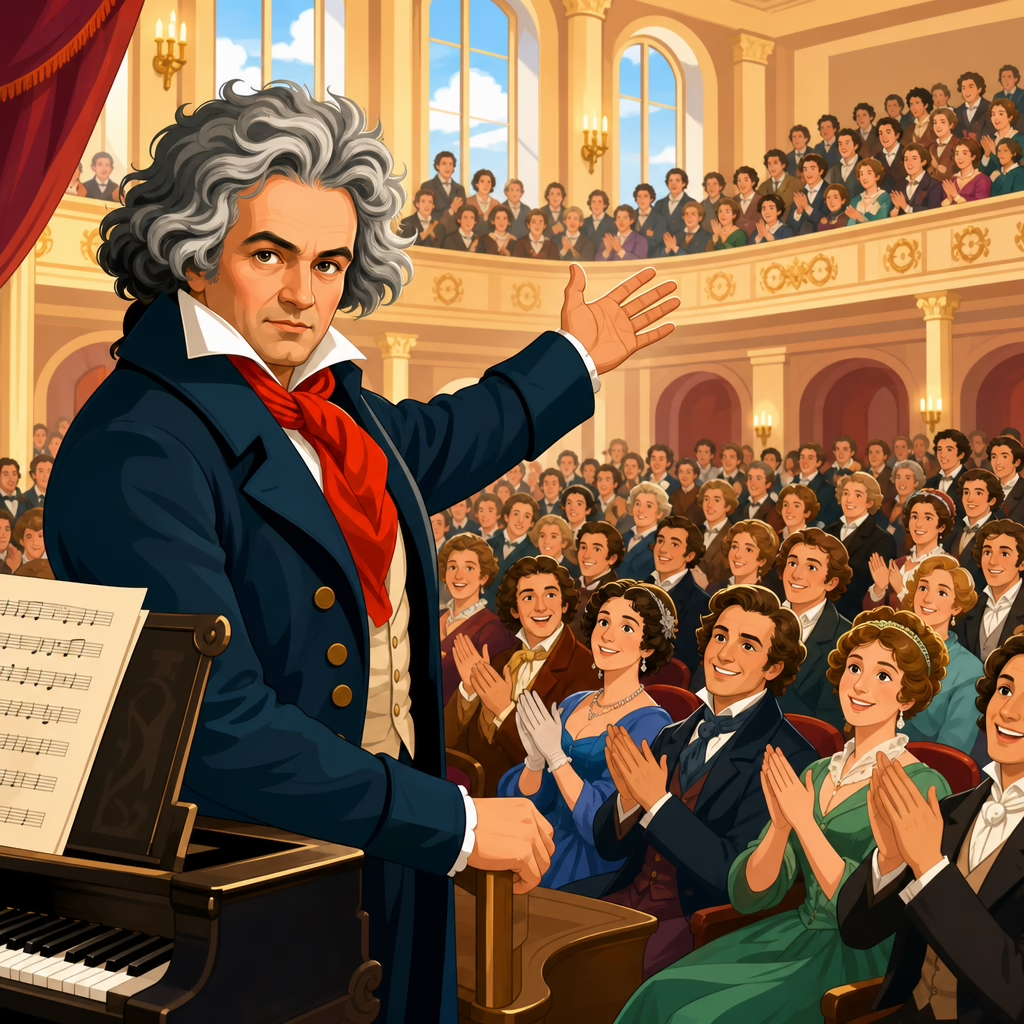
Beethoven’s Role in the Rise of the Public Concert
Beethoven’s role in the rise of the public concert was decisive because his career unfolded at the exact moment when European musical life was shifting away from courtly patronage and toward a paying audience gathered in large urban halls. A public concert, in this context, means a performance marketed beyond a private palace circle, financed partly or wholly by ticket sales, and aimed at listeners who attended as members of a broader civic culture rather than as servants or invited aristocratic guests. That distinction matters. In the late eighteenth century, composers still relied heavily on nobles, churches, and theaters for employment, but the center of gravity was moving. Vienna, London, Paris, and other cities were building new habits of listening, new concert institutions, and new expectations about what serious instrumental music could mean in public life.
Beethoven did not invent the public concert. Subscription series, benefit academies, and commercial musical events existed before him, and Mozart, Haydn, and many lesser-known figures all worked within them. What Beethoven changed was the scale of artistic ambition attached to the concert hall and the status of the audience’s experience. In my work with nineteenth-century concert programs and contemporary reviews, the pattern is unmistakable: Beethoven’s premieres repeatedly turned concerts into cultural events, not just pleasant entertainments. His music demanded concentration, provoked debate, and helped redefine listening as an active intellectual and emotional act. The concert became a place where the public encountered artistic seriousness, civic prestige, and even moral aspiration.
His influence was practical as well as aesthetic. Beethoven organized benefit concerts, negotiated with publishers and patrons, tested the limits of hall size and orchestral forces, and wrote works whose very dimensions pushed performers and impresarios to rethink programming. The famous marathon concert of 22 December 1808 in Vienna, which introduced the Fifth and Sixth Symphonies, the Fourth Piano Concerto, and the Choral Fantasy, illustrates both the promise and the strain of the new public model. It was long, cold, underrehearsed, and financially risky, yet it also showed that a composer could present a public concert as a major artistic statement. From that point forward, the idea of the concert as a destination for large-scale original works gained extraordinary force.
To understand Beethoven’s role clearly, it helps to focus on three linked developments: the decline of exclusive patronage, the transformation of audience behavior, and the emergence of the concert hall as the natural home of ambitious instrumental music. Beethoven stood at the intersection of all three. He still needed aristocratic support, but he was less a servant than many predecessors. He wrote for connoisseurs, yet increasingly for a broad paying public. And he created repertory so commanding that later concert institutions were built around it. His contribution to the public concert was not merely participation. It was redefinition.
From aristocratic salon to ticketed musical public
In eighteenth-century central Europe, musicians usually worked under systems of service. Court chapels, noble households, cathedrals, and opera companies provided salaries, lodging, and status, but they also imposed hierarchy. Haydn’s long employment with the Esterházy family remains the classic example. Public concerts existed alongside this world, especially in London and Paris, yet many instrumental works still circulated first within private or semi-private networks. Beethoven entered Vienna in the 1790s as this balance was changing. The city still depended on aristocratic sponsorship, but it also offered a growing market for published music, public appearances, and benefit concerts that could raise both income and reputation.
Beethoven understood early that independence would require multiple revenue streams. He cultivated patrons such as Prince Lichnowsky and Archduke Rudolph, but he also pursued publication aggressively and used public performance to establish authority. This mixed model was crucial. Because he was not confined to a single court position, he could build a career around public visibility. That visibility mattered not only financially but symbolically. A composer who appeared before a paying audience asserted that his work belonged to the city’s cultural life, not merely to a private household. The public concert thus became a site where Beethoven’s professional identity took shape.
Benefit academies were especially important. These concerts, often arranged for the financial advantage of a composer or performer, gave Beethoven a platform to premiere substantial works under his own name. Unlike routine court music, an academy framed composition as an event worthy of direct public support. Listeners bought tickets not simply to hear agreeable music but to witness the latest statement from a recognized artist. That shift in emphasis prepared the ground for the nineteenth-century concert economy, in which celebrity, novelty, and repertory value all interacted. Beethoven’s academies demonstrated how a composer could convert artistic stature into public demand.
The model had limits. Ticket income was uncertain, rehearsal time costly, and orchestral resources uneven. Political instability during the Napoleonic era disrupted urban life and disposable income. Yet Beethoven’s persistent use of public presentation helped normalize a new relationship among composer, performer, and audience. In practical terms, he proved that serious instrumental music could command public attention beyond the court. In cultural terms, he encouraged listeners to regard attendance as participation in a shared civic experience. That is one reason his career marks a turning point.
How Beethoven changed what audiences expected from a concert
Before Beethoven, concert audiences often treated performances as mixed social occasions. People talked, moved about, read librettos, and responded selectively to favorite passages. Beethoven did not singlehandedly impose modern silence, but his music accelerated a change in listening habits. The expanded development sections, abrupt dynamic contrasts, long-range tonal planning, and emotional volatility of works such as the “Eroica” Symphony made casual hearing difficult. To follow the argument of the music, listeners had to pay attention across a much larger span. This was not background sound for a salon. It was a public artwork unfolding in time.
Contemporary reactions show that audiences felt both attraction and strain. Some admired the power and originality; others complained about length, density, or eccentricity. That tension was productive. It signaled that a concert could be intellectually demanding and still culturally central. Beethoven’s premieres often became topics of conversation in newspapers, correspondence, and musical circles precisely because they challenged inherited standards of taste. A successful public concert was no longer defined only by immediate charm or virtuoso display. It could also be measured by seriousness, novelty, and the capacity to sustain public debate after the event ended.
One practical consequence was the growing prominence of instrumental music without theatrical support. Opera had long dominated public attention because it offered plot, spectacle, and vocal stars. Beethoven’s symphonies, overtures, and concertos helped elevate purely instrumental works within the concert economy. The audience did not need scenery or a story to justify the ticket price. The internal drama of the music itself became enough. This change was foundational for the nineteenth-century symphonic tradition and for the later reverence attached to orchestral concerts. If you want a broader view of that transformation in form and scale, see the main guide at how Beethoven reinvented the symphony.
Beethoven also affected expectations through difficulty. Performers had to rehearse more carefully, conductors or leaders had to coordinate larger plans, and promoters had to market premieres as exceptional occasions. The public concert became a more disciplined enterprise because the repertoire demanded it. Even when performances fell short, as they often did in Beethoven’s lifetime, the standard had risen. His works taught audiences to expect a concert to deliver revelation, struggle, and magnitude. That expectation outlasted him and became part of concert culture itself.
The 1808 Akademie as a case study in the new concert culture
No single event illustrates Beethoven’s relationship to the public concert better than the Theater an der Wien academy of 22 December 1808. The program was astonishingly ambitious: the premieres of the Fifth Symphony and Sixth Symphony, the Fourth Piano Concerto with Beethoven as soloist, excerpts from the Mass in C, the concert aria “Ah! perfido,” and the Choral Fantasy. By modern standards this would be a festival weekend, not a single evening. Yet Beethoven conceived it as one public event under his artistic authority. That decision reveals how fully he saw the concert hall as a stage for large-scale creative self-presentation.
The conditions were harsh. Vienna was in wartime distress, the hall was unheated, rehearsal was insufficient, and the players were stretched to their limits. The Choral Fantasy nearly collapsed in performance because of mistakes and coordination problems. Financially, the event was a gamble. Artistically, however, it was revolutionary. Beethoven assembled a program centered on original, substantial instrumental works and invited the public to experience them as a unified declaration of compositional power. The evening exposed the weaknesses of the early public-concert infrastructure, but it also proved that audiences would come for a demanding, composer-led orchestral event of unprecedented weight.
| Element | What happened in 1808 | Why it mattered for public concerts |
|---|---|---|
| Programming scale | Multiple premieres in one benefit academy | Showed a concert could be an artistic statement, not a routine entertainment |
| Composer visibility | Beethoven appeared as organizer, pianist, and creator | Strengthened the model of the composer as public figure |
| Audience demand | Listeners attended despite difficult conditions | Confirmed an appetite for serious new orchestral music |
| Performance strain | Limited rehearsal and logistical problems | Revealed the need for better institutions, rehearsal standards, and orchestral discipline |
What I find most telling about the 1808 academy is that its problems did not weaken Beethoven’s long-term impact. They clarified what the new public concert required: better-trained ensembles, more reliable concert management, and halls suited to sustained listening. Later nineteenth-century institutions effectively solved these problems by building themselves around the kind of repertoire Beethoven championed. In that sense, the academy was both a flawed performance and a blueprint. It anticipated the future by exposing exactly what had to change for the public concert to mature.
Symphonies, heroism, and the making of a concert repertory
Beethoven’s most durable contribution to the rise of the public concert was repertorial. Public concerts need works that reward repetition, justify rehearsal investment, and attract audiences beyond a single season. Beethoven supplied them. The Third, Fifth, Sixth, Seventh, and Ninth Symphonies did more than succeed individually; they established the symphony as the prestige genre of public musical life. Earlier symphonies by Haydn and Mozart were certainly admired, but Beethoven’s works created a stronger expectation that major concerts should feature monumental orchestral compositions capable of bearing cultural significance.
The “Eroica” is central here. Its unprecedented length, funeral march, and vast first movement altered the perceived scale of symphonic discourse. Listeners encountered not just elegant design but a public drama with ethical and historical overtones. The Fifth Symphony translated motivic economy into collective intensity so effectively that even non-specialist audiences could sense its trajectory from tension toward affirmation. The Sixth offered a different public function by legitimizing programmatic suggestion within the concert hall without reducing the music to mere description. The Seventh became known for rhythmic drive and communal energy. The Ninth, with chorus and soloists in its finale, expanded the concert itself into a quasi-civic ceremony.
These works helped form a repertory culture, meaning a system in which audiences return to hear established masterpieces repeatedly. That development is essential to the history of the public concert. A commercial concert world cannot depend only on novelty; it also needs recognized works that carry prestige and draw listeners across generations. Beethoven’s symphonies became exactly that. By the mid-nineteenth century, conductors, orchestras, and concert societies programmed him as a central pillar, and audiences learned to hear attending Beethoven as part of educated public life. The modern symphonic canon is unimaginable without this process.
Importantly, repertory status changed audience behavior. Repeat listening encouraged more analytical attention, comparison among performances, and a stronger sense of shared musical literacy. When people bought tickets for Beethoven, they often arrived with expectations formed by prior hearings, published criticism, or piano reductions studied at home. Public concerts thus became sites of informed judgment as well as immediate sensation. Beethoven’s music invited that level of engagement and, over time, helped make it normal.
Beethoven’s public image and the moral authority of the concert hall
Beethoven’s growing reputation also changed the symbolic meaning of the public concert. He came to embody the independent creative artist, accountable not to a single employer but to an ideal of artistic truth recognized by the public. That image was shaped partly by biography, including his deafness and difficult temperament, and partly by reception, as critics and admirers framed his works as expressions of struggle, freedom, and human dignity. However simplified that mythology became, it had real consequences for concert culture. Audiences increasingly treated attendance as an encounter with serious art carrying moral and civic weight.
Nowhere is this clearer than in the afterlife of the Ninth Symphony. Its “Ode to Joy” finale turned the public concert into something larger than private amusement. Choral symphony on that scale invited collective identification. The hall became a place where listeners could imagine community through sound. Later generations used Beethoven in political commemorations, memorial events, and institution-building projects because his music already possessed public authority. Concert societies, conservatories, and municipal orchestras drew legitimacy from performing him. In effect, Beethoven helped make the concert hall a cultural institution rather than merely a venue.
This development had tradeoffs. Reverence can harden into ritual, and ritual can narrow programming. The same Beethoven who expanded public listening also contributed, after his death, to a canon that sometimes overshadowed living composers. Yet the larger point remains: the prestige of the public concert as a serious social practice owes much to Beethoven’s example. He supplied not only masterworks but a model of why people should gather to hear them with focused attention. That model still shapes orchestral life today.
Beethoven’s role in the rise of the public concert can therefore be stated plainly. He entered a musical world still tied to aristocratic systems, used public performance to build a more independent career, wrote works that demanded concentrated listening, and left behind a repertory that became the backbone of concert institutions. His benefit academies showed both the opportunities and the fragility of a ticketed concert culture. His symphonies made instrumental music central to public prestige. His public image helped transform the concert hall into a place associated with seriousness, memory, and shared civic aspiration.
He was not alone in this transformation, and he did not control all of its economic or social forces. Urban growth, publishing markets, improved instruments, and changing class structures all mattered. But Beethoven gave those changes a compelling artistic center. He made audiences believe that gathering in a hall to hear new and challenging music was worth time, money, and attention. More importantly, he made later institutions organize themselves around that belief. The modern public concert, especially the orchestral concert, still carries his imprint in its programming, etiquette, and claims to cultural importance.
If you want to understand why concertgoing became more than fashionable diversion in the nineteenth century, start with Beethoven. Study the academies, the premieres, the reviews, and the repertory that followed. You will see the same conclusion repeatedly: Beethoven did not just succeed in public concerts; he helped define what a public concert could be. Explore his concert world more closely, and the history of modern musical listening comes into sharper focus.
Frequently Asked Questions
Why is Beethoven considered so important to the rise of the public concert?
Beethoven is considered central to the rise of the public concert because his career developed during a major transition in European musical life: the movement away from exclusive court patronage and toward performances supported by paying audiences in expanding cities. Earlier composers often depended primarily on aristocratic employers, church institutions, or noble households, and their music was frequently heard in private settings designed for a limited social circle. Beethoven certainly still relied on elite support, but he also worked in a world where music could increasingly be presented to the public as a civic event, advertised beyond the palace, funded through ticket sales, and judged by a broader body of listeners.
What makes Beethoven especially important is that he did not merely adapt to this new environment; he helped define it. His music demanded attention on a larger scale, both artistically and socially. Symphonies, concertos, and other large-form works became not just entertainment for background consumption, but central cultural experiences that audiences attended with expectation and seriousness. Beethoven’s growing reputation attracted listeners from beyond traditional aristocratic circles, and his concerts helped reinforce the idea that important music could belong to the public sphere. In that sense, he stands at the meeting point between old systems of patronage and the newer world of the ticket-buying concert audience.
How did Beethoven’s concerts differ from earlier courtly musical performances?
The difference lies largely in audience, purpose, and setting. Courtly musical performances were often tied to the needs of a prince, noble household, or ceremonial occasion. They served social functions such as banquets, celebrations, religious observances, or displays of prestige, and access was usually limited to invited guests, retainers, and members of elite circles. In contrast, the public concert was designed for a wider urban audience. It was promoted more openly, financed at least in part by admission fees, and attended by people who came not because they belonged to a court hierarchy, but because they chose to participate in public cultural life.
Beethoven’s role in this shift was significant because his works fit and accelerated the new expectations of public listening. His concerts were often treated as major artistic occasions, not just decorative court entertainment. Audiences came to hear difficult, ambitious music that invited sustained attention and emotional investment. This helped elevate the concert itself into a public institution. Instead of music functioning mainly as an adornment to aristocratic life, it increasingly became the main event. Beethoven’s presence in that transformation is one reason his career is so closely associated with the emergence of the modern concert experience.
Did Beethoven completely break free from aristocratic patronage?
No, and that is an important point. Beethoven did not simply abandon aristocratic support and live entirely by the market in the modern sense. He continued to depend on noble patrons, financial gifts, commissions, subscriptions, and elite connections throughout much of his life. In fact, the older system of patronage remained deeply important during his career, and without it, many composers of his time could not have sustained themselves. Beethoven’s world was transitional, not revolutionary in the sense of a clean break.
What makes him historically important is that he operated successfully between two systems. On one side stood the traditional structures of patronage, still powerful and often necessary. On the other side was an emerging public musical culture in which ticket-paying audiences, published music, urban concert institutions, and critical reputation mattered more than ever before. Beethoven’s career shows how a composer could use aristocratic backing while increasingly addressing a wider public. That dual position helped normalize the idea that serious art music could circulate beyond the private control of courts and become part of a broader civic culture. So the answer is not that Beethoven escaped patronage entirely, but that he helped push musical life toward a public-facing model.
How did Beethoven’s music itself encourage the growth of the public concert?
Beethoven’s music encouraged the growth of the public concert because it gave audiences compelling reasons to gather in large halls for focused listening. His works often had a scale, intensity, and dramatic force that suited public performance and rewarded collective attention. Symphonies, overtures, and concertos became events in themselves, capable of drawing interest from a mixed urban audience rather than serving merely as background sound for elite social ritual. The music projected ambition and individuality, and that helped shape the public expectation that a concert could be a serious artistic experience.
Just as importantly, Beethoven helped strengthen the idea of the composer as a major cultural figure whose works deserved repeated hearing and public discussion. His music invited interpretation, criticism, admiration, and debate, all of which are features of a mature public sphere. As audiences encountered his works, they were not simply consuming pleasant entertainment; they were participating in a shared cultural conversation. This elevated the concert hall into a space where civic identity, taste, and artistic values could be negotiated. In practical terms, Beethoven’s popularity and prestige also made it easier for organizers to present ambitious programs to paying audiences, reinforcing the economic and cultural viability of the public concert.
Why does Beethoven’s role in public concert history still matter today?
It matters because many features of modern concert culture can be traced back to the transformation that Beethoven helped embody. Today, people generally think of a concert hall as a public place where audiences purchase tickets, gather for serious listening, and encounter works presented as important artistic statements. That model did not always exist in the form we now take for granted. Beethoven lived at the moment when such practices were becoming more established, and his career illustrates how music moved from private aristocratic settings into the broader life of the city.
His historical importance also lies in the way he helped redefine musical authority. Instead of music existing primarily under the control of courts or noble employers, it increasingly became something that belonged to public culture, critical discourse, and collective memory. Beethoven’s success showed that a composer’s reputation could be shaped not only by patrons, but by audiences, publishers, performers, and the growing institutions of urban musical life. That shift remains foundational to how classical music is organized and valued today. When modern listeners attend a symphony concert in a public venue, they are participating in a tradition that Beethoven did much to strengthen and legitimize.