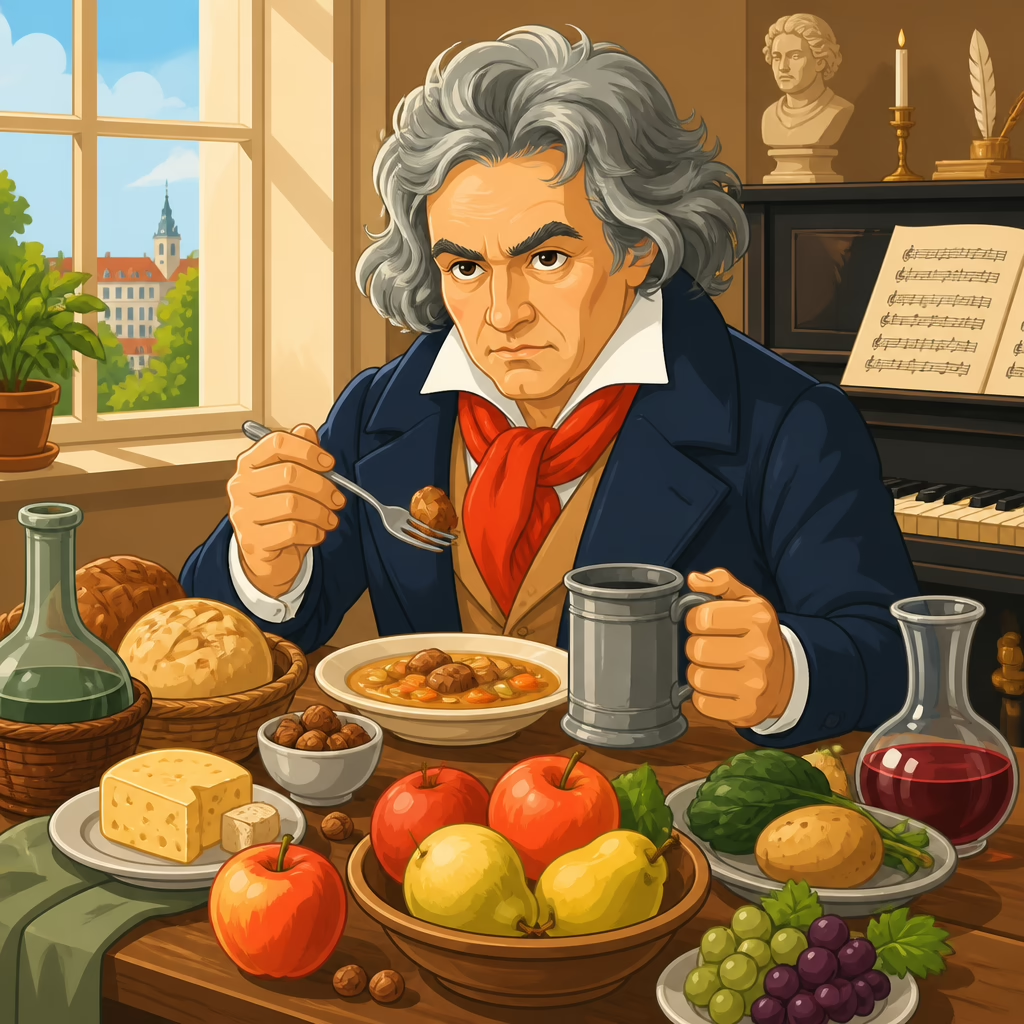
What Beethoven Ate and Drank
Ludwig van Beethoven’s music has been examined measure by measure, yet what Beethoven ate and drank reveals a different kind of biography: one written through shopping habits, tavern bills, household accounts, letters, and the recollections of friends. Food history, in this context, means reconstructing an everyday diet from fragmentary evidence rather than inventing a romantic menu. Drink history means asking not only what was poured into his glass, but how wine, coffee, and mineral waters fit into his routines, health complaints, finances, and social world. This matters because Beethoven lived in late eighteenth- and early nineteenth-century Bonn and Vienna, where class, season, religion, urban markets, and medical advice shaped every meal. Looking closely at his diet helps explain the practical texture of his life: when he composed, how he hosted guests, what comfort looked like during illness, and why modern medical debates about his liver disease and digestive problems keep returning to his table. I have worked through enough nineteenth-century household material to know that the truth is rarely glamorous. Beethoven was not sustained by mythic inspiration alone. He ate bread, soups, meat, fish, pastries, and simple cooked dishes available in Austrian urban markets, and he drank large amounts of wine and coffee, with all the pleasure and damage those habits could bring.
What sources tell us about Beethoven’s diet
The strongest evidence for Beethoven’s eating and drinking comes from conversation books, letters, memoirs by associates such as Anton Schindler and Carl Czerny, household recollections, medical reports, and the ordinary food culture of Vienna between about 1792 and 1827. None of these sources gives a perfect daily menu. Memoirs can exaggerate, especially when later admirers wanted to make him seem either heroic or self-destructive. That said, certain patterns are consistent across independent accounts. Beethoven drank wine regularly, often heavily. He was particular about coffee preparation. He enjoyed meals in inns and restaurants as well as food prepared at home by housekeepers. During periods of illness, he followed changing medical advice that affected what he consumed. If you want the wider documentary context for his life dates and records, the best companion piece is this guide to Beethoven’s birth record, because biography is strongest when grand narratives stay anchored to surviving documents.
We also have to remember what was normal in Vienna. Clean water could be unreliable, while wine and beer were everyday staples. Urban households bought from bakers, butchers, market women, and taverns rather than from modern grocery stores. Seasonality mattered. Winter diets leaned heavily on preserved foods, root vegetables, cabbage, legumes, and stored grain. Fresh fruit and tender vegetables appeared more predictably in warmer months. A composer living by commissions and patrons did not necessarily eat luxuriously every day, even if he sometimes dined well. Beethoven’s finances fluctuated, his domestic arrangements were unstable, and his health often interfered with regular habits. The result was a diet that mixed comfort, convenience, sociability, and neglect.
Daily meals in Vienna: bread, soup, meat, and familiar staples
If we strip away legend and ask what Beethoven probably ate most often, the answer is simple central European urban fare. Bread formed the backbone of daily eating, whether as breakfast, accompaniment to soup, or part of a cold supper. Soups were fundamental because they were economical, filling, and available both at home and in public eating houses. A typical Viennese table offered broth-based soups with dumplings, noodles, or vegetables; boiled beef; roasted meats; sausages; fish on fast days; eggs; cabbage dishes; lentils or beans; and pastries. Household records from the era show that these were not special-occasion foods but normal staples.
Beethoven appears to have liked solid, recognizable dishes rather than elaborate court cuisine. Friends often described his habits as irregular, but not especially refined. He could dine at taverns, order meals in lodgings, or eat food prepared by servants and housekeepers. Boiled beef was a Viennese standard and likely crossed his table repeatedly. So did veal, fowl, cutlets, river fish, and simple stews. In practice, someone of Beethoven’s class and city environment ate what was abundant in Vienna’s market system: wheat bread if affordable, rye breads more generally, dairy in moderate amounts, and meat often enough to signal middle-class respectability. He was not a peasant surviving on porridge, but neither was he a prince feasting daily on game.
Breakfast was often light by modern standards. Bread rolls, butter, and coffee fit the period perfectly, and coffee was one area where Beethoven’s personal preferences became famous. Midday dinners were the largest meal, often taken outside the home when schedules or company demanded it. Evening eating could be lighter, sometimes cold dishes, leftovers, bread, cheese, or wine with companions. This pattern helps make sense of his work habits. Like many urban professionals, he composed within a routine shaped by servants’ availability, market hours, and the social expectation of the dinner table.
Coffee, the famously exact bean count, and Beethoven’s morning ritual
No discussion of what Beethoven drank is complete without coffee. Several accounts report that he prepared his coffee with extreme precision, allegedly counting sixty beans per cup. Historians debate whether the number was always exact or whether the story has been polished by repetition, but the larger point is secure: Beethoven cared about coffee strength and preparation. That matters because coffeehouses were central to Viennese life, and coffee at home was increasingly common among the middle classes. It was both stimulant and ritual.
From my work with historical domestic practices, details like bean counting usually survive because they are memorable expressions of a deeper habit. In Beethoven’s case, coffee represented control. His household life was often chaotic, his hearing deteriorated relentlessly, and his finances and family entanglements caused constant strain. Measuring coffee gave order to the morning. Strong coffee also suited a composer who worked intensely, revised obsessively, and often needed to push through fatigue. Whether he always used exactly sixty beans matters less than the direct evidence that he took the beverage seriously.
Viennese coffee in his day was not identical to modern espresso bar culture. Beans were roasted more unevenly, brewing methods varied, and additions like milk or sugar depended on preference and means. Yet coffee already carried social and intellectual associations. For Beethoven, it was not mere ornament. It was part of his daily functioning, one of the few habits repeatedly noted by witnesses who otherwise disagreed about his manners. That consistency makes coffee one of the most reliable pieces of his dietary portrait.
Wine, taverns, and the role of alcohol in Beethoven’s life
Wine was even more central than coffee, and here the evidence becomes medically and biographically significant. Beethoven drank wine regularly throughout his adult life, often in quantities that alarmed friends and later commentators. Austrian and Hungarian wines were common in Vienna, as were wines from the Rhineland. Taverns and wine houses were part of normal social life, so drinking wine did not automatically mark excess. The issue is frequency, quantity, and context. Reports from those around him suggest that alcohol was a habit, a pleasure, and at times a burden.
One reason scholars connect wine to Beethoven’s health is the modern reexamination of his remains and medical history. Research into lead exposure has proposed that lead-contaminated wine, then a real risk because of adulteration and storage practices, may have contributed to his illnesses. That does not mean wine alone explains his hearing loss, gastrointestinal distress, or final liver failure; the evidence does not support such a simple answer. But habitual drinking likely aggravated an already fragile physical condition. By the 1820s, his liver disease was severe, and contemporary physicians repeatedly tried to regulate his intake.
Wine also served a social function. Beethoven dined with patrons, fellow musicians, publishers, and friends. Shared bottles were part of professional networking long before the term existed. He could be warm, witty, and expansive at table, then difficult, suspicious, or abrupt. Alcohol may have amplified these swings, though temperament and deafness already created strain. The strongest historical conclusion is moderate but firm: Beethoven was a regular wine drinker in a culture where wine was normal, and his level of consumption likely moved beyond ordinary conviviality into a pattern that harmed his health.
How illness changed what he ate and drank
Beethoven’s health problems make diet impossible to treat as a side note. He suffered recurrent abdominal complaints, diarrhea, inflammatory episodes, and later jaundice, edema, and signs of advanced liver disease. Nineteenth-century medical treatment was inconsistent, but doctors often prescribed dietary restraint: lighter broths, reduced alcohol, bland foods, and mineral waters. During acute illness, rich meats and heavy sauces would have been discouraged, while soups, boiled foods, and simple preparations were considered safer. He did not always comply.
Late in life, after serious deterioration, physicians reportedly restricted wine, though enforcement was imperfect. Medical culture then was humoral in inheritance but increasingly observational in method. Practitioners paid attention to digestion, stool, appetite, and swelling, and they linked these to food and drink in ways recognizable today even if their theories differed. Beethoven’s final years included repeated cycles of temporary improvement and relapse. During these periods, what he consumed was not just a matter of taste but of survival.
| Dietary element | Evidence from Beethoven’s life | Likely effect |
|---|---|---|
| Coffee | Repeated accounts of careful preparation and strong preference | Supported alertness and routine; unlikely to be his main health risk |
| Wine | Frequent references in social and domestic settings | Pleasure and sociability, but probable strain on liver and digestion |
| Simple soups and boiled foods | Consistent with Viennese norms and medical advice during illness | Easier digestion during recurrent abdominal distress |
| Restaurant and tavern meals | Documented part of his urban routine | Convenience and companionship, with less dietary control |
The most balanced reading is that Beethoven’s diet shifted with his health but never fully escaped his established habits. Like many patients, he followed advice selectively, especially when the recommended regimen reduced pleasure. That tension between discipline and appetite is one reason his food history feels so human.
Social dining, domestic disorder, and what meals say about character
Meals also reveal Beethoven’s personality. He was capable of hospitality, yet his domestic life was notoriously unstable. He changed lodgings often, quarreled with servants, and struggled to maintain orderly households. In practical terms, that meant food quality could vary sharply depending on who was managing the kitchen, how much cash was available, and whether he was dining alone or with company. A composer with a dependable cook develops one kind of table; a composer cycling through housekeepers develops another.
Witnesses often noticed contradictions. Beethoven could care intensely about one detail, such as coffee, while appearing indifferent to broader household order. He might enjoy a tavern meal with friends, then neglect regular domestic arrangements. This is common in archival lives. People are not consistent systems. They protect a few rituals and let the rest slide. His meals suggest exactly that pattern: not gourmet obsession, but selective intensity embedded in disorder.
Socially, dining out gave him access to conversation he increasingly could not hear clearly. Even after his deafness worsened, public meals remained important. They kept him within the network of publishers, pupils, admirers, and patrons who sustained his career. Food and drink were therefore not separate from music history. They were part of the infrastructure around composition, reputation, and survival in Vienna’s competitive cultural economy.
What Beethoven probably did not eat, and why myths persist
Because famous lives attract embellishment, Beethoven’s diet is sometimes portrayed in extremes: either austere genius fare or reckless bohemian indulgence. Neither is accurate. There is no serious evidence that he lived on coffee and wine alone, nor that he cultivated an unusually exotic palate. He ate the foods of his place and class. He likely enjoyed pastries and sweets available in Vienna, but dessert was not the defining feature of his table. He was not known for culinary experimentation, vegetarian principle, or philosophical food reform. Those belonged more to later nineteenth-century movements.
Myths persist because food is an easy way to dramatize character. Counting coffee beans becomes a symbol of genius. Drinking wine becomes a shorthand for suffering. Both contain some truth, but both flatten the evidence. In reality, Beethoven’s diet was ordinary in composition and extraordinary only in the way it intersected with illness, temperament, and fame. That is precisely why it deserves careful treatment. Everyday habits often explain historical lives better than anecdotes polished for quotation books.
What Beethoven ate and drank can be stated clearly. He lived on the standard foods of Bonn and especially Vienna: bread, soups, meat dishes, fish, eggs, vegetables, pastries, and other practical staples of an urban middle-class table. He drank coffee with famous exactness and wine with damaging regularity. He ate at home, in taverns, and in restaurants, depending on health, household stability, and company. As his illnesses worsened, doctors pushed simpler diets and less alcohol, but habit and pleasure limited compliance. The real value of this dietary portrait is not novelty. It is precision. Food and drink place Beethoven back inside the daily world he actually inhabited, where composition coexisted with shopping, servants, digestion, and the consequences of long-term drinking. If you want to understand him as a person rather than a monument, keep following the evidence in ordinary things. Start with the table, and the biography becomes sharper.
Frequently Asked Questions
What do historians actually know about what Beethoven ate and drank?
Historians know more about Beethoven’s daily eating and drinking habits than many readers might expect, but the evidence is indirect and incomplete. There is no single “Beethoven menu” preserved in perfect detail. Instead, scholars piece together his food history from household account books, shopping notes, tavern and restaurant bills, letters, legal papers, medical recommendations, and memoirs written by friends, servants, and visitors. That means the picture is documentary rather than romantic. We can speak with some confidence about the kinds of foods and drinks that appeared regularly in his life, especially in Vienna, but much less confidently about exact recipes, favorite plates on specific days, or grand culinary rituals.
This kind of reconstruction matters because Beethoven’s diet was shaped by ordinary realities: money, health, household management, local markets, and the customs of urban Austrian life in the late eighteenth and early nineteenth centuries. Like many middle-class men in Vienna, he likely ate bread, soups, boiled meats, simple vegetable dishes, pastries, and seasonal produce, with meals varying depending on where he lived, whom he employed, and how stable his finances were at the time. Drink records are often clearer, especially when it comes to wine, coffee, and mineral waters, because these show up more readily in bills and correspondence. So while historians must avoid inventing a lavish “composer’s table,” they can still recover a believable everyday diet that tells us a great deal about Beethoven as a working, aging, often unwell man navigating city life.
Did Beethoven really drink a lot of wine, and what role did it play in his life?
Wine was unquestionably part of Beethoven’s world, and it appears frequently enough in the surviving evidence to show that it was not an occasional curiosity but a regular feature of his diet and social life. In Vienna at the time, wine was an ordinary table drink for many people, safer and more culturally central than modern readers sometimes assume. Beethoven seems to have consumed it both at home and in public settings such as taverns, inns, and dining establishments. Accounts from contemporaries, along with bills and recollections, suggest he cared about the quality of wine and had preferences rather than drinking it merely out of necessity.
At the same time, the familiar image of Beethoven as a permanently drunken genius should be treated with caution. Historians distinguish between regular wine drinking, which was common and socially normal, and sensational claims that exaggerate his habits for dramatic effect. The evidence does suggest periods of substantial consumption, especially later in life, and this is relevant because modern medical discussions of Beethoven often connect alcohol intake to his chronic illnesses and especially to his severe liver disease. Still, it would be misleading to reduce his drinking to vice alone. Wine had practical, social, and even medicinal dimensions in his era. It accompanied meals, hospitality, professional conversation, and routine urban living. Understanding Beethoven’s wine consumption therefore means placing it within the habits of his class, city, and century, while also recognizing that his personal use may have had serious consequences for his health.
Was coffee important to Beethoven’s daily routine?
Yes, coffee appears to have been one of the most recognizable and personal elements of Beethoven’s daily routine. The best-known anecdote is that he supposedly counted out exactly sixty coffee beans for each cup, a story repeated so often because it neatly fits his reputation for precision, intensity, and ritual. Whether every retelling is exact, the broader point is credible: coffee mattered to him, and it seems to have been part of his working life rather than a trivial indulgence. In the musical and intellectual culture of Vienna, coffee had become a major urban beverage, tied to alertness, conversation, reading, and solitary labor.
For Beethoven, coffee was likely both stimulant and habit. Composing required long periods of concentration, and coffee fit the rhythms of a man who worked irregular hours, wrestled with health complaints, and often lived in emotionally and practically unsettled circumstances. It also carried social meaning. Coffeehouses were important institutions in Central European urban culture, though Beethoven’s own domestic coffee habits seem just as significant as any public consumption. The fascination with his coffee ritual is not merely charming trivia; it reveals how food and drink history can illuminate temperament. Rather than imagining inspiration descending from nowhere, we see a composer whose creativity was grounded in repetitive, material routines: buying supplies, preparing beverages, managing servants, and organizing the ordinary conditions under which artistic work became possible.
What kinds of everyday foods would Beethoven most likely have eaten in Vienna?
Beethoven’s everyday diet was probably far simpler and more typical of his environment than modern audiences expect. He lived in a city where meals often centered on bread, soups, broths, dumplings, noodles, boiled or roasted meats, fish on appropriate days, eggs, and seasonal vegetables. Cabbage, root vegetables, legumes, and modest meat portions would have been common components of an urban Central European diet. Depending on income, access, and household stability, such meals could be plain or moderately refined, but they were not the extravagant banquets often imagined in romantic biographies. Pastries and baked goods were also part of Viennese food culture, and fruit would have appeared seasonally.
His meals were also shaped by practical instability. Beethoven moved frequently, had uneven domestic arrangements, and often had difficult relationships with servants and housekeepers. That matters because diet in this period depended heavily on who purchased ingredients, who cooked, and whether one dined at home or outside it. A composer with fluctuating income and recurring illness might eat one way during a relatively comfortable stretch and another during periods of stress, travel, or disorder. Historians therefore avoid claiming a fixed “Beethoven diet.” What they can say is that he most likely ate recognizable middle-class Viennese food, sometimes at home, sometimes in public establishments, with drink and health concerns frequently influencing his choices. This grounded, everyday view is more historically convincing than the fantasy of a perpetually ceremonial table.
Why do mineral waters and medical diets matter when discussing what Beethoven drank?
Mineral waters and medically advised beverages are crucial because Beethoven’s later life was marked by chronic health problems, and what he drank cannot be separated from efforts to manage those conditions. In the late eighteenth and early nineteenth centuries, mineral waters were widely used for therapeutic purposes. They were recommended by physicians, consumed at spas, and associated with digestion, liver complaints, intestinal troubles, and general constitutional weakness. Beethoven’s known illnesses make it highly likely that such waters formed part of his broader regimen at various points, whether by prescription, self-treatment, or fashionable medical practice.
This is important for two reasons. First, it reminds us that beverage history is not just about pleasure. A glass might be chosen for relief, prevention, or obedience to medical advice just as much as for taste. Second, it helps explain the tension in Beethoven’s diet between enjoyment and bodily struggle. Wine, coffee, and ordinary meals belonged to his routine, but so did discomfort, medical consultation, and attempts at correction through regulated intake. When scholars discuss what Beethoven drank, they are not simply listing beverages; they are tracing how food and drink intersected with disease, treatment, self-discipline, and the realities of aging. Seen this way, mineral waters become more than a footnote. They are part of the documentary record showing Beethoven not as a mythic genius floating above material life, but as a man whose daily glass was often tied to the management of a failing body.