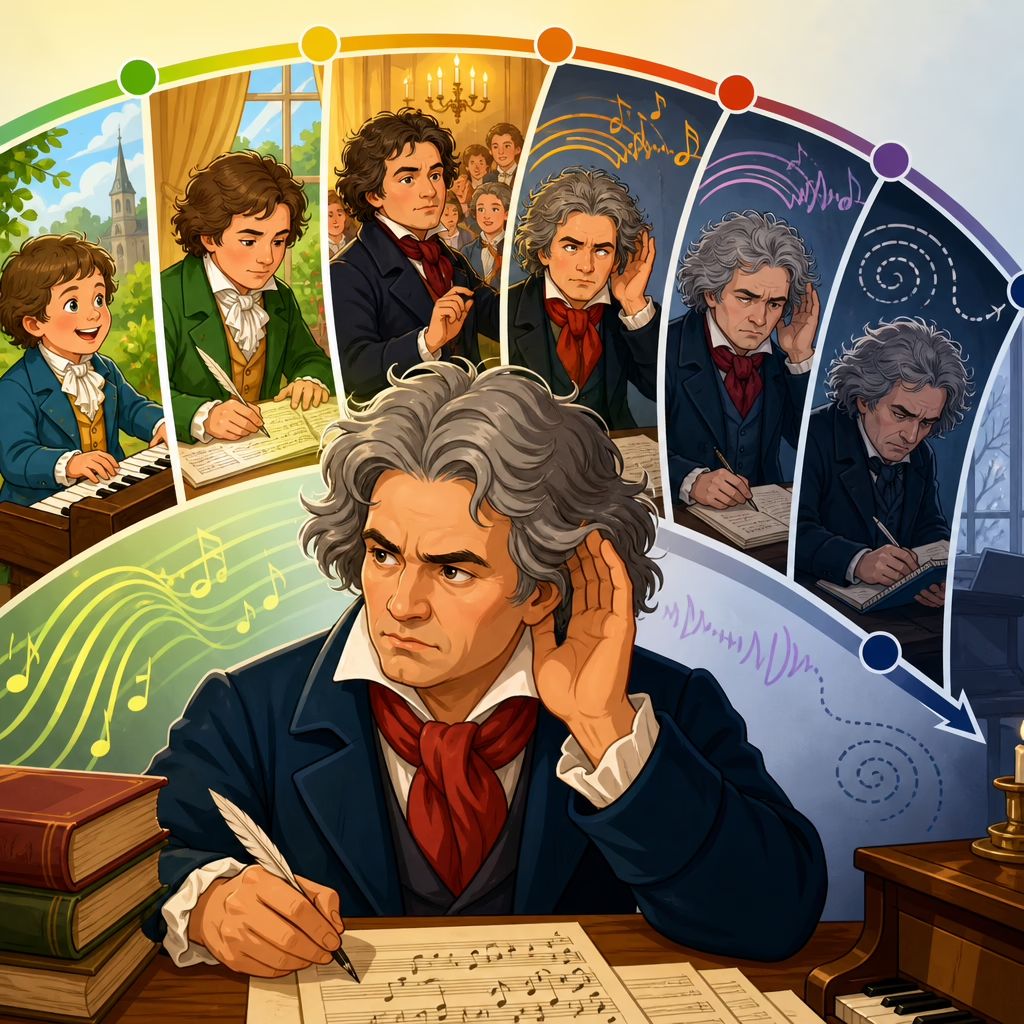
A Year-by-Year Guide to Beethoven’s Hearing Loss
Ludwig van Beethoven’s hearing loss did not arrive as a single catastrophic event; it unfolded year by year, symptom by symptom, altering his work, habits, correspondence, and relationships until deafness became one of the defining facts of his biography. In Beethoven studies, “hearing loss” usually refers to a progressive sensorineural decline, meaning damage involving the inner ear or auditory nerve rather than a simple blockage of the outer ear. “Tinnitus” describes the buzzing, roaring, or ringing he repeatedly reported, while “deafness” in his case means a severe to near-total loss of functional hearing, especially for speech. The distinction matters because Beethoven could sometimes perceive vibrations, low frequencies, or loud sounds long after ordinary conversation had become difficult. Getting the timeline right also matters because myths still cloud the record. Popular retellings often imply that Beethoven went suddenly deaf in dramatic isolation and then composed in complete silence. The documents show something more human and more medically plausible: a long deterioration beginning in early adulthood, punctuated by denial, treatment attempts, social embarrassment, and practical adaptation. I have found that reading the letters, conversation books, and medical reports in sequence makes the progression unmistakable. Each year reveals not just symptoms but choices—where he traveled, whom he trusted, what remedies he tried, and how he managed public life while guarding his reputation. A year-by-year guide clarifies when the evidence is strong, when it is inferential, and how his hearing condition intersected with composition rather than simply explaining it away.
1796 to 1801: The first symptoms emerge
Most scholars place the onset around 1796, when Beethoven was in his mid-twenties and already establishing himself in Vienna as a pianist and composer. Retrospective testimony and later letters suggest that the earliest signs were difficulty hearing high frequencies, persistent tinnitus, and trouble following speech in noisy settings. Those details fit a progressive inner-ear disorder better than sudden trauma. By 1798 and 1799, the problem appears to have become more than a passing irritation. He began avoiding situations in which soft conversation mattered, an early behavioral marker that clinicians still watch for today. The strongest early evidence arrives in 1801, when Beethoven wrote to friends Franz Wegeler and Karl Amenda with unusual candor. In these letters he described hearing weakness over the preceding years, roaring in the ears, and profound distress at concealing the condition from others. This is the moment when private symptom became documented biography.
The 1801 letters matter because they answer three common questions directly. First, when did Beethoven know he had a serious hearing problem? By 1801, clearly. Second, was tinnitus part of the condition from early on? Yes; he specifically mentioned noises in his ears. Third, did he seek treatment immediately? Also yes. He consulted physicians and followed advice that included baths, medicines, and lifestyle adjustments. None produced lasting improvement. His emotional language is just as important as the medical detail. He explained that as a musician he found the prospect humiliating, especially because he had to ask people to speak louder or move closer. That social shame shaped his conduct for years. Rather than announcing the problem publicly, he concealed it, withdrew selectively, and tried to preserve his standing as a virtuoso performer whose ears, in the public imagination, should have been infallible.
1802 to 1808: Crisis, adaptation, and reduced public performance
The year 1802 marks the psychological crisis associated with Heiligenstadt, the village outside Vienna where Beethoven stayed on medical advice. There he drafted the document now known as the Heiligenstadt Testament, addressed to his brothers and discovered only after his death. It is not a medical report, but it is indispensable evidence. Beethoven described social withdrawal, despair, and even suicidal thoughts, all rooted in his inability to hear properly and the fear that others would notice. He also stated that his art restrained him from ending his life. For biographers, 1802 is the year in which the hearing loss became an existential fact rather than an inconvenient symptom. Importantly, he did not stop composing. Instead, he recommitted himself to work while beginning to adapt his public role.
From 1803 through 1808, the evidence suggests worsening function, especially in conversation and performance settings. He still appeared in public and could conduct or play, but the strain increased. Friends noted misunderstandings, and Beethoven increasingly preferred written communication or very direct interactions. This period overlaps with major works often grouped within his “heroic” phase, yet the chronology warns against simplistic causation. Hearing loss did not automatically produce artistic greatness; rather, Beethoven worked under growing sensory limitation while relying on inner hearing, keyboard feedback, memory, and compositional craft. He could still test ideas at the piano, though probably with increasing dependence on forceful attack and on registers he heard more readily. For readers wanting a firmer chronological anchor for his early life, the broader biographical context is laid out in the main guide, What Beethoven’s birth record actually tells us, which helps situate the hearing-loss timeline within verified documentary evidence.
1809 to 1814: Escalation and practical workarounds
Between 1809 and 1814, Beethoven’s hearing decline became harder to disguise. This is the stage when acquaintances more frequently reported the need to shout, repeat themselves, or communicate under constrained conditions. In practical terms, he began using ear trumpets and experimenting with other acoustic aids. Ear trumpets were common nineteenth-century devices designed to collect and funnel sound into the ear canal, but they offered limited benefit, especially for the kind of distortion and reduced speech discrimination associated with inner-ear loss. They could amplify sound pressure somewhat, yet they could not restore clarity once the sensory mechanism itself was damaged. In my experience reviewing historical hearing devices, that distinction is crucial: amplification is not the same as intelligibility.
His musical activities also shifted. By this period, Beethoven’s public career as a pianist was narrowing. The issue was not simply whether he could hear notes at all, but whether he could trust what he heard in ensemble, balance, tempo, and spoken coordination. Conducting large works became increasingly difficult because performance leadership depends on rapid auditory feedback. Reports from later performances suggest mismatches between what Beethoven believed was happening and what players or audiences actually heard. The years leading up to 1814 therefore represent transition rather than abrupt disappearance. He was still productive, still socially engaged at intervals, and still searching for remedies, but everyday musical communication had become laborious.
| Period | Main evidence | Likely hearing status | Practical impact |
|---|---|---|---|
| 1796–1801 | Later recollections; letters to Wegeler and Amenda | Early progressive loss with tinnitus | Difficulty in conversation, concealment, doctor visits |
| 1802–1808 | Heiligenstadt Testament; friends’ observations | Worsening bilateral impairment | Social withdrawal, reduced ease in performance |
| 1809–1814 | Use of hearing aids; increasing reports of misunderstanding | Moderate to severe loss | Need for shouting, limited conducting reliability |
| 1815–1827 | Conversation books; late medical accounts | Severe to profound functional deafness | Written communication, near-total loss of speech hearing |
1815 to 1818: Conversation books and near-total functional deafness
From 1815 onward, the documentary record becomes unusually concrete because of the conversation books. Visitors wrote their side of exchanges in notebooks so Beethoven could follow the interaction, while he replied orally, in writing, or with brief annotations. These books do not survive complete, and many were altered or lost, but they remain one of the best windows into his daily communication. Their increasing necessity shows that his hearing loss had advanced to severe levels. This does not mean he heard absolutely nothing. It means normal speech had become unreliable enough that written support was often the most efficient option. Modern audiology would distinguish between residual auditory perception and usable speech comprehension; Beethoven appears to have retained some of the former while largely losing the latter.
These years also reveal the unevenness of progressive hearing loss. Accounts suggest he sometimes perceived loud sounds, piano resonance, or low tones better than spoken language. That pattern is medically coherent. Speech understanding depends heavily on higher-frequency consonants and on temporal clarity, both commonly degraded in sensorineural loss. As a result, a person may detect that sound is present without decoding words accurately. Beethoven’s frustration in social situations makes much more sense when viewed through that lens. He was not living in featureless silence from 1815 onward; he was navigating a distorted and unreliable auditory world. The conversation books, therefore, are more than biographical curiosities. They are functional evidence of how deafness reshaped the mechanics of his work, friendships, legal disputes, and household management.
1819 to 1824: Late style under severe hearing impairment
By 1819, Beethoven’s hearing was so poor that ordinary face-to-face conversation without writing was extremely difficult. Yet this period includes some of his most ambitious achievements, including the Missa solemnis and the Ninth Symphony. The obvious question is how a composer working under severe deafness could create such complex music. The answer is not mystical. Beethoven had decades of compositional training, a powerful memory for tonal relationships, a tactile relationship with the keyboard, and a highly developed capacity for what musicians call inner hearing—the ability to imagine and manipulate sound mentally with precision. Composers, arrangers, and conductors still rely on this faculty, though few under such adverse conditions. Beethoven’s manuscripts show revision, structural planning, and relentless problem-solving rather than supernatural exemption from limitation.
The premiere of the Ninth Symphony in 1824 illustrates both achievement and impairment. Beethoven was involved in the performance, but contemporary reports indicate that he could not reliably monitor what the audience heard. The famous image of his needing to be turned toward the applause captures a truth, even if later retellings embellish it. By this stage, public performance no longer functioned for him in the ordinary auditory sense. Still, severe hearing loss did not eliminate his engagement with sonic structure. He continued to conceptualize orchestration, counterpoint, and dynamic contrast through notation, experience, and imagination. This is the period that most clearly disproves the lazy claim that deafness simply “made” Beethoven profound. His late works were produced through disciplined craft under extreme constraint, not through suffering as an automatic source of genius.
1825 to 1827: Final years, medical theories, and what we can say with confidence
In the final years of Beethoven’s life, roughly 1825 to 1827, the evidence points to profound functional deafness. He remained able to sense certain vibrations and perhaps some very loud or low-frequency sounds, but useful hearing for conversation was essentially gone. Medical interest in the cause has never ceased. Historical physicians proposed explanations ranging from inflammation to gastrointestinal disturbance, reflecting the medicine of their time. Modern scholars have suggested otosclerosis, Paget disease, lead exposure, autoimmune disorders, syphilis, and various forms of sensorineural degeneration. The postmortem report described abnormalities of the auditory nerves and related structures, but it does not settle the diagnosis. Hair cells cannot be examined in a nineteenth-century autopsy, and some descriptions are too imprecise for certainty.
What can we state confidently? Beethoven’s hearing loss was progressive, bilateral, and accompanied early by tinnitus. It significantly impaired speech perception by 1801, caused severe social and professional consequences by 1802, required communication workarounds by the 1810s, and resulted in near-total functional deafness by the 1820s. Sudden total deafness is not supported by the primary record. Nor is the claim that one modern diagnosis has been definitively proven. Responsible biography holds the line between evidence and speculation. That restraint is especially important because Beethoven’s hearing loss has often been used to serve inspirational clichés. The real story is stronger. It shows a working musician confronting chronic impairment over three decades, experimenting with treatments that failed, protecting his dignity badly at times, and building practical systems that allowed him to keep composing.
Following Beethoven’s hearing loss year by year replaces legend with a documented progression: early symptoms in the late 1790s, open acknowledgment in 1801, psychological crisis in 1802, escalating difficulty through the next decade, dependence on conversation books after 1815, and profound deafness in his final years. That timeline matters because it explains both his isolation and his resilience without simplifying either one. He was neither instantly silenced nor miraculously untouched by disability. He lived with tinnitus, distortion, embarrassment, medical uncertainty, and shrinking access to ordinary speech, yet he continued to work at the highest level through methods that were concrete and disciplined. The main benefit of studying the chronology this closely is accuracy. It helps readers distinguish myth from record, understand what severe hearing loss actually does, and appreciate Beethoven’s achievement in realistic human terms. If you want to deepen that understanding, read the surviving letters, the Heiligenstadt Testament, and the conversation books alongside a reliable biography, then trace the years for yourself.
Frequently Asked Questions
When did Beethoven’s hearing loss begin, and what were the earliest signs?
Beethoven’s hearing loss appears to have begun gradually in the late 1790s, when he was still a relatively young man and already building his reputation in Vienna as a pianist, improviser, and composer. The earliest signs were not sudden silence, but subtle and deeply troubling changes in how he perceived sound. He reported difficulty hearing high frequencies, trouble following conversation, and episodes of ringing or buzzing in the ears, a symptom now described as tinnitus. In a year-by-year view, this matters because his condition did not begin as total deafness. It started as an intermittent, confusing impairment that likely made social situations exhausting and professionally alarming for a musician whose identity depended on acute hearing.
As the years passed, those early symptoms seem to have become more consistent. Beethoven noticed that speech became harder to understand, especially in noisy settings, and that sounds others heard easily were no longer clear to him. This progressive pattern is one reason scholars usually describe his condition as sensorineural hearing loss rather than a temporary blockage or infection of the outer ear. Instead of a single event, the evidence suggests a slow decline that reshaped his daily habits and emotional life long before he lost hearing almost completely. Looking at the onset year by year helps explain why Beethoven initially tried to conceal the problem: in its early stages, it was serious enough to frighten him but not yet so obvious that he could not continue working.
Was Beethoven completely deaf all at once, or did the hearing loss worsen gradually over time?
Beethoven did not go deaf all at once. One of the most important facts to understand is that his hearing loss unfolded progressively over many years. In the beginning, he seems to have experienced partial hearing difficulties rather than total deafness. These may have included reduced clarity, diminished ability to hear higher tones, distorted perception of sound, and persistent tinnitus. Over time, these symptoms intensified, making performance, conversation, and ordinary social interaction more difficult. A year-by-year guide is useful precisely because it shows the uneven but relentless nature of the decline. There were likely periods when he could still function relatively well and others when the worsening symptoms became impossible to ignore.
By the early 1800s, the problem had become serious enough to affect his confidence and his public life. By the 1810s, his ability to participate in conversation had deteriorated substantially, and he increasingly relied on strategies to compensate. In the later phase of his life, especially from the late 1810s onward, he was functionally deaf in practical terms, even if scholars still debate how much residual hearing he may have retained. This gradual progression is central to understanding Beethoven’s biography. It shaped his music-making in stages, forced him to adapt over time, and contributed to the emotional isolation reflected in his letters. Rather than a single catastrophic cutoff, his deafness was a drawn-out process that transformed his world year after year.
How did Beethoven’s hearing loss affect his composing, performing, and daily life?
Beethoven’s hearing loss affected every level of his life, but the impact changed as the condition advanced. Early on, the greatest threat was to his career as a performer. Beethoven had become famous not only for composing but for dazzling audiences at the piano, especially through improvisation. As hearing became less reliable, performing in public became increasingly risky. A pianist who cannot fully trust what he hears faces problems with balance, articulation, ensemble, and audience interaction. In practical terms, the decline pushed Beethoven away from a public identity centered on virtuoso performance and more toward one centered on composition. That shift was not immediate, but over the years it became decisive.
In daily life, the consequences were equally profound. Conversation grew difficult, especially in groups or noisy rooms, and misunderstandings became more common. Beethoven often appeared irritable, withdrawn, or abrupt, but many of these behaviors make more sense when viewed through the stress of progressive hearing impairment and constant tinnitus. He struggled in social settings, worried about humiliation, and at times isolated himself to avoid exposing his condition. Eventually, he relied on written exchanges, including the famous conversation books used in his later years, to communicate with visitors. Even so, his composing did not stop. In fact, some of his most celebrated works belong to the period when his hearing was severely compromised. His inner musical imagination remained extraordinarily powerful, allowing him to continue creating on a monumental scale even as ordinary hearing failed him.
What do scholars and doctors think caused Beethoven’s hearing loss?
No single explanation has been proven beyond doubt, and that uncertainty is part of why Beethoven’s hearing loss continues to attract medical and historical debate. Most scholars agree that the pattern was progressive and most consistent with sensorineural hearing loss, meaning damage involving the inner ear, auditory nerve, or related auditory pathways. This distinction matters because it separates his condition from simpler explanations such as earwax buildup or a temporary middle-ear problem. His reports of tinnitus, difficulty hearing speech, and gradual worsening over many years all fit a long-term inner-ear or nerve-related decline more than a brief or easily reversible disorder.
Over the years, many possible causes have been proposed, including otosclerosis, autoimmune disease, chronic inflammation, lead exposure, vascular problems, infectious disease, and other degenerative processes. Some theories draw on later examinations of Beethoven’s remains and hair samples, while others depend on descriptions in letters and recollections from contemporaries. Still, the historical record is incomplete, and retrospective diagnosis has obvious limits. What can be said with more confidence is that his hearing loss was not understood clearly by the medicine of his day, and the treatments available to him were inconsistent and often ineffective. For readers following his decline year by year, the key takeaway is that the exact cause remains uncertain, but the progressive nature of the condition is well supported by the surviving evidence.
How do Beethoven’s letters and personal documents help us trace his hearing loss year by year?
Beethoven’s letters and related documents are among the most valuable sources for reconstructing the timeline of his hearing loss. They provide firsthand evidence of his symptoms, his emotional reaction, and the practical difficulties he faced. One of the most important texts is the 1802 Heiligenstadt Testament, in which Beethoven described his despair over worsening deafness and his temptation to withdraw from society. This document is especially revealing because it shows that by 1802 his condition was already advanced enough to cause intense psychological suffering. He was not simply noticing a minor inconvenience; he believed his hearing problem threatened his career, his relationships, and his sense of self.
Beyond major documents like the Heiligenstadt Testament, scholars also rely on correspondence with friends, patrons, doctors, and publishers, along with recollections from people who knew him. These materials help map changes over time: when he first mentioned hearing difficulties, when the symptoms seemed to intensify, when public performance became less practical, and when written communication became necessary. In his later years, the conversation books are particularly useful because they show how others interacted with him when direct spoken exchange had become difficult. Taken together, these sources make it possible to build a year-by-year narrative rather than a vague legend. They reveal a gradual, deeply human story of adaptation, frustration, concealment, and persistence that is far more complex than the simplified image of “Beethoven suddenly went deaf.”