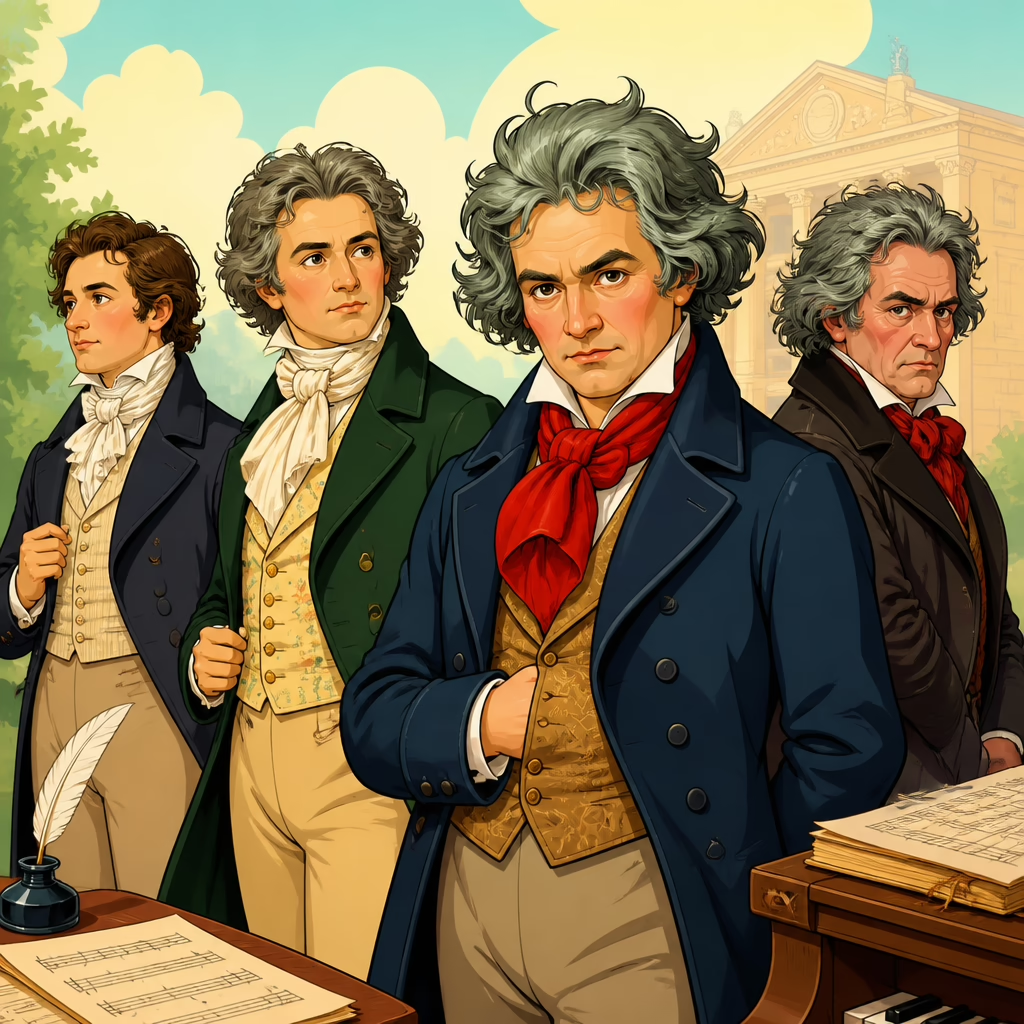
Beethoven’s Changing Fashion and Public Appearance
Ludwig van Beethoven’s changing fashion and public appearance reveal a great deal about his social ambitions, artistic identity, worsening health, and tense relationship with Viennese society. Clothing in late eighteenth- and early nineteenth-century Europe was never a trivial detail: coats, wigs, linen, boots, and grooming habits signaled rank, profession, solvency, and political sensibility. In Beethoven’s case, the record is unusually vivid because friends, patrons, copyists, servants, and later biographers all commented on how he looked. They noticed the broad forehead, dark complexion, restless movements, strong features, and especially the contrast between periods of deliberate elegance and moments of near-complete neglect. When people ask what Beethoven looked like, they are really asking several questions at once. How did he want to be seen? How did others read his appearance? And how did his outward presentation change as his circumstances changed?
These questions matter because Beethoven lived at a moment when the public image of the artist was shifting. The court servant in livery, the freelance virtuoso, and the autonomous genius all overlapped in his lifetime. I have worked through many of the anecdotal descriptions that survive from Vienna, Bonn, and later reminiscences, and a clear pattern emerges: Beethoven did not simply dress badly, as popular myth suggests. Early on, he cared about proper appearance, understood urban codes of dress, and used them strategically. Over time, however, hearing loss, physical discomfort, chaotic domestic habits, financial stress, and an increasingly inward creative life made consistency impossible. The result was the now-famous image of the unruly master with wild hair and ink-stained hands. That image contains truth, but only part of it.
To understand Beethoven’s changing fashion and public appearance, it helps to define terms precisely. “Fashion” here means the choices visible in garments, fabrics, cut, and grooming, not high style in a modern celebrity sense. “Public appearance” includes posture, movement, facial expression, manners in company, and the state in which he appeared on streets, in salons, concert halls, and while receiving visitors. The evidence comes from portraits, silhouette traditions, memoirs, conversation books from his later deaf years, police and residence records, and recollections by people such as Anton Schindler, Ferdinand Ries, Carl Czerny, and others. None of these sources is perfect; some are self-serving or romanticized. Yet when compared carefully, they trace an unmistakable evolution from disciplined young court musician to famously disordered cultural icon.
That evolution also helps explain why Beethoven’s face and body became so central to his legend. His appearance was read as evidence of character: proud, combative, intense, independent, and inaccessible. Even today, the standard Beethoven image is not built from one verified photograph, as with later figures, but from a cluster of painted and written impressions. Studying his appearance therefore does more than satisfy curiosity. It clarifies how biography, mythmaking, and social performance interacted around one of history’s most scrutinized composers.
From Bonn court musician to ambitious young professional
Beethoven’s earliest adult image was shaped in Bonn, where he served within an electoral court culture that still expected order and decorum. Musicians attached to courts did not have limitless freedom in dress. Even when not in formal livery, they were expected to appear respectable, clean, and appropriate to rank. Beethoven’s family background was unstable and financially pressured, but his professional environment taught him the visual grammar of advancement. He learned quickly that presentation affected access to teaching, patronage, and elite domestic music-making.
Descriptions from this period suggest that the young Beethoven could appear neat and even stylish when needed. He was not a dandy, but neither was he the caricature of permanent disorder. Hair was generally dressed according to current practice, linen mattered, and coats signaled seriousness. In the 1790s, after arriving in Vienna, he entered a city where musicians competed for patronage among aristocratic households intensely attentive to manners. A rising pianist and composer could not simply ignore appearance. Beethoven taught noble pupils, performed in private palaces, and cultivated supporters such as Prince Lichnowsky. To function in that world, he had to present himself as a man of education and promise rather than merely a rough provincial talent.
Portrait evidence from the 1790s and early 1800s supports this reading. The clothes are conventional, fitted, and respectable, in line with upper-middle-class and professional male dress of the period: tailored coat, waistcoat, cravat, and careful linen. His grooming in these images is controlled, even if the expression is already intense. Portraits are idealized, of course, but patrons did not commission likenesses that wholly contradicted social reality. They indicate that Beethoven could inhabit accepted forms of public respectability and understood their value.
The style codes of Vienna and Beethoven’s selective conformity
Vienna around 1800 was acutely sensitive to dress. Revolutionary politics, French influence, and changing class identities all affected men’s fashion. Brighter eighteenth-century courtly display was giving way to darker coats, cleaner lines, and a more restrained masculine ideal associated with seriousness and cultivation. In this setting, Beethoven’s clothing choices mattered because he moved between social worlds: aristocratic salons, publishers’ offices, rehearsal rooms, coffeehouses, and rented lodgings.
He conformed where it served him and resisted where it did not. Accounts repeatedly show that he could dress properly for dinners, lessons, and important visits, yet cared much less for elegance as an end in itself. He was sensitive to slights, proud of his artistic standing, and determined not to look servile. That helps explain a recurring feature of his public appearance: formality without deference. He might wear acceptable clothes, but his bearing could still seem abrupt, distracted, or confrontational. Witnesses often remembered not fabric first, but the force of his gaze and the impatience of his manner.
Real-world context sharpens this point. A piano virtuoso in Vienna needed to signal competence and distinction without appearing socially presumptuous. If he dressed too richly, he risked seeming ridiculous beside titled patrons. If he dressed too carelessly, he jeopardized trust and employability. Beethoven negotiated that narrow lane imperfectly but consciously. His changing appearance was not random eccentricity; it reflected a continual balancing act between patronage expectations and self-assertion.
Hair, face, and the making of an unforgettable image
No feature of Beethoven’s public appearance became more famous than his hair. Early depictions show a relatively ordered style consistent with the fading late eighteenth-century preference for managed appearance. As he aged, descriptions increasingly emphasize thickness, unruliness, and a refusal to stay arranged. This mattered because hair was highly legible in the period. A disordered head could imply neglect, temperament, illness, or bohemian independence. In Beethoven’s case, it came to symbolize all four.
His face also carried strong social meaning. Observers noted pockmarks, a ruddy or dark complexion, powerful jawline, and deep-set eyes. None of this matched polished aristocratic beauty, but it produced authority. Friends and strangers alike often described him as striking rather than handsome. The intensity of expression, especially when he was thinking musically or irritated, became inseparable from the legend. Some later writers exaggerated these traits to fit the “storm-tossed genius” narrative, yet the consistency across accounts suggests a real visual impact.
Body language completed the impression. Beethoven was known for abrupt movements, muttering, and a habit of seeming mentally elsewhere. In conversation, especially as hearing loss advanced, his face could tighten in concentration or suspicion. Public appearance is never just costume; it is motion, attention, and response. Beethoven’s external style grew more memorable as these behavioral signs increasingly overwhelmed the conventional respectability of his clothing.
What witnesses noticed at different stages
The strongest way to track Beethoven’s changing fashion and public appearance is to compare recurring eyewitness themes over time. Although individual descriptions vary, the broad pattern is stable.
| Period | Typical appearance | What observers emphasized | Likely causes |
|---|---|---|---|
| Bonn and early Vienna | Neat professional dress, controlled grooming | Promise, seriousness, social usability | Court training, ambition, active patronage building |
| Middle years | Respectable but inconsistent, less polished hair | Intensity, eccentric manners, growing distraction | Heavy work, hearing problems, stronger artistic independence |
| Late years | Often careless, stained or mismatched clothing, unruly hair | Neglect, isolation, force of personality, genius iconography | Deafness, illness, domestic disorder, inward focus, emotional strain |
This progression appears in memoir literature repeatedly. Ferdinand Ries, who knew Beethoven well, described habits that mixed dignity with carelessness. Carl Czerny remembered the penetrating look and the irregularity of outward polish. Visitors in the 1810s and 1820s frequently mention shabby coats, neglected shaving, and an air of complete absorption. The pattern does not mean Beethoven abandoned standards overnight. Rather, maintenance became episodic. He could still present himself adequately for a formal sitting or major social occasion, but ordinary daily appearance increasingly slipped beyond control.
For readers exploring how documentary evidence works in Beethoven studies, the broader biographical context is clarified well in the main guide at https://lvbeethoven.com/what-beethovens-birth-record-actually-tells-us/, which shows how carefully one must handle surviving records.
Hearing loss, health, and the decline of sartorial consistency
The single biggest factor in Beethoven’s changing public appearance was not taste but condition. Progressive hearing loss altered how he navigated rooms, conversations, rehearsals, and the street. People who cannot hear well often monitor social cues through visual concentration, guarded posture, and reduced spontaneity. In Beethoven’s case, this challenge combined with pain, gastrointestinal troubles, eye problems, and periods of severe emotional distress. Grooming requires routine, patience, and a stable domestic system. Beethoven often lacked all three.
Inevitably, hearing loss also damaged the feedback loop that helps people judge their own public presence. He could not easily catch side comments, soft corrections, or tonal shifts in company. That made social encounters more effortful and sometimes humiliating. Many witnesses interpreted his awkwardness as rudeness, but the mechanics of deafness were central. As his world narrowed, external finish became less rewarding. The labor went into composition, revision, legal disputes, and survival, not wardrobe coherence.
There were material factors too. Tailored clothing was expensive to maintain. Clean linen, brushing, mending, shoe care, and laundering depended on servants, money, and regular habits. Beethoven changed lodgings often and quarreled with housekeepers. Under such conditions, even a man who valued respectability could appear negligent. His late style was therefore partly psychological and partly logistical.
Servants, lodgings, and the practical mechanics of looking respectable
Modern readers sometimes imagine appearance as purely personal expression. In Beethoven’s Vienna, respectable appearance depended heavily on household management. Men of professional standing relied on laundresses, servants, boot cleaning, barbering, and orderly storage of garments. Beethoven was notoriously difficult domestically. He moved frequently, complained about noise and cooking, distrusted staff, and lived amid manuscripts, books, and personal disorder. This environment directly shaped what he looked like when stepping outside.
Evidence from the conversation books and reminiscences shows constant friction around practical details: meals, rooms, cleaning, errands, and clothing. A missing button, unbrushed coat, or crumpled cravat can sound minor, but repeated small failures create a recognizable public image. By the late years, visitors often encountered not a curated master but a man emerging from creative labor and household chaos. Ink stains, disarranged neckwear, and neglected hair were not symbolic choices prepared for posterity. They were the visible residue of an unmanaged daily life.
This is one reason portraits can mislead if taken alone. A formal painting captures how Beethoven wished to be represented, or how artist and patron agreed he should be represented. Eyewitness prose often captures the in-between reality of arrival, movement, and habit. Both matter, but the tension between them is especially revealing.
Portraits, mythmaking, and why the late image prevailed
The lasting public image of Beethoven comes above all from his later years: heavy features, untamed hair, stern expression, and clothes subordinated to intellectual force. Joseph Karl Stieler’s 1820 portrait crystallized this type with extraordinary power. It presents Beethoven in outdoor attire with manuscript in hand, the face concentrated and the hair animated by inner weather. The image is composed, but it feels truthful because it condenses countless verbal descriptions into one emblematic likeness.
Why did this image eclipse the better-groomed younger Beethoven? Because it fit nineteenth-century expectations of genius. Audiences wanted visible signs that greatness cost something. Disorder suggested authenticity, struggle, and independence from trivial society. A smooth, socially adaptable Beethoven was historically real, but less useful to legend. Biographers and publishers therefore repeated the later type until it became canonical.
That canon still needs correction. Beethoven’s changing fashion and public appearance were dynamic, not fixed. He was neither a lifelong sloven nor a polished gentleman ruined only by illness. He was a working musician who understood dress codes, used them when necessary, and gradually lost the capacity or willingness to sustain them. Seeing that progression restores a human scale to the icon.
Beethoven’s outward transformation tells a precise biographical story. In youth and early maturity, he dressed well enough to navigate patronage, teaching, and elite music culture. As success grew, so did his independence, and the need to please visually diminished. Then deafness, chronic illness, emotional strain, and domestic instability made consistency in grooming increasingly difficult. What remained constant was not negligence alone but intensity. Observers remembered the eyes, the hair, the abrupt motion, the sense of a mind working at full pressure. Clothes mattered, yet they became secondary to presence.
For anyone studying Beethoven closely, this subject is more than anecdotal color. It shows how social history, disability history, portraiture, and biography intersect in one highly visible life. His fashion choices and public appearance reflected status, labor, vulnerability, and self-conception at different moments. They also remind us to read evidence critically: portraits flatter, memoirs dramatize, and legends simplify. The truth lies in comparison across sources and over time.
The key takeaway is simple. Beethoven’s appearance changed because his life changed. Ambitious young professional, assertive independent artist, isolated deaf master: each phase produced a different outward style. If you want to understand the man behind the familiar image, follow the details of coat, hair, posture, and grooming alongside the music and the documents. They lead to a fuller, more credible Beethoven.
Frequently Asked Questions
Why does Beethoven’s clothing and appearance matter to historians?
Beethoven’s appearance matters because in his world dress was never merely decorative. In late eighteenth- and early nineteenth-century Europe, clothing functioned as a visible language of class, profession, discipline, creditworthiness, and even political attitude. A well-cut coat, clean linen, polished boots, properly tied neckcloth, and controlled hair all conveyed that a man understood social codes and could move competently within elite circles. For a composer who depended on aristocratic patronage, public reputation, and personal authority, these signals were especially important. Beethoven’s changing appearance therefore offers historians a practical way to trace how he wished to be seen, how others judged him, and how successfully he navigated the expectations of Viennese society.
His case is particularly revealing because so many contemporaries commented on him. Friends, patrons, servants, copyists, and visitors left descriptions that range from admiring to exasperated. These reports show that his dress and grooming shifted over time and that those shifts were interpreted as meaningful. At certain moments he appears as a man eager to establish himself respectably in the capital, attentive enough to presentation to support his ambitions. At other times he seems more disordered, resistant to convention, or simply less able to maintain outward regularity. Historians use these details not as gossip but as evidence. They help illuminate the tension between Beethoven’s desire for status, his self-conscious artistic individuality, his increasing physical difficulties, and his often strained relationship with the society around him.
How did Beethoven’s fashion change over the course of his life?
Beethoven’s style appears to have moved from relatively conventional respectability toward a more irregular and increasingly notorious appearance. As a younger man trying to establish himself beyond Bonn and then in Vienna, he had strong reasons to dress in a way that matched the expectations of patrons and cultivated society. Respectable coats, proper linen, suitable footwear, and a generally acceptable presentation would have helped him gain entry into salons, private performances, and aristocratic households. He was not a hereditary nobleman and did not possess independent wealth on the scale of his patrons, so appearance could serve as part of his social strategy. Looking competent and dignified was a way of reinforcing his authority as a serious musician rather than a mere servant-entertainer.
As the years passed, however, descriptions increasingly emphasize unkempt hair, careless dress, stained or wrinkled clothing, and a broader indifference to outward polish. This did not necessarily mean that he rejected fashion in a simple or theatrical way. Rather, his appearance seems to have reflected multiple pressures at once: his growing fame, his deepening confidence in his own artistic stature, his worsening deafness and health, and his declining patience with social ritual. By the middle and later periods of his life, the image of Beethoven as powerful, intense, and visibly disordered had become part of his public identity. What changed, then, was not just the cut of his garments but the social meaning of his appearance. He increasingly looked less like a man trying to fit seamlessly into elite Viennese decorum and more like a figure whose genius seemed to override ordinary expectations.
Did Beethoven use his appearance to shape his artistic identity?
Yes, although probably not always in a fully calculated or modern publicity-minded sense. Beethoven understood dignity, status, and impression very well. He was highly sensitive to rank, fiercely protective of his independence, and determined to be treated not as a household employee but as a creative equal, especially in relation to aristocratic patrons. Within that context, appearance could support his artistic identity by signaling seriousness and authority. Even when his dress was not immaculate, the broader presentation of Beethoven in portraits and recollections often emphasizes force, intensity, and inward concentration. His appearance contributed to an image of the composer as a figure set apart by mind and temperament.
At the same time, later generations have often read Beethoven’s roughened public appearance through the lens of Romantic genius: the untamed hair, the distracted manner, the disregard for superficial elegance. Some of that image was rooted in reality, but some was also shaped by retrospective mythmaking. Still, the myth took hold because it resonated with observable traits. Beethoven’s look seemed to embody a powerful new idea of the artist—not simply a skilled craftsman employed by society, but a commanding creative individual whose inner vision mattered more than polished manners. In that sense, his appearance helped bridge an important cultural transition. Whether by intention, temperament, or circumstance, he came to personify a model of artistic identity in which outward irregularity could be interpreted as evidence of intellectual and emotional depth.
How did Beethoven’s health and deafness affect his grooming and public presentation?
Beethoven’s worsening health and progressive deafness almost certainly affected the way he appeared in public. Deafness did more than limit hearing; it altered social interaction itself. Conversation became exhausting, embarrassing, and often alienating. A man who cannot hear properly may miss cues, withdraw from company, neglect rituals of polite sociability, and lose motivation to prepare for encounters that bring frustration rather than ease. For Beethoven, deafness was emotionally devastating and professionally threatening, even as his creative powers expanded. It likely contributed to a reduced willingness to participate in the finely regulated world of Viennese manners, where attentive conversation, responsiveness, and self-presentation mattered enormously.
There were also broader bodily and practical concerns. Beethoven suffered from recurring illness, digestive troubles, stress, and periods of obvious physical discomfort. Maintaining a carefully groomed appearance requires energy, routine, and a stable domestic environment, and he was not always strong in those areas. His lodgings changed frequently, his household life could be chaotic, and his temperament was often described as intense and difficult. In that setting, disordered clothing or grooming may reflect not only rebellion but fatigue, pain, distraction, and instability. Historians therefore avoid reducing his appearance to a romantic pose. His public presentation was shaped by real physical and psychological burdens. The more his health declined, the more his exterior could reveal the strain of living as a celebrated but suffering individual.
How did Viennese society respond to Beethoven’s changing appearance?
Viennese society responded with a mixture of admiration, tolerance, irritation, and fascination. Vienna was a city deeply attentive to rank and style, especially in circles where noble patronage, salon culture, and artistic display overlapped. In such an environment, neglect of dress and grooming could easily be read as disrespect, eccentricity, or social incompetence. Some contemporaries found Beethoven’s appearance embarrassing or exasperating, especially when measured against the polished standards expected in aristocratic settings. His manners and clothing could confirm for critics that he was difficult, unruly, or insufficiently adaptable to refined company.
Yet the response was never uniformly negative, because Beethoven’s talent altered the equation. His extraordinary musical stature inspired patrons and admirers to excuse behavior and appearance that would have damaged a lesser man. In fact, what might have appeared merely slovenly in another person could in Beethoven be interpreted as evidence of seriousness, absorption, or independence. His public image therefore existed in tension with Viennese convention. Society judged him by its standards, but it also made exceptions for him because his genius was undeniable. That tension is central to understanding his place in cultural history. Beethoven wanted recognition within elite society while resisting subordination to it, and his changing appearance vividly dramatized that struggle. He remained visible as both participant in and challenge to the social world that sustained him.