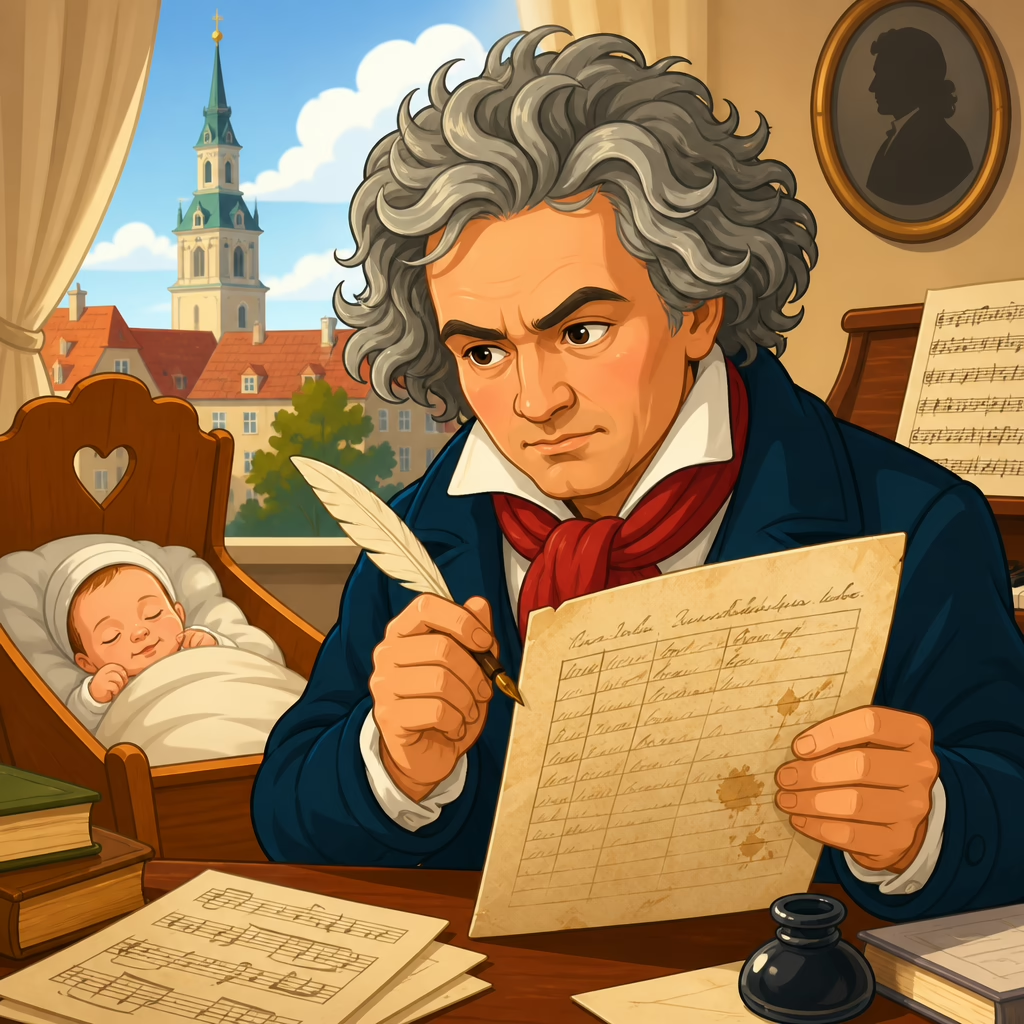
What Beethoven’s Birth Record Actually Tells Us
Ludwig van Beethoven’s birth record is one of the most cited documents in music history, yet it is also one of the most misunderstood, because the surviving entry does not record his birth at all; it records his baptism. That distinction matters. When readers search for proof of Beethoven’s birthday, they usually expect a neat civil certificate with a date, place, and time. Eighteenth-century Bonn did not work that way. In the Electorate of Cologne, as in much of Catholic Europe, parish registers were the routine official records for life events, and baptismal entries often stand in for birth evidence. If we want to understand what Beethoven’s birth record actually tells us, we have to read the document in its original legal, religious, and social context rather than forcing modern expectations onto an old source.
The specific record at the center of the debate appears in the baptism register of the parish of St. Remigius in Bonn. It notes that on 17 December 1770 a child named Ludovicus van Beethoven was baptized, the legitimate son of Johann van Beethoven and Maria Magdalena Keverich. The Latin wording is straightforward by church standards, but the implications are richer than they first appear. The record confirms the child’s existence on that date, identifies his parents, places the family within a Catholic parish structure, and anchors Beethoven’s earliest documented moment in a recognized community institution. It does not expressly state that he was born on 16 December 1770, but that has long been the most reasonable inference because infants in Catholic regions were commonly baptized very soon after birth, often within a day, partly from piety and partly from fear of early infant mortality.
This is why the document matters far beyond a trivia question about Beethoven’s birthday. Birth records, baptism records, civil certificates, and family registers are not interchangeable. A birth record usually records the event of birth; a baptism record records admission into the church through a sacrament. In biography, especially for figures born before modern civil registration systems became standard, researchers often rely on baptismal records as primary evidence for birth timing, parentage, residence, naming practices, and family networks. The Beethoven case is a textbook example of how a single archival line can support careful biography while also inviting myths when it is quoted loosely.
I have worked with parish registers and nineteenth-century musician biographies long enough to know that the hardest part is rarely locating a famous name. The harder task is resisting certainty where the source itself is narrower than later retellings suggest. With Beethoven, many popular accounts state that he was born on 16 December as though a clerk wrote that date directly into a birth ledger. No surviving contemporaneous record does that. The accepted date rests on an inference from the baptism entry, family custom, and the practical speed with which Catholic infants were usually baptized. That is strong historical reasoning, but it is still reasoning. Biography improves when we preserve that distinction.
The title “What Beethoven’s Birth Record Actually Tells Us” therefore points to a broader issue in biography as a discipline. Biographical writing depends on evidence types: letters, legal papers, school records, parish books, newspaper notices, property files, wills, and memoirs. Each source answers different questions and carries different risks. A baptism register is strong for names, dates of baptism, legitimacy formulas, and parish identity. It is weaker on exact birth timing unless the clerk explicitly included it, which this entry did not. Understanding those limits is not pedantic. It is how historians prevent tiny inaccuracies from turning into durable legend.
Beethoven is especially vulnerable to legend because his life sits at the intersection of genius, suffering, and national memory. Readers want beginnings that feel symbolic: a winter birth, a difficult household, an origin story that foreshadows greatness. The archival record is less theatrical and more useful. It gives us a child embedded in a real family, in a real confessional system, in a city tied to court culture and church administration. That context is the foundation of serious biography. Once we understand what the record says, what it implies, and what it leaves unsaid, we can use it properly to reconstruct Beethoven’s early life and to think more clearly about how biographers handle evidence.
A comprehensive look at Beethoven’s birth record also illuminates biography at a wider scale. Many historical figures born before the nineteenth century are known first through baptismal entries rather than modern birth certificates. The methods used to interpret Beethoven’s record apply just as well to writers, painters, rulers, and ordinary families whose traces survive in parish archives. This article explains the document itself, the historical setting of Bonn in 1770, the language and conventions of Catholic registers, the reasons historians infer a 16 December birth, the role of the record in Beethoven scholarship, and the larger lessons for biography as a field. It includes the practical question most readers are really asking: what can we say with confidence, and where should we remain cautious?
For readers interested in biography, that question is the real value of the topic. A good biography does not merely repeat inherited facts; it tests them against primary evidence, names its sources, and distinguishes direct proof from informed inference. Beethoven’s birth record rewards exactly that approach. It is a small document with large consequences, not because it solves every question, but because it shows how historians move from a sparse original source to a reliable account of a person’s life.
Table of Contents
1. The document itself: what survives in the parish register
2. Why a baptism entry is not the same as a birth certificate
3. What the St. Remigius record says about Beethoven’s family
4. Why historians infer a birth on 16 December 1770
5. Bonn in 1770: the local world behind the entry
6. How the record shaped Beethoven biography
7. What this case teaches about biography as a method
The Document Itself: What Survives in the Parish Register
The surviving source is the baptismal entry in the register of St. Remigius, the Catholic parish church in Bonn associated with Beethoven’s family at the time. In Latinized form, the child is listed as Ludovicus, the equivalent of Ludwig. The date attached to the sacramental act is 17 December 1770. The entry names the parents as Johann van Beethoven and Maria Magdalena Keverich, and it marks the child as legitimate. In parish record terms, that combination is highly valuable. It ties the child to a marital household, identifies the mother by her family name, and places the event within a specific administrative unit that can be checked against other records.
For historians, the first fact to establish is provenance. This is not a later family tradition or a memoir recollection written decades afterward. It is a contemporary church register maintained as part of regular parish administration. Records of this kind were created close to the event and for practical institutional reasons, which usually makes them stronger than retrospective anecdotes. At the same time, “strong source” does not mean “limitless source.” Parish clerks varied in precision. Some included the date of birth alongside the date of baptism. Others did not. Some named godparents in full. Others abbreviated. The Beethoven entry belongs to a common type: concise, functional, and sufficient for sacramental record keeping, but not expansive.
When I evaluate records like this, I focus on four immediate questions. What event is being recorded? Who created the record and under what routine? How close in time was it to the event? What standardized formulas might affect interpretation? In Beethoven’s case, the answer to the first question is decisive. The event recorded is baptism. The clerk was not trying to create a modern identity certificate. He was documenting a sacrament. That affects every downstream claim we make about it.
The record also survives because parish systems were durable bureaucracies. Catholic churches maintained registers not only for spiritual purposes but also for legal and social order. These books helped establish status, kinship, and rights in a world where confessional institutions carried administrative weight. When modern biographies cite the Beethoven entry, they are drawing on that archival stability. This is one reason church records remain indispensable in pre-modern and early modern biography. Without them, the first years of many lives would be almost invisible.
Why a Baptism Entry Is Not the Same as a Birth Certificate
A baptism record and a birth certificate overlap, but they are not equivalent documents. A birth certificate, in the modern sense, is usually generated by civil authority and centered on the event of birth itself: date, place, parentage, and often time. A baptism entry records a religious rite. Sometimes that rite happened on the day of birth, sometimes the next day, sometimes later. Sometimes the register notes both dates. Sometimes it records only one. The surviving Beethoven entry records one date, and that date is 17 December 1770, the date of baptism.
This distinction is fundamental in biography because readers routinely compress “first surviving record” into “birth certificate.” That shortcut creates false precision. If we say Beethoven’s birth record proves he was born on 16 December, we overstate the source. If we say the baptismal record dated 17 December strongly supports a birth on 16 December, we are much closer to the truth. The historical method is not weaker for making that distinction; it is stronger.
There are practical reasons baptisms often occurred quickly in Beethoven’s time. Infant mortality in eighteenth-century Europe was high. Clergy and families took seriously the religious urgency of baptizing a newborn. In Catholic teaching and everyday practice, delaying baptism without reason was uncommon, especially when a child’s health was uncertain. That is why next-day baptism is not a speculative modern guess. It reflects normal custom. Even so, custom is not the same as explicit notation, and careful biography keeps both ideas in view.
Biographers also have to consider survival bias in archives. Civil birth records for Beethoven’s era and region were not maintained in the modern way most readers imagine, so the church entry becomes the operative first record. That makes it central, but it does not magically transform its genre. Good biographical writing preserves the source type. Saying “Beethoven’s baptismal record” is more accurate than saying “Beethoven’s birth certificate,” and the wording matters because it tells readers how the evidence was generated.
| Question | What the record supports | What it does not prove by itself |
|---|---|---|
| Was a child named Ludwig van Beethoven connected to this family? | Yes. The entry identifies the child and parents. | It does not narrate the family’s later life. |
| Was the child baptized on 17 December 1770? | Yes. That is the recorded sacramental date. | It does not, by itself, give the exact time of baptism. |
| Was Beethoven born on 16 December 1770? | It strongly suggests this when read with local custom. | It does not explicitly state that birth date. |
| Does the record establish legitimacy and parentage? | Yes, within church register conventions. | It does not describe emotional family relations. |
What the St. Remigius Record Says About Beethoven’s Family
The entry matters not only for dating but for family identification. Johann van Beethoven, Ludwig’s father, was a musician associated with the electoral court in Bonn. Maria Magdalena Keverich, his mother, came from a respectable Catholic background and had been widowed before marrying Johann. The baptism entry situates Ludwig within that marital household and therefore within the social world that shaped his earliest years. In biographical work, that is not a minor detail. Parentage determines which other archives become relevant: marriage records, burial entries, court payrolls, residential traces, and kin networks.
The use of “legitimate” in such entries also deserves attention. In church registers, legitimacy was a formal status category, not a moral flourish. It meant the child was recognized as born within a lawful marriage according to ecclesiastical norms. That could affect inheritance assumptions, social standing, and the way later documents linked generations. For biographers, it helps stabilize the family structure early in the narrative.
The maternal surname Keverich is especially important because women’s identities are often harder to trace in older records. When a baptism entry preserves the mother’s family name, it allows historians to connect the child to maternal relatives and previous marriages. In Beethoven’s case, that matters because his mother’s life before this marriage forms part of the emotional and practical backdrop of the household. A spare entry can therefore open multiple paths of inquiry.
This is one reason I caution against reading parish records as dry administrative debris. They are compact, but they are dense with biography. A single line can establish family composition, confessional affiliation, likely neighborhood, and the documentary trail needed to reconstruct a person’s first environment. In Beethoven’s case, the baptism entry points toward a family rooted in court-connected musical labor yet vulnerable to domestic strain, financial instability, and the ordinary pressures of urban life. The document does not tell that whole story by itself, but it gives us the verified starting point from which the story can be responsibly built.
Why Historians Infer a Birth on 16 December 1770
The accepted birth date of 16 December 1770 rests on converging evidence rather than a single explicit statement. First, the baptism occurred on 17 December. Second, prompt baptism of newborns was standard Catholic practice in that place and period. Third, later celebration patterns within Beethoven’s lifetime and shortly after often aligned with the assumption that he had been born the previous day. None of these points alone would compel certainty, but together they make 16 December the historically preferred conclusion.
It is worth asking why the issue persists if the inference is so strong. The answer is that modern readers prefer exact dates, while historians work with probabilities grounded in source criticism. There is no surviving contemporaneous birth entry saying “born on 16 December.” That absence leaves room for caution. A child could be baptized the day of birth, or two days later, especially if circumstances intervened. Yet in Beethoven’s case, the one-day gap fits ordinary practice so neatly that most serious scholarship accepts it while acknowledging the basis of the conclusion.
The tendency to celebrate Beethoven’s birthday on 16 December has old roots, but even historical commemorations do not convert inference into direct documentary proof. Anniversaries can reflect tradition, family memory, or scholarly consensus rather than original notation. The responsible formulation is therefore simple: Beethoven was baptized on 17 December 1770, and he was almost certainly born on 16 December 1770. That sentence is both accurate and sufficiently precise for serious biography.
In my experience, this is exactly the kind of wording that improves biographical credibility. It gives readers a clear answer without pretending the archive says more than it does. That approach also scales beyond Beethoven. Many biographies gain authority when they say “likely,” “almost certainly,” or “attested by baptism on” in the right places. Precision is not only about exact dates. It is also about exact confidence.
Bonn in 1770: The Local World Behind the Entry
Understanding the record means understanding Bonn at the time of Beethoven’s infancy. Bonn was not yet the capital city modern tourists often imagine from later German history. In 1770 it was a court town within the Electorate of Cologne, shaped by ecclesiastical government, court employment, and Catholic institutions. That environment mattered directly to the Beethoven family. Johann van Beethoven worked within the orbit of court music, and that tied the household to a world of salaried service, rank, patronage, and instability familiar to many musicians of the period.
Parish records in such a setting were part of everyday governance. The church was not merely a place of worship but an administrative center through which life passages were documented. St. Remigius, the parish connected with Beethoven’s baptism, therefore functioned as a keeper of identity in practical as well as religious terms. If you want to write biography responsibly, local institutions like this are not background decoration. They determine what records exist, how they were phrased, and what social facts they encoded.
The speed of baptism also makes more sense in this urban Catholic context. Newborns were incorporated into sacramental life quickly, often with family and community witnesses. Godparent networks could reinforce social ties, and the register itself made the event legible to the parish. Although the surviving citation of Beethoven’s baptism is frequently reduced to one famous line, in reality it belongs to a dense matrix of entries for ordinary Bonn families navigating birth, illness, marriage, and death in a world where the church tracked the crucial thresholds of life.
This local frame also pushes back against the romantic habit of treating genius as detached from institutions. Beethoven did not emerge from abstraction. He entered history through routine paperwork in a parish book maintained by a clerk serving a confessional bureaucracy. That is not a reduction of greatness. It is a reminder that biography starts with ordinary mechanisms before it reaches extraordinary achievement.
How the Record Shaped Beethoven Biography
Once a figure becomes canonical, early documents acquire symbolic power. Beethoven’s baptism entry has done exactly that in scholarship, education, museum practice, anniversary culture, and popular reference works. It appears in biographies because it is the earliest secure anchor point in the chronology. It appears in exhibitions because it materializes the elusive beginning of a world-famous life. It appears in textbooks because it teaches students how historians date people born before modern civil registration. Few documents have carried so much interpretive weight from so little text.
That weight has consequences. One consequence is simplification. Reference summaries often flatten the distinction between baptism and birth because concise formats reward certainty. Another consequence is overcorrection. Some writers, eager to expose myth, imply that Beethoven’s birthday is unknown in any meaningful sense. That also goes too far. The evidence is not weak; it is simply indirect. Strong indirect evidence is common in historical biography and can support firm conclusions when handled transparently.
Major Beethoven scholars and editors have generally treated 16 December 1770 as the accepted birth date while identifying the baptismal register as the primary source. This is a sound practice because it pairs usable chronology with documentary honesty. The best biographical writing does exactly this: it states the consensus conclusion, names the surviving source, and explains the reasoning. Readers get both clarity and method.
The record also shaped how Beethoven’s childhood is narrated. Because the first firm document is ecclesiastical and familial, early biography often opens not with music but with household identity: parents, parish, and Bonn. That sequence is historically appropriate. Before Beethoven was a prodigy, he was a baptized infant in a Catholic court town. The birth record, properly understood, keeps that order intact and prevents retrospective legend from swallowing the documentary facts.
What This Case Teaches About Biography as a Method
Beethoven’s birth record is an ideal lesson in how biography should be built. First, start with the earliest surviving primary source, but identify its genre correctly. Second, distinguish between what the document states directly and what historians infer from context. Third, test the inference against broader social practice rather than against modern assumptions. Fourth, use the record as a gateway to connected archives instead of expecting one document to tell the whole story. Those four habits separate durable biography from decorative storytelling.
They also reveal why biography is not just a sequence of dates. A life is reconstructed from evidence with different degrees of certainty. Baptism registers can establish beginnings, but letters reveal personality, account books reveal pressure, legal disputes reveal conflict, and memoirs reveal self-fashioning, even when memoirs must be checked against harder records. In Beethoven’s case, the baptism entry is the foundation stone, not the completed building.
For researchers, students, and general readers, one practical takeaway stands out. When you encounter a clean biographical fact, ask what type of source supports it. Is it a church register, civil record, newspaper report, family recollection, or later encyclopedia entry? The answer changes how much confidence the claim deserves. Beethoven’s case is famous precisely because the answer is knowable and instructive. We can point to the exact category of record, explain its strengths, note its limits, and still arrive at a reliable conclusion.
This is also why biography remains such a powerful form of historical writing. It joins archival discipline with human narrative. A parish clerk entering a baptism in Bonn in 1770 could not have known that the child would become one of the central figures in Western music. Yet because that clerk followed institutional practice, later generations can recover the first secure coordinates of Beethoven’s life. Biography depends on such small acts of record keeping more than most readers realize.
The larger lesson is intellectual honesty. Historical lives become clearer, not weaker, when we acknowledge uncertainty at the right scale. Saying that Beethoven’s baptism is documented on 17 December 1770 and that he was almost certainly born the day before is not evasive. It is the exact form of confidence the sources justify. That is what Beethoven’s birth record actually tells us, and it is enough to ground a trustworthy beginning.
In the end, Beethoven’s birth record tells us something both specific and broadly useful. Specifically, it tells us that a child named Ludovicus van Beethoven, legitimate son of Johann van Beethoven and Maria Magdalena Keverich, was baptized at St. Remigius in Bonn on 17 December 1770. From that entry, read against the well-established baptismal customs of Catholic eighteenth-century Bonn, historians almost certainly place his birth on 16 December 1770. Broadly, the record teaches how biography works when direct evidence is limited but not absent: define the source accurately, infer cautiously, and connect a single document to the larger social world that produced it.
That method matters because biography is strongest when it is both readable and exact. Beethoven’s earliest surviving record does not give us a modern certificate, but it gives us something better for historical purposes: a contemporaneous, institutionally grounded trace that fixes his family, confession, place, and first documented appearance in the archive. Used carefully, it supports the accepted birthday, clarifies the boundaries of proof, and keeps legend from outrunning evidence.
If you write, study, or simply enjoy biography, use Beethoven’s case as a model. Ask what the document is, what it says, what it implies, and what it cannot prove on its own. That habit will make every life story you read more trustworthy. And if you are exploring Beethoven further, begin where historians do: with the baptismal register, then follow the records outward into the life.
Frequently Asked Questions
Does Beethoven’s birth record actually give his birth date?
No. The surviving document commonly called Beethoven’s “birth record” does not record his birth date at all; it records his baptism. That is the key fact readers often miss. In eighteenth-century Bonn, there was no modern civil birth certificate in the way people now expect, with a clearly labeled date of birth, hour, place, and official seal from a state registry office. Instead, parish registers were the main local record-keeping system for major life events, especially in Catholic territories such as the Electorate of Cologne. When Beethoven’s name appears in the register, it is because the church documented his baptism, not because a clerk was formally certifying the day he entered the world.
This matters because a baptism date and a birth date are related but not identical. The baptism entry gives historians a secure date for a religious ceremony, not direct proof of the exact day of birth. That distinction shapes how careful biographers phrase the issue. Rather than saying the document proves Beethoven was born on a certain day, it is more accurate to say the document proves he was baptized on a certain day and allows scholars to infer that he was probably born very shortly before that. For anyone trying to understand what the record “actually tells us,” this is the starting point: the document is real, valuable, and important, but it is often misdescribed.
Why do so many people say Beethoven was born on December 16 if the record is for his baptism?
The reason is historical inference, not explicit wording in the document. Beethoven’s baptism is recorded on December 17, 1770, and because infants in Catholic communities of that period were typically baptized very soon after birth, many scholars conclude that he was most likely born on December 16. That conclusion is reasonable and widely repeated, but it is still an inference rather than a statement written into the surviving parish entry. In other words, December 16 is the probable birth date, while December 17 is the documented baptism date.
Why was baptism usually so prompt? In eighteenth-century Catholic Europe, baptism was not treated as a casual ceremony to be postponed for convenience. It was an urgent sacrament, especially for newborns, because of religious concerns about infant mortality and the spiritual importance of baptism. Families commonly brought babies to the font within a day of birth, sometimes the same day, especially if the child’s health seemed uncertain. That custom is what makes the December 16 conclusion persuasive. Still, historians avoid turning probability into certainty unless the source itself says so. So when people confidently state that Beethoven was born on December 16, they are relying on a historically informed reconstruction built from the baptism date and period practice, not on a document that literally spells out “born December 16.”
What would Beethoven’s baptismal entry in Bonn typically include?
A parish baptismal entry from Beethoven’s time and place would usually be concise and formulaic by modern standards. Rather than offering a full biographical profile, it would generally note the date of baptism, the child’s name, the names of the parents, and often the names of the godparents or sponsors. These entries were created for ecclesiastical record-keeping, not for future biographers trying to reconstruct the exact circumstances of a famous composer’s arrival into the world. As a result, they often omit details modern readers instinctively look for, such as the precise birth time, a separately stated birth date, a street address, or any descriptive remarks about the child.
That difference in documentary culture is important. Today, people are used to state-issued certificates designed for legal identity. In Beethoven’s Bonn, parish registers served a different function. They anchored a person within a sacramental and family network, confirming that the child had been baptized in a particular church community. The record therefore tells us a great deal about the social and religious world into which Beethoven was born: that his family participated in the parish system, that the local church documented the rite, and that the event was recorded according to the conventions of the time. It tells us less than many modern readers hope in one sense, because it does not behave like a civil birth certificate, but it tells us a great deal in another, because it places Beethoven squarely inside the ordinary administrative life of eighteenth-century Catholic Bonn.
Why didn’t Bonn have a civil birth certificate for Beethoven?
Because that was not yet the standard administrative system in his region and era. Beethoven was born in 1770 in Bonn, then part of the Electorate of Cologne, a Catholic ecclesiastical territory within the Holy Roman Empire. In many parts of Europe at that time, parish churches functioned as the primary institutions for recording baptisms, marriages, and burials. Modern civil registration systems developed unevenly and often later, depending on the state and period. So the absence of a neat government-issued birth certificate is not unusual at all; it is exactly what historians would expect for a child born in that setting.
This is one of the biggest sources of misunderstanding in popular writing. People often approach the eighteenth century with modern documentary expectations and assume that if someone important was born, there must be a dedicated birth record somewhere waiting to be found. But record-keeping practices were shaped by local law, religion, and administrative custom. In Beethoven’s case, the parish register is not a poor substitute for a “real” record. It is the real record in the sense that it is the authentic contemporary entry the community created for such events. Understanding that helps readers avoid anachronism. The issue is not that Beethoven’s birth was oddly undocumented; it is that the kind of documentation people now expect did not yet function in Bonn the way it does today.
So what can historians say with confidence about Beethoven’s early record—and what remains uncertain?
Historians can say with confidence that Ludwig van Beethoven was baptized in Bonn on December 17, 1770, because that is what the surviving parish record documents. They can also say that this register entry is one of the foundational contemporary records for establishing the basic chronology of his early life. Beyond that, they can speak with strong probability, though not absolute documentary certainty, about his birth date. Given Catholic practice in the region and period, it is highly likely that he was born on December 16, the day before the baptism. That date has long been accepted by many scholars for precisely that reason.
What remains uncertain is the exact level of precision modern readers often want. The surviving baptismal entry does not independently verify the hour of birth, and it does not itself state “born on December 16.” Unless some additional contemporary document were discovered that explicitly recorded the birth date, historians must continue to distinguish between what is directly attested and what is carefully inferred. That is not a weakness in historical method; it is actually a sign of good scholarship. Responsible historians do not flatten the difference between evidence and conclusion. In Beethoven’s case, the record tells us enough to be highly confident about the general timeline, but it also reminds us that even the most famous lives can begin in documents that are modest, practical, and easy to misread if we impose modern assumptions on them.