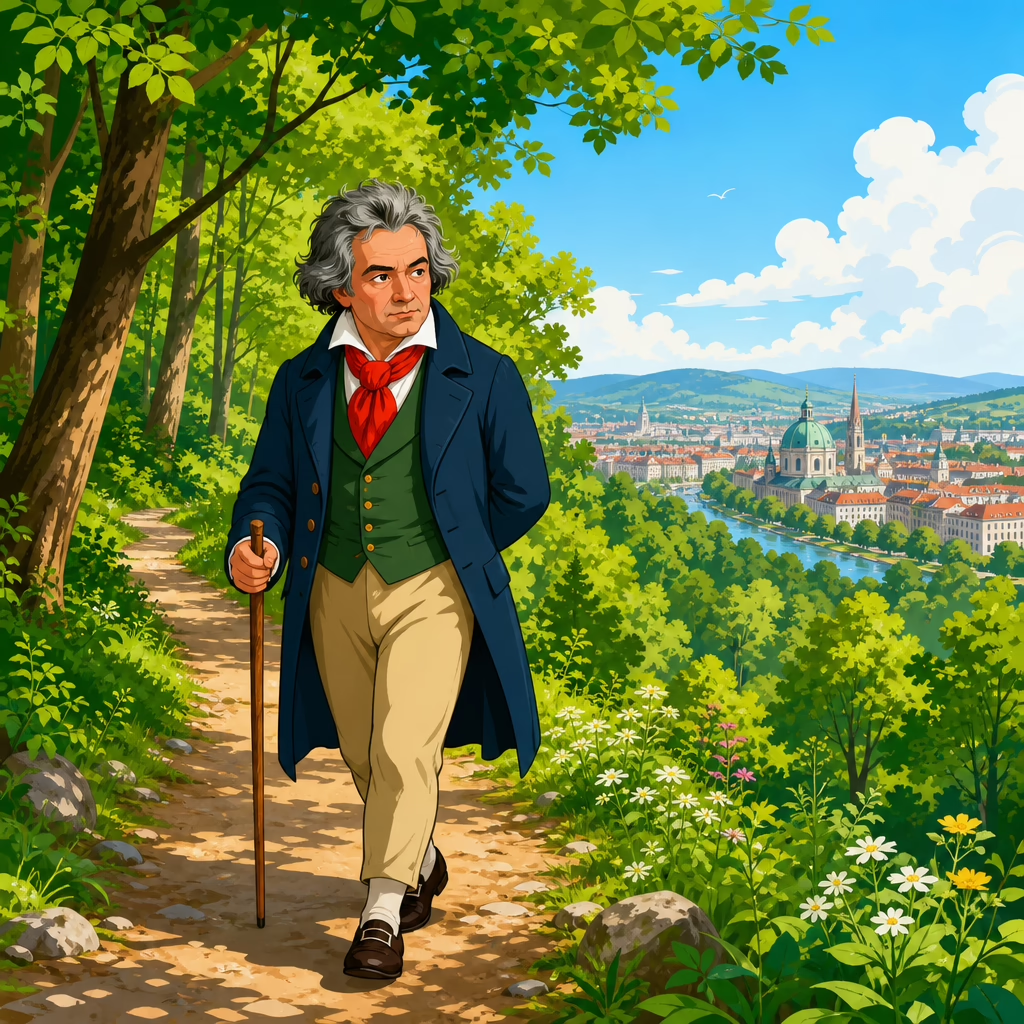
Vienna Woods and Beethoven’s Walking Routes
Vienna Woods and Beethoven’s walking routes belong together because the composer did not treat nature as scenery; he used it as a working environment, a refuge from urban noise, and a moving studio where rhythm, memory, and observation fused into musical thought. In discussions of Beethoven and nature, the Vienna Woods usually refers to the forested hills and meadows on Vienna’s western edge, stretching through villages such as Heiligenstadt, Döbling, Grinzing, Nussdorf, Mödling, Baden, and the wooded approaches toward the Wienerwald proper. Beethoven’s walking routes were not one fixed trail but a network of habitual paths linking summer lodgings, vineyards, creek beds, spa towns, and upland lookouts. They matter because these routes explain how a composer with worsening hearing continued to think physically: by pacing, climbing, pausing, sketching, and listening inwardly while surrounded by streams, birdsong, wind, and the irregular pulse of rural paths.
I have walked many of these areas with period maps, modern transit guides, and Beethoven’s letters in hand, and the geography changes how the music reads. Distances that seem small on a map become meaningful when you feel the incline from Heiligenstadt into the vineyards or the longer wooded transitions toward Baden. Beethoven chose places where he could leave the city quickly yet find enough seclusion to work. Contemporary accounts describe him striding with notebook in pocket, often inattentive to social niceties, fully occupied by musical ideas. His surviving sketchbooks confirm that walking and composition were linked habits, not romantic legend. The Vienna Woods were practical as much as poetic: they offered clean air, affordable seasonal lodging, and routes that could be repeated until the body itself became a metronome for invention.
The geography of Beethoven’s Vienna Woods
For Beethoven, the Vienna Woods were less a single forest than an accessible ring of landscapes just beyond the dense core of imperial Vienna. He moved repeatedly among districts and villages that are now absorbed into the city, but in his time they offered a semi-rural edge: orchards, vineyards, chestnut groves, springs, and rough tracks climbing into cooler elevations. The northern zone around Heiligenstadt, Grinzing, and Döbling was especially important in the early 1800s. Southward, places such as Mödling and Baden gave him broader valley views, spa infrastructure, and longer excursions. These locations combined three advantages Beethoven consistently sought: temporary escape from social pressure, enough proximity for patrons and publishers to reach him, and varied terrain suitable for sustained solitary walks.
The topography mattered musically. Gentle vineyard lanes encourage an even tread; wooded ascents break that regularity with sudden turns, steeper effort, and moments of suspension at overlooks. Anyone studying Beethoven’s middle-period expansiveness should notice this alternation between propulsion and release. I do not mean that one path “caused” one passage, which would oversimplify creative process. Rather, the landscapes supported a habitual bodily rhythm that matched how he developed motifs. Repetition with variation is what a walker experiences: each route is familiar, yet light, season, weather, and physical energy alter the return. Beethoven’s routes around the Vienna Woods gave him that structure daily, and his music often mirrors exactly that tension between recurrence and transformation.
Heiligenstadt, Döbling, and the northern routes
Heiligenstadt holds a central place in any account of Beethoven’s walking life because it combined medical hope, emotional crisis, and direct access to restorative terrain. In 1802, while staying there on doctors’ advice, Beethoven wrote the document now known as the Heiligenstadt Testament, addressing his brothers and confronting the despair brought on by hearing loss. The village sat close to vineyards and rising wooded paths, allowing him to leave habitation within minutes. From there he could move toward Grinzing and Nussdorf, follow lanes between walls of vines, or climb to wider views over the Danube plain. These were not grand wilderness expeditions. They were repeatable working walks, exactly the kind a composer could fit around meals, lessons, copying, and correspondence.
Accounts from friends and visitors make clear that Beethoven preferred energetic, often lengthy outings and was capable of vanishing for hours. Anton Schindler’s reliability is mixed and must be treated cautiously, yet even when his embellishments are discounted, other evidence supports the core image of Beethoven roaming the outskirts with a sketchbook. In practice, the northern routes offered useful variety. Lower paths through cultivated land let him pace steadily while forming ideas; higher wooded sections provided withdrawal from conversation and traffic. The alternation between enclosed lane and sudden panoramic opening remains striking today. It helps explain why these routes became habitual. For Beethoven, a good walk was not passive relaxation. It was a sequence of changing acoustic and visual conditions that kept the mind alert while freeing it from indoor constraints.
What Beethoven actually did while walking
Beethoven’s walks were compositional labor. He carried small notebooks, jotted motifs, and then reworked them extensively indoors in larger sketchbooks. That distinction matters. The route supplied raw material, but not finished music. A melodic cell, rhythmic profile, harmonic turn, or structural idea could occur during motion because walking stabilizes attention without fixing it narrowly on one task. Modern cognitive research often calls this a state of diffuse focus; Beethoven practiced it instinctively. He would test an idea through repetition in memory, sometimes stopping abruptly, singing or growling fragments, and then writing enough to preserve the thought until he returned to his desk.
His contemporaries frequently noticed the physicality of this process. He gestured, stamped, counted, and seemed oblivious to onlookers. That behavior makes sense when one remembers his hearing impairment. As external hearing deteriorated, internal audition became more dominant, and bodily movement likely helped him register pulse and form. Walking also solved a practical problem familiar to anyone who has composed or written seriously: ideas arrive unevenly at a desk, but they often cohere once the body enters a steady cadence. Beethoven’s routes through the Vienna Woods provided repeatable conditions for that cadence. The path itself became part of the workflow, just as paper type, piano action, and room acoustics were part of it indoors.
| Route area | Likely purpose | What the terrain offered |
|---|---|---|
| Heiligenstadt–Grinzing | Short daily composition walks | Vineyard lanes, moderate climbs, quick access from lodging |
| Döbling–Nussdorf | Reflective pacing and idea testing | Alternation of settlement edge and open views |
| Mödling surroundings | Longer excursions during summer stays | Valleys, wooded paths, more pronounced elevation changes |
| Baden and nearby hills | Health-oriented retreats with work | Spa culture, forest margins, broader rural circuits |
Mödling, Baden, and the southern circuits
If the northern villages gave Beethoven convenience, the southern circuits around Mödling and Baden gave him depth of retreat. He stayed in both areas at different times, especially in summer, when Vienna’s heat and social demands could become oppressive. Baden, famous for its mineral springs, attracted many seasonal residents, yet Beethoven could still find routes leading quickly into quieter ground. The surrounding hills and woods offered longer gradients and more varied day walks than the immediate northern outskirts. In Mödling, ravines, ridges, and castle ruins created a more dramatic terrain than the vineyard belt near Heiligenstadt. This mattered to a composer whose imagination often expanded through contrast rather than simple pastoral calm.
These southern routes also fit Beethoven’s practical health concerns. He sought fresh air and relief from the stress linked to deafness, digestive trouble, and chronic irritability. Walking was one of the few therapies he controlled himself. Doctors in the era commonly recommended rural air, bathing, and moderate exercise, but Beethoven rarely did anything moderately. He walked hard. Friends complained about the speed. Servants had trouble keeping up. Yet that intensity was functional: it pushed him into concentration. When listening to works associated with these years, especially those with broad dynamic spaces and sudden textural clearing, one should remember that Beethoven was not imagining nature from a salon. He was inhabiting landscapes where effort, breath, weather, and distance constantly reset his attention.
How the routes illuminate the music
It is tempting to force direct one-to-one links between a specific trail and a specific composition, but the evidence is stronger when framed more carefully. Beethoven’s walking routes did not produce a literal soundtrack of birds and brooks, except in rare, explicitly programmatic cases. Instead, the Vienna Woods shaped process, proportion, and sensibility. The most famous example is the Sixth Symphony, the “Pastoral,” completed in 1808. Beethoven himself distinguished it as “more the expression of feeling than painting,” which is exactly how these routes functioned in his creative life. They supplied recurring emotional and sensory conditions: spaciousness, patterned motion, interruption, shelter, exposure, and the awareness of natural cycles beyond urban schedules.
The same logic can illuminate piano sonatas, string quartets, and sketchbook habits without claiming simplistic cause. Long walks encourage large-form thinking because they unfold in time across sections: departure, ascent, plateau, turn, return. Beethoven’s mature works often move that way. A motif is set out, tested under pressure, redirected, and finally brought home altered by the journey. That is not accidental rhetoric. It is consistent with the bodily experience of route-based thought. For readers wanting the wider context of this habit within his creative life, the main guide at Beethoven’s love of walking and what it meant for his music provides the broader frame, but the Vienna Woods remain the most concrete setting in which that relationship can be traced on the ground.
Following Beethoven’s paths today
Modern visitors can still recover much of the logic behind Beethoven’s walking routes, even though nineteenth-century rural edges are now crossed by streets, tramlines, and suburbs. Start with Heiligenstadt if your goal is orientation. The district preserves the essential relationship between settlement and rising landscape. From there, moving toward Grinzing reveals how quickly Beethoven could exchange urban life for vineyards and higher air. In Baden and Mödling, the surviving green corridors make the scale of his excursions easier to grasp. You do not need an exact authenticated path for every step; in fact, no scholar can provide that. What matters is understanding the patterned geography of his summers: lodgings positioned near immediate exits into nature, then routes long enough to sustain serious solitary thought.
When walking these areas now, the best method is to combine documentary caution with sensory attention. Read letters, check residence dates, study local topography, and then walk at an unhurried pace long enough to notice transitions in gradient, enclosure, and sound. That approach avoids myth while preserving insight. The Vienna Woods were neither an abstract symbol nor a decorative backdrop in Beethoven’s life. They were a dependable compositional environment that joined health, habit, and imagination. To understand Beethoven’s music more concretely, follow the routes he likely followed: out of crowded Vienna, into vineyards and woods, through repeating circuits where physical motion sharpened thought. Those paths still teach the essential lesson they taught him—that artistic clarity often arrives not in stillness, but in movement. Walk them, and the connection becomes immediately, physically believable.
Frequently Asked Questions
Why are the Vienna Woods so closely associated with Beethoven’s walking routes?
The Vienna Woods and Beethoven’s walking routes are closely linked because walking in these landscapes was not a casual pastime for him; it was part of how he lived, thought, and worked. The wooded hills, vineyard paths, meadows, and village roads on Vienna’s western edge offered him a setting where composition could continue away from the demands and noise of the city. Rather than treating nature as a picturesque backdrop, Beethoven used it as an active creative environment. He walked to clear his mind, test musical ideas internally, and absorb patterns of movement, weather, silence, and rural sound that could feed his imagination.
This connection is especially strong in places such as Heiligenstadt, Döbling, Grinzing, Nussdorf, Mödling, and Baden, all of which appear in the broader geography of Beethoven’s life around Vienna. These were not remote wildernesses but reachable edges of the city where cultivated land, forest, and village life met. That in-between quality mattered. It gave Beethoven a practical refuge: close enough to Vienna’s musical world, but far enough from its social pressures to support concentration and emotional release.
For that reason, modern interest in Beethoven’s walking routes is really interest in his creative habits. People are not only asking where he went; they are asking how movement through the Vienna Woods shaped the way he listened, remembered, and composed. The enduring association exists because these routes help explain Beethoven not just as a genius at a desk, but as a thinker in motion whose music was formed in dialogue with landscape.
Which places in the Vienna Woods are most important when tracing Beethoven’s walking paths?
Several places stand out as especially important when tracing Beethoven’s connection to the Vienna Woods. Heiligenstadt is often at the center of that discussion because it is deeply tied to his biography and emotional history. It was there, in 1802, that he wrote the document known as the Heiligenstadt Testament, revealing his despair over increasing deafness and his determination to continue living through art. The surrounding terrain therefore carries more than scenic interest; it is part of the setting of one of the most significant turning points in his life.
Döbling, Grinzing, and Nussdorf are also important because they formed part of the rural and semi-rural fringe Beethoven frequented during his stays outside central Vienna. These areas offered access to vineyard lanes, rising paths toward wooded heights, and quieter roads where long walks were possible. They represent the kind of environment Beethoven repeatedly sought: places where village life and open landscape overlapped, giving him room to think while still remaining connected to the cultural orbit of Vienna.
Farther south, Mödling and Baden are equally meaningful. Beethoven spent time in Baden on multiple occasions, and the town became one of the best-known locations associated with his summer working routine. Walks in and around Baden connected him to streams, wooded hills, and the broader spa-town environment that drew many Viennese visitors while still allowing pockets of solitude. Mödling, too, belongs to the wider map of Beethoven’s natural surroundings, with trails and scenic terrain that reflect the sort of countryside he valued.
When people speak of “Beethoven’s walking routes,” they usually mean this network rather than one single preserved trail. The most important places are those where documentary evidence, local memory, and landscape character come together to show how Beethoven used the Vienna Woods as an extension of his creative life.
How did walking in nature influence Beethoven’s music and creative process?
Walking influenced Beethoven’s music by giving him a physical rhythm within which musical thought could develop. He was known for carrying sketchbooks, and while not every idea originated outdoors, the act of moving through fields, forest paths, and village roads clearly supported his compositional process. Walking helped him sustain concentration over time. It allowed fragments of melody, harmony, and structure to be tested mentally, revised in memory, and later captured in written form. For a composer with an intensely active inner hearing, this moving solitude could function like a workshop without walls.
Nature also gave Beethoven a specific kind of sensory world. In the Vienna Woods, he encountered wind, birdsong, changing light, distant bells, uneven terrain, flowing water, and the alternation between enclosure and openness. These were not necessarily copied literally into music, but they shaped his imagination. His response to nature was often structural and emotional rather than merely descriptive. In other words, it is less useful to think that he was “imitating” the woods than to understand that he was absorbing natural processes—growth, contrast, repetition, interruption, calm, force—and transforming them into musical logic.
This is one reason the topic is often linked to works such as the “Pastoral” Symphony, though the influence extends beyond any single composition. Beethoven himself distinguished between simple depiction and deeper feeling, suggesting that nature in music could express emotional experience rather than only external sound. Walking gave him access to that experience. It created the conditions in which observation, memory, and inward listening could merge. In that sense, the Vienna Woods were not just inspiring scenery; they were part of the method by which Beethoven converted life into form.
Can visitors today follow authentic Beethoven walking routes in the Vienna Woods?
Visitors today can certainly explore landscapes strongly associated with Beethoven, but it is important to be precise about what “authentic” means. In most cases, there is no single continuous route preserved exactly as Beethoven walked it, complete with guaranteed turns and exact timing. Roads have shifted, villages have expanded, and the urban edge of Vienna has changed dramatically since the early nineteenth century. So anyone claiming to offer one perfectly verified Beethoven trail is simplifying a much more complex historical reality.
What visitors can do, however, is follow historically plausible routes and visit places with well-established ties to his life. Areas around Heiligenstadt, Grinzing, Nussdorf, Baden, and nearby wooded paths preserve enough of their older topography and atmosphere to give a meaningful sense of the environments Beethoven knew. Some local walking paths, memorial markers, museums, and Beethoven houses help interpret these connections. These resources can be valuable, especially when they place the walks within the context of his summer lodgings, working habits, and documented stays.
The best approach is to think of the experience as interpretive rather than perfectly reconstructive. A walk becomes most rewarding when visitors understand why Beethoven sought these landscapes: for quiet, motion, distance from the city, and creative freedom. If you walk with that in mind, the route is not just about retracing footsteps. It becomes a way of reading the countryside as Beethoven may have read it—as a space for thought, resilience, and artistic labor.
What should travelers know before exploring Beethoven-related routes in the Vienna Woods?
Travelers should know first that Beethoven-related routes in the Vienna Woods are best appreciated with both historical curiosity and realistic expectations. This is not a theme-park experience with a single official path and neatly packaged narrative. It is a network of places where biography, music history, and landscape overlap. Reading a little about Beethoven’s stays in Heiligenstadt or Baden before visiting can make the experience much richer, because the paths gain meaning when tied to his personal struggles, working habits, and evolving musical style.
It is also useful to plan according to the kind of experience you want. If your goal is biography, focus on houses, memorial sites, and villages associated with documented stays. If your goal is landscape, choose routes that move from vineyards into wooded hills and open viewpoints, since those transitions capture much of what made the Vienna Woods distinctive. Many visitors find that combining the two works best: a museum or Beethoven residence for context, followed by a walk that lets the setting speak for itself.
Practical preparation matters as well. Wear suitable walking shoes, check seasonal conditions, and allow time to move slowly rather than rushing between points. Some of the most meaningful aspects of these routes are atmospheric: the contour of the path, the quiet between villages, the sense of distance from urban noise, and the relationship between cultivated land and forest. Those qualities are easy to miss if the visit is treated only as sightseeing.
Finally, travelers should remember that the real value of these walks lies in understanding Beethoven as an artist who thought with his whole body in motion. Exploring the Vienna Woods with that perspective transforms the visit from a simple historical excursion into a more intimate encounter with the environments that supported one of music history’s most powerful creative minds.