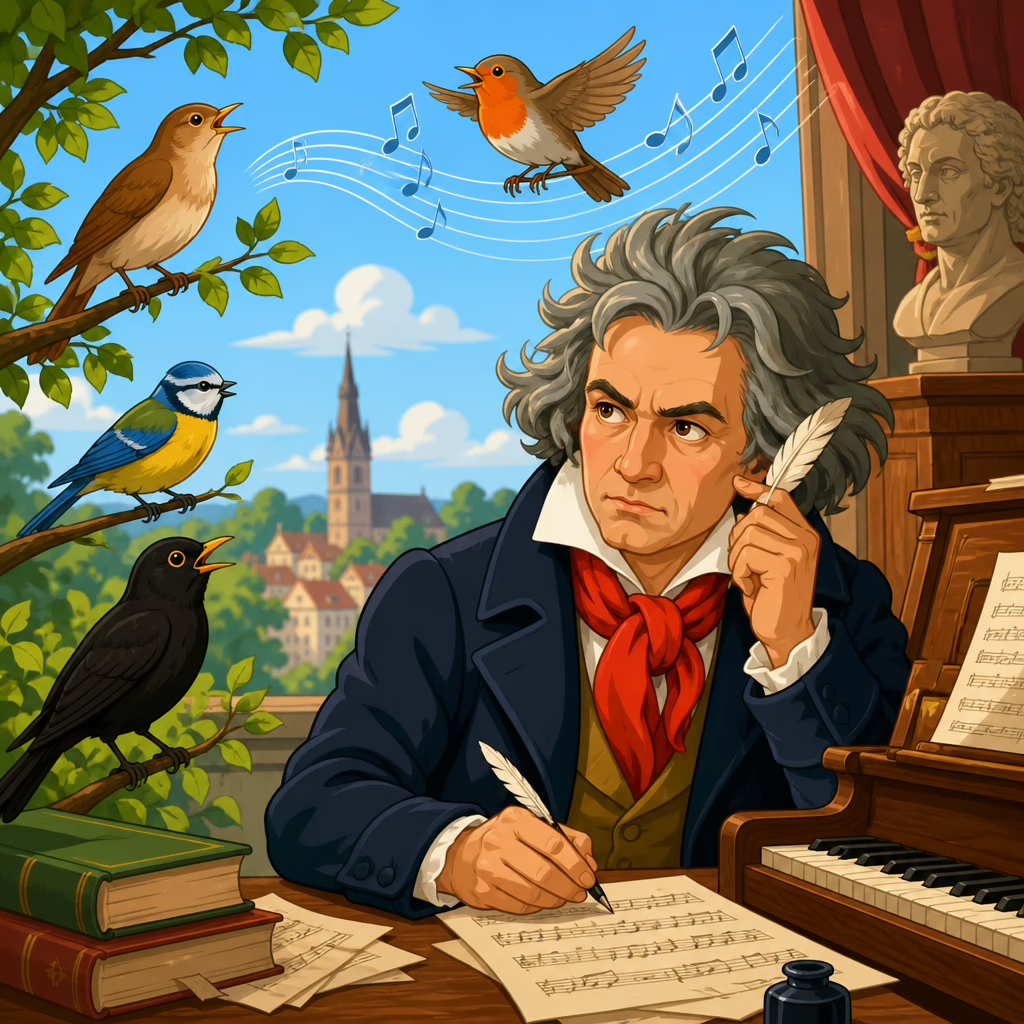
Birdsong in Beethoven: Myth and Musical Reality
Birdsong in Beethoven sits at the intersection of literary myth, compositional craft, and the stubborn human desire to hear nature speaking directly through great art. The phrase usually points first to the “Pastoral” Symphony, yet it also gathers a wider set of assumptions: that Beethoven roamed the countryside with a notebook, that he transcribed actual bird calls into melody, and that his music offers a simple acoustic window onto woods, brooks, and open fields. Some of that story is true. Some of it is sentimental overreach added by later listeners who wanted Beethoven to sound more picturesque than he intended. To understand the musical reality, it helps to separate three related ideas. Birdsong can mean literal imitation of avian calls. It can mean broader nature evocation through rhythm, texture, and timbre. And it can mean the symbolic use of birds as signs of freedom, distance, memory, or divine order. In Beethoven, these meanings overlap, but they are not interchangeable.
The question matters because Beethoven is often misread at both extremes. One camp reduces the relevant passages to charming sound effects, as if the composer were merely decorating a scene with chirps. The other dismisses any representational element and insists that the music is purely abstract. In practice, Beethoven occupied a middle ground. He used referential signals with unusual precision while subordinating them to large-scale form, motivic coherence, and expressive argument. I have found that performers, students, and attentive listeners hear the “Pastoral” more clearly once they stop asking whether the notes are authentic bird transcriptions and start asking how Beethoven converts observed nature into musical structure. His own famous note on the symphony points the way: it is “more the expression of feeling than painting.” That sentence does not reject depiction. It ranks it. Birdsong is present, but its artistic purpose lies in how it frames human response to nature, not in documentary fidelity.
The historical Beethoven was deeply attached to walking in rural surroundings, especially around Vienna’s outskirts, and contemporaries repeatedly described his habit of carrying sketch materials outdoors. That biographical reality encourages a tempting image of the composer notating nightingales in real time. Yet surviving sketches show something more complex than field recording. Beethoven gathered fragments, tested intervals, altered rhythms, and fitted details into a symphonic plan. He listened intently, but he composed selectively. This distinction is essential for anyone studying birdsong in Beethoven: the music is rooted in lived sensory experience, then transformed by craft.
The Pastoral Symphony and the Famous Bird Calls
The most explicit birdsong in Beethoven appears near the end of the second movement of Symphony No. 6 in F major, Op. 68, the “Scene by the Brook.” Here Beethoven does something exceptionally rare for him: he labels specific birds in the score. The flute is marked “Nachtigall,” or nightingale. The oboe is “Wachtel,” the quail. The clarinet is “Kuckuck,” the cuckoo. Because the instruments are named so directly, listeners often assume the entire movement is a sequence of naturalistic imitations. It is not. The bird calls arrive as a local event within a much broader musical landscape built from murmuring accompaniment, sustained harmonic calm, and gently turning melodic cells that suggest continuous flow.
Those notated birds are musically economical. The cuckoo is the clearest case, reduced to its characteristic descending interval, conventionally a falling third. Beethoven did not invent that device; the cuckoo call had long been represented this way in European music. The nightingale and quail are handled less as scientific reproductions than as recognizable types. The nightingale’s flute figuration is agile and ornamental, associated with lyrical fluidity rather than exact ornithological profile. The quail’s oboe call is rhythmically pointed and more repetitive. In performance, the passage works because Beethoven balances recognition with integration. The birds do not interrupt the movement’s logic; they emerge from it.
This is where myth often distorts reception. Program notes sometimes imply that Beethoven is simply reporting what he heard by a stream. But the passage is highly arranged. Instrument choice matters. Register matters. Timing matters. The scene closes with these calls because Beethoven needs a moment of focused recollection before the peasant gathering and thunderstorm that follow. In other words, the birds function dramaturgically. They sharpen the listener’s sense of place, then prepare a transition. They are compositional agents, not ambient wallpaper.
For readers interested in the broader context of Beethoven’s outdoor habits and their artistic importance, the main guide at https://lvbeethoven.com/beethovens-love-of-walking-and-what-it-meant-for-his-music/ provides useful background. Within the narrower question of birdsong, that context helps explain why the “Pastoral” sounds observed rather than generic. Beethoven knew the experiential rhythm of walking, pausing, listening, and remembering. What the symphony preserves is less a sonic snapshot than a sequence of states of attention.
Myth Versus Evidence: Did Beethoven Transcribe Real Birds?
The strongest version of the myth says Beethoven copied bird calls directly into his music. The evidence does not support that claim in any strict sense. Unlike later composers and researchers who attempted systematic notation of birdsong, Beethoven left no body of field studies comparable to ornithological transcription. His sketches reveal a working composer shaping motives, not a natural scientist cataloging species. Even in the “Scene by the Brook,” the musical signs are stylized enough that they belong first to convention and instrumental character, second to observed sound.
That does not mean the passage is artificial. On the contrary, its persuasiveness comes from selective truth. Anyone who has stood near water in the countryside knows that one seldom hears isolated, laboratory-pure calls. Perception blends repetition, distance, resonance, and movement. Beethoven captures that perceptual reality by embedding brief call-types within a continuous texture. The result feels authentic because it models human hearing in nature, not because it offers exact acoustic data.
There is also a practical reason literal transcription would have been beside the point. Birdsong is rhythmically irregular, microtonally unstable, and timbrally complex in ways that early nineteenth-century notation and orchestral instruments cannot reproduce directly. Beethoven understood the limits of his medium. He therefore translated rather than copied. Composers still do this today when writing nature-inspired music for standard ensembles: they use contour, interval, articulation, and orchestration to suggest the source while remaining idiomatic for players.
From a historian’s perspective, the safest conclusion is precise. Beethoven listened closely to birds and other natural sounds. He occasionally invoked them explicitly. But he treated those sounds as materials for imaginative reconstruction. That distinction preserves both his sincerity and his sophistication.
How Beethoven Turns Birdsong Into Musical Structure
The deepest musical reality is that birdsong in Beethoven matters less as imitation than as structural energy. In the “Pastoral,” brook murmurs are sustained by repeated accompanimental figures that create continuity over long spans. Bird-like motives appear as points of articulation within that continuity. This relation between background flow and foreground call mirrors actual listening outdoors, where a stable environment supports fleeting sonic events. Beethoven’s genius lies in making that perceptual model serve symphonic form.
He also uses meter and phrase length to avoid mechanical picture painting. Literal imitation tends to fragment musical time, because real birds do not sing in tidy four-bar phrases. Beethoven solves the problem by allowing suggestive irregularities inside a larger, intelligible pulse. The listener gets freshness without losing orientation. I have seen conductors improve the second movement dramatically by resisting overemphasis on the labeled birds and instead shaping the long line. When the stream keeps moving, the calls sound like part of a living ecology.
Harmony plays an equally important role. The pastoral atmosphere depends on prolonged stability, diatonic clarity, and carefully managed tension. Bird figures are effective because they arise against that calm harmonic field. If the underlying music were harmonically restless, the representational details would feel arbitrary. Beethoven knew that depiction gains force when the musical environment makes it credible.
| Element | How Beethoven uses it | Why it matters |
|---|---|---|
| Interval | Simple call-shapes such as the cuckoo’s falling third | Makes a species-type instantly recognizable |
| Instrumentation | Flute, oboe, and clarinet assigned distinct avian roles | Uses timbre to separate calls clearly within the texture |
| Texture | Continuous murmuring accompaniment under brief motifs | Creates environmental context rather than isolated effects |
| Form | Bird calls placed near the movement’s close | Turns depiction into a structural marker and transition device |
| Expression | Calm, receptive atmosphere rather than comic novelty | Focuses on human feeling in nature, not caricature |
Beyond Literalism: Why the Birds Mean More Than They Sound
If the analysis stopped at imitation, it would miss Beethoven’s central point. The birds in the “Pastoral” matter because they participate in a work about orientation, gratitude, vulnerability, and renewal. The symphony moves from cheerful arrival in the countryside to contemplative listening, rustic sociability, storm, and thankful response. Within that arc, birdsong marks a moment of heightened receptivity. The listener is not conquering nature or decoding it; the listener is dwelling inside it.
This is one reason Beethoven’s note about feeling over painting has been misunderstood. He was not apologizing for programmatic content. He was distinguishing artistic priority. Nature in this symphony is not scenery pasted onto music. It is the medium through which inner life becomes legible. Bird calls are therefore expressive signs. Their brevity matters. They are glimpses, not lectures, reminders that the natural world exceeds human framing. In performance, the passage is most moving when the birds seem lightly encountered rather than aggressively demonstrated.
There is also a cultural layer. In European art, birds long carried symbolic associations with season, pastoral innocence, transience, and praise. Beethoven inherited those traditions, but he avoided easy allegory. His birds are concrete enough to hear, restrained enough to remain musical, and suggestive enough to invite reflection. That balance is rare. It explains why the passage has survived endless parody without losing dignity.
Performance, Listening, and Common Misreadings
Modern performances often go wrong in two opposite directions. Some conductors spotlight the bird calls so heavily that the movement turns into a children’s guide to woodland noises. Others smooth everything into generalized lyricism and erase the specificity Beethoven notated. The strongest interpretations maintain proportion. The accompaniment should ripple with supple regularity, wind entries should remain distinct but unforced, and the named calls should register as discoveries within a larger sound world.
Tempo is crucial. Too slow, and the brook stagnates while the bird figures become self-conscious insertions. Too fast, and the environmental texture loses detail. Articulation matters as well. The flute’s nightingale-like gestures need flexibility without becoming virtuosic display. The oboe’s quail call benefits from clarity and a slightly dry attack. The clarinet’s cuckoo should sound inevitable, not comic. These are interpretive decisions, but they are grounded in the score’s balance of character and restraint.
Listeners can test the myth against the music by asking three simple questions. First, would the movement still cohere if the labels were removed? Yes, which shows that Beethoven built a strong abstract design. Second, do the bird calls gain meaning from their location in the movement? Yes, which shows they are structural, not decorative. Third, do they sound like exact transcripts? No, which shows stylization at work. Those answers lead to a more mature hearing of birdsong in Beethoven.
The broader lesson reaches beyond one symphony. Beethoven teaches that musical nature is neither raw data nor empty symbol. It is crafted experience. When we hear birds in his score, we are hearing a composer who listened outdoors, remembered selectively, and transformed what he heard into form. That is the musical reality beneath the myth, and it is richer than the legend because it honors both nature and art. If you want to revisit the “Pastoral,” start with the second movement and follow the stream before chasing the birds. You will hear more, not less, by listening for structure, context, and feeling together.
Frequently Asked Questions
What does people usually mean by “birdsong in Beethoven”?
Most people are referring first and foremost to Beethoven’s Symphony No. 6 in F major, the “Pastoral” Symphony, especially the famous scene by the brook where specific bird calls are indicated in the score. Over time, however, the phrase has grown into something larger than a single passage. It now carries a bundle of ideas about Beethoven’s relationship to nature: that he listened closely to the countryside, that he brought those impressions into his music, and that his compositions somehow preserve a direct sonic record of the natural world. That larger cultural meaning is important, because it explains why “birdsong in Beethoven” often becomes a debate not just about notes on the page, but about artistic intention, biography, and romantic storytelling.
In practice, the subject sits between literal imitation and poetic suggestion. Beethoven did sometimes evoke natural sounds, and in the “Pastoral” he even names birds. At the same time, he was not trying to create a field recording before field recording existed. His music transforms experience through rhythm, harmony, texture, and structure. So when listeners talk about birdsong in Beethoven, they are usually talking about a mixture of real natural reference and imaginative musical interpretation. That is precisely what makes the topic so compelling: it is not a simple case of nature copied into art, but a case of art shaping how people think they hear nature in the first place.
Did Beethoven actually copy real bird calls into his music?
The careful answer is: only in a limited and highly stylized sense. Beethoven did not generally “transcribe” birds the way a modern ornithologist or sound archivist might document a call. His musical language was rooted in the conventions of Classical composition, and any bird references had to function inside that language. In the “Scene by the Brook” from the “Pastoral” Symphony, he famously labels the nightingale, quail, and cuckoo near the end of the movement. Those gestures are recognizable and intentional, but they are still musical figures shaped for instrumental performance, tonal coherence, and expressive effect. They are not exact replicas of birdsong as it occurs in the wild.
This distinction matters because it helps separate myth from musical reality. Beethoven was observant, and he clearly wanted listeners to notice these natural associations. But his larger goal was expressive composition, not zoological accuracy. He used selective features that audiences could identify or imagine identifying, then placed them in a broader sonic environment that suggests tranquility, motion, and listening itself. In other words, the bird calls are real references, but they are artistically filtered. The result is more evocative than documentary, which is why the music still works even for listeners who do not know one bird from another.
Is the “Pastoral” Symphony supposed to be a realistic portrait of nature?
No, not in a narrowly realistic sense. Beethoven himself gave an essential clue when he described the symphony as “more the expression of feeling than painting.” That statement is often quoted because it goes to the heart of the work. The “Pastoral” does contain scenes, images, and sonic suggestions that point toward country life, flowing water, rustic dancing, and birdsong. But the symphony is not trying to imitate the outdoors in a literal, continuous way. Instead, it presents nature as emotionally experienced by a human being: peaceful, expansive, vulnerable to sudden storm, and ultimately restorative.
That is why the piece resists simplistic listening. If someone expects straightforward sound effects, they will miss much of what Beethoven is doing. The brook is not just a brook; it is also a sustained musical texture that creates calm through repetition and flow. The storm is not just weather; it is a dramatic orchestral event with structural purpose. The shepherds’ song after the storm is not just rustic local color; it becomes a musical image of gratitude, relief, and renewed order. In that sense, the symphony is deeply about nature, but it is about nature as felt, remembered, and artistically shaped rather than merely reproduced.
How much of the popular story about Beethoven wandering in nature with a notebook is true?
There is a solid basis for the image of Beethoven as a devoted walker who drew inspiration from the countryside. He spent time outside Vienna in rural settings, valued long walks, and had a well-documented attachment to nature. Friends and contemporaries often described his love of fields, woods, streams, and open air. That side of the story is not invented. It fits both biographical evidence and the broader place nature occupied in early nineteenth-century culture, where walking, contemplation, and artistic inspiration were closely linked.
What becomes exaggerated is the idea that Beethoven functioned like a direct collector of natural sounds, jotting down bird calls and turning them into finished melodies with minimal transformation. That is where myth tends to outrun evidence. Beethoven certainly used sketchbooks, but he used them as a composer working through motifs, forms, and musical problems, not simply as a stenographer of the environment. The romantic image of the solitary genius receiving pure messages from nature is powerful, but it oversimplifies his process. Beethoven’s music came from intense labor, revision, and craft. Nature mattered to him, but it entered the music through compositional intelligence rather than bypassing it.
Why does the myth of birdsong in Beethoven remain so appealing?
It endures because it satisfies several desires at once. Listeners often want great music to feel immediate and universal, and the idea of birdsong offers that promise. If Beethoven can be heard as channeling actual nature, then his art seems to connect the concert hall to the living world in a direct, almost magical way. The myth also supports a familiar portrait of Beethoven himself: the inspired genius, half solitary and half prophetic, listening more deeply than ordinary people and translating the voice of nature into music. That story is emotionally persuasive, even when it smooths over the complexities of historical reality.
At the same time, the myth survives because it is not wholly false. Beethoven did care about nature. He did use musical signs that evoke birds and landscapes. He did create passages in which listeners feel invited to hear the outdoors inside orchestral sound. The problem is not that the myth invents everything, but that it tends to collapse a rich artistic process into a neat anecdote. The more interesting truth is that Beethoven’s music does not merely copy birdsong; it teaches listeners how to imagine nature musically. That is a deeper and more lasting achievement. It explains why the topic continues to fascinate scholars, performers, and general audiences alike: it sits exactly where biography, imagination, and musical form meet.