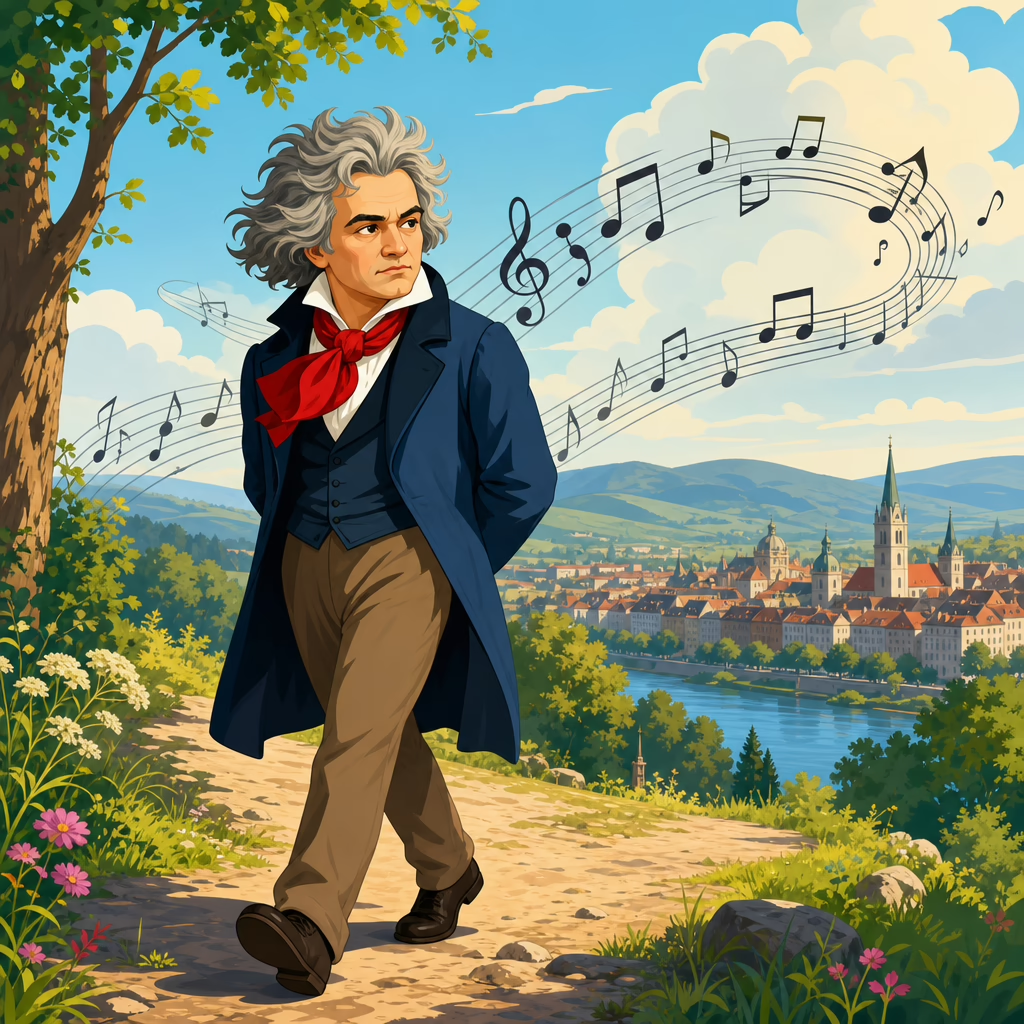
Beethoven’s Love of Walking and What It Meant for His Music
Ludwig van Beethoven walked almost every day, and those walks were not a quaint personal habit but a central practice that shaped how he thought, composed, listened, and endured. To understand Beethoven and nature, it is useful to begin with this simple, repeatable fact: he was a tireless walker who treated fields, paths, woods, streams, and changing weather as part of his working environment. In letters, reminiscences, notebooks, and reports from friends, Beethoven appears again and again outdoors, moving quickly, pausing to jot down ideas, carrying sketch materials, and returning home with musical fragments that later became finished works. His love of walking matters because it connects biography to style. It helps explain the expansiveness of his themes, the rhythmic propulsion of his middle-period music, the atmospheres of the “Pastoral” Symphony, and even the discipline with which he fought isolation during advancing deafness. For a composer often reduced to the image of heroic struggle, walking restores something essential: Beethoven was also a practical observer of the natural world.
When discussing Beethoven and nature, several key terms need clear definition. Nature, in Beethoven’s context, did not mean untouched wilderness in the modern environmental sense. It usually meant cultivated countryside, riverbanks, village edges, wooded lanes, and the hilly surroundings of Vienna and nearby spa towns such as Heiligenstadt, Baden, Mödling, and Döbling. Walking meant more than leisure. For Beethoven, it functioned as exercise, emotional regulation, field observation, and a compositional method. Sketching meant the practice of capturing motives, rhythmic cells, harmonic turns, and structural plans in notebooks rather than waiting for complete inspiration to arrive whole. Pastoral did not mean decorative prettiness. In early nineteenth-century music, pastoral language could suggest birdsong, flowing water, rural dance, drone basses, open intervals, and a sense of proportion derived from outdoor space. Beethoven used these devices, but he also transformed them. He did not merely imitate scenery; he translated lived experience into musical process.
This topic matters because it corrects two common misunderstandings. The first is that Beethoven’s music emerged from pure inner genius detached from place. In practice, his creative life was highly physical and environmental. He needed movement. He needed routes, routines, and seasonal relocation. The second misunderstanding is that his engagement with nature began and ended with the Sixth Symphony. In fact, references to brooks, storms, birds, meadows, and rural calm appear most obviously there, but nature shaped far more than one programmatic masterpiece. The spacious openings of certain piano sonatas, the muscular momentum of symphonic development, the dance-derived energy of scherzos, and the late works’ sense of breathing time all become easier to hear once you recognize Beethoven as a composer who thought while walking. I have worked through enough sketches, correspondence, and performance traditions to say this plainly: if you remove walking from Beethoven’s life, much of the logic of his output becomes harder to explain.
A broad view of Beethoven and nature also reveals why the subject remains relevant today. Artists, writers, and knowledge workers still use walking to solve problems, regulate mood, and generate ideas. Modern neuroscience often confirms what Beethoven practiced intuitively: moderate movement improves attention, supports memory integration, and helps complex ideas unfold over time. He had no scientific language for that process, but he built his life around it. He left crowded rooms for roads and gardens. He escaped urban noise for village margins. As his hearing deteriorated, nature provided not only inspiration but a form of orientation. Wind in trees, visual patterns in water, cloud movement, and the bodily rhythm of steps gave structure when auditory certainty was failing. That combination of artistic craft, emotional survival, and environmental sensitivity is why Beethoven’s love of walking deserves close study, and why it opens the best possible doorway into the larger subject of Beethoven and nature.
Table of Contents
| Section | Focus |
|---|---|
| Beethoven the walker | Daily habits, routes, and working methods outdoors |
| Vienna, villages, and landscapes | How specific places shaped his routine and imagination |
| Walking as composition | Sketchbooks, memory, rhythm, and formal thinking in motion |
| The “Pastoral” and beyond | How nature appears directly and indirectly in the music |
| Illness, deafness, and solitude | Why walking became emotionally and physically necessary |
| Miscellaneous perspectives | Food, weather, conversation, reputation, and modern lessons |
| Conclusion | Main takeaways and why this theme matters now |
Beethoven the Walker: A Daily Practice, Not a Romantic Myth
Beethoven’s attachment to walking is supported by an unusual density of evidence. Friends and visitors repeatedly described him taking long country walks, often after working in the morning or before settling into an afternoon of composition. Anton Schindler’s reliability is uneven and must always be handled carefully, but even when his testimony is discounted where necessary, many independent accounts still confirm the pattern. Beethoven himself wrote of his affection for trees and for being alone with them. The image that survives is not a symbolic stroller but a man with a demanding, nearly procedural habit. He rose, worked, walked, returned, revised, and walked again. That rhythm mattered because Beethoven was not a composer who relied on immediate fluency at the desk. He developed ideas through repetition and pressure, and walking gave him the temporal space in which pressure could produce form.
Several practical details are worth emphasizing. Beethoven frequently carried sketchbooks or loose sheets because ideas came to him mid-route and could not be trusted to memory alone. Witnesses describe him stopping suddenly, noting something, then continuing. This behavior aligns with what survives in the sketch materials: short motives, variant contours, harmonic possibilities, and structural reworkings rather than polished dictation. He was known to walk regardless of imperfect weather, a sign that this was not occasional pastoral recreation. He often chose lodgings in villages outside Vienna precisely because they offered direct access to quieter lanes and less social interruption. In an era before modern commuting language, Beethoven effectively optimized his environment for creative mobility. Walking was part workspace design.
His style of walking also seems to have matched his temperament. Contemporaries regularly depict him as abrupt, intense, absorbed, and physically energetic outdoors. He did not take dainty scenic strolls. He strode, muttered, sang, beat time, and inhabited music in his body. There are familiar anecdotes of him startling passersby by gesturing or vocalizing while ideas were forming. Those stories are credible because they fit the larger record of his compositional behavior. Beethoven’s music is unusually bound to kinetic energy, to the feeling of momentum gained through insistence rather than mere speed. A person who thinks by pacing and striding tends to shape musical argument differently from one who thinks in static contemplation. In Beethoven’s case, recurring cells gather force through movement, like steps accumulating distance.
Walking also fit the social and medical culture of his time. Late eighteenth- and early nineteenth-century physicians commonly recommended fresh air, bathing, country stays, and moderate exercise for nervous complaints, digestive troubles, and general health. Beethoven suffered recurrent intestinal problems, inflammatory episodes, eye troubles, and later more serious systemic illness. He was often irritable, exhausted, and physically uncomfortable. Walking was therefore both artistic preference and practical self-care. This matters because it prevents over-romanticizing the subject. Beethoven did not head outdoors only to commune with sublime landscapes. Sometimes he walked because city life was oppressive, his body felt bad, his mind was overloaded, and he needed relief. Yet that relief repeatedly became music.
Vienna, Heiligenstadt, Baden, and the Working Geography of Beethoven’s Nature
Beethoven’s experience of nature was shaped by specific places, and those places were not remote alpine scenes but the permeable boundary between Vienna and its surrounding countryside. Vienna around 1800 was a growing imperial capital, lively but also dirty, noisy, and socially demanding. For a composer trying to manage patrons, pupils, publishers, and illness, the urban center could become exhausting. The surrounding villages offered a different scale: vineyards, orchards, woodland paths, open views, streams, and roads where one could walk for hours without constant interruption. Beethoven repeatedly sought out these edges. Heiligenstadt became especially important, not only because of the famous 1802 testament written there, but because it exemplified the kind of semi-rural refuge he needed.
Heiligenstadt provided more than scenery. It offered therapeutic distance. When Beethoven went there on medical advice, he was confronting the devastating progression of hearing loss. The village’s quieter atmosphere and access to open air made it possible for him to maintain routine while processing psychological crisis. That is one reason the place looms so large in Beethoven biography. It represents the intersection of nature, illness, and artistic persistence. Baden later served a related role. Beethoven spent multiple summers there, attracted by both the spa culture and the surrounding walking routes. Baden’s woods and hills became part of his mature compositional world, especially in the 1820s when the late quartets and Ninth Symphony emerged under conditions of increasing deafness and social complication.
Other locations around Vienna mattered as well: Döbling, Mödling, and the broader Wienerwald region. These were not all identical environments, but they shared an essential advantage. They allowed Beethoven to move between habitation and landscape without requiring a dramatic expedition. That proximity matters musically. Nature for Beethoven was not an annual spectacle; it was a recurrent medium of daily thought. If the countryside is a place you can enter after breakfast and leave before dinner, it influences working habits differently than a distant destination visited only for retreat. Beethoven’s repeated relocations to village lodgings were therefore strategic. He was selecting acoustic, visual, and social conditions favorable to composition.
The routes themselves likely shaped perception. A lane that opens gradually onto a valley teaches long-range unfolding. A brook with repeated eddies suggests patterned variation. Rural dances heard or imagined in village settings offer rhythmic types distinct from courtly urban forms. No one can prove a one-to-one correspondence between a particular path and a particular theme, and responsible analysis should avoid that kind of fantasy. But the larger connection is solid. Beethoven’s landscapes supplied recurring experiences of distance, return, interruption, weather change, and layered motion. Those are exactly the kinds of processes his music dramatizes with extraordinary command.
Walking as Composition: Sketchbooks, Memory, Pulse, and Form
The strongest case for the musical significance of Beethoven’s walking lies in how he composed. Unlike composers whose manuscripts often look like clean transmission from mind to page, Beethoven’s surviving sketches reveal a laborious, exploratory process. Motives are tested, inverted, compressed, expanded, reharmonized, displaced, and repositioned within larger plans. This is the workshop of a composer who thinks incrementally. Walking supported that method in four linked ways: it generated motives, stabilized memory, organized pulse, and clarified formal proportion. Each can be traced in practical terms.
First, walking generated motives because repetitive bodily motion encourages small units of thought. When a composer moves steadily, short rhythmic and melodic cells can loop against footsteps until they become musically charged. Beethoven’s music is famous for extracting vast structures from minimal material. The opening of the Fifth Symphony is the textbook case, but the principle appears everywhere, from piano sonatas to string quartets. A compact idea heard inwardly during a walk can be turned over dozens of times before being notated. By the time it reaches paper, it has already been stress-tested in motion. In my experience studying Beethoven’s sketches, this is one of the clearest reasons his motives feel simultaneously simple and inevitable: they have survived bodily repetition before they survive manuscript revision.
Second, walking stabilized memory. Beethoven did not always write down a thought the instant it arose. He often carried material mentally over some distance. That act of retention imposes a filter. Only ideas with enough profile, coherence, or potential tend to survive sustained inward rehearsal. This does not mean weaker ideas never entered sketches, but it does mean that walking served as a memory audit. A phrase that evaporates after a minute of movement is different from one that grows stronger after twenty. Many of Beethoven’s themes have exactly that durable contour. They can be remembered, transformed, and recalled because they are built from sharply characterized intervals, rhythms, and harmonic implications.
Third, walking organized pulse. Beethoven’s rhythmic imagination is broader than mere imitation of footsteps, but bodily regularity clearly mattered to him. Even when he writes syncopation, disruption, or metric ambiguity, the underlying energy often feels grounded in physical propulsion. Conductors and performers know this intuitively. A Beethoven movement fails when it loses kinesthetic necessity. Tempo in Beethoven is never just speed; it is the rate at which character can remain embodied. Walking likely reinforced this sensitivity. Steps create a natural baseline against which acceleration, hesitation, asymmetry, and release can be measured. That is one reason Beethoven’s transitions can feel so compelling. They move like someone negotiating real terrain rather than decorating abstract time.
Fourth, walking clarified formal proportion. Long forms are difficult to conceive only at the desk. They benefit from extended spans of thought in which one section can be mentally compared with another while attention remains active but not overcompressed. Beethoven’s sonata forms, variation sets, and symphonic movements often depend on large-scale balance: how long tension can be prolonged, when a return will satisfy, how development can widen the field without losing orientation. A substantial walk offers exactly the kind of duration in which such decisions can mature. Instead of forcing a premature answer, the composer lets the problem accompany him until its shape becomes audible.
This does not mean every masterpiece was literally composed step by step outdoors. Beethoven worked at keyboard, table, and manuscript like any serious composer. But walking was part of the system that made those desk hours productive. It was ideation, incubation, rehearsal, and review. Modern creative practice would call it an integrated workflow. Beethoven simply lived it.
The “Pastoral” Symphony and the Wider Language of Nature in Beethoven’s Music
No discussion of Beethoven’s love of walking can ignore the Sixth Symphony in F major, Op. 68, known as the “Pastoral.” Yet the most important thing to understand about this work is Beethoven’s own distinction between emotional response and literal depiction. He indicated that the symphony was “more the expression of feeling than painting.” That line is often quoted because it is foundational. Beethoven did use recognizable scenic references: the “Scene by the Brook,” bird calls identified as nightingale, quail, and cuckoo, a peasant gathering, a storm, and a hymn-like shepherds’ song after the tempest. But these episodes matter less as sound effects than as parts of a coherent natural experience. The symphony unfolds like a day in the countryside translated into musical states of mind.
The first movement, often rendered in English as “Awakening of cheerful feelings on arriving in the country,” does not rush to descriptive novelty. It establishes breadth, ease, and repetition without stagnation. Phrases seem to breathe in longer arcs than urban brilliance would require. The brook movement offers one of Beethoven’s most refined examples of continuous patterned motion. The accompaniment’s flowing figures are not just water imitation; they are a structural environment in which melody can rest and drift. The storm movement is brief by symphonic standards but remarkably concentrated, using tremolo, dynamic violence, and harmonic turbulence to create meteorological drama. What follows is crucial: the thanksgiving after the storm is not triumph in the Fifth Symphony sense. It is restoration, gratitude, and released tension.
Once the “Pastoral” is understood properly, its relationship to Beethoven’s broader output becomes clearer. Nature in Beethoven is not limited to pictorial moments. It also appears in textures, pacing, and tonal imagination. The Piano Sonata in D major, Op. 28, often nicknamed “Pastoral,” uses drone-like bass patterns and open-air spaciousness. The Violin Sonata in A major, Op. 47, the “Kreutzer,” though not pastoral in program, contains elemental force that many performers connect to outdoor breadth. The “Spring” Sonata, Op. 24, carries a lyrical freshness linked by tradition to seasonal imagery, even if the nickname is not Beethoven’s. In chamber music and piano writing alike, one repeatedly hears registers opened widely, accompanimental motion suggesting flow, and themes that seem to emerge as if from distance rather than from salon display.
Even the Eroica Symphony can be heard differently through the lens of walking and nature. It is not a landscape piece, but its sense of scale, terrain, and prolonged journey exceeds interior elegance. The same is true of many scherzos, where rustic energy and dance inflection reappear in transformed, often explosive ways. Beethoven absorbed the older pastoral tradition inherited from composers such as Handel, Haydn, and Mozart, yet he pushed it toward greater structural seriousness. Rural topic became not ornament but a means of articulating time, contrast, and renewal. That is why the “Pastoral” Symphony still feels modern. It does not ask listeners merely to recognize birds or storms. It asks them to inhabit an ecological sequence of calm, activity, threat, and recovery.
Deafness, Distress, and the Solace of the Outdoors
Beethoven’s walking cannot be separated from his deafness. As hearing loss advanced from the late 1790s onward, ordinary social life became increasingly humiliating and tiring. Conversation demanded effort. Public spaces could be alienating. Music itself, the center of his identity, became a site of pain and adaptation. Under those conditions, the outdoors offered advantages that were both practical and psychological. One could withdraw without formally withdrawing. One could think without needing to decode speech. One could exchange the strain of failed listening for the stability of visual and bodily orientation. For Beethoven, this mattered enormously.
The Heiligenstadt Testament shows how severe the crisis had become by 1802. There he describes despair, isolation, and the temptation toward self-destruction, held off by art and duty. Although the document is not a pastoral essay, the circumstances around it illuminate why nature became so important. Physicians had sent him to a healthier environment. Walking was part of treatment. Solitude in fields and among trees was less wounding than solitude in a crowded room where one could not hear. That distinction should not be underestimated. Nature did not cure Beethoven’s suffering, but it gave him a mode of continuing life that was less socially punitive.
Later, as he relied more heavily on notebooks for conversation and navigated chronic illness in addition to deafness, walking remained one of the few forms of autonomy he could preserve. Accounts from the 1820s still show him outdoors for long stretches. This persistence tells us that the habit was no youthful luxury. It was a survival practice. Many artists retreat inward when disability narrows ordinary interaction; Beethoven certainly had periods of ferocious inwardness. But he also kept seeking external environment. The result is audible in late music that combines introspection with astonishing spaciousness. The late quartets and the Ninth are not nature pieces in obvious programmatic terms, yet they often breathe with a sense of horizon. Their silences, expansions, and unexpected returns feel shaped by someone who still measured thought against open space.
There is also a moral dimension here. Beethoven’s relation to nature was not escapist in the weak sense. He did not go walking merely to avoid work; he went walking to remain capable of work. The countryside helped him metabolize anger, grief, and frustration into structure. That transformation is one of the most impressive facts of his life. It reminds us that artistic discipline is rarely separable from environmental habit.
Miscellaneous Perspectives: Weather, Meals, Companions, Reputation, and Modern Lessons
The broader topic of Beethoven and nature includes many smaller details that enrich the picture. Weather is one. Beethoven was strongly responsive to atmospheric change, and the “Pastoral” storm is only the most obvious example. Accounts suggest that heat, wind, and seasonal shifts affected his routines and mood. Summer country stays were not accidental. They aligned with both health advice and compositional strategy. Meals and domestic life also matter. Beethoven was often dissatisfied with lodgings, servants, and household order, which made outdoor escape even more attractive. A difficult room can drive a person toward a more usable landscape.
Companionship on walks was inconsistent. At times Beethoven enjoyed conversation outdoors with friends, pupils, or patrons; at other times he preferred to be alone. This is important because solitude in nature can be either sociable or defensive. For Beethoven, it was both. He could discuss musical plans while moving, but he could also preserve dignity by choosing isolation on his own terms. His reputation as a rough, distracted, somewhat unruly walker probably grew from this tension. To polite society, a man muttering themes to himself on a country road looked eccentric. To anyone serious about creative work, he looked efficient.
Another miscellaneous point concerns notation and material practice. Sketchbooks were not accessories in Beethoven’s life; they were field tools. Scholars who study them see how often a tiny outdoor idea later expands into a major passage through successive drafts. That process supports a larger lesson for musicians today: inspiration is usually modular. Beethoven did not wait for finished perfection under a tree. He collected fragments, then built architecture later. Nature provided input, not instant completion.
Modern readers also often ask whether Beethoven can be considered an environmental thinker. The answer requires caution. He did not write in modern conservation language, and projecting contemporary ecological politics backward would distort the record. Still, he valued nonurban environments not merely for utility but for intrinsic nourishment. He treated trees, water, and open land as sources of truth, calm, and renewal. His oft-cited declaration that he loved a tree more than a man can be exaggerated when stripped of context, yet it captures a real disposition: nature was ethically restorative because it did not deceive, flatter, or demand performance.
For performers, Beethoven’s walking offers practical interpretive guidance. Tempos should carry physical inevitability. Phrasing should allow for distance and return. Repetition should feel accumulative rather than decorative. In the “Pastoral,” brook figures must flow without fuss; in the scherzos, rustic impulses must remain earthy, not merely refined. For writers and other creators, the lesson is equally concrete. A disciplined walking habit can function as part of one’s method, especially when work depends on long-form thinking. Beethoven shows that movement is not the enemy of concentration. Properly used, it is one of concentration’s oldest allies.
Conclusion
Beethoven’s love of walking mattered because it joined body, mind, place, and art into one working practice. He walked for health, for solitude, for relief from urban pressure, for protection against the psychological damage of deafness, and above all for composition. The countryside around Vienna was not a backdrop to genius but one of its active conditions. In fields, lanes, villages, and wooded paths, Beethoven gathered motives, tested rhythms, clarified forms, and renewed emotional balance. The “Pastoral” Symphony gives the most explicit musical testimony, but the larger truth reaches across his output: much of Beethoven’s power comes from music shaped by movement through real landscapes.
Seen this way, the topic of Beethoven and nature becomes broader and more precise at the same time. It is broader because it includes biography, health, geography, sketch practice, listening, and interpretation, not just one famous symphony. It is more precise because it replaces vague romantic imagery with observable habits and documented places. Beethoven loved nature in the way a working artist loves what makes work possible. He did not idealize the outdoors from a distance; he used it, returned to it, and depended on it. That dependence helped turn personal struggle into durable musical form.
If you want to understand Beethoven more deeply, follow the paths he followed in principle: connect the scores to the walks, the walks to the landscapes, and the landscapes to the daily labor of invention. Read the letters, study the sketches, listen again to the Sixth Symphony, and then hear the rest of the music with fresh ears. Beethoven’s footsteps are still in it.
Frequently Asked Questions
Why was walking so important to Beethoven’s daily life and creative process?
Walking was far more than exercise or recreation for Beethoven. It functioned as a core part of his working life. He walked almost every day, often for long stretches, and treated the outdoors as an extension of his studio. Fields, wooded paths, village roads, streams, and shifting weather were not just scenery in the background of his life; they formed a practical environment in which he thought through musical ideas, tested emotions, and organized large compositions in his mind. For Beethoven, movement through nature created a rhythm that supported concentration. The steady pace of walking gave him space to reflect, rehear ideas internally, and shape themes before they were written down.
This habit also mattered because Beethoven’s compositional process was unusually intense. He did not simply wait for inspiration to arrive fully formed. He wrestled with motifs, revised obsessively, and developed small musical cells into powerful structures. Walking gave him a setting in which this kind of mental labor could continue away from the desk. Reports from contemporaries often describe him outdoors, absorbed in thought, humming, gesturing, or suddenly stopping to jot something down. That tells us that walking was not separate from composition; it was one of the places where composition happened. In that sense, his daily walks were a discipline that helped transform raw feeling and observation into musical architecture.
How did nature influence Beethoven’s music during these walks?
Nature influenced Beethoven in ways that were both direct and subtle. He was clearly responsive to outdoor experience: birdsong, flowing water, wind, open space, seasonal change, and the emotional atmosphere of the countryside all mattered to him. But it is important not to reduce this influence to simple sound imitation. Beethoven did not usually compose as though he were painting a literal landscape in notes. Instead, nature gave him moods, energies, contrasts, and a sense of living motion that could be translated into musical form. His walks exposed him to patterns of calm and turbulence, stillness and interruption, repetition and transformation, all of which align closely with the dramatic qualities found throughout his music.
The clearest example is the Pastoral Symphony, officially Symphony No. 6, where Beethoven explicitly linked the work to rural feeling. Even there, he emphasized that the piece was “more an expression of feeling than painting.” That statement is crucial. It shows that when Beethoven absorbed the natural world, he turned it into emotional and structural experience rather than mere description. The countryside could inspire serenity, gratitude, awe, and vitality, but also tension, unpredictability, and release. Those states are heard across his output, not only in obviously “pastoral” works. His walks gave him repeated contact with forms of motion and feeling that became deeply embedded in his musical language.
Did Beethoven actually compose while walking, or did he just find inspiration outdoors?
He did both. Beethoven certainly found inspiration outdoors, but the evidence strongly suggests that he also used walking time for active composition. He was known to carry notebooks with him so that he could capture ideas as they came. Friends and observers describe him singing to himself, marking out rhythms, and seeming completely immersed in internal musical thought while on the move. This is exactly what we would expect from a composer who worked by developing and reworking material continuously. Walking was one of the settings in which themes could be discovered, transformed, and mentally rehearsed.
That distinction matters because it changes how we understand his creativity. Inspiration, in a romantic sense, sounds sudden and mysterious. Beethoven’s actual process was more disciplined and physical. He used the body to support the mind. The act of walking helped maintain concentration over time, and that sustained focus was ideal for someone building large sonata movements, symphonies, string quartets, and piano works from small, tightly controlled motifs. Outdoor movement may have loosened thought enough for new ideas to emerge, but it also provided a practical framework for sorting and refining them. In other words, Beethoven did not merely take scenic breaks from work. For him, walking itself was often work.
What did walking mean for Beethoven personally, especially as he struggled with deafness?
Walking had deep personal meaning for Beethoven, especially given the pressures and suffering he endured. As his hearing declined and his social life grew more difficult, the outdoors offered a space of relative freedom. Nature did not demand easy conversation, social performance, or relief from anxiety on anyone else’s terms. It gave him solitude, continuity, and a sense of contact with something larger than his immediate troubles. For a man dealing with frustration, isolation, ill health, and the emotional burden of deafness, that mattered enormously. Walking could steady him, restore him, and help him persist.
There is also a profound irony here: as Beethoven’s external hearing weakened, his relationship to inward hearing became even more important. Walking likely supported that inward musical life. Away from noise and social strain, he could retreat into mental sound, imagining textures, harmonies, and forms with extraordinary vividness. The physical world of paths, weather, and landscape may have helped counterbalance the confinement and distress of his condition. So his walks were not just habits of health or creativity. They were part of his endurance. They helped him remain an artist under circumstances that might have silenced someone else.
What can listeners hear differently in Beethoven’s music once they understand his love of walking?
Once you know how central walking was to Beethoven, many features of his music can feel newly alive. You may begin to hear motion not simply as tempo, but as directed physical energy: the sense of pushing forward, pausing, gathering force, and setting off again. Repeated rhythmic patterns can resemble footsteps in their persistence, while long developments can feel like journeys through changing terrain rather than static displays of craft. Even moments of stillness may seem less like inactivity and more like a halt on a path, a pause to observe, listen inwardly, or prepare for the next surge of movement.
This perspective is especially useful because it keeps Beethoven grounded in lived experience. His music can seem monumental, even overwhelming, but it was often born from ordinary, repeatable acts: walking, noticing, thinking, revising, and returning to the same ideas with renewed energy. Understanding his love of walking helps listeners connect the grandeur of the finished works with the embodied process behind them. It reminds us that Beethoven’s art was not detached from the world. It grew out of contact with roads, weather, trees, streams, silence, effort, and solitude. Hearing that connection can make the music feel both more human and more powerful.