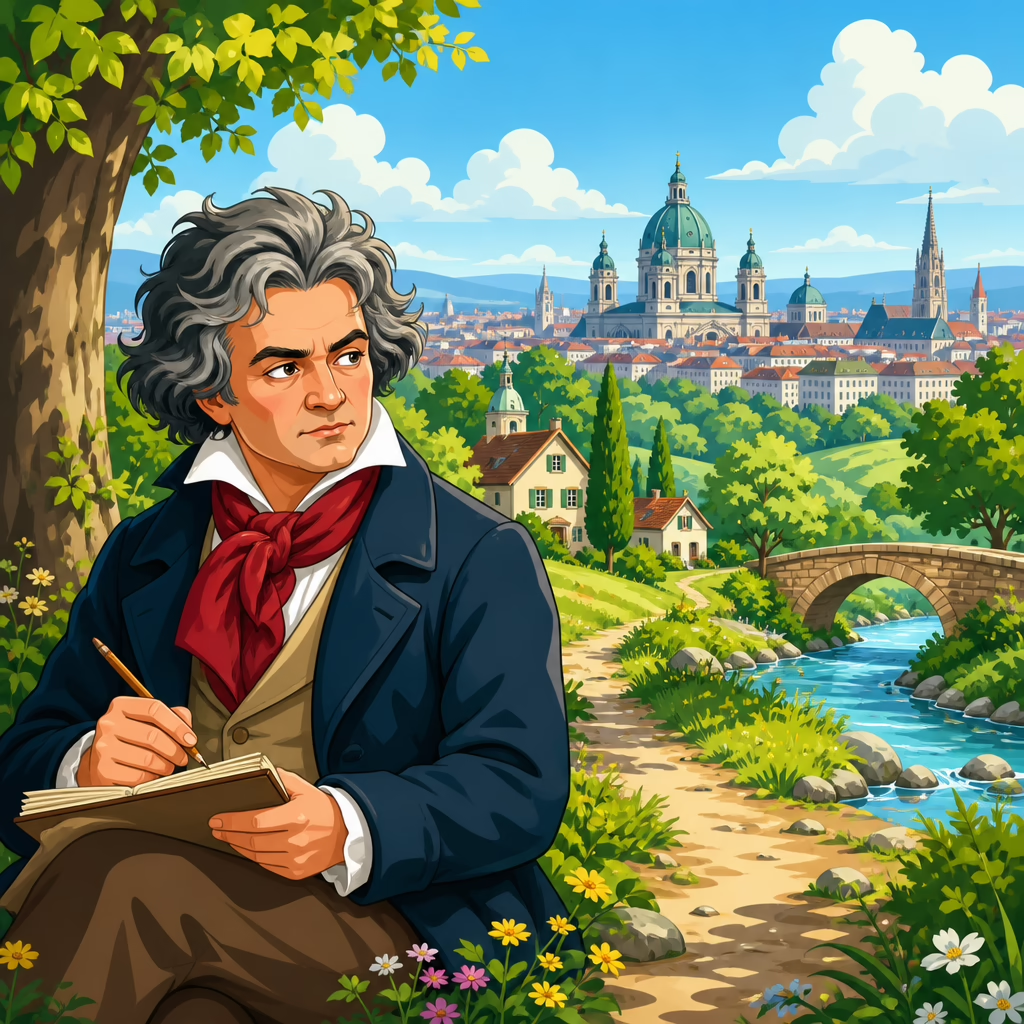
Beethoven’s Favorite Escapes from Urban Vienna
Vienna gave Ludwig van Beethoven patrons, publishers, premieres, and constant artistic friction, but it also pressed on him with dust, noise, gossip, and social obligations he often found exhausting. When people picture Beethoven in the city, they usually imagine crowded apartments, keyboard battles, and stormy encounters with aristocrats. Just as important, however, were the places beyond the dense center where he could walk, think, sketch, and recover a measure of inner balance. Beethoven’s favorite escapes from urban Vienna were not random outings. They formed a practical geography of retreat: nearby villages, wooded paths, vineyard hills, spa towns, and river landscapes that let him trade urban compression for physical movement and mental clarity.
In this context, an escape means more than a pleasant excursion. For Beethoven, it was a repeatable movement away from the pressures of the inner city into environments that supported concentration and emotional regulation. He did not seek untouched wilderness in the modern sense. Instead, he favored inhabited edges of Vienna and accessible rural districts where nature, agriculture, and village life met. Places such as Heiligenstadt, Döbling, Baden, Mödling, and the Prater offered different combinations of air, quiet, views, and distance from urban routine. These settings mattered because Beethoven worked through walking. He carried musical ideas in motion, tested them over repeated routes, and used landscape as a partner in composition rather than as mere scenery.
This matters for anyone trying to understand Beethoven’s daily life and creative method. His countryside retreats illuminate why certain residences recur in biographies, why summer moves were so productive, and why his letters describe health, hearing, and environment alongside artistic plans. They also explain the stubborn regularity of his habits. I have worked through Beethoven’s address lists, letters, and seasonal patterns enough to see a clear truth: he kept returning to places that solved practical problems. Some offered therapeutic distance when his hearing crisis deepened. Others placed him near streams, orchards, and wooded slopes while keeping him close enough to Vienna’s musical economy. The result was a map of preferred refuges that shaped not only his routines but the conditions under which some of his most important music was imagined.
Why Beethoven needed to leave the city
Urban Vienna around 1800 was stimulating, but it was not restful. Streets were crowded with carts and horses, sanitation was limited, and domestic privacy was fragile in lodging houses and rented rooms. Beethoven’s temperament made this harder. He disliked trivial conversation, guarded his working time fiercely, and became increasingly distressed by hearing loss from the late 1790s onward. For a composer whose craft depended on inward listening, the city’s demands could feel doubly oppressive. Leaving Vienna was therefore not a luxury. It was part of his survival strategy.
The evidence appears in both behavior and correspondence. Beethoven repeatedly changed lodgings, spent summers outside the center, and favored long walks as a daily discipline. The villages north and south of Vienna were especially useful because they were close enough for social and professional contact, yet far enough to alter his rhythm of life. Fresh air was considered medically beneficial, and physicians often recommended country residence for nervous strain. Beethoven followed that logic, but he also shaped it into a working method. In quieter surroundings, he could pace, carry notebooks, and develop motifs without interruption. Readers who want the broader context of this walking habit can trace it in the main guide, Beethoven’s love of walking and what it meant for his music, but the crucial point here is narrower: his favorite escapes were functional creative environments.
Heiligenstadt and Döbling: the most consequential refuge
No escape from Vienna is more important in Beethoven’s life than Heiligenstadt, with neighboring Döbling forming part of the same northern zone of retreat. At the time, these were wine-growing villages outside the city, marked by vineyards, lanes, gardens, and rising ground toward the Vienna Woods. Beethoven stayed there in multiple years, and the area offered exactly what he needed: manageable distance from Vienna, semi-rural quiet, and space for walking among cultivated landscapes rather than urban stone.
Heiligenstadt carries special weight because of the 1802 document now known as the Heiligenstadt Testament, the unsent letter to his brothers in which Beethoven confronted despair over his worsening deafness. The location matters. He was there on medical advice, hoping country air and rest might help. Instead, the stay intensified his reckoning with the permanence of his condition. Yet Heiligenstadt was not only a site of crisis. It was also a site of continuation. From that turning point emerged a renewed determination to live for his art. In practical terms, the village gave him enough quiet to think honestly, and enough beauty to remain attached to life.
The surrounding topography helps explain its appeal. Paths led through vineyards and upward toward wooded areas, allowing graded walks rather than abrupt exertion. Village life provided food, rooms, and social distance without complete isolation. For Beethoven, that balance was ideal. He could withdraw without disappearing. Modern visitors often focus on the testament house, but the wider landscape was the real resource. The escape worked because it combined air, movement, and psychological space.
Baden: summer residence, spa culture, and sustained productivity
If Heiligenstadt was emotionally decisive, Baden became one of Beethoven’s most dependable recurring escapes. Located south of Vienna, Baden was a spa town with thermal springs, established lodging, gardens, and easy access to surrounding wooded hills. Beethoven spent multiple summers there, especially in his later years, and the pattern was not accidental. Baden supplied a mature version of what he sought all along: relief from the city without severing connections to publishers, performers, and visitors.
Spa culture mattered. Early nineteenth-century Baden was associated with health cures, bathing, and seasonal migration by Viennese society. That environment could be inconvenient because Beethoven disliked empty sociability, yet it also meant good accommodation and services. More importantly, the countryside around Baden supported extensive walking. The Helenental valley and nearby forest routes provided shaded paths that encouraged long solitary excursions. Accounts from contemporaries repeatedly place Beethoven outdoors there, often wandering intensely, stopping to jot notes, or singing and gesturing to himself as ideas formed.
Baden is especially significant for late Beethoven. During these years he was wrestling with communication books, legal troubles over custody of his nephew Karl, worsening health, and increasingly complex compositional ambitions. A lesser retreat would not have sufficed. Baden worked because it offered durable routine. He could rent for a season, establish walking circuits, receive necessary contacts, and continue serious work. Several late masterpieces are associated with summer periods outside Vienna, and Baden stands at the center of that rhythm. It was not simply pleasant. It was structurally supportive of deep concentration.
Mödling, the Brühl, and the southern wooded edge
Another favorite direction led Beethoven toward Mödling and the Brühl region, south of Vienna near the wooded foothills and romantic ravines that later generations also prized. This area differed from the vineyard villages of the north. Its attraction lay in more dramatic terrain: limestone formations, narrower valleys, forested slopes, ruins, and varied walking routes that felt distinctly separate from the city. For a composer responsive to contrast, this landscape offered a stronger sense of release.
What made Mödling effective as an escape was the combination of accessibility and immersive terrain. Beethoven did not need a long journey to feel transported. Once there, he could move among paths that unfolded gradually, with changing elevations and wider views over the surrounding countryside. Such routes favored the kind of sustained, rhythmically regular walking that composers often use to organize thought. I find this especially important when assessing Beethoven’s habits: he was not merely collecting pretty scenes. He needed routes that could hold attention for hours without the mental abrasion of city encounters.
The Brühl area also aligned with early nineteenth-century taste for picturesque landscapes, but Beethoven’s relation to it was more practical than touristic. He valued places where he could be alone within reach of settlement. Inns and lodgings existed, yet the terrain quickly absorbed the walker. That balance between support and seclusion appears again and again in his preferred escapes. Mödling exemplified it on the southern edge of Vienna.
The Prater and the Vienna Woods: nearby nature when longer retreats were impossible
Not every escape required summer relocation. When Beethoven remained in or near Vienna, the Prater and the wider Vienna Woods functioned as shorter, more immediate refuges. The Prater, especially before later urban development changed its character, included broad avenues and more natural stretches where one could walk beyond the tight grain of the city. It was public, not remote, but it offered space and air. For a composer needing daily motion, that mattered.
The Vienna Woods served a similar purpose on a larger scale. This broad band of forested hills west and northwest of the city was not one single destination but a network of possible routes and villages. Beethoven’s affinity for edge landscapes makes these areas especially plausible as regular working environments. They were close enough to be practical and varied enough to prevent monotony. Short escapes can be as revealing as long ones because they show habit rather than exception. Beethoven did not only flee the city at moments of crisis. He repeatedly used nearby green zones to regulate ordinary life.
| Escape | Primary appeal | Distance from central Vienna | Why Beethoven returned |
|---|---|---|---|
| Heiligenstadt/Döbling | Vineyards, quiet lanes, medical retreat | Near northern outskirts | Accessible solitude and psychological space |
| Baden | Spa amenities, valley walks, seasonal lodging | Day journey south | Reliable summer routine for serious work |
| Mödling/Brühl | Wooded ravines, varied terrain, stronger separation from city life | Moderate journey south | Immersive walking routes without extreme remoteness |
| Prater/Vienna Woods | Immediate open space and forest access | Very close to city | Frequent shorter escapes between obligations |
What these places had in common
Beethoven’s favorite escapes share a clear pattern. First, they were close enough to preserve professional continuity. He depended on Vienna’s networks of patrons, copyists, instrument makers, and performers, so total withdrawal was unrealistic. Second, they offered walkable terrain rather than spectacle alone. A scenic outlook was useful, but repeated movement along paths mattered more. Third, they combined habitation with partial seclusion. Beethoven seldom chose wilderness far from service and shelter; he chose rural zones where he could rent rooms, eat, and still disappear for hours.
There is also a health dimension that should not be romanticized but should be taken seriously. Country air, bathing culture, and reduced noise were all understood as therapeutic, and for Beethoven these concerns intersected with deafness, digestive troubles, and emotional strain. Finally, his favored escapes supported composition by lowering friction. Every artist has conditions that waste energy and conditions that conserve it. For Beethoven, urban Vienna often consumed energy through interruptions and stress, while these peripheral landscapes conserved it through routine, motion, and sensory relief.
How the escapes shaped the music without turning landscape into cliché
It is tempting to draw a simple line from specific places to specific works, but that overshoots the evidence. Beethoven did not compose postcard music tied neatly to one village. The better claim is stronger and more accurate: these escapes created the physical and mental conditions in which he could sustain high-level work. Long walks helped him rehear material internally, test proportions, and release tension. Quiet lodgings reduced social drag. Recurrent routes encouraged iterative thinking, the kind required for transforming a tiny motif into a large structure.
That does not mean landscape was irrelevant to expression. Beethoven’s sensitivity to weather, distance, birdsong, water, and pastoral textures is well documented, and the Sixth Symphony proves he could engage rural experience directly while insisting it was more “expression of feeling” than literal painting. The same principle applies here. His favorite escapes mattered less as picturesque subjects than as environments that nourished expressive capacity. They helped him remain Beethoven: restless, exacting, physically in motion, and able to convert lived experience into form.
Understanding these refuges changes how we see his Vienna years. The city was central, but it was never sufficient. Beethoven’s real working world stretched across thresholds between urban necessity and rural repair. To follow his favorite escapes from urban Vienna is to see a composer designing his own conditions for endurance. He chose places that let him breathe, walk, think, and continue. Heiligenstadt gave him a setting for confrontation and resolve. Baden gave him repeatable summer stability. Mödling and the Brühl offered immersive terrain. The Prater and Vienna Woods supplied daily relief when longer absences were impossible.
The lesson is simple and concrete. Beethoven’s retreats were not decorative background to genius; they were part of its infrastructure. Anyone studying his life closely should map these locations alongside the usual concert halls and apartments, because the geography of escape explains the geography of creation. If you want a sharper understanding of Beethoven and nature, start with these specific places and the routines they made possible, then follow how often he returned to them across the years. That pattern reveals what he valued most: not luxury, not spectacle, but accessible landscapes where solitude, movement, and work could finally align.
Frequently Asked Questions
Why did Beethoven seek escapes from urban Vienna so often?
Beethoven depended on Vienna for nearly everything that sustained his career: aristocratic patrons, publishers, performers, students, and a public ready to argue about his latest work. Yet the same city that made him famous could also wear him down. Dense streets, cramped lodgings, constant social visits, financial pressures, and the expectation that he remain visible within elite circles often left him mentally and physically exhausted. He was intensely sensitive to noise and distraction, and as his hearing problems advanced, ordinary urban life became even more stressful and isolating.
His retreats beyond the city center were not simply leisure outings; they were part of how he preserved his creative energy. In quieter districts and semi-rural villages on Vienna’s edge, he found cleaner air, open walking paths, and a slower rhythm that contrasted sharply with the pressures of metropolitan life. These settings allowed him to think through musical ideas at length, carry notebooks for sketches, and immerse himself in the natural world that repeatedly stirred his imagination. For Beethoven, escape was not avoidance in a trivial sense. It was a practical and emotional strategy for regaining focus, calming agitation, and creating the conditions in which major works could take shape.
Which places outside central Vienna were especially associated with Beethoven?
Several locations around Vienna became closely linked with Beethoven’s habit of withdrawing from the city. Among the most famous were Heiligenstadt, Döbling, Mödling, Baden, and villages along the Vienna Woods. In Beethoven’s time, these areas stood at the edge of urban life or beyond it, offering vineyards, hills, woodland paths, streams, and a sense of distance from the packed streets of the imperial capital. They were accessible enough for seasonal residence yet removed enough to feel restorative.
Heiligenstadt is perhaps the most historically resonant, not only because Beethoven spent time there seeking relief for his health, but because it became bound up with one of the most important personal documents of his life, the Heiligenstadt Testament. Baden, south of Vienna, later became another important refuge, prized for its spa culture, fresh air, and relative quiet. Mödling and neighboring rural stretches also appealed to him for their walkable landscapes and less formal atmosphere. These places mattered because they gave Beethoven what central Vienna rarely could: room to move, room to think, and room to turn inward without entirely severing ties to the musical world on which he relied.
How did nature and walking influence Beethoven’s creativity in these retreats?
Walking was central to Beethoven’s working life. He was not the kind of composer who sat only at a desk waiting for inspiration to arrive. Instead, he developed ideas while moving through fields, woods, and village lanes, often carrying sketchbooks in which he could capture melodic fragments, harmonic turns, or structural plans as they occurred to him. His retreats outside Vienna gave him the physical and mental space for this process. The act of walking helped organize thought, release tension, and create a rhythm in which musical ideas could deepen gradually rather than emerge under social pressure.
Nature itself also mattered deeply to him. He was highly responsive to changing weather, bird calls, flowing water, and the broad emotional atmosphere of the countryside. This does not mean he simply copied natural sounds into music, but rather that landscape fed his inner life and sharpened his powers of reflection. A calm rural morning, a distant storm, or the sensation of moving alone through open air could all become part of the emotional vocabulary he later transformed into music. His country escapes therefore served as creative laboratories. They offered solitude, sensory renewal, and the kind of extended contemplation that helped him shape works of extraordinary intensity and breadth.
Was Heiligenstadt really one of Beethoven’s most meaningful escapes?
Yes, Heiligenstadt holds a special place in Beethoven’s story because it was far more than a pleasant summer retreat. Located north of central Vienna, it offered a quieter environment where he could rest, walk, and seek some relief from worsening health concerns, especially those connected to his hearing. In 1802, while staying there, he wrote the document now known as the Heiligenstadt Testament, a private letter to his brothers in which he confronted despair, isolation, and the devastating reality of his condition. Although the letter was never sent, it remains one of the clearest windows into his emotional life.
That context makes Heiligenstadt especially significant. It was a place of refuge, but also a place of reckoning. There, removed from the relentless demands of Vienna, Beethoven faced the possibility that his hearing loss might permanently alter both his social life and artistic future. At the same time, Heiligenstadt became associated with his resolve to continue living and composing despite that suffering. In that sense, it symbolizes exactly why these escapes mattered: they were not merely scenic detours, but locations where Beethoven could endure crisis, recover determination, and return to his work with renewed purpose.
Did these escapes influence specific works or Beethoven’s broader artistic development?
They almost certainly influenced both. Beethoven’s retreats into the countryside did not function as isolated holidays separate from his creative life; they were woven into his compositional process. Many of his most important years as a composer included regular periods outside the city, and the habits he practiced there—long walks, solitary reflection, sketching away from the keyboard, and close attention to natural atmosphere—helped shape the scale, emotional depth, and imaginative range of his music. While it is not always possible to match a single landscape to a single finished piece with complete certainty, the broader connection between his rural retreats and his creative growth is well established.
The most obvious example in the public imagination is the Pastoral Symphony, which reflects Beethoven’s deep feeling for country life, not as decorative scenery but as lived emotional experience. More broadly, these escapes supported the inward concentration required for the symphonies, sonatas, quartets, and sacred works of his middle and late periods. Time away from urban Vienna helped him withdraw from gossip, obligation, and performance culture long enough to think on a larger scale. The result was not music that fled the world, but music strengthened by intervals of distance from it. His favorite escapes gave him the freedom to listen inwardly, and that inner listening became one of the defining forces of his art.