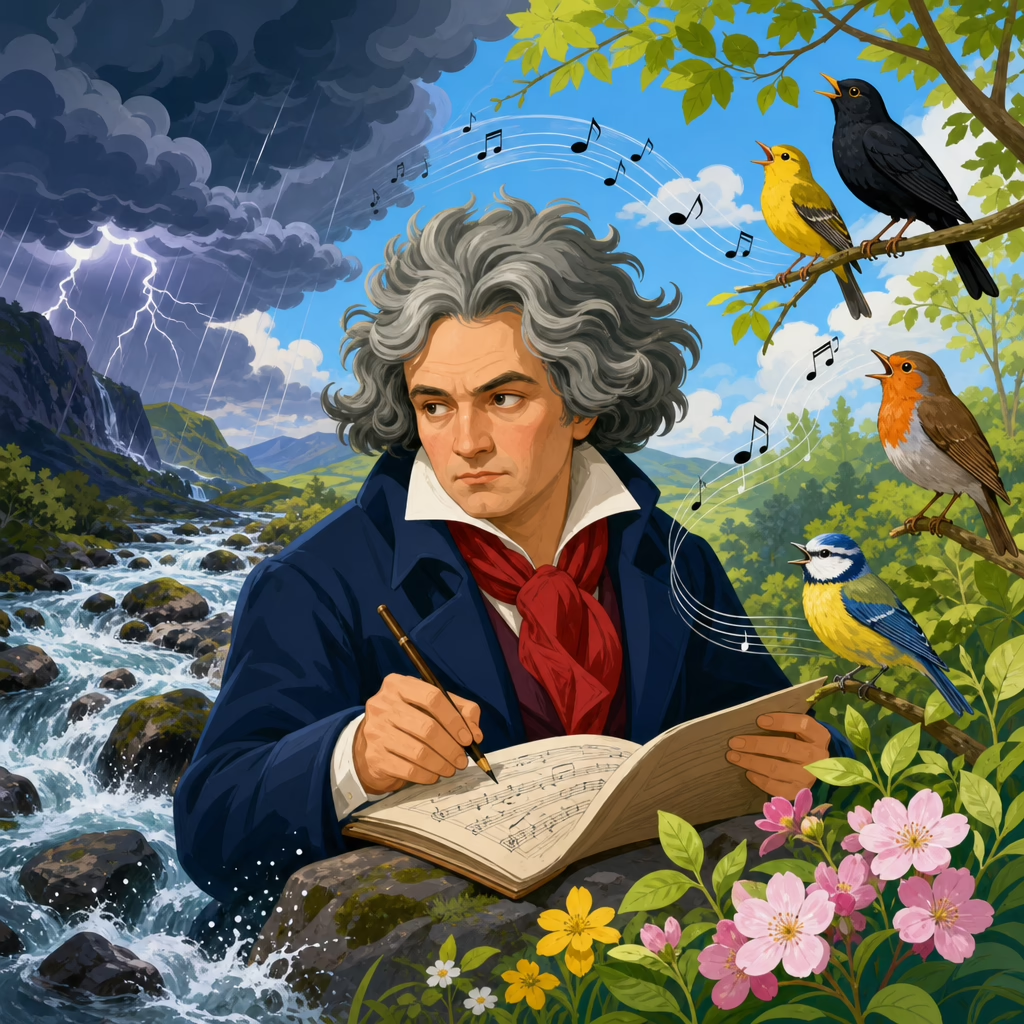
The Streams Storms and Birdcalls of Beethoven
Ludwig van Beethoven’s music is often described in grand abstractions, yet few subjects are more concrete than the streams, storms, and birdcalls woven into his art, especially in the Sixth Symphony, the “Pastoral.” This article focuses on how Beethoven translated observed natural sound into musical structure, not as decorative imitation but as part of a larger expressive method. Streams in his work are not generic signs of peace; storms are not just noise; birdcalls are not random touches of rustic color. Each element is shaped through rhythm, harmony, orchestration, and form so that nature becomes audible without reducing the music to mere sound effects.
That distinction matters because Beethoven was not writing simple landscape music. He repeatedly insisted that the “Pastoral” involved “more the expression of feeling than painting,” a crucial idea for understanding what listeners actually hear. In practical terms, that means he used recognizable natural references while allowing emotion, memory, and human response to lead the composition. Having spent years studying the score, rehearsing passages with players, and comparing Beethoven’s sketches with the finished work, I find that the most revealing moments are the ones where realism and imagination overlap. A murmuring brook may sound vividly physical, but it also regulates musical time, softens harmonic tension, and frames a state of attentive listening.
Beethoven’s lifelong habit of walking in the countryside around Vienna helps explain this precision. He knew creeks, changing weather, rural dance bands, and the distinct calls of common birds not from books but from repeated direct encounter. Anyone exploring this subject in context should also read the broader guide to Beethoven’s love of walking and what it meant for his music, because the habits of movement, observation, and solitude behind these sounds matter. In this focused discussion, however, the goal is narrower: to show exactly how streams, storms, and birdcalls function inside Beethoven’s musical language, why they remain convincing, and what they reveal about his understanding of nature as both heard environment and inner experience.
The brook scene: how Beethoven makes water audible
The clearest musical stream in Beethoven appears in the second movement of the Sixth Symphony, “Scene by the Brook.” The movement is in 12/8 meter, a choice that immediately enables flowing subdivisions associated with continuous motion. Instead of heavy thematic assertion, Beethoven builds texture from undulating accompaniment figures, especially in the lower strings, that suggest ceaseless current. These figures are not isolated effects pasted onto a melody. They are structural material. The brook’s motion supports phrase expansion, regulates pacing, and creates a gently suspended atmosphere in which the listener feels time moving without urgency.
What makes this portrayal persuasive is Beethoven’s restraint. The harmony does not lurch theatrically from one surprise to another. It breathes. The orchestra rarely attacks with sharp edges, and the dynamic world is controlled so the listener remains inside an acoustic environment rather than in front of a display. In rehearsal, players quickly notice that the challenge is not volume but consistency of pulse and balance. If the accompaniment becomes too emphatic, the illusion of water breaks. Beethoven understood that natural sound is often compelling because it is continuous, layered, and slightly beyond exact human control. His notation recreates that quality through repeated figuration and overlapping lines.
He also avoids monotony by varying register and instrumental color. Woodwinds float above the string texture like shifting reflections. Melodic fragments emerge, recede, and return, much as a walker notices details along a stream without losing awareness of the whole. This is why the movement feels observed rather than diagrammed. Beethoven is not saying, “Here is water.” He is inviting the listener into the act of attending to it. The stream becomes a medium for thought, patience, and sensory focus, all achieved through disciplined compositional craft.
Storm music: controlled chaos, not orchestral disorder
Beethoven’s storm, the fourth movement of the Sixth Symphony, remains one of the most famous weather scenes in orchestral literature because it balances immediacy with design. The movement does not merely get loud. It stages an atmospheric event. Cellos and basses stir the ground first, while tremolos, rapid scales, syncopations, and wind interjections build unstable energy. Timpani and brass intensify the threat, but Beethoven carefully grades the escalation. A real storm gathers in layers, and so does this music. The result is dramatic because the listener senses changing pressure, not just accumulated decibels.
One reason the storm still works on modern ears is Beethoven’s command of rhythmic disruption. Earlier movements establish patterns of rural ease, so when the storm arrives, accents feel displaced and momentum becomes harder to predict. That loss of rhythmic security is central to the effect. In performance, conductors who treat the passage as mere speed often miss its essence. The movement requires clarity inside turbulence. Every entrance must sound urgent yet intelligible, because Beethoven’s terror is never shapeless. The danger lies precisely in hearing order strained to its limit.
There is also a tonal argument at work. The storm interrupts a larger expressive arc and therefore carries narrative weight. It is not an independent spectacular episode but a crisis within a five-movement cycle. Because Beethoven places it between the brook scene and the shepherds’ thanksgiving, the storm transforms the meaning of both. Calm becomes more precious after violence, and gratitude becomes earned rather than assumed. This dramatic placement reveals Beethoven’s sophistication: weather is not local color but an agent of formal and emotional change.
| Natural element | Main musical devices | What the listener perceives | Why it matters structurally |
|---|---|---|---|
| Stream | 12/8 meter, rolling accompaniment, soft dynamic control, sustained harmonic flow | Continuous water movement and reflective calm | Creates temporal suspension and supports long phrases |
| Storm | Tremolos, syncopation, timpani, brass weight, rapid scales, dynamic surges | Gathering weather, instability, and sudden threat | Provides crisis and contrast within the symphonic arc |
| Birdcalls | Short wind motives, specific interval shapes, exposed timbre | Distinct avian signatures at the edge of silence | Marks observation, closure, and the listener’s focused attention |
Birdcalls in the score: specific species, specific instruments
The most discussed birdcalls in Beethoven occur near the end of the brook movement, where he labels the nightingale, quail, and cuckoo. This is not a vague pastoral gesture. Beethoven assigns the calls to flute, oboe, and clarinet respectively, using instrumental timbre to sharpen recognition. The cuckoo’s falling interval is especially memorable because Beethoven preserves the call’s simplicity instead of overdeveloping it. That decision is artistically important. A real birdcall stands out by contour and repetition, and Beethoven respects that acoustic fact.
These markings show how closely he listened. The nightingale’s association with the flute makes sense because the instrument can suggest fluid, ornamental song. The oboe’s quail call has a more pointed profile. The clarinet’s cuckoo gains warmth without losing distinctness. In workshops, when musicians isolate these figures, audiences often expect them to sound quaint. Instead they sound exact. Beethoven is not joking, and he is not indulging in whimsy. He is documenting a moment of recognition inside a broader soundscape.
Yet the famous labels can mislead if treated as the whole point. The birdcalls arrive after an extended meditation on the brook, and their effect depends on that preparation. Beethoven first teaches the ear to inhabit stillness and texture; only then do the individual calls register with special vividness. In real outdoor listening, one notices birds most clearly against a stable environmental bed of air, water, and distance. Beethoven reproduces that perceptual truth. The calls are brief, but because the movement has prepared an acoustic horizon around them, they feel uncannily real.
Why the “Pastoral” is not simple imitation
A common misunderstanding is that Beethoven’s nature writing works like a catalog of sound effects: water equals rippling figures, thunder equals timpani, birds equal woodwind chirps. Those ingredients are present, but the composition does much more. Beethoven organizes natural references within sonata-derived thinking, long-span harmonic planning, and motivic integration. In other words, the music is never just about resemblance. It is about how resemblance participates in a coherent musical argument.
This is why the “Pastoral” differs sharply from lesser descriptive pieces of the era. In weaker program music, an effect can be removed without damaging the form. In Beethoven, remove the brook texture and the movement’s pacing collapses. Remove the storm and the final thanksgiving loses necessity. Remove the birdcalls and the closing perspective of the brook scene narrows. The natural elements are embedded in structural function. They matter because they change what the music is doing, not simply what it depicts.
There is also a philosophical dimension. Beethoven’s comment about expression over painting does not reject representation; it reorders priorities. He is less interested in copying a landscape than in translating the human experience of being in one. That includes memory, bodily calm, apprehension, relief, and sharpened hearing. I have found that this approach explains why the “Pastoral” survives listeners who do not know the movement titles. Even without labels, the music communicates environmental presence because the emotional logic is inseparable from the sonic image.
Listening like Beethoven: observation, memory, and transformation
Beethoven’s treatment of streams, storms, and birdcalls suggests a method that begins in observation but ends in transformation. He listens carefully to recurring patterns in nature: the uneven steadiness of flowing water, the staged arrival of a storm front, the concise intervallic identity of bird song. He then translates those patterns into musical equivalents that obey compositional logic. The result is faithful without being literal. That balance is harder to achieve than straightforward imitation because it demands double accountability to the world and to the score.
His sketchbooks support this view. Beethoven often worked through multiple rhythmic and motivic options before settling on a final version, which shows that “naturalness” in his music is crafted, not accidental. The brook had to sound inevitable while being meticulously composed. The storm had to feel uncontrolled while remaining playable and formally proportioned. The birdcalls had to be recognizable but not disruptive. These are compositional problems, and Beethoven solves them with unusual economy.
For modern listeners, this matters because it changes how the Sixth Symphony should be heard. Instead of asking whether the stream sounds realistic enough or whether the storm is vivid enough, a better question is how Beethoven turns natural hearing into musical form. When approached this way, the score reveals itself as one of the most intelligent engagements with nature in Western music: specific in detail, rigorous in construction, and deeply humane in outlook.
The streams, storms, and birdcalls of Beethoven endure because they are not superficial ornaments attached to a famous symphony. They are the means by which Beethoven converts lived contact with the natural world into organized sound. The brook scene teaches sustained attention through flowing meter, stable texture, and subtle orchestral shading. The storm demonstrates how disruption can be shaped so precisely that chaos remains legible. The birdcalls show that a few well-chosen intervals, voiced by the right instruments, can capture not only a species marker but the startled pleasure of recognition.
Taken together, these elements reveal a composer who heard nature with uncommon accuracy and then subjected what he heard to exact musical reasoning. That is why the “Pastoral” never feels like a novelty piece. Its references are concrete, but its meanings are larger: patience, vulnerability, recovery, gratitude, and the sharpened consciousness that comes from outdoor listening. Beethoven does not ask us to admire a painted backdrop. He asks us to hear environment as experience and experience as form.
If you want to understand Beethoven’s relationship with nature at a deeper level, start by listening again to the Sixth Symphony with these three sound worlds in mind. Follow the current of the brook, trace the architecture of the storm, and wait for the birdcalls to emerge from the texture. The more closely you listen, the more clearly Beethoven’s craft becomes audible.
Frequently Asked Questions
What makes Beethoven’s treatment of nature in the “Pastoral” Symphony different from simple musical imitation?
Beethoven’s approach to nature, especially in the Sixth Symphony, is far more ambitious than straightforward sound-painting. He does include recognizable references to the natural world, but those references are never the whole point. A brook does not appear merely to suggest pleasant scenery, and a storm does not arrive simply to startle the listener with loud effects. Instead, Beethoven absorbs observed natural phenomena into the deeper architecture of the music. What matters is not just that something resembles a stream, thunder, or birdsong, but that the resemblance becomes part of a broader expressive process.
That distinction is crucial. In many earlier works by other composers, imitation can function almost like illustration: this figure means a bird, this tremolo means thunder, this flowing motion means water. Beethoven certainly knew how to write those kinds of gestures, but in the “Pastoral” he places them inside movements whose pacing, harmony, rhythm, and thematic development carry emotional and structural weight. The famous scenes do not interrupt the symphony’s argument; they are the argument. The music presents nature as lived experience, unfolding in time, shaping mood, memory, tension, and release.
Beethoven himself pointed listeners away from literalism by suggesting that the symphony expressed “more the feeling than painting.” That does not mean the sounds are vague or abstract. On the contrary, they are concrete and often carefully observed. But their function is larger than depiction. The listener hears not only external nature, but the human mind encountering it: calm attention by the brook, communal festivity in the countryside, alarm in the storm, and renewed gratitude afterward. In that sense, Beethoven transforms natural sound into musical thought.
How does Beethoven musically represent streams, and why are they more than a symbol of calm?
Beethoven’s streams are among the most revealing examples of his method. In the “Scene by the Brook” movement of the “Pastoral,” the sense of water comes from continuous rhythmic motion, gently undulating accompaniment patterns, smooth phrase shaping, and a harmonic flow that feels sustained rather than sharply segmented. The result is not a static image of stillness, but a living process. The brook moves, glimmers, persists, and subtly changes. Beethoven captures the continuity of natural motion in musical continuity.
What makes this especially compelling is that the brook music does not merely sit in the background as an atmospheric wash. It provides a framework within which time seems to stretch and perception becomes more refined. Listeners are invited to hear detail inside apparent simplicity. The repeated figurations suggest water, yes, but they also create a condition of listening: attentive, patient, absorbed. The movement becomes less about “here is a stream” and more about what it feels like to dwell beside one long enough for the mind to quiet and the ear to sharpen.
That is why Beethoven’s streams should not be reduced to a generic emblem of pastoral peace. There is tranquility here, but not passivity. The music is organized, developmental, and deeply intentional. It balances repetition with variation, surface ease with formal control. In practical terms, Beethoven uses the stream to explore duration, texture, and suspended motion. The brook becomes a medium through which he studies continuity itself. In that respect, the natural image is inseparable from the symphonic craft.
What role do birdcalls play in Beethoven’s music, especially in the “Pastoral” Symphony?
Birdcalls in Beethoven are often discussed because they are among the clearest moments of identifiable natural reference, particularly near the end of the brook scene in the Sixth Symphony. There, Beethoven famously marks specific bird species in the score, associating certain instrumental lines with the nightingale, quail, and cuckoo. This is one of the rare places where he invites an almost explicit act of recognition. Even so, the point is not novelty or whimsy. These calls emerge from the surrounding musical environment and feel earned by the movement’s long cultivation of attentive listening.
Musically, the birdcalls matter because they are both distinct and integrated. Each call has its own contour and intervallic character, making it recognizable as an observed sound. Yet Beethoven does not isolate these figures as detachable ornaments. They arise at the edge of the movement’s texture, as if the landscape itself were becoming briefly audible in sharper focus. The effect is not cartoonish realism, but heightened presence. The listener has spent so much time inside the murmuring brook music that the birdcalls feel like a natural culmination of perception.
They also reveal Beethoven’s sophistication in handling the relationship between the human and nonhuman worlds. The birds are not random touches of rustic color. They mark a threshold where musical discourse opens itself to the environment without surrendering its coherence. In other words, Beethoven lets nature sound like itself while still making it function within a composed form. That balance is central to his achievement. The birdcalls remind us that, for Beethoven, nature was not a decorative backdrop but a source of pattern, contrast, and expressive truth.
Why is the storm in the “Pastoral” Symphony so important to the work’s overall structure and meaning?
The storm is essential because it changes the emotional and formal stakes of the entire symphony. Without it, the “Pastoral” might be heard simply as a sequence of agreeable country scenes. With it, the work becomes a drama of exposure, disruption, and renewal. Beethoven does not treat the storm as mere noise or theatrical spectacle. He builds it as a concentrated event with its own trajectory, using intensifying rhythm, darker orchestral color, forceful dynamics, and harmonic instability to create a sense of gathering danger and unleashed energy.
What gives the storm its power is its position within the larger sequence of movements. It follows scenes of arrival, brookside contemplation, and rustic festivity, so its eruption feels both inevitable and shocking. Nature, in Beethoven’s hands, is not only soothing and picturesque. It is also overwhelming, indifferent, and capable of breaking human order apart in an instant. The peasant merrymaking does not simply conclude; it is interrupted. That interruption matters structurally because it prevents the symphony’s pastoral world from becoming sentimental or simplified.
Just as important is what comes after. The storm leads into the final movement, often understood as a shepherds’ hymn or song of thanksgiving. This resolution would mean far less if the preceding violence had not tested the stability of the musical world. Beethoven’s expressive logic depends on contrast: repose is deeper after disturbance, gratitude is more convincing after fear, and restored order feels spiritually charged because disorder was real. In this way, the storm is not an episode pasted onto the symphony. It is the pivot that allows the work to move from pleasant observation to profound affirmation.
How does Beethoven turn real natural sound into musical structure rather than using it as decorative effect?
Beethoven’s great skill lies in translation rather than imitation. He listens to the qualities of natural sound—its repetition, irregularity, continuity, interruption, layering, and dynamic force—and then reimagines those qualities in terms of musical form. A stream becomes not just a watery figure but a sustained textural principle. A storm becomes not just loudness but an organized escalation of tension. Birdcalls become not just cute references but sharply profiled motives placed at meaningful points within a movement. In each case, Beethoven asks what a sound does perceptually and emotionally, then builds that function into the composition.
This is why his nature music remains compelling even when listeners are not consciously identifying every reference. The music works on structural terms. Patterns accumulate, expectations form, climaxes arrive, textures clarify, and contrasts reshape the listener’s sense of time. Natural phenomena are thus folded into the symphonic process itself. Beethoven is not attaching external labels to otherwise ordinary music; he is allowing observed aspects of the natural world to influence rhythm, pacing, orchestration, thematic placement, and formal design.
That method helps explain why the “Pastoral” feels both vividly descriptive and unmistakably Beethovenian. The sounds of nature do not weaken the rigor of his style; they give it new material to organize and transform. Streams, storms, and birdcalls become vehicles for thinking musically about continuity, disturbance, perception, and recovery. For readers interested in how Beethoven’s art works from the inside, that is the key insight: nature in his music is not a layer added on top of form. It is one of the ways form itself comes alive.