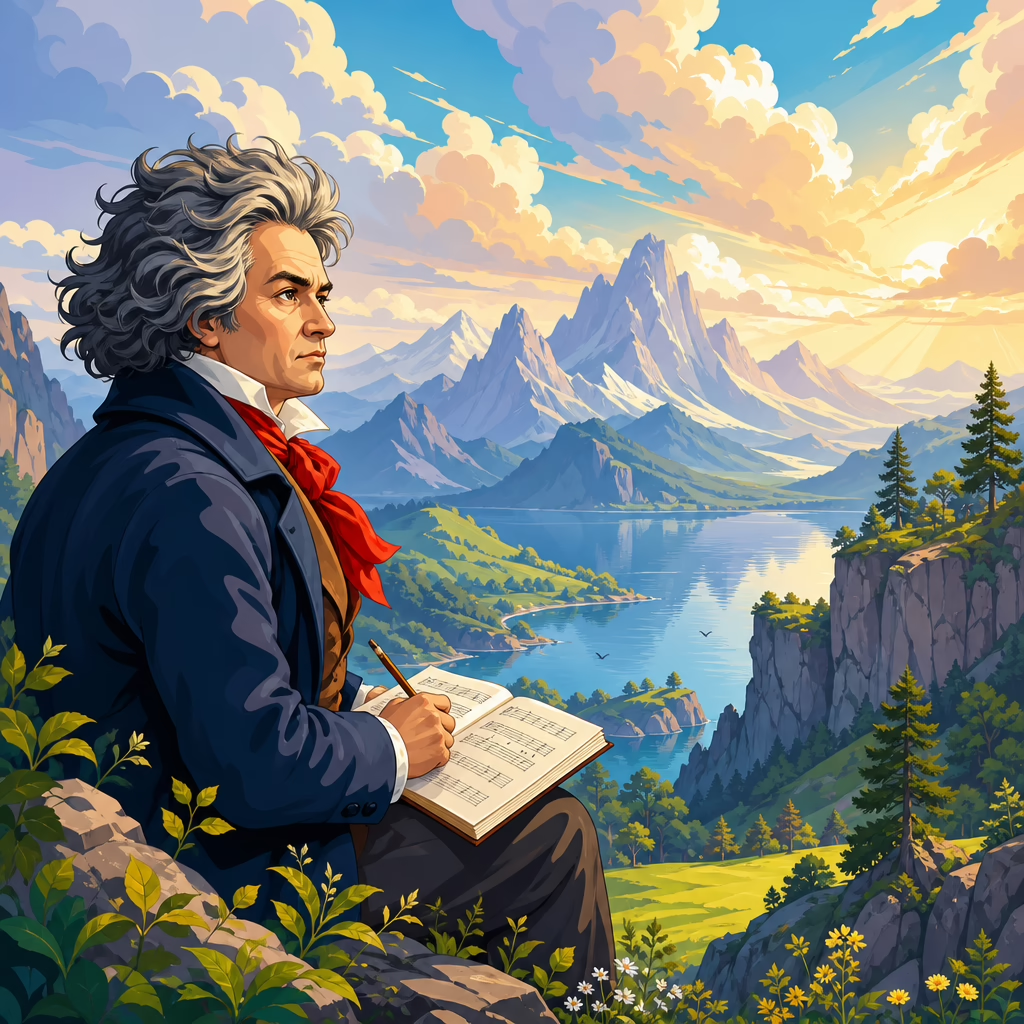
Beethoven and the Idea of the Sublime Landscape
Ludwig van Beethoven did not paint mountains or write travel books, yet few artists shaped the modern idea of the sublime landscape more powerfully than he did. In his music, landscape is never mere scenery. It becomes a field of force where scale, weather, distance, memory, and human feeling meet. The phrase sublime landscape refers to nature experienced as overwhelming, elevating, and partly beyond comprehension: not just pretty countryside, but cliffs, storms, vast skies, lonely paths, and the emotional intensity they awaken. Beethoven mattered to this idea because he turned natural experience into musical structure. He gave listeners ways to hear awe, threat, solitude, and release. That achievement influenced concert audiences, Romantic painters, poets, and later film composers alike. To understand Beethoven and the sublime landscape, it is necessary to look closely at how he transformed walking, observation, and acoustic imagination into works that sound larger than the room in which they are played.
When I have worked through Beethoven scores with performers, one point becomes clear very quickly: his “nature” is built through precise craft, not misty sentiment. He uses register, pedal points, dynamic range, rhythmic persistence, and abrupt harmonic turns to create spatial sensation. He also distinguishes between pastoral calm and the sublime. The pastoral offers repose, balance, and nearness; the sublime adds danger, immensity, and inner disturbance. Eighteenth-century writers such as Edmund Burke had already described the sublime as tied to terror, obscurity, power, and vastness, while Immanuel Kant later treated it as an experience in which the mind confronts what exceeds ordinary measure. Beethoven did not set these theories to music literally, but his works repeatedly enact their core drama. A quiet drone can suggest open land; a surge from pianissimo to fortissimo can feel like weather overtaking a traveler; a prolonged coda can resemble the mind standing before something too large to master at once.
This matters because Beethoven arrived at a historical turning point. Around 1800, Europeans were rethinking nature. Landscape gardening moved away from rigid geometric control. Alpine travel became culturally prestigious. Painters and writers sought scenes that fused beauty with danger. Beethoven’s music belongs inside that shift, but with a crucial difference: he made landscape temporal. A painting offers a view all at once. Beethoven offers approach, encounter, shock, and aftermath in sequence. That is why his landscape imagination still feels modern. It does not simply describe a brook or storm; it stages perception itself. For listeners interested in how music can evoke place without losing formal rigor, Beethoven remains the central case.
The historical meaning of the sublime in Beethoven’s world
In Beethoven’s Vienna, the sublime was not a vague compliment for anything grand. It was a serious aesthetic category. Burke’s 1757 treatise associated the sublime with astonishment, darkness, loudness, infinity, and power, contrasting it with the gentle attractions of beauty. Kant’s Critique of Judgment, published in 1790, divided the sublime into mathematical vastness and dynamic power, both of which challenge the senses while awakening a higher faculty of mind. These ideas circulated widely in educated Europe. Beethoven may not have cited them in letters, but the intellectual climate shaped the expectations of audiences and artists around him. The key point is that the sublime was experiential: one encountered it at waterfalls, storms, mountain precipices, and in art that recreated analogous feelings.
Beethoven’s originality was to join that vocabulary to sonata procedure and motivic development. Haydn had written memorable storms and sunrise moments, and Mozart could create grandeur with extraordinary economy. Beethoven went further by making the encounter with vast or threatening nature drive the whole form. In the “Waldstein” Sonata, Op. 53, the opening’s repeated harmonies and relentless momentum suggest horizon and propulsion rather than enclosed domestic music making. In the Fourth Piano Concerto, the spacious orchestral opening and later dramatic contrasts create a sense of exposed emotional terrain. Even works with no explicit nature title can operate as landscapes of scale and resistance.
That distinction matters because readers often overfocus on the “Pastoral” Symphony and miss the broader pattern. Beethoven’s sublime landscape is not one piece; it is a recurring way of organizing musical space. He favors long-range tension, bass foundations that feel geological, and climaxes that arrive like weather fronts rather than decorative peaks. The result is music that listeners experience physically. It stretches attention. It makes distance audible.
Walking, observation, and the conversion of terrain into sound
Beethoven’s relationship to landscape was practical before it was symbolic. He walked constantly around Vienna and in the surrounding countryside, carrying notebooks and developing ideas in motion. Friends and early biographers repeatedly connect his creative routine with outdoor wandering. Anyone wanting fuller context on that habit should see the main guide at Beethoven’s love of walking and what it meant for his music. The important point here is not simply that he liked fresh air. Walking gave him a bodily model for musical span: pacing, ascent, delay, interruption, sudden views, and return.
In rehearsal, I often describe certain Beethoven passages as topographical rather than melodic. A repeated-note figure can function like footsteps. A drone can anchor the ear the way a valley floor anchors sight. A distant horn call, whether literal or implied through interval and register, opens a scene beyond the immediate foreground. Beethoven knew these effects intimately because he experienced terrain as a moving listener, not as a painter fixed before a canvas. That is one reason his landscape writing rarely feels static. Even in stillness, there is expectancy.
He was also careful not to confuse imitation with expression. The famous note attached to the Sixth Symphony says the work is “more the expression of feeling than painting.” That statement is often quoted but not always unpacked. It means Beethoven did not want listeners reducing music to sound effects. Bird calls, thunder, and brook murmurs appear, but they matter only within a larger emotional and structural arc. Landscape becomes sublime when the natural scene opens inward onto consciousness. The storm is meteorological, yes, but it is also psychic and formal.
The “Pastoral” Symphony and the boundary between pastoral and sublime
Symphony No. 6 in F major, Op. 68, is the unavoidable center of this subject because it names scenes directly: arrival in the country, scene by the brook, peasants’ merrymaking, thunderstorm, and shepherds’ song. Yet the work is subtler than a sequence of postcards. The first movement’s flowing meters and drones establish habitation within landscape, not spectacle. The brook movement uses undulating accompaniment and sustained harmonic poise to suggest continuity. Then Beethoven breaks the frame. The storm movement compresses fear, disorientation, and elemental force into timpani rolls, tremolo strings, wind blasts, and destabilized harmony. The sublime enters exactly where the pastoral proves insufficient.
What makes this storm enduring is proportion. Beethoven does not linger for theatrical excess. He prepares it, unleashes it, and resolves it into thanksgiving. That trajectory resembles actual weather experience and also the classic sublime pattern described by philosophers: threatened self, confrontation with power, then reflective recovery. The finale’s gratitude is not decorative cheerfulness. It is the moral afterimage of survival. Listeners leave with a sharpened sense of nature’s generosity because they have also heard its indifference.
| Work or passage | Landscape idea | Musical method | Why it feels sublime |
|---|---|---|---|
| Symphony No. 6, Storm | Violent weather crossing open land | Tremolos, timpani, sudden dynamic surges, unstable harmony | Power exceeds human control before calm returns |
| Piano Sonata Op. 53 “Waldstein,” finale opening | Radiant distance and expanded horizon | Pedal haze, wide register, continuous propulsion | Space feels immense rather than room-sized |
| Violin Sonata Op. 47 “Kreutzer,” first movement | Elemental energy and exposed terrain | Extreme contrasts, large gestures, urgent rhythm | The listener confronts force, not decoration |
| Symphony No. 9, opening | Cosmic emergence from void | Open fifths, ambiguity, gradual accumulation | Vastness is heard before stable form fully appears |
The table shows why the Sixth Symphony should not be isolated from Beethoven’s larger language. Its scenic labels make things easier to recognize, but the techniques belong to a broader compositional practice. He creates sublimity through scale, instability, and directional energy, whether or not a score names a brook or storm.
Beyond the Sixth: how Beethoven makes space audible
Several major works without explicit landscape programs are indispensable to this topic. The “Waldstein” Sonata is a prime example. Its first movement drives forward with a brightness that feels less like salon brilliance than exposure to open air and distance. The finale begins with a shimmering sonority produced by pedal and register, creating an acoustic haze listeners often describe as moonlit or misted. That is not accidental romance imposed later; it is a spatial effect built into the keyboard writing. Beethoven enlarges the instrument’s field so the piano suggests atmosphere.
The “Kreutzer” Sonata, Op. 47, does something different. Its opening Adagio sets up a grave, almost ceremonial horizon, then the Presto erupts with astonishing force. Here the sublime is not scenic tranquility broken by weather but raw, unstable energy. Violin and piano become adversaries and companions crossing dangerous ground together. In performance, this work can feel like standing in high wind: exhilarating, difficult, and never fully secure.
The beginning of the Ninth Symphony offers one of Beethoven’s most influential landscape gestures. Out of open intervals and uncertain tonal definition, sound seems to gather from a distance rather than begin in a conventional way. Later composers learned from this. Bruckner, Mahler, and even film scorers inherited Beethoven’s idea that immensity can be created by making emergence itself the drama. The sublime landscape, in other words, may begin before any theme is fully visible.
Influence on Romantic landscape art and modern listening
Beethoven’s landscape imagination helped shape nineteenth-century Romanticism because it offered artists a model for treating nature as spiritually and psychologically charged. Caspar David Friedrich’s lonely figures before seas, mountains, or fog are not illustrations of Beethoven, but they share the same structure of feeling: the human being is small, aware, and transformed by confronting what exceeds measure. Writers from E. T. A. Hoffmann onward heard in Beethoven a new art of infinity. Hoffmann’s celebrated criticism of instrumental music essentially placed Beethoven at the center of a specifically Romantic sublime.
This legacy also explains why Beethoven still feels relevant in visual media. Modern cinema uses many of the same devices: low drones for scale, suspended harmony for uncertainty, sudden orchestral expansion for revelation or threat. When audiences hear a mountain vista underscored by swelling strings and brass, they are hearing techniques Beethoven consolidated into a persuasive language. Yet his originality remains unmatched because his effects arise from developmental logic, not just surface color. The storm in the Sixth matters because the entire symphony has prepared us to hear it as crisis within a lived environment.
The deepest lesson of Beethoven and the sublime landscape is that nature in art becomes powerful when form and perception are inseparable. He does not ask us merely to imagine hills, clouds, and thunder. He asks us to undergo distance, pressure, shock, and release in time. That is why his landscapes feel larger than description and more durable than fashion. If you want to hear how music can make the world seem vast without surrendering precision, start with the storm in the “Pastoral,” then listen outward to the “Waldstein,” the “Kreutzer,” and the opening of the Ninth. Beethoven will show you that the sublime is not scenery. It is an encounter that changes the listener.
Frequently Asked Questions
What does “the sublime landscape” mean in relation to Beethoven?
In Beethoven’s case, the sublime landscape does not refer to painted scenery or literal descriptions of mountains, forests, and skies. It refers to a way of experiencing nature as immense, emotionally charged, and only partly understandable. The sublime is different from the merely beautiful. Beauty suggests harmony, charm, and balance; the sublime introduces vastness, danger, awe, distance, and a feeling that human perception is reaching beyond its normal limits. When listeners connect Beethoven to the idea of the sublime landscape, they are recognizing how his music can create the sensation of standing before something larger than oneself.
That is why Beethoven matters so much to the modern imagination of nature. He does not simply decorate his music with pastoral details. Instead, he turns nature into a field of force where weather, scale, memory, struggle, and transcendence all interact. In his music, a quiet open interval can suggest distance, a sudden surge in dynamics can feel like elemental power, and a long unfolding structure can resemble a journey through changing terrain. Even when there is no explicit program, listeners often hear cliffs, storms, open space, lonely paths, and vast skies because Beethoven composes in ways that make feeling and landscape seem inseparable. The result is a powerful artistic model of nature not as background scenery, but as a place where human emotion encounters immensity.
How did Beethoven shape the modern idea of landscape if he was not a painter or travel writer?
Beethoven shaped the modern idea of landscape through sound, form, and emotional architecture rather than through visual representation. Many artists describe nature by showing it directly, but Beethoven did something more influential in some respects: he taught audiences how nature could be felt. His music gave listeners an inner experience of expansiveness, turbulence, solitude, elevation, and release. This was especially important in a period when European culture was increasingly fascinated by mountains, storms, ruins, wilderness, and the emotional power of remote places. Beethoven’s works helped translate those cultural interests into musical experience.
His influence comes from the fact that he makes landscape dynamic rather than static. A Beethoven movement often unfolds like an encounter with changing conditions: a distant horizon becomes a struggle, calm gives way to pressure, motion expands into grandeur, and disruption opens onto revelation. This kind of musical thinking strongly parallels the way the sublime landscape was imagined in literature, philosophy, and visual art of the late eighteenth and early nineteenth centuries. He also had an enormous impact on later composers, writers, and listeners, many of whom came to understand nature through a Beethovenian lens. In that sense, he did not need to paint a mountain to shape how generations imagined one. He created the emotional grammar through which modern audiences could hear landscape as spiritual, dramatic, and transformative.
Is Beethoven’s “Pastoral” Symphony the main example of sublime landscape in his music?
The Sixth Symphony, known as the “Pastoral,” is certainly the most obvious starting point, but it is not the whole story. The symphony is famous because Beethoven openly links it to countryside experience, giving movements titles such as “Scene by the Brook” and “Thunderstorm.” Yet even here, he makes clear that the work is “more the expression of feeling than painting.” That statement is crucial. He is not trying to imitate nature in a simple descriptive way. He is exploring what it feels like to be immersed in natural surroundings: tranquility, spaciousness, gathering tension, fear, gratitude, and renewal. The storm, for example, matters not just as meteorology but as an emotional and existential event.
At the same time, the sublime landscape extends far beyond the “Pastoral” Symphony. It can be heard in the monumental breadth of the “Eroica,” in the open, searching character of the late piano sonatas, in the spiritual altitude of the Missa solemnis, and in the immense journey from darkness to exaltation in the Ninth Symphony. Beethoven repeatedly composes experiences of distance, exposure, resistance, and breakthrough that resemble encounters with powerful natural environments. So while the “Pastoral” is the clearest direct example, the larger truth is that Beethoven’s landscape imagination is embedded across his style. He continually invites listeners into spaces that feel larger than domestic life or polished salon culture. Those spaces, whether named or unnamed, are where the sublime often emerges.
What musical features make Beethoven’s music feel like landscape?
Several musical features contribute to this effect. One is scale. Beethoven often builds large spans of tension and release, allowing a movement to feel like a journey across great distance rather than a compact statement. Another is contrast. Sudden changes in dynamics, texture, rhythm, and harmony can create the sensation of shifting weather, broken terrain, or abrupt changes in emotional altitude. He also uses repetition in a distinctive way. Rather than sounding merely decorative, repeated motives can feel like footsteps, waves, pulses of energy, or the persistence of an idea moving through space.
Orchestration and register also matter. High sustained lines can suggest air, light, or remoteness; low sonorities can imply depth, weight, or threat. Wide spacing between parts may evoke openness, while dense textures can feel stormy, enclosed, or overwhelming. Beethoven’s handling of rhythm is equally important: propulsion can resemble forward movement through terrain, while suspended moments can feel like pauses before a vista or moments of listening in solitude. Perhaps most importantly, he binds all of this to human inwardness. His music does not merely sound big; it makes the listener feel small, challenged, uplifted, or transformed in relation to that bigness. That psychological dimension is what turns musical effect into landscape experience and landscape experience into the sublime.
Why does Beethoven’s idea of the sublime landscape still matter today?
It still matters because modern audiences continue to look to art for ways of understanding their relationship to nature, scale, and emotional intensity. Beethoven offers a vision of landscape that is not superficial or touristic. Nature in his world is not just pleasant scenery to consume; it is something that unsettles, enlarges, and tests the self. That remains deeply relevant in an age shaped by environmental anxiety, urban life, and a widespread hunger for experiences of genuine wonder. His music reminds listeners that landscape can be inward as well as outward, and that encounters with the nonhuman world can change how we think and feel.
Beethoven also remains important because he helped establish a lasting cultural language for awe. When contemporary listeners hear music that swells toward vastness, moves through storm and struggle, or opens into radiant stillness, they are often responding to patterns that Beethoven intensified and made central to the Western musical imagination. His work continues to influence film scores, concert music, and popular ideas about grandeur and transcendence. More than two centuries later, he still provides one of the clearest artistic models for how nature can be experienced not as decoration, but as a profound meeting point between the external world and the deepest capacities of human feeling.