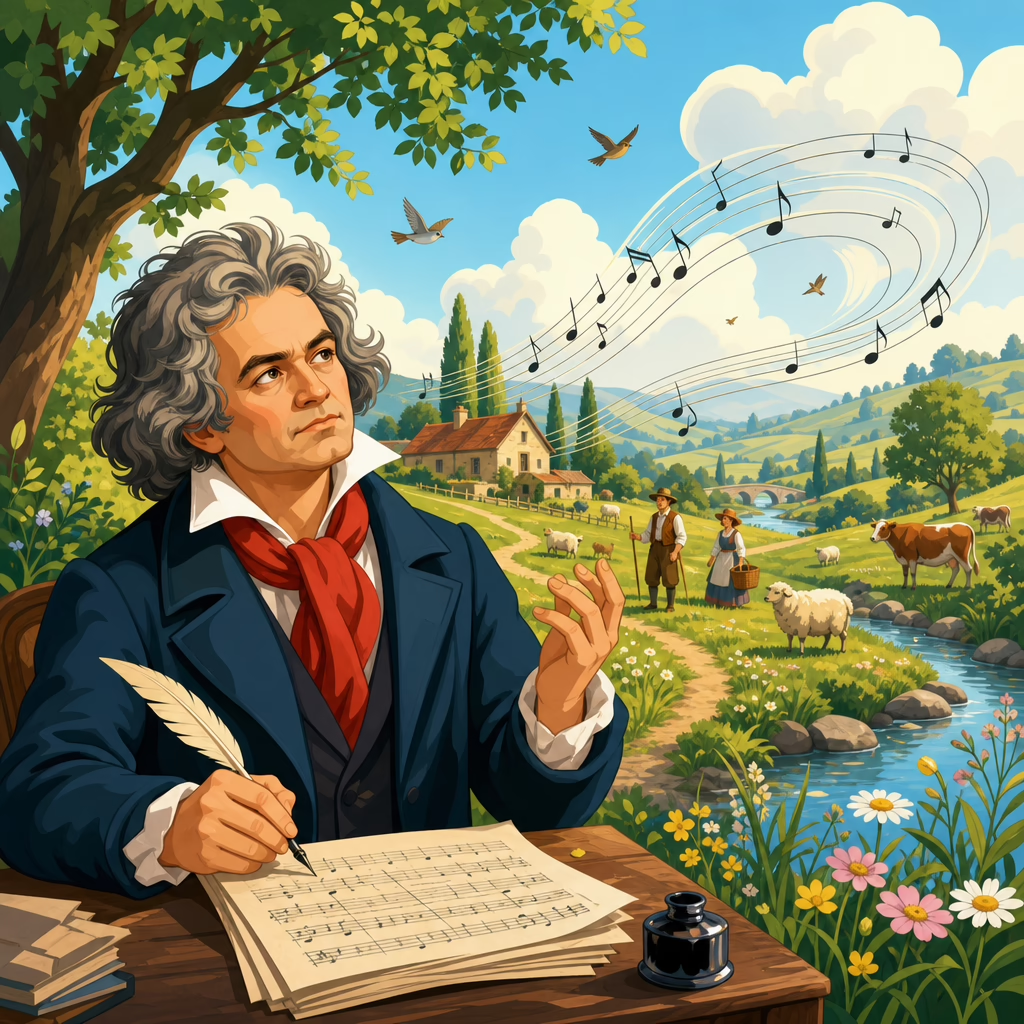
How Beethoven Imagined Country Life in Sound
How Beethoven imagined country life in sound comes into sharp focus in his Symphony No. 6 in F major, Op. 68, the “Pastoral,” a work that does not merely describe rural scenery but translates lived experience into musical form. When musicians and listeners speak about “country life” in Beethoven, they usually mean more than birdsong, streams, and storms. They mean a whole network of ideas: walking beyond city walls, noticing weather and terrain, feeling human emotion settle in open air, and discovering that nature can shape rhythm, harmony, pacing, and orchestral color. I have worked through this score in rehearsal rooms, at the keyboard, and bar by bar on the page, and what stands out most is Beethoven’s precision. He was not painting a vague Arcadia. He was organizing sound so that listeners could sense motion, rest, celebration, disruption, and gratitude as if they were physically present.
The “Pastoral” matters because it sits at the center of a long argument about what instrumental music can communicate. Beethoven gave each movement a heading, yet he famously clarified that the symphony was “more the expression of feeling than painting.” That distinction is essential. Tone painting imitates external things directly: a bird call, thunder, a peasant dance. Expression of feeling goes further. It asks how the body and mind respond to an environment. In practical terms, Beethoven used melodic contour, pedal points, drone-like basses, repeating rhythmic cells, and carefully controlled harmonic pacing to suggest the experience of being in the countryside. The result is one of the clearest examples in Western music of landscape becoming structure rather than decoration.
To understand how Beethoven achieved this, it helps to define a few terms. Program music refers to instrumental music linked to an extra-musical idea, scene, or narrative. Motive means a short musical idea that can be repeated and transformed. Orchestration is the distribution of musical material across instruments. Form describes the large-scale design of a movement. In the “Pastoral,” all four work together. A murmuring accompaniment can suggest flowing water, but its deeper role is to steady the pulse and create an atmosphere of continuity. A rustic dance tune can sound simple, yet Beethoven places it within a sophisticated formal plan. Country life, in this symphony, is imagined through craft.
Biographical context matters too, because Beethoven’s response to nature was habitual rather than occasional. He walked constantly, especially in and around Vienna’s outskirts, carrying sketch materials and storing up impressions that later entered his compositions. For a broader view of how those walks informed his creative life, see this guide to Beethoven’s love of walking and what it meant for his music. In the “Pastoral,” those habits become audible. This is not a salon fantasy of the countryside composed by someone observing from a distance. It is music shaped by repeated contact with fields, brooks, village bands, changing skies, and the emotional reset that open land can provide.
Beethoven’s rural imagination was built from movement, memory, and form
Beethoven began the Sixth Symphony around the same period as the Fifth, and the pairing is instructive. The Fifth is often heard as concentrated struggle; the Sixth unfolds through spaciousness and recurrence. That contrast tells us something about how Beethoven imagined country life. He did not abandon discipline when writing about nature. Instead, he slowed certain kinds of musical urgency and allowed patterns to breathe. The first movement, “Awakening of cheerful feelings upon arriving in the countryside,” starts not with a dramatic proclamation but with a relaxed, grounded theme built from simple intervals and repeated notes. Those repetitions matter. They resemble the mental settling that happens during a walk when the ear adjusts to recurring natural sounds.
One of Beethoven’s most effective techniques here is rhythmic regularity. The accompaniment often creates a gently rocking motion, avoiding the sharp instability that would suggest urban agitation or theatrical conflict. The harmony moves with confidence but without hurry. In rehearsal, this movement only comes alive when players resist the temptation to make every phrase goal-driven. Beethoven’s imagined countryside is not static, yet its energy is cyclical rather than combative. That is a profound compositional choice. He captures the way country paths invite steady physical motion while also widening attention. We hear progress, but we also hear room for observation.
The first movement’s sonata form strengthens this impression. Themes return recognizably, but they also absorb what has happened in between. This resembles memory during a long walk: landmarks recur, though one’s mood has changed. Beethoven’s development section does not treat nature as a pretext for chaos. It explores and rebalances. Even when textures thicken, the music retains a sense of groundedness through sustained bass support and recurring rhythmic figures. Country life, as Beethoven imagines it, is not sentimental escape. It is a state in which thought, motion, and environment align.
The brook scene turns natural detail into musical process
The second movement, “Scene by the brook,” is often cited for its obvious imitations: flowing accompaniment and, near the close, notated bird calls for nightingale, quail, and cuckoo. Those details are famous, but they are not the movement’s real achievement. Its deeper originality lies in how Beethoven converts the idea of water into duration. The brook is not a sound effect placed on top of a normal slow movement. It governs the movement’s texture, pulse, and harmonic patience from beginning to end.
Listen to the lower strings and accompanying figures and you hear almost continuous motion, usually in even note values that avoid abrupt accentuation. This creates what performers call a maintained current. Above that current, woodwinds and strings exchange melodic fragments that feel less declamatory than conversational. Beethoven keeps the melodic line flexible, often allowing it to hover rather than push. The effect is psychologically exact. Sitting by water can sharpen attention while slowing internal time. Beethoven reproduces that altered sense of time through long spans of stability interrupted by delicate inflections.
The bird calls at the end are best understood as a frame, not a climax. Beethoven labels the flute as nightingale, oboe as quail, and clarinet as cuckoo. This has encouraged generations of listeners to hear the movement as straightforward realism, but the realism is selective. Real brooks do not organize themselves in ternary or sonata-related proportions, and real birds do not arrive as neatly cataloged instrumental emblems. Beethoven is doing something more interesting. He establishes a contemplative field and then places recognizable signs within it, almost as if confirming that the emotional state we have been inhabiting belongs to an outdoor world. The named birds verify the setting, but the setting has already been built by texture.
Rustic dance and village celebration are stylized, not naive
The third movement, “Merry gathering of country folk,” shifts from solitude to community. Here Beethoven draws on idioms associated with peasant and village music: repeated phrases, stomping accents, drones, open intervals, and humorously rough edges in contour. Yet nothing in the writing is crude. He stylizes rustic music for the concert hall while preserving enough asymmetry and weight to suggest real bodies dancing. The accent patterns can feel slightly off-balance, which is precisely why the movement sounds alive. Country festivity is not courtly elegance.
One reason this section works so well is Beethoven’s command of orchestral character. Winds often carry dance-like material with a pungent directness that contrasts with smoother string writing elsewhere in the symphony. Bass lines can sound intentionally earthbound, reinforcing the sense of feet on the ground. In performance, if the trio-like episodes become too polished, the social picture weakens. Beethoven wanted animation, not prettiness. He understood that communal rural life included noise, repetition, and exuberance. By embedding those traits in phrase structure and articulation, he gives the scene credibility.
| Movement | Scene or idea | Main musical method | Why it suggests country life |
|---|---|---|---|
| I | Arrival in the countryside | Repeated-note themes, steady pulse, broad phrasing | Conveys walking, ease, and mental release |
| II | Brook scene | Continuous accompaniment, soft wind dialogue, bird calls | Creates flowing time and focused listening |
| III | Village gathering | Rustic dance rhythms, drones, heavy accents | Suggests communal festivity and physical movement |
| IV | Thunderstorm | Tremolos, low-register drive, sudden dynamic force | Introduces natural disruption and vulnerability |
| V | Shepherds’ song | Hymn-like melody, clarified harmony, gentle reprise energy | Expresses relief, gratitude, and restored balance |
Importantly, the third movement does not stand alone. Beethoven links it directly into the storm, making celebration vulnerable to interruption. That transition is one of the symphony’s most realistic gestures. Country life is not just idyllic stillness; it is exposure. Weather can overturn human plans instantly. By refusing a clean break between dancing and disturbance, Beethoven places people within nature rather than above it.
The storm is dramatic because the whole symphony has prepared for it
The fourth movement, “Thunderstorm,” is brief compared with the surrounding panels, but its impact is enormous. Beethoven uses timpani, trombones, piccolo, driving scales, tremolos, and abrupt dynamic surges to depict gathering wind, rain, thunder, and lightning. On the page, these devices can look obvious. In context, they are devastating because the preceding music has established continuity, warmth, and sociability. The storm breaks that continuity by fragmenting texture and destabilizing rhythmic confidence.
What I find most compelling in this movement is Beethoven’s refusal to turn the storm into pure spectacle. Yes, it is theatrical, and audiences then and now respond immediately to its sonic violence. But structurally it functions as a test. It introduces contingency into a symphony that has so far relied on organic flow. Harmonic motion becomes more urgent, orchestral registers widen, and the listener loses the secure footing that characterized earlier movements. This is how Beethoven imagines weather: as a force that changes human orientation.
There is also restraint in the writing. The storm does not dominate the work’s proportions, which would have shifted the symphony toward sensationalism. Instead, Beethoven gives disruption its due and then moves beyond it. That proportion reflects a mature understanding of rural experience. Storms matter because they are temporary yet unforgettable. Their meaning lies partly in what follows.
Gratitude after the storm completes Beethoven’s idea of nature
The finale, “Shepherds’ song; happy and thankful feelings after the storm,” is where Beethoven’s conception of country life becomes ethically clear. The point is not merely that sunshine returns. The point is that renewed calm is experienced as gratitude. Musically, Beethoven signals this through clarified harmony, buoyant but unforced rhythm, and melodies that feel hymn-like without becoming liturgical quotation. The movement restores balance, but it does not erase what happened. Relief carries memory inside it.
This finale is often played too generally, as if any warm major-key ending would do. In fact, Beethoven is highly specific. The shepherds’ character comes through in the simplicity of melodic profile and the pastoral associations of drone and pipe-like wind color. At the same time, the movement’s architecture remains symphonic. Beethoven does not retreat into decorative genre music. He integrates rustic signifiers into a finale that resolves the emotional and formal arc of all five movements. That integration is the work’s genius.
The broader lesson is that Beethoven imagined country life as a cycle of orientation: arrival, contemplation, gathering, disruption, thanksgiving. Each stage has its own sonic world, but each also transforms material expectations established earlier. That is why the “Pastoral” still feels persuasive. It does not ask modern listeners to believe in a flawless rural paradise. It shows human beings finding proportion within a natural order larger than themselves.
Beethoven imagined country life in sound by doing much more than imitating nature. He translated the countryside into rhythm, form, texture, and emotional sequence, creating a symphony that feels observed, inhabited, and remembered. The “Pastoral” remains the clearest musical answer to a simple question: how can instrumental music make listeners sense place without words? Beethoven’s answer was to treat landscape as a force that shapes attention. The first movement gives us release on arrival, the brook teaches us how to listen, the village dance grounds us in community, the storm exposes vulnerability, and the finale turns survival into gratitude.
That is why this work continues to matter for performers, scholars, and ordinary listeners. It demonstrates that depictions of nature become powerful when they are structural rather than superficial. The birds, the brook, and the thunder are memorable, but the lasting impression comes from Beethoven’s command of pacing and return. He understood that country life is not a postcard. It is a pattern of bodily motion, weather, social ritual, and reflective feeling. In the “Pastoral,” those experiences are organized with exceptional economy and authority.
If you want to hear Beethoven’s relationship with nature at its most focused, return to the Sixth Symphony and follow its five movements as one continuous outdoor drama. Listen for the recurring pulse of walking, the patience of the brook, the rough joy of the dance, the storm’s rupture, and the final hush of thanks. The more closely you listen, the more clearly you will hear how Beethoven imagined country life not as scenery, but as a way of being in the world.
Frequently Asked Questions
What does Beethoven mean by “country life” in the “Pastoral” Symphony?
In Beethoven’s Symphony No. 6 in F major, Op. 68, the idea of “country life” goes far beyond simple musical imitation of nature. He is not just painting a pretty outdoor scene or adding birdsong for decorative effect. Instead, he translates the emotional, physical, and even philosophical experience of being in the countryside into sound. That means the symphony reflects the sensation of leaving behind urban pressure, moving through open landscapes, observing weather, hearing water and animal life, and feeling the mind become calmer and more expansive in nature.
Beethoven himself helped define this approach by indicating that the symphony was “more an expression of feeling than painting.” That statement is essential. It tells listeners that the work should not be understood as a literal sound-effects piece. The countryside here is a lived environment, one that shapes perception and emotion. The music captures how a person feels in nature: the ease of walking, the serenity of flowing streams, the liveliness of village gathering, the terror and grandeur of a storm, and finally the deep gratitude that follows renewal and calm.
So when people say Beethoven imagined country life in sound, they usually mean that he turned rural experience into musical structure, pacing, mood, and gesture. The “Pastoral” is not a postcard of the countryside. It is a dramatic, reflective, and highly crafted musical meditation on how human beings encounter the natural world.
How does the “Pastoral” Symphony musically represent nature without becoming mere sound imitation?
Beethoven uses recognizable natural references, but he integrates them into the symphony’s larger emotional and formal design. That is what keeps the work from sounding like a collection of effects. For example, the famous scene by the brook includes flowing rhythms and gently undulating lines that suggest water, but the movement is also a carefully sustained study in calm, continuity, and listening. The stream is not only something seen in the distance; it becomes a musical environment in which time seems to slow and the listener’s awareness becomes more attentive.
Similarly, Beethoven includes bird calls near the end of the brook movement, with instruments associated with specific birds. Yet these details are brief and purposeful. They do not overwhelm the music or turn it into novelty. Instead, they sharpen the listener’s sense that the natural world is alive with distinct presences. Nature is rendered as texture, atmosphere, and relationship, not just as imitation. Beethoven’s craft lies in making these references feel organic to the movement’s emotional landscape.
The same principle applies to the storm movement. Thunder-like timpani, rushing strings, and forceful dynamics clearly evoke violent weather, but the storm also functions as a dramatic turning point within the symphony. It interrupts pastoral ease, introduces danger and instability, and then gives way to a mood of relief and thanksgiving. In other words, Beethoven uses descriptive material in service of a broader expressive arc. Nature in the “Pastoral” is not decorative scenery; it is an active force that shapes human feeling and musical form alike.
Why is the “Pastoral” Symphony so important for understanding Beethoven’s relationship with nature?
The “Pastoral” Symphony is central because it reveals just how deeply nature mattered to Beethoven, both personally and artistically. He was known to value long walks in the countryside and to seek restoration outside the city. For him, nature was not merely pleasant background. It was a source of energy, reflection, solitude, and spiritual orientation. The Sixth Symphony gives that bond a major symphonic form, showing that his engagement with the natural world was profound enough to shape one of his most original orchestral statements.
This is especially important because Beethoven is often described in terms of struggle, heroism, and overpowering dramatic force. While those qualities are certainly part of his music, the “Pastoral” broadens the picture. It shows a composer capable of patience, tenderness, sustained observation, and gratitude. The symphony presents an alternative to the image of Beethoven as only defiant and titanic. Here he is attentive, receptive, and open to the rhythms of the nonhuman world.
The work also matters historically because it expands what a symphony could express. Beethoven demonstrates that a large instrumental work can explore environment, mood, memory, and human-nature connection without relying on words. That achievement influenced later composers who sought to depict landscapes, seasons, weather, and rural life in orchestral music. In that sense, the “Pastoral” is not just evidence of Beethoven’s personal love of nature; it is a landmark in the history of musical imagination.
How do the five movements of the “Pastoral” Symphony create a picture of rural experience?
The five-movement design is one of the clearest ways Beethoven turns country life into an unfolding experience rather than a static scene. The first movement, often understood as an awakening of cheerful feelings on arriving in the countryside, establishes the basic emotional premise. It is not a grand entrance but a release into openness. The themes feel spacious, recurring, and grounded, as if the listener is settling into the pace of walking and breathing outside the city.
The second movement, the scene by the brook, deepens that experience through sustained calm and close attention. Here Beethoven narrows the focus from general arrival to a more intimate encounter with place. The music suggests flowing water, stillness, and the subtle activity of surrounding life. It is less about action than about presence, which is part of why this movement feels so absorbing and humane.
The third movement shifts to social energy with a gathering of country folk. Beethoven does not idealize this as elegant or refined. Instead, he gives it vitality, humor, and a touch of rustic roughness. This matters because country life, in his imagination, includes people as well as landscape. The rural world is communal, embodied, and festive. The sudden storm that follows breaks into this celebration with striking force, reminding listeners that nature is not always gentle. Then the final movement, often heard as a shepherd’s song of thanksgiving, resolves the entire journey in gratitude and restored peace. Taken together, the movements form an arc of arrival, contemplation, community, disruption, and renewal. That sequence is one reason the symphony feels so vivid and complete.
Is the “Pastoral” Symphony just about pleasant scenery, or does it express something deeper?
It expresses something much deeper than pleasant scenery. Although the symphony is full of warmth and sensory richness, its real subject is the relationship between human inwardness and the natural world. Beethoven is exploring how landscape affects feeling, how weather changes perception, how open space can quiet mental agitation, and how exposure to nature can lead to reflection, humility, and thanks. In that sense, the work is psychological and even spiritual as much as it is descriptive.
The storm is a particularly important clue. If the symphony were only about charming rural images, there would be little need for such an intense interruption. But Beethoven includes it because country life is not a fantasy of endless calm. Nature contains instability, power, and unpredictability. The symphony therefore acknowledges that being in the countryside means encountering forces larger than oneself. The final thanksgiving movement becomes more meaningful because it follows disturbance rather than bypassing it.
Many listeners also hear in the “Pastoral” a model of balance: between human life and environment, between observation and emotion, and between individual feeling and larger natural processes. That is why the work continues to resonate so strongly. It does not simply ask us to picture fields, birds, or brooks. It invites us to hear what happens when a composer transforms the experience of being outdoors into a full emotional journey. The result is not background music for scenery, but one of Beethoven’s most eloquent statements about attention, vulnerability, and joy in the world beyond the city.