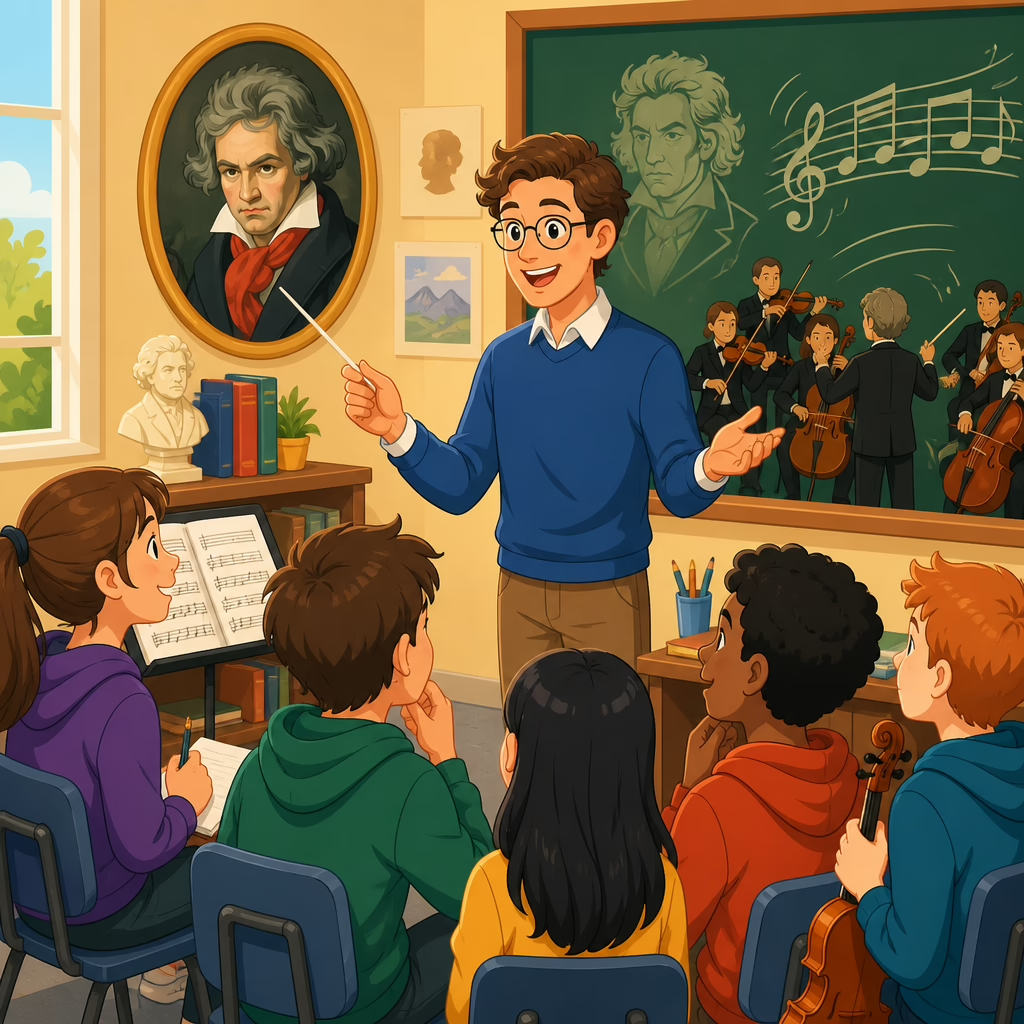
Teaching the Eroica Symphony in the Classroom
Teaching the Eroica Symphony in the classroom gives students a vivid way to hear how music can express conflict, ambition, grief, and triumph while also revealing a major turning point in Western art music. Beethoven’s Symphony No. 3 in E-flat major, Op. 55, commonly called the Eroica Symphony, is not simply a long orchestral work from the early nineteenth century. It is a piece that expanded the scale of the symphony, challenged listeners’ expectations, and helped define what teachers now describe as the beginning of Beethoven’s middle period. In practical classroom terms, that means students can study one work and encounter form, rhythm, orchestration, historical context, political ideals, and active listening all at once.
When I have taught the Eroica Symphony, the first hurdle has never been student resistance to classical music. It has been scale. The piece is longer, denser, and more structurally ambitious than many classroom listening examples. Yet that difficulty is exactly why it matters. Students quickly sense that this music is trying to do something larger than entertain. They hear disruptive accents, a funeral march that feels weighty and public, a scherzo with startling energy, and a finale built on transformation rather than a simple tune repeated for comfort. Once those features are named and demonstrated, the work becomes teachable.
Defining a few key terms at the start helps. A symphony is a large-scale orchestral composition, usually in multiple movements. A movement is a self-contained section within a larger work. Sonata form, which shapes much of the first movement, typically includes exposition, development, and recapitulation, though Beethoven stretches each part dramatically. Theme and variations, central to the finale, means a musical idea returns in altered forms. Programmatic music tells an explicit story; the Eroica Symphony is not fully programmatic, but it invites narrative thinking through its title, gestures, and historical associations. Students do not need advanced theory to engage these concepts, but they do need language precise enough to describe what they hear.
The historical background also deserves direct explanation. Beethoven originally associated the symphony with Napoleon Bonaparte, whom he admired as a symbol of republican ideals. According to early accounts, Beethoven became enraged when Napoleon declared himself emperor and removed the dedication. Whether every detail of that story has been polished by repetition, the broader context is sound: the Eroica emerged from a Europe reshaped by revolution, warfare, and shifting ideas about heroism. That context matters in class because it moves discussion beyond “happy” or “sad” reactions. Students can ask what heroism sounds like, whether a hero can fail, and how music reflects public ideals without using words.
Start with listening goals, not biography
A common mistake is spending too long on Beethoven’s life before students hear the music. Biography is useful, but listening goals should come first. I begin with a simple question: what makes the opening unforgettable? Students can identify the two forceful E-flat major chords immediately, even without technical vocabulary. Those chords function as a declaration. From there, the cello theme enters in an unexpectedly exposed way, allowing students to track a main idea from the start. Asking students to map tension, surprise, and return gives them a reason to listen actively rather than passively waiting for the teacher’s explanation.
For elementary and middle grades, shorter curated excerpts work better than assigning the entire symphony at once. The opening minute of the first movement, a focused passage from the development, the main section of the Funeral March, the horn-driven Scherzo, and a variation from the finale provide a manageable sequence. Older students can then connect those excerpts into the full four-movement design. This staged approach prevents cognitive overload and lets the class revisit recurring ideas. If you need broader sequencing support, link students or fellow teachers to the main planning resource at Beethoven lesson plans for elementary music classes, then return to the Eroica as a sustained case study.
Clear objectives keep the lesson focused. Students should be able to identify the four movements, describe how Beethoven expands expectations, recognize the Funeral March as a contrasting second movement, and explain at least one way the finale transforms earlier material. Those outcomes are measurable. They can be assessed through exit tickets, listening maps, brief discussions, or comparative writing. The most successful lessons I have run avoid asking students whether they “like” the piece until after they can describe what it does. Informed reaction is more meaningful than first-impression preference.
Teach the first movement as a study in musical disruption
The first movement, Allegro con brio, is one of the best classroom demonstrations of how a composer can stretch form without abandoning it. In plain terms, Beethoven takes a familiar structure and makes it more dramatic, more unstable, and much longer. The opening theme does not settle into polite symmetry. Syncopations, sforzando accents, and abrupt harmonic turns make the music feel restless. One famous detail teachers should highlight is the early C-sharp, a note outside the home key that jolts the ear and signals that the journey will not remain comfortable. Students often notice that something sounds “wrong” or tense before they can explain why. That instinct is valuable evidence of close listening.
Another teachable moment comes in the development section, where Beethoven treats motives as raw material for argument. Rather than merely repeating themes, he fragments them, sequences them, and drives them through distant harmonic regions. This is where students can learn that development in sonata form is not decoration. It is where ideas are tested. I often compare it to revising a paragraph under pressure: the original sentence is still there, but it is broken apart, challenged, and rebuilt. When students hear the famous horn entrance that seems to announce the recapitulation early, they also discover that surprise can be structural, not just loud.
Because the movement is expansive, visual organization helps. A comparison chart can anchor what students should listen for in each movement without reducing the music to a worksheet.
| Movement | Main character | Key teaching focus | Listening cue |
|---|---|---|---|
| I. Allegro con brio | Bold, unstable, argumentative | Expanded sonata form | Two opening chords and disruptive accents |
| II. Marcia funebre | Solemn, public, grieving | Processional rhythm and contrast | Steady march pulse and dark orchestral color |
| III. Scherzo | Light, urgent, explosive | Rhythmic energy and orchestral contrast | Whispered opening and horn calls in the trio |
| IV. Finale | Inventive, cumulative, victorious | Theme and variations | Repeated bass idea becoming many textures |
With high school students, score study can deepen this section. Even a reduced score or projected opening page lets them see that the theme begins in the cellos rather than the violins, a choice that immediately affects color and authority. If full notation is too advanced, use a conductor video and ask students to count visible entrances, dynamic changes, or moments when strings and winds trade prominence. The point is to connect musical structure to observable evidence.
Use the Funeral March to connect sound, history, and emotion
The second movement, Marcia funebre: Adagio assai, is often the emotional center of classroom study because students can grasp its character quickly while still uncovering deeper layers over time. A funeral march is not merely slow music. It combines processional rhythm, ceremonial gravity, and collective expression. Beethoven writes a movement that sounds public rather than private, as though grief is being enacted before witnesses. That distinction matters. Students can compare the sense of communal mourning here with more intimate laments they may know from film or song.
This movement also opens rich discussion about how composers shape emotion through texture and contour rather than lyrics. The minor mode, dotted rhythms, low strings, and restrained pacing establish solemnity. But the movement does not remain static. Episodes build toward intensification, then collapse back into exhaustion. I ask students to track where the music seems to stand upright with resolve and where it seems to bend under weight. Those physical metaphors help them describe phrasing and dynamic contour without forcing abstract theory too early.
Historically, this is a strong point to revisit the idea of heroism. If the first movement presents striving, the second confronts loss. Some teachers frame the movement as evidence that heroic narratives include sacrifice and mourning, not just victory. That interpretation is pedagogically useful as long as it is presented as a reading supported by musical evidence, not as a fixed story Beethoven officially narrated. Students should learn to distinguish between documented history and interpretive listening. That practice builds critical thinking alongside musical understanding.
Highlight contrast in the Scherzo and invention in the finale
The third movement replaces the older minuet with a scherzo of extraordinary volatility. In classroom language, a scherzo is faster, sharper, and more unpredictable than the courtly dance it displaced. The whispered opening gives the impression of motion gathering from almost nothing, then the full ensemble erupts. Students respond strongly to this contrast because it is easy to hear and physically feel. Have them describe the opening in verbs: creeping, flickering, charging, bursting. Those words lead naturally into discussion of articulation, dynamics, and ensemble coordination.
The trio section is essential because of the horn writing. Beethoven uses three horns, unusual for the time, to create a sonority associated with hunting calls, open air, and ceremonial power. Even young listeners can hear that the sound world changes. This is a good moment to discuss orchestration as a compositional decision, not a neutral backdrop. Why horns here? Why does the trio feel broader and more expansive than the scherzo material around it? When students answer with specific sonic evidence, they begin listening like musicians.
The finale can be the hardest movement to teach if it is introduced as “just variations.” In reality, Beethoven builds a complex structure from a bass line and theme he had used in earlier works, including the ballet The Creatures of Prometheus and the E-flat major Contredanse, WoO 14. This cross-reference gives teachers a concrete example of a composer reworking material across genres. Students can hear that creativity does not always mean inventing from nothing. It often means returning to an idea and finding greater potential in it. That is an important artistic lesson in any classroom.
In practice, guide students to notice how the finale unveils material gradually. At first the bass line appears with minimal context. Then texture, counterpoint, rhythmic animation, and full thematic statements accumulate. The result is not a single melody repeated with surface changes. It is an argument about transformation. By the closing pages, students should hear that the finale resolves the symphony not by erasing struggle but by mastering it through invention and control.
Build activities that move from response to evidence
Effective Eroica lessons work best when students move through three stages: immediate reaction, guided noticing, and evidence-based interpretation. A first listen might ask for only one sentence: what did the music seem to do? A second listen adds a target such as rhythm, instrumentation, or contrast. A third listen asks for evidence: which passage created that effect, and how? This progression mirrors how musicians and informed audiences actually listen. It also keeps discussion from drifting into unsupported opinion.
Assessment does not need to be elaborate. Students can label movement excerpts, compare the first and second movements in a short paragraph, or explain how the finale demonstrates variation technique. Ensemble classes can extend the work by performing reduced motives, clapping rhythmic cells, or tracing phrase lengths. General music classes can build timeline activities that connect the symphony’s 1803–1804 composition period, the first public performance in 1805, and Beethoven’s changing reputation in Vienna. Across grade levels, the strongest results come when historical context serves listening rather than replacing it.
Teachers should also acknowledge limitations. The Eroica Symphony demands time, repeated exposure, and careful excerpt selection. Some students will initially find it long or emotionally distant. That is not failure; it is normal. The remedy is structure, not simplification. Give students specific entry points, revisit them across several lessons, and let the music’s scale become part of the lesson rather than a problem to hide. When taught this way, the work becomes one of the clearest examples of how close listening can deepen historical understanding and emotional vocabulary.
Teaching the Eroica Symphony in the classroom succeeds when the piece is presented as a set of audible questions about heroism, struggle, grief, energy, and transformation. Students do not need to master every formal detail to gain something lasting from it. They need guided opportunities to hear how Beethoven uses form expansively, how orchestration shapes character, and how each movement contributes to a larger dramatic arc. Once those elements are in place, the symphony stops feeling remote and starts sounding urgent.
The main benefit of teaching this work is not only that students learn a famous composition. They learn how to listen for evidence, how to connect art with historical context, and how large musical structures can carry powerful meaning without words. That combination makes the Eroica unusually valuable in community and education settings, where the goal is not passive appreciation but active understanding. Plan the lesson around focused excerpts, direct vocabulary, and repeated listening, and students will meet the symphony with more confidence and curiosity.
Use your next class period to test one movement, one listening question, and one follow-up discussion grounded in musical evidence. That small start is enough to open the door to Beethoven’s most revolutionary symphonic classroom experience.
Frequently Asked Questions
Why is Beethoven’s Eroica Symphony such an important work to teach in the classroom?
Beethoven’s Symphony No. 3, the Eroica Symphony, is one of the most important works to teach because it stands at a major turning point in music history. It dramatically expanded what audiences and composers expected a symphony to do. Earlier symphonies were often elegant, balanced, and relatively compact, but the Eroica introduced a much broader emotional range, greater structural ambition, and a more intense sense of struggle and resolution. In practical classroom terms, that makes it an ideal piece for showing students that music is not just decorative sound. It can communicate ideas about conflict, heroism, disappointment, mourning, resilience, and transformation without using words.
The symphony also helps students understand the transition from the Classical style associated with Haydn and Mozart to the more emotionally expansive and individualistic spirit of the Romantic era. Teachers can use the work to demonstrate how Beethoven stretched familiar forms rather than abandoning them altogether. Students hear sonata form, variation, march, and scherzo traditions, but they also hear those forms pushed to new expressive extremes. This makes the Eroica especially valuable for teaching because it connects musical analysis, historical context, and emotional listening in one piece.
Just as importantly, the Eroica invites big classroom conversations. Students can ask what makes music sound heroic, why a funeral march can be central to a symphony, or how repetition creates tension rather than boredom. They can compare musical expectations from Beethoven’s time with their own expectations today. Because the symphony is both historically significant and emotionally immediate, it gives teachers a rich, lasting way to help students hear music as a powerful artistic argument rather than background entertainment.
What should students listen for in the Eroica Symphony if they are hearing it for the first time?
For first-time listeners, it is helpful to focus on a few clear listening anchors rather than trying to follow every detail. In the first movement, students should listen for the two bold opening chords and the driving main theme that follows. Those opening gestures announce that this is not a modest or restrained work. As the movement unfolds, students can notice how Beethoven develops small musical ideas across a very large span, creating a sense of momentum, instability, and determination. Teachers often point out the dramatic contrasts in dynamics, the sudden surprises, and the feeling that the music is constantly pushing forward.
In the second movement, the Funeral March, students should listen for the heavy, processional rhythm and the dark, solemn atmosphere. This movement is especially effective for helping students hear how orchestral color, pacing, and harmonic tension can suggest grief and public mourning. Rather than hearing sadness as a single mood, students can listen for changing shades of emotion: dignity, despair, reflection, and even moments of defiant strength. This movement often becomes a turning point in student engagement because it shows how instrumental music can feel deeply expressive without any text.
The third movement, a scherzo, provides a sharp contrast. Students should listen for the sudden shift into speed, lightness, and energy. The rhythmic vitality can sound almost like a release after the weight of the Funeral March. In the trio section, the horns play a particularly memorable role, and this is a good moment to discuss orchestration and how specific instruments contribute to a heroic or outdoor character. In the finale, students should listen for how Beethoven builds a large movement from a recurring theme through variation, contrast, and cumulative energy. It can help to tell students that they do not need to “understand everything” on first hearing. The goal is to notice recurring ideas, emotional contrasts, and the overall journey from tension toward affirmation.
How can teachers make the Eroica Symphony engaging for students who are new to classical music?
One of the best ways to engage students is to frame the Eroica as a story of bold artistic risk rather than as a museum piece. Students are often more interested when they understand that Beethoven was breaking expectations, not merely following rules. Teachers can introduce the symphony by asking students what makes a person or character seem heroic, whether heroes can fail, and how music might represent ambition or struggle. Those questions create an entry point before any formal analysis begins. Once students have that framework, the symphony feels more like an expressive journey and less like a historical obligation.
Active listening strategies are especially effective. Teachers might play short excerpts and ask students to respond with descriptive words, emotional reactions, or imagined scenes. They can compare the first movement’s forceful opening with the solemn tread of the Funeral March, or contrast the tension of the development with the exuberance of the scherzo. Graphic organizers, listening maps, and guided timelines can help students track where they are in a long movement. Even simple prompts such as “What changed?” or “Why does this return feel different?” encourage focused listening and build confidence.
It also helps to connect the Eroica to broader themes students already recognize in literature, film, and history. The symphony explores ideas that are immediately understandable: striving, disappointment, mourning, renewal, and triumph. Teachers can draw parallels to narrative arcs in novels or movies where the main character faces crisis and emerges transformed. Classroom engagement increases when students see that the symphony is not remote from their lives but participates in the same human questions they encounter elsewhere. A thoughtful mix of historical background, guided listening, and open discussion usually makes the work accessible even for students with no prior experience in classical music.
How does the historical background of the Eroica Symphony help students understand the music better?
Historical background matters because the Eroica was created during a period of intense political and cultural change in Europe, and that atmosphere helps explain the work’s unusual scale and emotional force. Beethoven originally associated the symphony with Napoleon Bonaparte, whom he admired as a symbol of republican ideals and heroic leadership. When Napoleon declared himself emperor, Beethoven reportedly reacted with anger and withdrew the dedication. Whether or not every detail of the story is told exactly the same way in every source, the episode gives students a vivid example of how artistic ideals, political hopes, and personal disillusionment can intersect.
That context helps students hear the symphony not simply as “absolute music,” but as a work shaped by the idea of heroism in a complicated world. The title Eroica, meaning “heroic,” encourages listeners to think about greatness, struggle, and public significance. At the same time, the presence of a Funeral March in the second movement complicates any simplistic reading of heroism as constant victory. Teachers can guide students to consider whether the symphony celebrates a hero, mourns one, questions the idea of heroism itself, or presents a broader human journey through conflict and loss toward renewal.
Historical context also clarifies why the symphony shocked early listeners. Its unprecedented length, dense development, dramatic dissonances, and emotional seriousness challenged conventional expectations. Students often gain a deeper appreciation when they realize that this music once sounded startlingly new. That realization can change how they listen. Instead of treating Beethoven as automatically “classic” or familiar, they begin to hear him as an innovator. In the classroom, this opens valuable discussion about how artistic breakthroughs are received, why audiences sometimes resist change, and how works that are now considered masterpieces often began as disruptions.
What are some effective lesson ideas or discussion topics for teaching the Eroica Symphony?
There are many strong lesson possibilities, depending on the age and background of the students. One effective approach is a movement-by-movement listening lesson in which students identify a central emotional or dramatic function for each movement. For example, they might describe the first movement as struggle and assertion, the second as mourning and reflection, the third as renewal of energy, and the fourth as transformation and victory. This encourages students to hear the symphony as a coherent whole rather than as four unrelated sections. Teachers can deepen the exercise by asking students to justify their interpretations with specific musical evidence such as tempo, dynamics, instrumentation, thematic development, or harmonic tension.
Another effective lesson centers on the concept of heroism. Students can discuss what qualities make music sound heroic and whether the Eroica supports a single heroic image or something more complex. This works well alongside short writing assignments, group discussion, or comparisons with literary and historical heroes. A class might also examine the Funeral March in detail and ask why Beethoven placed such a grave and extended movement at the center of a symphony associated with heroism. That question often leads to excellent conversation about loss, sacrifice, memory, and public ritual in the arts.
For more analytical classrooms, teachers can focus on form and innovation. Students can compare the Eroica to a symphony by Haydn or Mozart to hear how Beethoven enlarged formal expectations. They can trace motifs through the first movement, follow the variation procedures in the finale, or analyze orchestral choices such as the prominent horn writing. For interdisciplinary teaching, the symphony pairs well with lessons on the Napoleonic era, Enlightenment ideals, Romanticism, or the changing role of the artist in society. No matter which angle a teacher chooses, the most effective discussions usually combine careful listening with larger interpretive questions, helping students understand both how the music works and why it still matters.