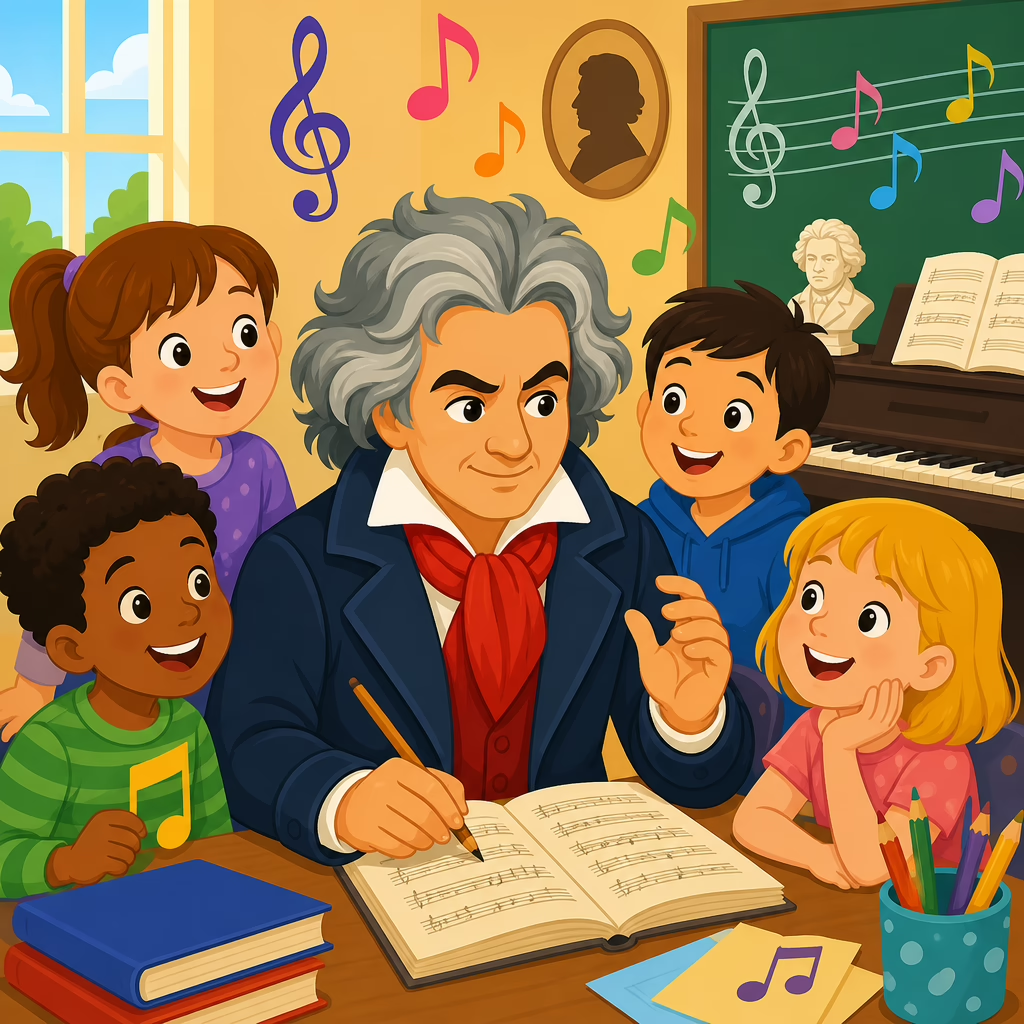
Beethoven Lesson Plans for Elementary Music Classes
Beethoven lesson plans for elementary music classes work best when they move beyond a single composer biography and become a practical way to teach rhythm, listening, form, emotion, creativity, and classroom community through music that children can grasp and enjoy. In elementary settings, students do not need a graduate lecture on late Classical style or a catalog of opus numbers. They need clear listening goals, memorable activities, movement, visual supports, and repeated chances to connect what they hear to what they feel and create. That is why a strong Beethoven unit belongs in the broader conversation about community and education. It gives teachers a familiar cultural anchor, but it also opens the door to collaborative music making, respectful discussion, and inclusive participation across grade levels.
In practice, Beethoven lesson plans usually center on a few key works: Symphony No. 5 for rhythm and motif, Symphony No. 6 for musical storytelling and nature imagery, “Ode to Joy” from Symphony No. 9 for melody and community singing, and pieces such as “Für Elise” for expressive listening and basic form. These works are useful because they are instantly recognizable, widely recorded, and flexible enough for kindergarten through fifth grade. When I have built elementary composer units, the most successful lessons did not ask children to memorize dates first. They started with a musical question: What pattern do you hear? What instrument enters next? How does this music sound different from a lullaby, a march, or a storm? Those questions give students an access point before historical details are layered in.
For clarity, a lesson plan is the structured sequence of objectives, materials, procedures, assessment, and extension activities used to guide instruction. In an elementary music classroom, an effective Beethoven lesson plan aligns listening, performing, responding, and creating. It also fits the realities of short class periods, varying student readiness, and limited rehearsal time. The most dependable plans map to standards such as the National Core Arts Standards, especially the strands of creating, performing, responding, and connecting. They also support literacy and social learning by asking students to describe sound with evidence, compare interpretations, and work together on performances.
Teaching Beethoven matters because his music offers unusually strong teaching materials for core musical concepts. The famous four-note opening of Symphony No. 5 is one of the clearest examples in Western music of a short motif developed across an entire piece. “Ode to Joy” is ideal for melodic contour, phrase recognition, and ensemble singing. Symphony No. 6, the “Pastoral,” helps students hear how composers suggest scenes without using words. Beethoven’s life also invites age-appropriate discussion about persistence, adaptation, and hearing loss, provided that teachers present those topics accurately and sensitively rather than turning them into oversimplified inspiration stories. Children can understand that he was a composer who gradually lost much of his hearing and still found ways to imagine, revise, and communicate music.
A comprehensive pillar page on Beethoven lesson plans should therefore do three things at once. It should explain what to teach, show how to teach it, and help teachers adapt lessons for different grades and classroom contexts. It should also address the broader educational value of a composer study. When students sing together, pass a steady beat around a circle, draw what they hear in the “Pastoral,” or perform a class arrangement of “Ode to Joy” on barred instruments, they are not only learning about one historical figure. They are practicing attention, turn taking, interpretation, and collective effort. In that sense, Beethoven lesson plans support community and education in a direct, usable way.
The guide below is designed as a broad, practical resource for elementary music teachers, homeschool educators, arts integration specialists, and classroom teachers planning cross-curricular units. It covers essential repertoire, grade-band strategies, classroom management, assessment, inclusion, technology, and family or school community connections. It also includes a table of contents so teachers can quickly locate the exact section they need when planning a unit, a single lesson, or a schoolwide performance connection.
Table of Contents
1. Why teach Beethoven in elementary music
2. Learning goals and standards alignment
3. Core repertoire for elementary Beethoven units
4. Grade-band lesson ideas from K to 5
5. Sample activities, assessments, and differentiation
6. Building community through Beethoven projects
7. Materials, technology, and teacher planning tips
8. Common mistakes to avoid and how to improve results
9. Conclusion
Why Teach Beethoven in Elementary Music
Beethoven is one of the most teachable composers in elementary music because his music contains bold contrasts, memorable themes, and clear structural features that children can hear without advanced training. Teachers often need repertoire that communicates quickly in a twenty-five to forty-minute class period. Beethoven delivers that. Students can identify loud and soft changes, repeated motives, question-and-answer phrases, and shifts in mood after only one or two hearings. That makes his music especially effective for active listening lessons, movement response, and beginner analysis.
There is also a strong curricular reason to include Beethoven. Elementary music programs are expected to expose students to a range of historical periods, genres, and cultural practices while building transferable music skills. Beethoven serves as an entry point into the transition from the Classical era to the Romantic era, though younger students do not need that phrase emphasized heavily at first. What they do need is a sense that composers make choices for expressive reasons. Beethoven helps teachers demonstrate that idea because his music often feels dramatic, purposeful, and emotionally direct.
Another reason Beethoven belongs in elementary music classes is that his work supports multiple modes of learning. Auditory learners can focus on listening examples. Kinesthetic learners can step the beat, move scarves for phrasing, or freeze during cadences. Visual learners can track icons, color maps, or instrument pictures. Students who are hesitant singers may respond strongly to body percussion patterns from Symphony No. 5 or to classroom instrument arrangements of “Ode to Joy.” A good composer unit should never privilege one kind of participation. Beethoven’s repertoire makes varied participation easy to plan.
When teachers frame Beethoven well, they can also deepen historical understanding without overwhelming students. The essential facts are manageable: Ludwig van Beethoven was born in Bonn in 1770, worked largely in Vienna, composed symphonies, sonatas, chamber music, and choral works, and experienced severe hearing loss over time. These details are enough for elementary learners when attached to meaningful listening tasks. The goal is not trivia retention. The goal is making history audible.
Learning Goals and Standards Alignment
The strongest Beethoven lesson plans start with specific learning goals rather than with the composer’s name alone. “We are studying Beethoven” is a topic, not an objective. Better objectives sound like this: students will identify a short rhythmic motif; students will compare two contrasting sections using music vocabulary; students will perform “Ode to Joy” on solfege or barred instruments; students will create an eight-beat pattern inspired by Symphony No. 5; students will explain how music can suggest a scene or feeling. Those targets are observable and assessable.
In standards-based planning, Beethoven units often align naturally with four broad domains: creating, performing, responding, and connecting. Creating might involve students composing a short four-note motif and developing it through repetition or dynamic change. Performing could include singing “Ode to Joy,” keeping a steady beat with body percussion, or playing a simplified bordun under a melody. Responding involves listening for form, texture, or expressive qualities and using evidence from the music. Connecting brings in history, community traditions, visual art, poetry, or science topics such as sound and hearing.
Assessment should be light enough for elementary use but clear enough to guide instruction. In my own planning, the most reliable tools have been quick performance checks, exit tickets with one precise prompt, and simple rubrics with three or four criteria. For example, during an “Ode to Joy” recorder or xylophone lesson, I might assess pulse, pitch accuracy on the taught notes, ensemble attention, and phrasing. During a listening lesson on Symphony No. 6, I might assess whether students can match music excerpts to scenes and justify their choices using words such as tempo, dynamics, and timbre.
Cross-curricular goals can be built in without turning the music class into a general classroom duplicate. Beethoven supports language development through descriptive vocabulary, sequencing, and oral discussion. He supports social-emotional learning through emotional identification and respectful listening. He supports general education themes in community and education because group performances, class compositions, and shared listening routines require cooperation, empathy, and focus. These are not secondary benefits. In many schools, they are part of the reason music programs prove their value.
Core Repertoire for Elementary Beethoven Units
Teachers do not need a massive Beethoven survey to build an excellent elementary unit. A focused repertoire set usually produces stronger results. The best anchor works are Symphony No. 5 in C minor, first movement opening; Symphony No. 6 in F major, the “Pastoral”; “Ode to Joy” from Symphony No. 9; and “Für Elise.” Each serves a different instructional purpose. Symphony No. 5 teaches motif, rhythm, and dramatic contrast. Symphony No. 6 teaches imagery, programmatic thinking, and instrumental color. “Ode to Joy” teaches melody, phrase structure, singing, and ensemble playing. “Für Elise” introduces expressive piano writing and sectional form that many students already recognize from media and culture.
Additional repertoire can expand the unit for older elementary grades. Excerpts from the Egmont Overture work well for discussing dramatic openings. The “Moonlight” Sonata can support listening for mood and accompaniment patterns, though it should be introduced carefully so students do not generalize that all Beethoven sounds quiet and sad. A brief excerpt from the Violin Concerto or one of the piano sonatas can help students hear soloist versus ensemble texture. The main rule is simple: choose excerpts with a clear listening purpose.
Recording quality matters. Use a respected orchestra or pianist rather than low-fidelity clips when possible. Students hear more nuance when the recording has dynamic range and clear instrumental balance. Visual concert clips can help children identify orchestral families, but audio-only listening also has value because it trains focused attention. If you use video, pause strategically. Ask students to predict what they will hear next or to notice how the conductor signals entries and energy.
| Piece | Best Grade Levels | Main Concept | Practical Classroom Use |
|---|---|---|---|
| Symphony No. 5 opening | 1–5 | Motif, rhythm, dynamics | Body percussion, rhythm reading, call and response |
| Symphony No. 6 “Pastoral” excerpts | K–5 | Musical storytelling, timbre, mood | Movement, drawing response, scene matching |
| “Ode to Joy” | 2–5 | Melody, phrase structure, ensemble performance | Singing, recorder, xylophone, solfege |
| “Für Elise” | 3–5 | Form, piano timbre, expression | Listening maps, A-B-A identification, creative writing |
Grade-Band Lesson Ideas From Kindergarten Through Fifth Grade
Kindergarten and first grade lessons should emphasize beat, movement, listening contrasts, and simple composer recognition. A highly effective opening lesson begins with a portrait of Beethoven, a very short spoken introduction, and the first motif of Symphony No. 5. Students tap the rhythm on knees, then transfer it to claps, then to classroom drums. Next, the teacher plays contrasting excerpts and asks students to move in small or large shapes depending on whether the music sounds gentle or strong. At this age, the goal is to experience musical character rather than master historical terminology.
For second grade, “Ode to Joy” becomes especially useful. Students can echo-sing short phrases, show melodic contour with hand movement, and play simplified patterns on bells or barred instruments. One successful sequence is sing, decode, play, and create. First students sing the melody on a neutral syllable. Then they identify repeated phrases. After that they play the melody using limited pitches. Finally they invent a new ending phrase while keeping the same steady beat. This balances literacy and creativity.
Third grade students are ready for clearer discussion of motif and form. Symphony No. 5 is ideal here. Start with the four-note motive and ask students to listen for how often it returns. Have them create a visual tally during listening, then compare observations. Next, assign small groups to perform the motive using different timbres: clapping, sticks, hand drums, or boomwhackers. Discuss how the same pattern changes character with different sound sources. This shows that composers and arrangers make timbral decisions to shape meaning.
Fourth grade can handle richer listening analysis and more complex performance tasks. “Für Elise” works well for identifying A and B sections. Provide a listening map with symbols rather than dense notation if students are not strong readers yet. Ask them to raise a scarf during the returning A section and lower it during contrasting material. Later, connect the piece to piano mechanics by showing how hammers strike strings. This is a natural bridge to science content about vibration and resonance, making the unit valuable within the wider educational community.
Fifth grade students can synthesize biography, analysis, and performance. A strong fifth-grade lesson might compare Symphony No. 5 and Symphony No. 6 as two different approaches to musical expression: one tightly motivic and dramatic, the other scene based and descriptive. Students can write short evidence-based responses using music vocabulary. They can also perform “Ode to Joy” in a rondo-style class arrangement with percussion interludes composed in small groups. That kind of culminating task allows students to demonstrate understanding through both words and sound.
Sample Activities, Assessments, and Differentiation
One of the best Beethoven activities for elementary classes is motif transformation. After hearing the opening of Symphony No. 5, students create their own four-sound pattern using ta and ti-ti rhythms, then change one element at a time: dynamics, tempo, instrument, or articulation. This teaches a powerful compositional idea in concrete terms. Even very young students can understand that a pattern stays related to the original when only one feature changes. Older students can notate their ideas with rhythm icons or standard notation.
Another reliable activity is guided listening with a purpose. Before playing the music, give students one clear target. For Symphony No. 6, ask them to listen for sounds that suggest nature or weather. For “Für Elise,” ask them to identify when the opening idea returns. For “Ode to Joy,” ask them to notice which phrases sound the same and which sound different. Purpose-driven listening increases focus and gives teachers better evidence of understanding than open-ended “What did you think?” questions.
Assessment should match the instructional focus. If the lesson is about steady beat, assess steady beat. If it is about form, assess section recognition. This sounds obvious, but elementary units often fail because they try to assess too much at once. A short checklist is usually enough: kept beat consistently, sang phrase accurately, identified repeated motive, used one descriptive music term correctly, contributed respectfully in group work. Those checkpoints produce usable data without interrupting the flow of music making.
Differentiation is essential in mixed-readiness classes. For students who need support, reduce the response demand. They might point to icons instead of writing sentences, play only the bordun rather than the full melody, or show form with colored cards instead of verbal explanation. For students ready for extension, add challenge through improvisation, notation, leadership roles, or comparison across recordings. A fifth grader who already plays piano might compare two performances of “Für Elise” for tempo flexibility and dynamics. A beginning learner might simply identify where the A section returns. Both can succeed in the same lesson when tasks are tiered well.
Accessibility also matters when discussing Beethoven’s hearing loss. Avoid presenting deafness or hearing impairment as a single dramatic obstacle story. Instead, state that Beethoven experienced progressive hearing loss and continued to compose using the musical knowledge, inner hearing, and working methods available to him. If your school community includes deaf or hard-of-hearing students, this topic should be handled with extra care and respect. The educational point is not pity. The point is that musicians engage sound, vibration, memory, notation, imagination, and community in many ways.
Building Community Through Beethoven Projects
Beethoven lesson plans become more powerful when they extend beyond isolated listening days and create shared classroom culture. “Ode to Joy” is particularly effective for this because it is associated with collective singing and broad themes of unity. In elementary settings, that does not require abstract philosophical discussion. It can be as simple as teaching students that some music is written to bring many people together in one musical experience. A class performance with layered parts, even very simple ones, helps students feel that idea physically.
One practical community project is a grade-level Beethoven share-out. Each class prepares one short response to a Beethoven piece: a rhythm demonstration from Symphony No. 5, a movement interpretation of the “Pastoral,” a recorder version of “Ode to Joy,” or a narrated listening map for “Für Elise.” During an assembly or informal showcase, classes present to one another. This creates internal audience motivation and reinforces that music learning contributes to the life of the school, not just to isolated class time.
Another successful project is an arts integration display. Students listen to Symphony No. 6 and create landscape art showing calm countryside, flowing water, or storm imagery. Older students write a few sentences explaining which musical elements influenced their choices. Hallway displays like this matter more than many teachers assume. They make music learning visible to families, administrators, and other teachers, and they give children a public sense of ownership over their interpretations.
Family engagement can also be simple and effective. Send home a short listening guide with links or titles for approved recordings and two or three questions families can discuss: Which instrument do you notice first? Does this music sound peaceful, energetic, or mysterious? What picture comes to mind? This invites families into the learning process without demanding prior musical knowledge. In communities where home internet access is uneven, provide printed prompts and encourage students to describe the music from memory after class listening.
These projects support community and education because they turn composer study into shared practice. Students learn that music history is not only about distant famous people. It is also about what a school community does together when it listens, performs, reflects, and celebrates effort. That shift in framing increases buy-in and gives Beethoven lasting relevance in elementary classrooms.
Materials, Technology, and Teacher Planning Tips
Most Beethoven units can be taught with modest materials: quality speakers, selected recordings, a projector if available, rhythm instruments, scarves, whiteboard space, and barred instruments or recorders for performance tasks. If you have limited instruments, rotate centers. One group performs the melody, one group does body percussion, one group completes a listening map, and one group works with the teacher. Rotation prevents downtime and gives students multiple entry points into the same content.
Technology can improve clarity when used deliberately. Interactive slides are useful for sequence, vocabulary, and visual listening maps. Notation software screenshots can help older students see phrase patterns in “Ode to Joy.” Short orchestral videos can introduce instrument families in Symphony No. 5 or No. 6. Learning platforms such as Google Classroom, Seesaw, or Schoology can host listening links, reflection prompts, and performance recordings for formative assessment. However, technology should support the musical objective, not replace live music making.
Teacher planning improves significantly when a Beethoven unit is built backward from one culminating demonstration. Decide first what you want students to show by the end. Will they perform “Ode to Joy,” identify a motif, compare two Beethoven excerpts, or create a short pattern inspired by his music? Once that endpoint is clear, choose only the repertoire and activities that support it. This keeps the unit coherent and prevents the common problem of collecting disconnected composer worksheets.
Pacing is another major factor. In a four-lesson mini-unit, I would usually sequence the work this way: lesson one, composer introduction plus active listening; lesson two, focused concept work such as motif or melody; lesson three, performance and small-group creation; lesson four, assessment and sharing. In a longer unit, add comparison lessons, arts integration, and a community performance element. Always preserve repetition. Elementary students learn deeply when they revisit the same excerpt with a new purpose, not when they rush through many unfamiliar pieces.
Common Mistakes to Avoid and How to Improve Results
The most common mistake in Beethoven lesson plans for elementary music classes is teaching biography without enough musical engagement. A worksheet on birth year, city, and famous pieces may look academic, but it does very little for actual music learning unless students repeatedly hear, perform, and discuss the music itself. Children remember Beethoven because of the sound of his work, not because they copied facts into blanks. Keep factual instruction concise and tie every fact to a listening or performance task.
Another mistake is choosing excerpts that are too long or too dense for the stated objective. If the goal is to identify a motive, use the opening of Symphony No. 5, not an extended movement without scaffolding. If the goal is imagery, select short “Pastoral” excerpts that clearly suggest scene changes. Focused excerpting is not a weakness. It is good pedagogy for elementary learners.
Teachers also sometimes overestimate how much vocabulary students need. Terms such as motif, phrase, dynamics, tempo, and timbre are worthwhile because students can use them directly. Longer lists are rarely necessary. Precision matters more than volume. I would rather have a class accurately explain that a four-note motif repeats and grows louder than have them half remember five era labels and three Italian terms they never apply.
Finally, do not neglect joy and participation. Beethoven’s music has depth, but elementary teaching succeeds when students sing, move, play, laugh, and contribute. If a unit feels heavy, break it open with a drumming pattern, a freeze-movement game, a student conductor activity, or a partner discussion. Strong results come from lessons that are musically rigorous and physically alive.
Conclusion
Beethoven lesson plans for elementary music classes are most effective when they combine clear musical objectives, carefully chosen repertoire, active participation, and meaningful classroom community. Teachers do not need to cover every major work or every biographical detail. They need to help students hear what matters: the unforgettable motif of Symphony No. 5, the expressive scenes of the “Pastoral,” the singable shape of “Ode to Joy,” and the returning patterns of “Für Elise.” From those experiences, students learn rhythm, form, timbre, expression, and collaboration in ways that last.
The broader value is equally important. A well-designed Beethoven unit strengthens community and education by giving students shared musical experiences that require listening, cooperation, and reflection. It supports standards, connects to other subjects, and gives teachers a practical path from simple listening activities in the primary grades to evidence-based analysis and ensemble performance in upper elementary. It also reminds students that great music is not distant or inaccessible. With the right structure, it becomes something they can feel, describe, perform, and make their own.
If you are planning a composer study, start small and teach with purpose. Choose one Beethoven excerpt, set one measurable objective, build one active response, and assess one clear skill. Then expand the unit as students gain confidence. That approach produces stronger learning than trying to do everything at once, and it turns Beethoven from a famous name on a poster into a living part of your elementary music curriculum.
Frequently Asked Questions
1. How can I make Beethoven lesson plans engaging and age-appropriate for elementary music classes?
The most effective Beethoven lesson plans for elementary students focus less on long biographical lectures and more on active musical experiences. Young learners respond best when Beethoven’s music is presented through clear listening targets, movement, rhythm practice, visual aids, and creative participation. Instead of asking children to remember dates, cities, or long lists of compositions, guide them toward simple and meaningful goals such as hearing loud and soft contrasts, identifying repeated patterns, moving to the beat, or noticing how music can sound powerful, playful, or dramatic. This keeps the lesson rooted in skills they can understand and use.
A strong approach is to choose one piece or one short excerpt at a time and build a lesson around a specific concept. For example, a Beethoven listening lesson might use the opening of Symphony No. 5 to teach rhythm, steady beat, and short-short-short-long patterns. “Ode to Joy” works especially well for melodic shape, singing, recorder or xylophone practice, and form. If you pair the music with icons, pictures, movement cues, or rhythm syllables, students can track what they hear without needing advanced vocabulary. This makes the lesson accessible for a wide age range, including early elementary classes.
Engagement also increases when students are invited to do something with the music. They can march to strong beats, create scarf movements for changing dynamics, tap rhythmic motifs, draw what the music makes them imagine, or compare two excerpts using simple language. Call-and-response activities, listening maps, and classroom instruments help students stay involved from beginning to end. When Beethoven becomes a way to teach music concepts through participation rather than memorization, students are much more likely to connect with the repertoire and remember the learning.
2. What musical concepts can elementary students learn through Beethoven lesson plans?
Beethoven lesson plans can support a wide range of elementary music objectives when they are designed with practical classroom outcomes in mind. Rhythm is one of the easiest concepts to teach through Beethoven, especially with famous motifs like the opening of Symphony No. 5. Students can clap it, echo it, transfer it to instruments, and identify it when they hear it repeated. Beat, tempo, and dynamics are also natural fits because Beethoven’s music often includes clear contrasts that children can hear and physically respond to. These features make his music highly teachable in active classroom settings.
Listening and form are equally strong areas of instruction. Students can learn to recognize repetition, contrast, phrase structure, and sections within a piece by following a listening map or moving in different ways for different musical ideas. “Ode to Joy,” for example, is especially helpful for teaching melodic contour, phrase repetition, and simple formal awareness. Children can sing the melody, identify when it returns, and notice how the music changes when new layers or dynamics appear. These types of listening experiences help students move from passive hearing to intentional musical understanding.
Beethoven lesson plans can also support emotional expression and creativity. Elementary students often connect deeply with the dramatic and expressive quality of his music, even when they do not know technical terms. Teachers can ask students how the music feels, what story it suggests, or what colors and movements match the sound. These prompts strengthen artistic response and classroom discussion skills while reinforcing the idea that music communicates meaning. In this way, Beethoven becomes more than a historical figure; his music becomes a tool for teaching foundational musical skills, imagination, and thoughtful listening.
3. Which Beethoven pieces work best for elementary music activities?
The best Beethoven pieces for elementary classes are usually the ones with memorable themes, strong contrasts, and manageable excerpts. “Ode to Joy” from Symphony No. 9 is one of the most useful choices because the melody is familiar, singable, and adaptable to many classroom activities. Teachers can use it for singing, barred instrument playing, recorder practice, melodic contour, phrase identification, and ensemble work. Its clear structure helps students recognize repetition and form, and its accessible tune makes it easier for children to feel successful quickly.
The opening of Symphony No. 5 is another excellent option because the famous rhythmic motif is instantly recognizable and ideal for rhythm instruction. Students can clap, chant, move, or play the short-short-short-long pattern while exploring beat, rhythm, and repeated motives. This excerpt also supports lessons on dynamics, intensity, and musical character. Because the motif is so compact and distinct, even younger students can identify it after only a few hearings, which builds confidence in listening tasks.
Other useful choices include short excerpts from Beethoven’s “Pastoral” Symphony for nature-themed listening, mood exploration, and creative movement, as well as selected piano works such as “Für Elise” for melodic recognition and expressive listening. The key is not to cover too much at once. A short, purposeful excerpt usually works better than an entire movement in elementary settings. By selecting music with one or two clear teaching goals, teachers can make Beethoven’s repertoire feel approachable, focused, and enjoyable rather than overwhelming.
4. How long should a Beethoven unit be in elementary music, and what should it include?
A Beethoven unit in elementary music does not need to be lengthy to be effective. In many classrooms, a short sequence of two to five lessons works very well, especially when each lesson has a clear objective and builds on the previous one. Elementary students benefit from repetition and routine, so it is often better to revisit one or two Beethoven excerpts across several class periods than to introduce a large amount of new information all at once. This allows students to deepen their listening, strengthen recognition, and connect the music to different classroom activities over time.
A practical Beethoven unit usually includes four core elements: a brief and child-friendly introduction to the composer, focused listening, active music-making, and a simple reflection or assessment. The introduction should be concise and memorable, highlighting only details that help students connect with the music, such as the fact that Beethoven wrote music with strong emotions and memorable themes. The listening portion should have a clear task, such as identifying a rhythm pattern, following a listening map, or hearing dynamic changes. The active component might include movement, singing, rhythm practice, instrument playing, or student composition inspired by the excerpt.
To close the unit, students can demonstrate learning in age-appropriate ways. They might perform a rhythmic motif, describe the mood of a piece, draw the form they heard, or work in groups to create movement for a Beethoven excerpt. Informal assessments like observation checklists, exit questions, partner discussion, and student performance are often more effective than written quizzes in elementary music. A well-planned short unit can be highly meaningful when it combines consistency, participation, and musical skill-building rather than trying to cover every fact about Beethoven’s life and works.
5. How can Beethoven lesson plans support creativity, social learning, and classroom community?
Beethoven lesson plans can do much more than introduce students to a famous composer. When taught thoughtfully, they can strengthen creativity, collaboration, and community within the music room. Group listening tasks, partner rhythm games, ensemble instrument parts, and shared movement activities all encourage students to work together while engaging with high-quality music. Because Beethoven’s music often includes bold contrasts and recognizable ideas, it gives students common material they can discuss, interpret, and perform as a class. This creates a sense of shared experience that supports community building.
Creativity grows when students are invited to respond to Beethoven in original ways. They might invent body percussion for a rhythmic motif, create classroom instrument accompaniments to “Ode to Joy,” draw a listening response based on musical mood, or choreograph movement that matches changing dynamics and form. These kinds of activities show students that classical music is not something distant or untouchable; it is something they can explore, shape, and understand through their own ideas. Creative extensions also help differentiate instruction by allowing students with different strengths to participate meaningfully.
Social learning is especially strong when students collaborate on performances or listening responses. Small groups can decide how to move during one section of music, arrange rhythm cards to match a motif, or discuss how a piece sounds and why. These tasks build communication, turn-taking, attention, and respect for different interpretations. In this way, Beethoven lesson plans can help create a classroom culture where students listen carefully not only to music, but also to one another. That combination of musical understanding and cooperative learning makes composer study much more valuable in the elementary setting.