Beethoven Activities for Museum Field Trips
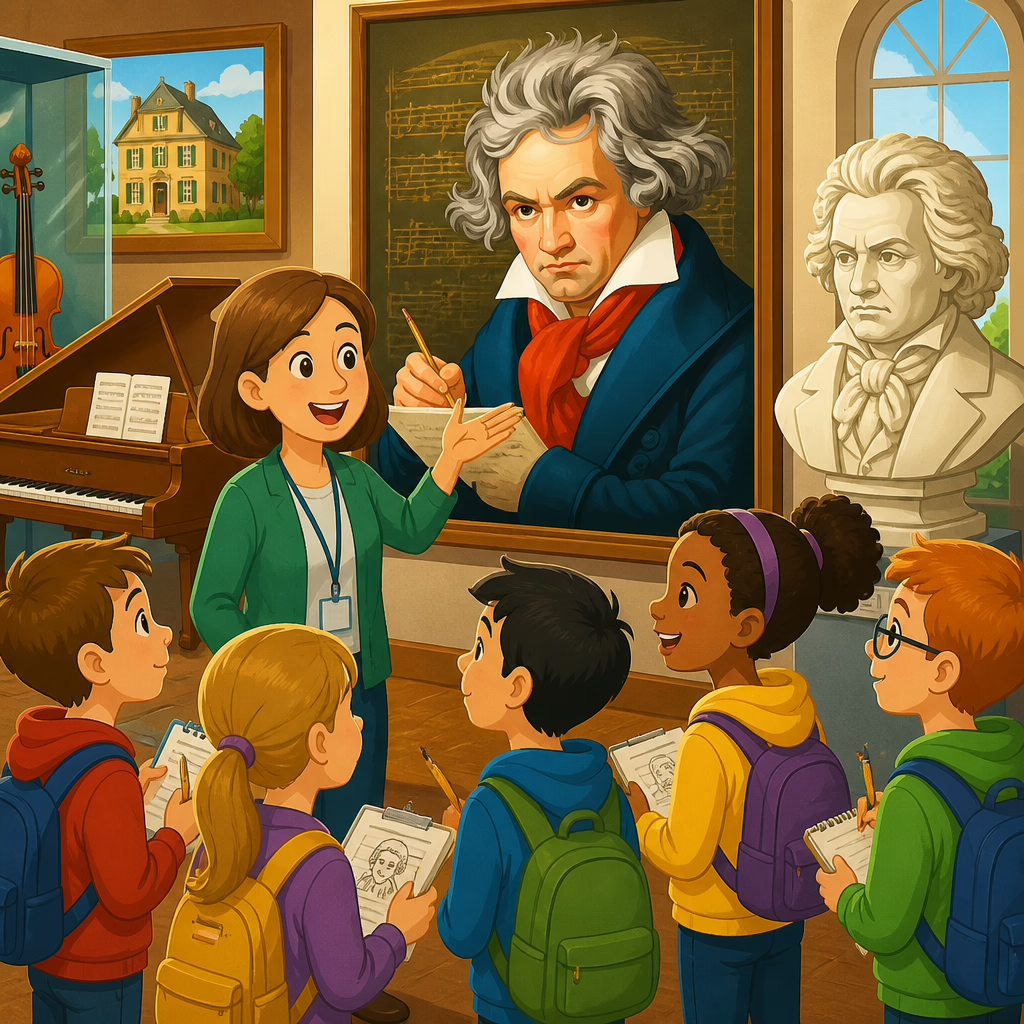
Beethoven activities for museum field trips work best when they turn a visit from passive observation into structured musical inquiry. In this context, a museum field trip is not simply a bus ride to see artifacts; it is a carefully designed learning experience that uses galleries, historical objects, listening prompts, and short performance tasks to help students understand Ludwig van Beethoven as a working composer, a public figure, and a person shaped by his era. When teachers and museum educators plan these activities well, students leave with stronger listening skills, richer historical knowledge, and a clearer sense that classical music was created by real people solving artistic problems.
I have built museum-based music lessons around composer exhibits, instrument collections, portrait galleries, and temporary cultural history installations, and the same pattern holds every time: students engage most deeply when the trip has a narrow purpose. A general “learn about Beethoven” goal is too broad for one visit. A focused plan built around observation, evidence, and response gives students a reason to look closely, listen actively, and talk precisely. That matters in community and education settings because museum trips often have limited time, mixed age groups, and competing logistical demands. Strong activities make the educational value visible to teachers, families, and museum staff.
Beethoven remains especially useful for field-trip design because his life and music offer clear entry points for elementary and middle-grade learners. Students can grasp the drama of a composer who studied in Bonn, worked in Vienna, changed the scale of the symphony, and continued composing while facing hearing loss. They can also compare visual and material evidence: portraits, manuscripts, fortepianos, concert programs, letters, and period clothing all show that music history is not abstract. Key terms help frame the trip. A manuscript is a handwritten score. A motif is a short musical idea. A patron is a person who financially supports an artist. These concepts give students language for what they encounter in the museum.
This topic matters because field trips are expensive in time and money, and schools increasingly need measurable academic outcomes from enrichment experiences. Beethoven activities can support music standards, literacy goals, social studies objectives, and speaking-and-listening practice in one setting. They also encourage cultural participation. A child who identifies a rhythmic motif in a gallery audio station, sketches a fortepiano action, or explains how a portrait shapes public image is practicing close reading in a different medium. The museum becomes a classroom, but with original objects and expert interpretation that schools cannot easily replicate. The result is memorable learning grounded in evidence rather than worksheet completion.
Start with a clear field-trip objective
The most effective Beethoven museum activities begin with one essential question. Good examples include: How did Beethoven communicate emotion without words? What can objects tell us about his daily work? How did audiences experience his music during his lifetime? A single question prevents the trip from becoming a scavenger hunt of disconnected facts. In practice, I usually match the question to the strongest museum assets. If a museum has instruments and sound stations, the objective should emphasize listening and performance practice. If the collection highlights letters and manuscripts, the objective should focus on process, revision, and historical context.
Age-appropriate outcomes matter. For grades three through five, students should be able to identify one Beethoven work, describe two objects they observed, and explain one way museums preserve music history. Older students can go further by evaluating how curators use labels, lighting, and object placement to tell a story. Before the trip, define what counts as success. A vague goal such as “students appreciate Beethoven” is difficult to measure. A better goal is “students use evidence from two artifacts and one listening example to explain how Beethoven worked as a composer.” That statement guides instruction, discussion, and assessment.
Preparation should also account for timing. Most schools get sixty to ninety minutes of active gallery time. That is enough for three stations, one short whole-group orientation, and a closing reflection. Trying to cover every famous piece or every stage of Beethoven’s life leads to rushed movement and shallow understanding. Depth beats breadth. Students remember the object they examined closely and connected to a sound clip far better than five labels they barely read. A focused trip objective allows the museum educator to coordinate docent talking points, student note sheets, and post-visit assignments without wasting attention.
Use object-based learning to make Beethoven concrete
Object-based learning is the backbone of successful museum teaching because it asks students to build meaning from what they can actually see. For Beethoven, useful objects include portraits, manuscript pages, hearing devices, quill pens, early pianos, first-edition scores, concert advertisements, and domestic items from the late eighteenth and early nineteenth centuries. Instead of telling students what an object means, ask them to observe first. What materials do they notice? What signs of use appear? What clues suggest wealth, status, labor, or technology? This sequence slows students down and produces better historical thinking.
A portrait activity works particularly well. Students can compare two images of Beethoven from different periods and infer how each artist wanted viewers to perceive him. One portrait may emphasize intensity, with a fixed gaze and windswept hair. Another may present a more formal public identity tied to respectability and status. The lesson is not merely “this is what Beethoven looked like.” It is that portraits are constructed messages. Students learn that visual culture helped shape the myth of Beethoven as a genius, and they begin to question how public reputation is made.
Manuscripts offer another strong activity because they reveal composition as revision, not magic. When students see scratched-out notes, crowded margins, or altered dynamics, they immediately understand that Beethoven tested ideas. That insight is powerful for young learners who assume great artists work effortlessly. If the museum has a facsimile or digital enlargement, ask students to identify three visible signs of revision and then connect those signs to a listening excerpt. Even without reading notation fluently, they can understand that the page records decisions. This object-to-sound link is one of the most effective ways to teach creative process in a museum.
Build listening tasks that match the gallery experience
Listening activities on a field trip must be short, intentional, and physically manageable. Museums are not concert halls, so students need focused excerpts of thirty to ninety seconds paired with one concrete listening prompt. The opening motif of Symphony No. 5 is ideal because it is recognizable and easy to track. Students can listen for repetition, contrast, and dynamic growth, then locate an artifact nearby that suggests performance conditions in Beethoven’s time, such as an early keyboard or printed concert program. This creates an immediate bridge between sound and setting.
Another reliable choice is Symphony No. 6, the “Pastoral,” especially if the museum includes landscapes, nature imagery, or rural life objects from the period. Ask students how Beethoven represents outdoor experience without using words. They may notice flowing lines, repeated rhythmic patterns, or changes in orchestral color. A museum visit gives them visual anchors: paintings of countryside scenes, travel objects, or maps of Central Europe. The goal is not to force exact one-to-one matches, but to help students hear that musical ideas can respond to place, memory, and environment.
If headphones or an audio guide are available, assign one excerpt per station and one sentence frame: “This music sounds ___ because ___.” Sentence frames keep the task accessible while still demanding evidence. I have found that students give more thoughtful responses when they must tie a musical judgment to a specific feature such as tempo, articulation, or instrumentation. For classes preparing in advance, teachers can connect the trip to classroom study with the resource hub at Beethoven lesson plans for elementary music classes, then use the museum visit to extend one piece in a real historical setting.
Design stations that balance movement, talk, and evidence
Stations keep groups organized and prevent the field trip from becoming one long lecture. Each station should have one central artifact or cluster, one task, and one product. The product can be verbal, written, sketched, or performed softly with body percussion. What matters is that students do something with the information. In most museums, three stations are optimal: one visual culture station, one manuscript or document station, and one instrument or listening station. This structure supports varied learners and keeps cognitive demands manageable.
| Station | Main Artifact Type | Student Task | Evidence Collected |
|---|---|---|---|
| Portrait and Image | Portraits, busts, engravings | Infer how Beethoven is presented to the public | Two visual details and one interpretation |
| Composer at Work | Manuscripts, letters, facsimiles | Find signs of revision and creative decision-making | Three observed edits or markings |
| Sound and Instruments | Fortepiano, strings, audio stations, programs | Match a listening excerpt to an object or performance clue | One musical feature linked to one artifact |
Docents and chaperones should know the purpose of each station in advance. Give adults one card with prompts instead of a full script. For example: “What do you notice first?” “What detail supports that idea?” “How might this object change how music sounded?” These questions encourage evidence-based discussion without overwhelming volunteers. I have seen field trips improve dramatically when adults stop supplying facts too early and instead let students observe, hypothesize, and revise. The museum becomes interactive without requiring elaborate technology.
Station design should also consider accessibility. Provide clipboards for note-taking, large-print prompts when possible, and alternatives to extended writing. A sketch box, sticker-based response, or oral partner share can collect understanding just as effectively for many learners. If a gallery is crowded, rotate half the class through a quiet reflection task while the other half does close observation. Good logistics protect learning time. They also reduce behavior issues, because students who know exactly what they are looking for are less likely to drift.
Connect Beethoven’s life story without turning it into myth
Students are naturally drawn to Beethoven’s biography, but the educational goal should be accuracy and balance. Yes, his hearing loss matters. Yes, his reputation for intensity and independence is significant. But a museum field trip should show that these facts existed within larger systems: family training, urban music markets, aristocratic patronage, publishing networks, and changing concert culture. Presenting Beethoven only as a solitary genius oversimplifies music history and misses an important teaching opportunity. Great art emerges from individual skill and social context together.
A strong biographical activity asks students to place artifacts along a simple timeline: Bonn childhood and court connections, move to Vienna, rise as pianist-composer, increasing hearing problems, late works and legacy. If the museum does not permit physical handling, students can use image cards or a printed map. This helps them understand sequence and causation. For example, moving to Vienna mattered because it placed Beethoven at the center of a vibrant musical network. Hearing loss mattered because it affected performance, communication, and workflow, yet did not end his composing. These are historical relationships, not isolated anecdotes.
It is also important to discuss limitations in the evidence. Not every dramatic story about Beethoven is equally well documented, and younger students benefit from hearing that historians compare letters, contemporary reports, and surviving objects before making claims. That approach models responsible interpretation. It tells students that museums are not storage rooms of unquestioned truth; they are places where experts assemble evidence to tell the most accurate story possible. That alone is a valuable civic lesson.
Turn the visit into lasting classroom learning
The best Beethoven activities for museum field trips continue after the bus ride home. A brief post-visit task consolidates memory and helps teachers assess what students actually learned. One effective option is a claim-evidence reflection: “Beethoven was a careful reviser,” or “Museums help us understand how music was performed.” Students support the claim with one object and one listening detail from the trip. This is short, standards-aligned, and much more meaningful than asking for a generic summary of the day.
Creative follow-ups also work when they remain evidence-based. Students can write a concert program note for a Beethoven excerpt, curate a mini classroom exhibit with labels, or compare a museum artifact to a modern music-making tool. For younger children, a simple foldable with “I saw,” “I heard,” and “I learned” sections is enough. For older students, a discussion of curation, audience, and interpretation can deepen the experience. The field trip then functions as a primary source encounter rather than a standalone event.
Well-planned Beethoven activities for museum field trips make music history visible, audible, and memorable. The core strategy is simple: set one objective, use real objects, pair them with short listening tasks, and ask students to support every idea with evidence. Done this way, a museum visit teaches more than dates and famous titles. It shows how a composer worked, how audiences listened, and how institutions preserve cultural memory. If you are planning an upcoming trip, choose three strong stations, prepare one essential question, and build the day around careful observation. Students will leave knowing Beethoven not as a distant legend, but as a musician whose world they can genuinely investigate.
Frequently Asked Questions
What are the best Beethoven activities for a museum field trip?
The best Beethoven activities for a museum field trip are the ones that actively guide students to observe, listen, compare, and respond rather than simply walk through exhibits. A strong museum experience usually includes a mix of gallery-based inquiry, short listening exercises, visual analysis, and simple creative tasks. For example, students can study portraits of Beethoven and people from his time to discuss how composers were presented as public figures, examine period instruments or manuscripts to understand how music was created and shared, and complete a listening prompt tied to a specific symphony, sonata, or chamber work while viewing related historical objects.
Effective activities also give students a clear purpose. Instead of asking them to “look around,” teachers can provide scavenger-style prompts such as identifying objects connected to performance, patronage, publishing, or daily life in Beethoven’s era. Another highly effective option is a short musical reflection in which students describe how a selected piece sounds, what emotions it suggests, and what historical or personal factors may have shaped it. Older students can compare a draft score, program note, or portrait with what they hear in the music, while younger students can focus on rhythm, mood, and storytelling. The most successful Beethoven museum activities are structured enough to keep students engaged, but flexible enough to encourage curiosity and discussion.
How do Beethoven museum activities help students learn more than a standard classroom lesson?
Beethoven museum activities deepen learning by placing students in direct contact with historical evidence. In a classroom, students may read about Beethoven’s life, hear recordings, and discuss major works. In a museum, they can connect those ideas to physical objects and curated spaces that make abstract concepts more tangible. Seeing manuscripts, hearing period-informed recordings, examining instruments, viewing clothing, furniture, letters, or concert ephemera helps students understand that Beethoven was not just a name in music history, but a real person working within social, political, and artistic systems.
This setting also supports interdisciplinary learning in a way that feels natural rather than forced. Students can connect music to history, literature, art, technology, and even civics by asking how composers built careers, how audiences responded to new music, and how public culture shaped artistic reputation. Museum-based Beethoven activities are especially valuable because they slow students down and encourage close looking and close listening. Instead of memorizing dates or titles alone, students practice interpretation: What does this object reveal about performance in Beethoven’s lifetime? How does this portrait shape our understanding of him? Why might a manuscript with revisions matter? These experiences develop historical thinking, artistic literacy, and analytical confidence in ways that standard lessons often cannot match on their own.
How can teachers structure a Beethoven field trip so students stay engaged throughout the visit?
The key to engagement is planning the trip as a sequence of short, purposeful tasks rather than one long tour. Students tend to stay focused when the experience is broken into manageable segments with clear goals. A practical structure often begins with a pre-visit introduction in the classroom, where students learn a few essential ideas about Beethoven’s life, major works, and historical context. This foundation gives them something to look for when they arrive at the museum. During the visit itself, teachers can organize activities around themes such as Beethoven the composer, Beethoven the celebrity, Beethoven in his historical world, and Beethoven’s musical legacy.
Within each theme, students should be asked to do something specific: sketch an object, answer a comparison question, listen for a musical feature, discuss a label with a partner, or complete a short response. Rotating between observation, listening, movement, and conversation helps maintain energy. It is also useful to limit lecture-heavy moments and prioritize interaction. For example, a five-minute prompt on how Beethoven revised his music can be more effective than a twenty-minute explanation if students are then invited to inspect a reproduction of a manuscript and infer what the revisions reveal. Teachers can also assign small-group roles such as observer, note-taker, question asker, or discussion leader to increase accountability. A successful Beethoven field trip feels guided, but not overcontrolled, giving students enough structure to stay on task while still leaving room for personal discovery.
What should students focus on in a museum to better understand Beethoven as both a composer and a historical figure?
Students should focus on the relationship between the music, the objects, and the world Beethoven lived in. To understand him as a composer, they should look closely at anything that reveals process: sketches, manuscripts, instruments, publishing materials, and performance history. These items help students see that composing was active labor involving revision, experimentation, collaboration, and public presentation. Listening prompts connected to these materials can be especially powerful because students begin to recognize how ideas on the page become sound in performance.
To understand Beethoven as a historical figure, students should also pay attention to portraits, letters, household or personal objects, concert culture, and materials related to patronage and audience reception. These kinds of artifacts show how Beethoven was shaped by the political and cultural changes of his era, including shifting ideas about genius, public performance, class, and artistic independence. Students can ask useful historical questions such as: Who supported composers financially? How were performances organized? What did audiences expect? How was Beethoven represented to the public? This broader focus helps students move beyond familiar biographical facts and see Beethoven as a person whose music was connected to real institutions, relationships, and historical pressures. That perspective makes both the museum visit and the music itself far more meaningful.
How can teachers extend Beethoven museum field trip activities after returning to the classroom?
Post-visit activities are essential because they help students turn impressions into lasting understanding. One of the best ways to extend learning is through reflection and synthesis. Teachers can ask students to write a response explaining which object, gallery, or musical example most changed their view of Beethoven and why. Students can also complete a listening journal that connects a work by Beethoven to something they observed during the trip, such as a manuscript, portrait, or period instrument. This encourages them to make evidence-based connections rather than relying only on general reactions.
Teachers can also build stronger academic outcomes by using the field trip as the basis for projects, presentations, or comparative analysis. Students might create a mini exhibit panel on Beethoven as a working composer, develop a short presentation on how public image shaped his legacy, compare museum artifacts to textbook narratives, or perform a brief musical excerpt and explain its historical context. Group discussions are also useful for revisiting essential questions raised during the trip, such as how museums shape interpretation or how historical objects influence the way we hear music today. When the classroom follow-up asks students to analyze, present, or create, the museum trip becomes part of a broader inquiry rather than a one-day event. That is what makes Beethoven activities for museum field trips truly educational and memorable.