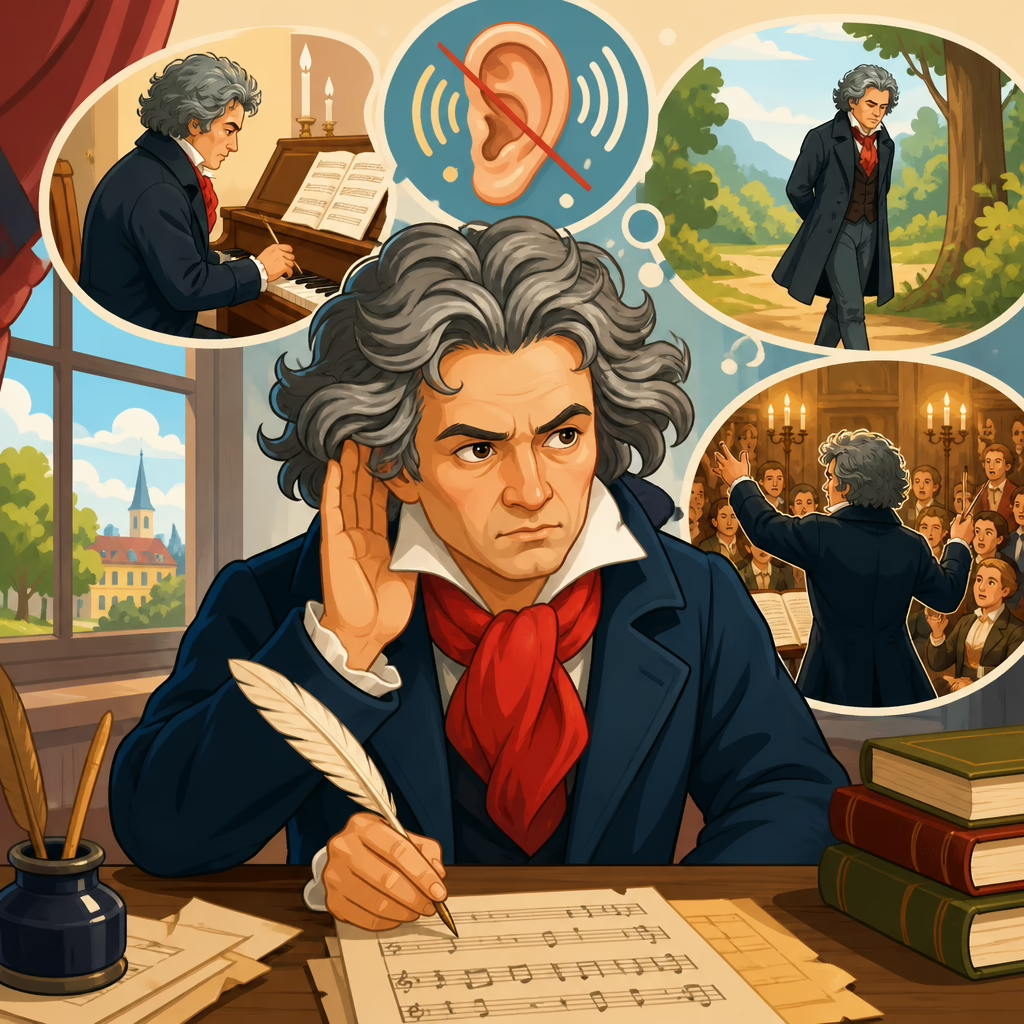
Teaching Beethoven’s Deafness with Historical Accuracy
Teaching Beethoven’s deafness with historical accuracy requires more than repeating the familiar story that a genius composer “went deaf and kept writing music.” In classrooms, that shorthand is common because it is memorable, but it leaves out the medical uncertainty, the gradual timeline, the emotional cost, and the social realities that shaped Ludwig van Beethoven’s life and work. When teachers present this topic carefully, students gain a truer picture of disability history, artistic resilience, and the limits of simplified biographies. They also learn an important habit of historical thinking: famous figures were real people whose lives resist neat moral lessons.
Historical accuracy matters here because Beethoven’s deafness is often treated as a mythic symbol rather than a documented, evolving condition. The basic facts are clear. Beethoven was born in Bonn in 1770, moved to Vienna in the 1790s, began noticing hearing problems in his twenties, and was functionally deaf by the last phase of his life. Yet many details remain debated, including the exact cause of his hearing loss and the speed of its progression. Scholars rely on letters, medical notes, eyewitness accounts, and conversation books from his later years. These sources show a gradual decline, not a single dramatic moment, and they reveal how hearing loss affected his work, relationships, public performance, and sense of identity.
For teachers in community and education settings, the challenge is balancing inspiration with evidence. Students deserve direct answers to common questions. Was Beethoven born deaf? No. Did he compose after losing much of his hearing? Yes. Could he hear anything at all in later life? Probably very little, and likely less over time. Did deafness define everything about him? No. It was central to his life, but he was also a working composer navigating patrons, publishers, performance demands, illness, and family conflict. Teaching the subject accurately avoids both pity and hero worship. It frames Beethoven as a historical person whose deafness mattered profoundly without becoming the only lens through which his life is understood.
The most reliable way to teach this topic is to organize it around evidence, chronology, and language. Evidence means showing students what historians actually use: the 1802 Heiligenstadt Testament, letters to friends, reports from physicians, and conversation books used in his later years. Chronology means tracing change across decades. Language means avoiding outdated assumptions that hearing loss automatically equals silence, isolation, or inability. In practice, I have found that students respond best when the lesson starts with what is known, names what is uncertain, and explains why uncertainty exists. That approach strengthens historical literacy while keeping the focus firmly on Beethoven’s documented experience.
What historians know about the timeline of Beethoven’s hearing loss
The clearest starting point is that Beethoven’s deafness developed gradually. He was not deaf as a child, and early accounts describe him as an active pianist, improviser, and performer. By the late 1790s, however, he began reporting auditory problems, including difficulty hearing high frequencies, buzzing, and ringing, symptoms consistent with tinnitus and progressive hearing impairment. In a 1801 letter to his friend Franz Wegeler, Beethoven admitted that his hearing had been deteriorating for several years. That letter is crucial because it places the onset well before the dramatic self-reflection of 1802 and shows that he had already been hiding the problem from others.
The 1802 Heiligenstadt Testament is the document most often quoted in classrooms, but it should be taught as a private letter to his brothers, not as a public manifesto. Written during a retreat in Heiligenstadt, it records his despair over increasing deafness, social withdrawal, and thoughts of death. It also shows his determination to continue living for his art. Teachers should emphasize that this source captures a moment in an ongoing process. Beethoven was not suddenly deaf in 1802. He was confronting the worsening reality that a composer and pianist depended on a sense that was failing him.
As the years progressed, his hearing continued to decline. By roughly 1814, Beethoven’s ability to perform publicly as a pianist had been severely compromised. By 1818, he was using conversation books so visitors could write their side of exchanges while he responded aloud or in writing. These books are valuable classroom evidence because they make the social impact of deafness concrete. They show daily logistics, not just abstract suffering. By the 1820s, when he composed late masterpieces such as the Missa solemnis and the String Quartets, he appears to have had extremely limited hearing. Most scholars describe him as functionally deaf by that period, even if absolute total deafness is difficult to prove with modern precision.
What caused Beethoven’s deafness and why certainty is impossible
Students often ask the most natural question: what caused it? The honest answer is that no single explanation has been proven. Over the years, physicians and scholars have proposed otosclerosis, Paget’s disease, lead poisoning, autoimmune disorders, syphilis, typhus, and other possibilities. Some theories draw on the autopsy report after Beethoven’s death in 1827, which described abnormalities including shrunken auditory nerves and skull thickening. Other theories rely on symptom patterns in his correspondence. More recently, scientific testing of authenticated hair samples has contributed evidence about lead exposure, though contamination questions and interpretation limits remain important.
That uncertainty is not a weakness in teaching; it is a strength if handled properly. Historical medicine rarely offers perfect diagnosis because the record is incomplete and modern categories do not map neatly onto older descriptions. Teachers should say plainly that Beethoven’s hearing loss was real, serious, and progressive, while the precise pathology remains unsettled. This distinction helps students understand how historians and medical researchers work. It also prevents the lesson from drifting into speculative storytelling. If a source or classroom resource claims a definitive cause without caveat, it should be treated cautiously.
A useful teaching method is comparing stronger and weaker claims.
| Claim | How accurate it is | Why |
|---|---|---|
| Beethoven was born deaf. | Inaccurate | He performed and taught successfully before symptoms appeared in adulthood. |
| Beethoven’s hearing declined gradually. | Highly accurate | Letters from 1801 onward and later conversation books support a progressive timeline. |
| Doctors know exactly what caused his deafness. | Inaccurate | Multiple theories exist, but no final diagnosis has been universally accepted. |
| Beethoven composed major works after severe hearing loss. | Highly accurate | Late works date from periods when he had very limited functional hearing. |
This kind of comparison trains students to distinguish evidence-based biography from legend. It also gives them language they can reuse: “the evidence suggests,” “scholars debate,” and “the primary sources confirm.” Those are disciplined historical habits.
How deafness affected Beethoven’s daily life, work, and relationships
Historical accuracy means showing consequences beyond the headline fact. Beethoven’s hearing loss changed how he socialized, performed, and managed his career. In early stages, he concealed the problem because hearing difficulty carried stigma, especially for a musician known as a virtuoso pianist. He avoided situations where his impairment would be obvious, and his letters describe embarrassment when he could not hear spoken words or distant sounds. Students often assume the central issue was composing notation on paper. In reality, public performance, conversation, rehearsal, and professional networking were equally affected.
By the time conversation books became necessary, communication had become laborious. Visitors wrote comments, questions, or news, and Beethoven answered verbally, sometimes supplemented by writing. These exchanges reveal a composer still engaged in practical matters: fees, travel, publishing, domestic concerns, and musical planning. For students, this is one of the best antidotes to myth. Deafness did not remove Beethoven from life and freeze him into a statue of suffering. It forced adaptation. Adaptation, however, was costly. Misunderstandings increased, isolation deepened, and his already difficult temperament could seem harsher under pressure.
It is also important to distinguish composing from hearing in ordinary ways. Beethoven could still imagine, revise, and structure music internally with extraordinary skill. That does not mean deafness had no effect on composition, nor does it mean he simply “heard everything perfectly in his head” as a magical compensation. Rather, he relied on training, memory, theory, tactile feedback at the piano, and long experience with instrumental sound. Teachers should present this as expertise developed over a lifetime, not as a superhuman mystery. Students understand the point when it is phrased plainly: Beethoven did not overcome deafness by ignoring it; he worked through it using every musical resource he had.
When building lessons, I recommend pairing biographical discussion with one or two tightly chosen listening examples instead of broad surveys. The opening of the Fifth Symphony, a late piano sonata passage, or a section from the Ninth Symphony can anchor discussion about chronology and working methods. If you need age-appropriate classroom structure, the broader teaching sequence in this main Beethoven lesson plans guide can support the lesson, but the deafness topic should remain anchored in primary evidence rather than generalized inspiration themes.
How to teach the topic without romanticizing disability
One of the biggest mistakes in school materials is turning Beethoven’s deafness into a simplistic moral: “He never gave up, so you can do anything.” While perseverance is part of the story, that message can erase the real hardship of disability and suggest that worth depends on extraordinary achievement. A historically accurate lesson does something better. It acknowledges frustration, adaptation, dependence on others, professional limits, and the uneven nature of Beethoven’s later life. It also avoids implying that deaf people as a group experience music, identity, or communication in the same way Beethoven did.
Language matters. Avoid saying Beethoven “lived in total silence” unless the lesson carefully explains that hearing loss can be partial, fluctuating, and accompanied by tinnitus. Avoid presenting ear trumpets or modified pianos as miracle solutions; they offered limited help. Avoid pretending every late work is a direct result of deafness. Composers develop for many reasons, including style, patronage, intellectual interests, and changing artistic goals. Deafness shaped Beethoven’s circumstances, but it was not a single explanatory key to every musical decision.
Students benefit from direct framing such as this: Beethoven’s deafness was disabling, emotionally painful, and career-altering. It did not erase his agency, and it did not turn him into a saint. That sentence alone can reset the tone of a lesson. In my experience, it leads to better questions from students, especially about evidence, adaptation, and the difference between admiration and mythmaking.
Practical classroom strategies for historical accuracy
Strong teaching starts with a short source set. Use the 1801 Wegeler letter, an excerpt from the Heiligenstadt Testament, and one image or transcript from the conversation books. Ask students what each source can and cannot prove. Then build a timeline on the board: onset in the late 1790s, crisis in 1802, worsening impairment in the following decade, conversation books by 1818, severe late deafness during the final major works. This sequence gives students a factual scaffold before interpretation begins.
Next, correct misconceptions explicitly. Ask: Was Beethoven born deaf? No. Did he stop composing when hearing worsened? No. Do scholars know the exact medical cause? No. Was his life only a tragedy? No. These direct answers are especially effective because students often arrive with fragments from cartoons, children’s biographies, or viral social posts. Precision replaces folklore.
Finally, assess understanding through explanation rather than trivia. A good prompt is: “Describe Beethoven’s hearing loss using two primary sources and one uncertainty.” Another is: “Explain how deafness changed Beethoven’s work without making it his entire identity.” Responses to questions like these show whether students can handle nuance, and nuance is the real learning goal.
Teaching Beethoven’s deafness well means giving students a richer and more responsible story. The evidence supports a gradual hearing decline beginning in adulthood, severe impairment by his later years, and continued composition under difficult conditions. The evidence does not support tidy myths about a sudden transformation, a proven medical diagnosis, or a life reducible to inspirational slogans. When teachers use letters, timelines, and careful language, students learn both music history and historical method at the same time.
The main benefit of this approach is clarity. Students come away knowing what historians can document, what remains uncertain, and why that distinction matters. They also learn to view disability history with respect instead of sentimentality. If you are planning a lesson on Beethoven, build it around primary sources, answer common questions directly, and keep the focus on documented reality. That is the surest way to teach Beethoven’s deafness with historical accuracy.
Frequently Asked Questions
1. What is the most historically accurate way to explain Beethoven’s deafness to students?
The most historically accurate approach is to present Beethoven’s hearing loss as a gradual, medically uncertain, and deeply human experience rather than as a simple inspirational slogan. He did not suddenly become deaf overnight, and historians cannot point to one universally accepted medical cause. Evidence from letters, contemporary accounts, and later medical speculation suggests that his hearing problems began to trouble him in early adulthood, worsened over many years, and eventually became profound. That timeline matters because it helps students understand that disability can develop progressively and affect a person’s identity, relationships, and work in complicated ways.
It is also important to explain that Beethoven was aware of the social consequences of hearing loss. In his time, hearing impairment could threaten a musician’s professional reputation and public standing. He feared misunderstanding, embarrassment, and isolation, which helps explain why he sometimes concealed the severity of his condition. Teaching this context gives students a more complete picture: Beethoven was not simply a heroic figure triumphing over adversity in a neat, dramatic arc, but a working artist living through uncertainty, frustration, and change.
A balanced classroom explanation might say that Beethoven experienced progressive hearing loss, continued composing as his condition worsened, and adapted in ways that reflected both extraordinary determination and real emotional struggle. That framing is historically stronger than the popular myth because it avoids exaggeration, acknowledges ambiguity, and treats disability history with seriousness and respect.
2. Do historians know what caused Beethoven to lose his hearing?
No, historians and medical scholars do not know with certainty what caused Beethoven’s hearing loss. Over the years, many theories have been proposed, including illnesses, infections, lead exposure, gastrointestinal disease, autoimmune conditions, and other possible medical explanations. Some theories are based on descriptions from Beethoven’s own writings, some on reports from people who knew him, and some on later scientific analysis of physical evidence associated with him. However, none of these explanations has been proven conclusively enough to settle the question beyond doubt.
This uncertainty is actually valuable in teaching because it shows students how historical knowledge works. Not every important question from the past has a final answer, especially when modern researchers must piece together evidence from letters, memoirs, medical notes, and contested artifacts. Rather than presenting one theory as fact, teachers can model careful historical thinking by distinguishing between evidence, interpretation, and speculation. That helps students learn to be responsible readers of both history and science.
In the classroom, a good rule is to say that Beethoven’s hearing loss is well documented, but its exact cause remains uncertain. That sentence is accurate, clear, and honest. It prevents the spread of oversimplified claims while also encouraging students to understand that biography is often more complex than textbook summaries make it seem.
3. How did Beethoven’s deafness affect his composing and daily life?
Beethoven’s hearing loss affected both his music-making and his everyday social world, but not in a way that can be reduced to a single dramatic statement. As his hearing declined, communication became more difficult, especially in conversation and public interaction. He grew more isolated over time, and his letters reveal distress, frustration, and emotional pain connected to his condition. For a composer and performer, the loss of hearing had obvious professional implications, yet the personal cost was just as significant. It affected friendship, self-image, privacy, and the ability to participate easily in social life.
At the same time, Beethoven did not stop working when his hearing worsened. He continued composing, revising, and producing major works across different stages of his hearing decline. That fact is often celebrated, but it should be taught carefully. His continued output does not mean his deafness was irrelevant or somehow easily overcome. Instead, it shows that creative work can persist under difficult conditions, often through adaptation, discipline, and inner musical understanding. Students should know that perseverance is part of the story, but not the whole story.
Teachers may also wish to discuss practical adaptations associated with his later years, such as the use of conversation books and other methods of managing communication. These details help students move beyond myth and see disability history in concrete terms. Beethoven’s deafness shaped how he lived, worked, and related to others, and understanding that full reality makes his life and achievements more meaningful, not less.
4. Why is it misleading to say Beethoven was simply “a deaf genius who wrote music he could not hear”?
That familiar phrase is memorable, but it compresses a complicated history into a dramatic cliché. First, it ignores the gradual nature of Beethoven’s hearing loss. He lived through different stages of impairment rather than one fixed condition from beginning to end. Second, it suggests a clear-cut separation between hearing and composing that does not fully reflect how musicians think, remember, imagine, and internally conceptualize sound. Beethoven’s training, memory, craft, and musical imagination all mattered, and reducing everything to a paradox can leave students with a distorted understanding of both music and disability.
The phrase is also misleading because it turns Beethoven into a symbol instead of a person. It encourages a heroic narrative in which suffering exists mainly to make genius look more impressive. That kind of storytelling can unintentionally flatten disability into a lesson about inspiration for others. Historically responsible teaching should resist that tendency. Beethoven’s deafness was not just a dramatic obstacle in a motivational story; it was part of a lived experience involving uncertainty, stigma, adaptation, and emotional strain.
A better classroom formulation is that Beethoven was a composer who experienced progressive hearing loss and continued to create significant works throughout that process. This version is less theatrical but more accurate. It leaves room for nuance, preserves the dignity of the historical subject, and helps students think critically about how famous lives are often simplified in popular culture.
5. How can teachers discuss Beethoven’s deafness in a way that is accurate, respectful, and engaging?
Teachers can begin by replacing mythic shorthand with evidence-based storytelling. That means using primary sources when possible, especially Beethoven’s letters and documented reflections, to show students how he described his own situation. It also means being honest about limits: scholars know a great deal about the progression and impact of his hearing loss, but they do not know everything. When students hear that history includes uncertainty, they learn to value precision over dramatic simplification.
Respectful teaching also requires avoiding language that treats disability only as tragedy or only as triumph. Beethoven’s experience included suffering, adaptation, productivity, and social challenge all at once. Presenting those elements together gives students a fuller understanding of disability history and prevents the lesson from turning into either pity or empty inspiration. Teachers can invite students to think about how society responds to disability, how communication barriers affect daily life, and how personal identity can be shaped by public expectations and private struggle.
To keep the topic engaging, teachers can connect the history to larger themes students already study: biography, medical uncertainty, resilience, artistic process, and the ethics of historical interpretation. Comparing textbook summaries with actual historical evidence can be especially effective. Students often respond well when asked to identify what gets left out of popular versions of Beethoven’s story. That approach not only deepens their understanding of Beethoven but also strengthens their ability to read historical narratives critically and compassionately.