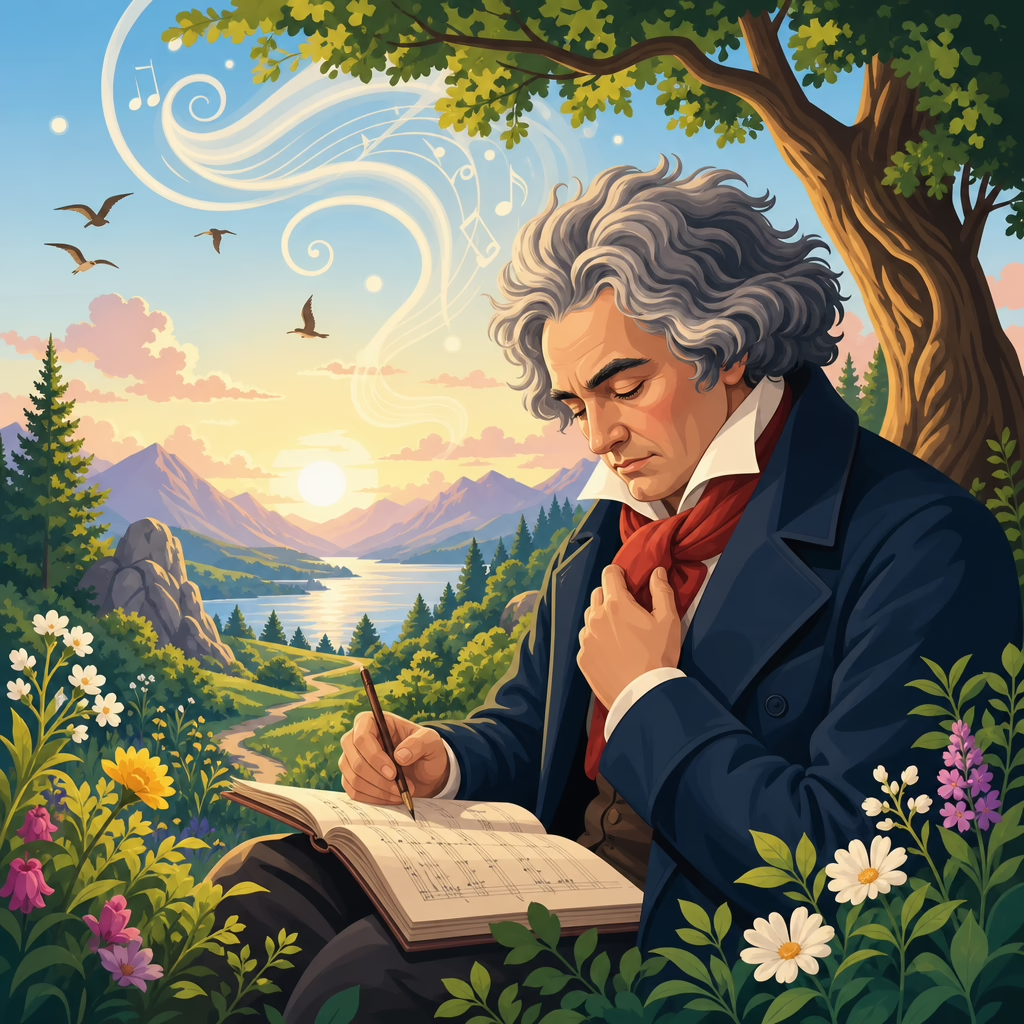
Nature and Spiritual Reflection in Beethoven’s Late Style
Nature and spiritual reflection converge with unusual intensity in Beethoven’s late style, where outward landscape becomes inward revelation. In this final creative period, roughly the works of the late 1810s through 1827, Beethoven stopped treating nature mainly as scene, symbol, or emotional trigger and instead transformed it into a medium for contemplation. The result is not simple pastoral writing. It is music in which stillness, recurrence, silence, interval, and prayer-like pacing suggest that the natural world had become inseparable from questions of mortality, transcendence, and inner freedom.
Late style, in Beethoven scholarship, usually refers to the period of the final piano sonatas, the Missa solemnis, the Diabelli Variations, the Ninth Symphony, and the late string quartets. These works are famous for formal compression and expansion, abrupt contrasts, fugue, variation, and passages that seem to suspend ordinary time. When listeners hear spiritual reflection in them, they are responding to technical features as much as to mood. Long pedal points can feel like horizons. Repeated rhythmic cells can resemble walking, breathing, or prayer. Sudden shifts into radiant major can suggest breakthrough after struggle. Nature enters this language not only through imitation of birds, storms, or brooks, but through pattern, spaciousness, cyclic return, and a sense of life unfolding beyond human control.
This matters because Beethoven’s late music is often misread as purely abstract, detached from the world of fields, weather, and bodily movement that shaped his daily life. That view ignores evidence from his habits and from the expressive design of the works themselves. Beethoven walked constantly, carried sketch materials outdoors, and sought mental clarity in open air. In the late works, those habits seem sublimated rather than abandoned. Instead of painting scenery directly, he distilled what nature offered him: order without rigidity, variety within recurrence, and solitude that sharpened spiritual attention. Understanding that shift helps explain why these compositions feel at once intimate and universal, earthly and metaphysical, severe and deeply humane.
From pastoral depiction to inward landscape
To understand nature and spiritual reflection in Beethoven’s late style, it helps to contrast these works with the more explicit nature writing of the Sixth Symphony. The “Pastoral” names scenes directly: brook, storm, shepherds’ song. In the late period, Beethoven almost never labels nature so literally. Yet the relationship to nature becomes, in some ways, more profound. I have found that when performers and listeners stop waiting for obvious pictorial cues, they begin hearing how late Beethoven creates environments rather than illustrations. He builds sonic spaces where one can sense altitude, distance, and elemental motion without any programmatic caption.
A clear example is the opening of the Piano Sonata in E major, Op. 109. Its broken textures, sudden changes of tempo, and luminous harmonic pacing do not depict a specific outdoor image, but they project a kind of airiness and permeability unlike Beethoven’s middle-period rhetoric. The music seems to arrive as if already in motion, like thought encountered midstream during a walk. That impression matters. Beethoven’s late works frequently replace argument with emergence. Instead of music driving forward through public declaration, it often unfolds as private perception. This is one way nature enters the late style: not as object, but as a model for continuity and organic growth.
The same inward turn can be heard in the C-sharp minor String Quartet, Op. 131, whose seven connected movements create a continuous experiential arc. The opening fugue has often been described in sacred or introspective terms, and rightly so. But it also resembles a natural process: line answering line, energy circulating without theatrical display, a system alive through relation. Beethoven’s mature command of counterpoint here does not feel academic. It feels ecological. Each voice has autonomy, yet the whole depends on interdependence. That balance between individuality and larger order is central both to late Beethoven and to spiritual reflection rooted in nature.
Walking, solitude, and the discipline of attention
Beethoven’s attachment to walking is not a decorative biographical detail; it is one of the strongest practical links between nature and his late style. Friends, secretaries, and contemporaries repeatedly described his long walks around Vienna and in the surrounding countryside. He drafted musical ideas while moving, and movement itself seems to have regulated his concentration. For a useful broader context, see the pillar guide Beethoven’s love of walking and what it meant for his music. In the late works, walking is less likely to appear as cheerful rusticity than as disciplined solitude: repeated steps, recurring motifs, stretches of suspension, and sudden vistas.
That discipline matters spiritually. Reflection is not mere mood. It is sustained attention. Beethoven’s deafness intensified his isolation, but it also redirected perception inward. Removed from ordinary social hearing, he cultivated forms of concentration that resemble meditative practice. Late slow movements often demand that performers hold a line without forcing it, letting tones resonate and decay with unusual patience. In rehearsal, the challenge is always the same: resist the urge to fill every silence. Beethoven writes spaces that must remain spaces. Those gaps are structural, not empty. They allow the listener to experience sound as something akin to presence encountered in solitude, the way one notices wind, water, or distant bells when walking alone.
Consider the “Heiliger Dankgesang” movement from the A minor String Quartet, Op. 132. Beethoven inscribed it as a holy song of thanksgiving from a convalescent to the Deity, in the Lydian mode. The title makes the spiritual dimension explicit, but the music’s natural dimension is equally striking. The modal purity, the alternating slow chorale and “new strength” sections, and the patient spacing of phrases evoke recovery as a biological and spiritual process at once. This is not church music detached from the world. It is embodied devotion. Illness, breath, renewed motion, and gratitude are organized into a ritual of listening.
Musical features that create spiritual-natural resonance
Beethoven’s late style creates spiritual reflection through identifiable compositional means. Modal writing, especially in Op. 132, evokes archaic sacred sound while also stripping harmony to a cleaner, more elemental profile. Variation form, central to Opp. 109 and 111 and to the Diabelli Variations, mirrors natural transformation: identity persists while surfaces change. Extreme registers suggest vertical space, from subterranean bass to remote treble. Sustained pedal points function like drones of landscape, stabilizing the ear while events unfold above. Rhythmic recurrence can resemble pulse, gait, or seasonal return. Silence and caesura become meaningful thresholds rather than interruptions.
These features are not vague impressions; they are audible design choices with strong expressive consequences. In the Arietta variations of Op. 111, for example, Beethoven takes an apparently simple theme and subjects it to metamorphosis so radical that time itself seems altered. Some variations float in trills and suspended textures that many listeners experience as transcendent. Yet transcendence here is built from material continuity. Beethoven does not escape the theme; he reveals latent possibilities within it. That is one reason this music feels spiritually persuasive rather than sentimental. It suggests that revelation is immanent, discovered within ordinary material through deeper attention, much as nature discloses complexity to anyone who looks beyond first appearance.
| Work | Nature-related quality | Spiritual effect | Technical means |
|---|---|---|---|
| Op. 109 Sonata | Airy, open texture | Contemplative inwardness | Fragmented pacing, luminous harmony, variation finale |
| Op. 111 Sonata | Organic transformation | Sense of transcendence through continuity | Arietta variations, trills, registral expansion |
| Op. 132 Quartet | Recovery as living process | Thanksgiving and renewal | Lydian mode, chorale blocks, contrasting “new strength” sections |
| Op. 131 Quartet | Interdependent growth | Mystery, inevitability, inner order | Continuous form, fugue, thematic linkage |
The Missa solemnis extends these procedures onto a monumental scale. Although overtly liturgical, it repeatedly conveys awe through vastness, suspension, and carefully controlled accumulation rather than through operatic display alone. Beethoven reportedly wrote “From the heart—may it return to the heart,” and the score justifies that statement through craft. The Benedictus, with its elevated violin line, can sound like a visitation, but the effect depends on preparation: harmonic clearing, registral contrast, and pacing that resembles waiting in an open space. Nature is present not as birdsong but as atmosphere and proportion, as the shaping of reverence through breadth and light.
Late Beethoven’s spirituality is not escapism
A common mistake is to hear spiritual reflection in Beethoven’s late style as withdrawal from earthly reality. The opposite is closer to the truth. These works confront suffering, fragmentation, and human limitation directly. Their serenity is hard won. Op. 132 emerges from illness. The late quartets are full of strain, irony, rustic interruption, dance fragments, and severe fugues. Even passages that feel sublime are often bordered by roughness. That roughness matters because Beethoven’s view of nature was never decorative. Nature offered replenishment, but it also modeled law, resistance, and process beyond comfort. Spiritual reflection, in this context, means learning to inhabit truth without illusion.
This balance is especially important for performers. If the late works are played as uniformly holy, they flatten into abstraction. If they are played only as intellectual structures, they lose their human depth. The best interpretations hold both dimensions together. Quartets such as the Busch Quartet, the Takács Quartet, and the Alban Berg Quartet, despite different stylistic priorities, show how articulation, tempo, and dynamic control can preserve Beethoven’s grain while allowing moments of suspension to bloom. On piano, interpreters from Wilhelm Kempff to Maurizio Pollini and Mitsuko Uchida demonstrate that transparency and rhythmic discipline are essential if this music is to suggest contemplation rather than vagueness.
Historical context sharpens the point. Beethoven worked in an era shaped by Enlightenment rationality, Catholic ritual, personal crisis, and early Romantic ideas of the sublime. His late style does not simply choose one of those worlds. It fuses them. Counterpoint invokes learned tradition; stark motivic economy reflects uncompromising logic; visionary stillness points toward the sublime; references to dance and song keep the body present. Nature, then, becomes a meeting ground where intellect, sensation, and devotion can coexist. That synthesis is why the late works continue to speak across belief systems. One need not share Beethoven’s theology to hear in this music a disciplined search for meaning grounded in lived experience.
Why this perspective changes how we listen
Hearing nature and spiritual reflection together in Beethoven’s late style changes listening from passive admiration to active encounter. The music stops being merely “difficult” or “profound” in a generalized sense and becomes legible as a record of attention. Repetition is no longer redundancy; it is return with difference. Silence is no longer delay; it is space for recognition. Counterpoint is no longer just craft; it is relation held in balance. Once those ideas become audible, late Beethoven sounds less like a monument and more like a companion in thinking through suffering, renewal, and the search for order beyond noise.
The central takeaway is simple. Beethoven’s late style does not abandon nature; it interiorizes it. Landscapes become states of listening. Walking becomes musical pacing. Recovery becomes thanksgiving. Organic growth becomes variation. Vastness becomes harmonic and registral space. Through those transformations, Beethoven created a language of spiritual reflection that remains unmatched for seriousness and intimacy. If you want to understand these works more deeply, return to Op. 109, Op. 111, Op. 132, and Op. 131 with this question in mind: how does Beethoven turn natural process into inner revelation? Listen slowly, and the answer emerges from the music itself.
Frequently Asked Questions
What does “nature” mean in Beethoven’s late style?
In Beethoven’s late style, nature is no longer presented mainly as picturesque scenery or as a straightforward pastoral topic. Earlier in his career, natural imagery could appear through recognizable musical signs such as flowing accompaniment, birdlike figures, storms, and luminous outdoor atmospheres. In the late works, however, nature becomes much more interiorized. It is less about depicting a landscape and more about creating the conditions for contemplation. This means Beethoven often uses stillness, repetition, spacious pacing, and long-breathed harmonic movement to evoke the experience of being in the presence of something larger than the self.
That shift is crucial for understanding the spiritual force of the late music. Nature becomes a medium through which inward reflection unfolds. Instead of saying, in effect, “this is a field, a brook, or a storm,” the music asks what silence, return, distance, and resonance feel like when the mind is turned toward mystery. A sustained interval, a hovering harmony, or a phrase that seems to pause before continuing can suggest the attentive listening one associates with solitary encounters in nature. In that sense, Beethoven’s late style transforms the outer world into a spiritual environment. The result is not scenic music but meditative music, where the natural world is absorbed into a deeper search for order, humility, and transcendence.
How do nature and spiritual reflection converge in Beethoven’s late works?
They converge through Beethoven’s ability to make musical time feel contemplative rather than merely dramatic. In many late compositions, the listener senses an unusual balance between motion and suspension. Themes return in altered form, textures open into quiet spaces, and silence is treated as an expressive force rather than as empty interruption. These features can resemble the rhythms of observation in nature: watching light change, hearing distant echoes, noticing repetition without exact sameness. Beethoven turns those qualities into spiritual language. The effect is that nature is not simply represented; it becomes the model for inward reflection.
This convergence also depends on the late style’s resistance to conventional closure. Rather than moving efficiently from tension to release, Beethoven often lingers over thresholds, transitions, and states of waiting. That lingering can feel prayer-like. It encourages listening that is patient, humble, and receptive. Such music does not force meaning; it allows meaning to emerge gradually, much as spiritual insight often arises through silence, attention, and return. The late quartets, sonatas, and the final movements of certain large works frequently create this atmosphere. Their power lies in suggesting that the contemplation of nature and the contemplation of ultimate things are not separate experiences, but closely related modes of awareness.
Why isn’t this simply “pastoral” music in the traditional sense?
Traditional pastoral music usually relies on conventions that signal the countryside, rural leisure, or harmonious relation with the natural world. These may include dance rhythms, drone basses, flowing figurations, and uncomplicated lyrical charm. Beethoven certainly knew that tradition and could use it brilliantly. But in his late style, he moves beyond those inherited codes. The music does not aim primarily to paint an idyllic scene or celebrate rustic ease. Instead, it explores states of inward listening, solitude, and spiritual gravity that are much more complex than conventional pastoral expression.
That is why the late works often feel simultaneously serene and searching. Their relationship to nature includes wonder, but also distance, austerity, and even metaphysical questioning. A slow movement may unfold with an almost ritual stillness, where repeated figures and bare intervals sound less like external description and more like acts of meditation. The emotional world is therefore broader and deeper than pastoral sweetness. Beethoven is not simply revisiting the natural world as a place of comfort; he is using it as a gateway into reflection on mortality, gratitude, suffering, and transcendence. In that respect, the late style transforms pastoral inheritance into something closer to spiritual philosophy in sound.
Which musical features make Beethoven’s late style feel contemplative or prayer-like?
Several recurring features contribute to that impression. One is the use of stillness: passages may unfold slowly, with wide spacing and a striking absence of decorative excess. Another is recurrence. Beethoven often revisits a motif, interval, or harmonic idea in ways that feel less like argument and more like meditation. Rather than constantly developing material toward dramatic climax, he sometimes allows it to circle, hover, or deepen through repetition. This gives the listener time to inhabit the sound rather than simply follow its progress.
Silence is equally important. In the late works, rests and pauses can carry enormous expressive weight. They can suggest breath, interruption, reverence, or the limits of speech itself. Harmonic pacing also matters: Beethoven may delay resolution, stretch transitions, or sustain sonorities long enough for their color and resonance to become spiritually charged. Finally, there is the role of interval and line. Simple melodic shapes, especially those that rise gently or remain poised within a narrow range, can sound chant-like or devotional without quoting any specific liturgical source. Taken together, these elements create an atmosphere in which musical experience resembles reflection, vigil, or prayer. The listener is invited not just to hear events, but to dwell within them.
Why is this aspect of Beethoven’s late style so important for listeners and scholars today?
It matters because it helps explain why the late works continue to feel inexhaustible. If we hear them only as technical achievements or as heroic monuments, we miss a central dimension of their power. Their depth lies partly in the way they reimagine expression itself. Beethoven’s late music often speaks most profoundly through restraint, patience, and inwardness. The fusion of nature and spiritual reflection offers a framework for understanding how these works can feel intimate and immense at the same time. They seem to open a space where personal experience, philosophical thought, and something like sacred attention meet.
For scholars, this perspective illuminates Beethoven’s final creative period as more than a stylistic endpoint. It becomes a distinctive mode of musical thinking, one that transforms familiar materials into vehicles of contemplation. For listeners, it offers a richer way to enter the music. One need not decode every formal detail to sense the significance of stillness, return, or suspended time. These works ask for a listening posture that is unusually attentive and reflective. In a modern culture often defined by speed and distraction, that quality feels especially meaningful. Beethoven’s late style reminds us that music can do more than narrate emotion or display craft; it can create an interior landscape where nature, silence, and spiritual awareness become inseparable.