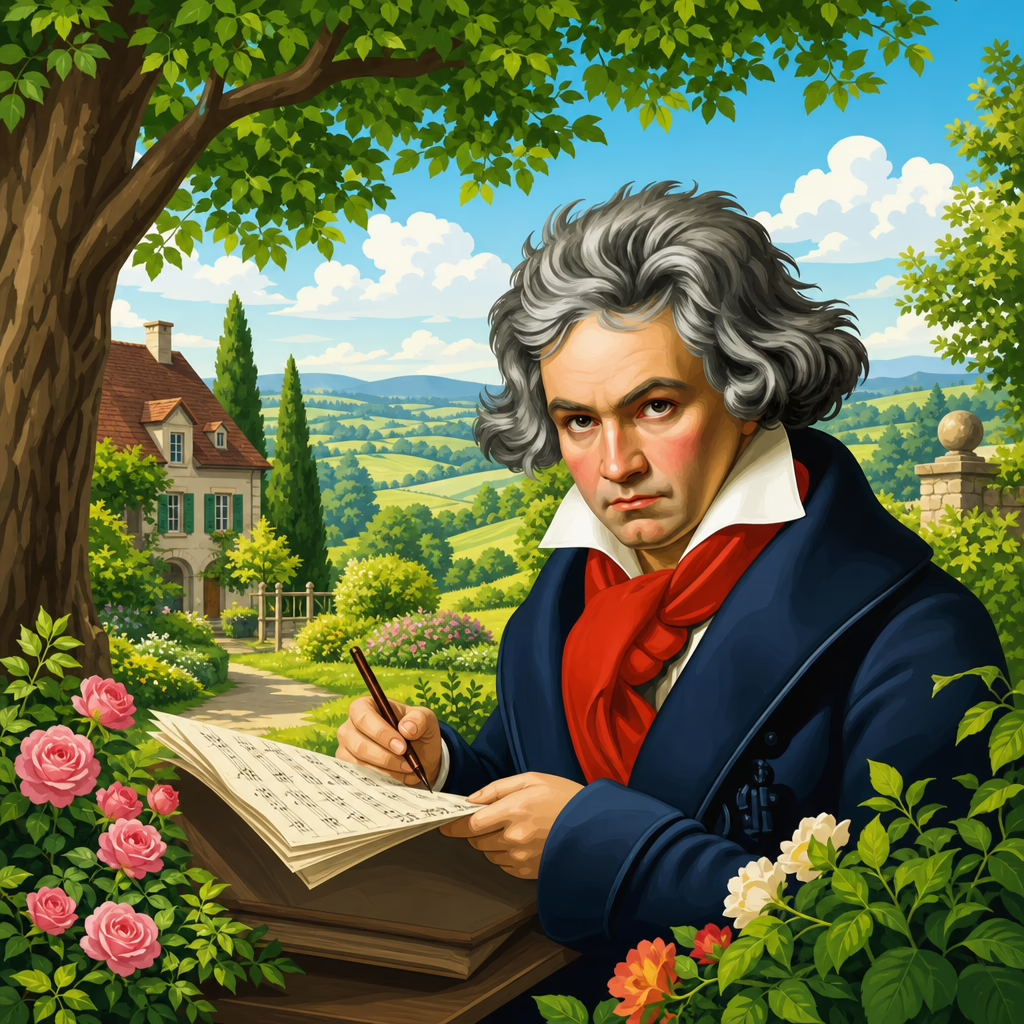
Trees Gardens and Rural Space in Beethoven Portraiture
Trees, gardens, and rural space recur so persistently in Beethoven portraiture that they function as more than background decoration; they are visual arguments about the composer’s identity. In paintings, engravings, lithographs, and later commemorative images, artists repeatedly placed Ludwig van Beethoven outdoors, beside trunks and hedges, at the edge of fields, or within idealized parkland. These choices mattered because portraiture in the late eighteenth and early nineteenth centuries rarely treated setting as neutral. A tree could imply constancy, solitude, learned reflection, or communion with creation. A garden could signal cultivation, taste, and controlled nature. Rural space, especially the outskirts of Vienna and the wooded paths associated with Heiligenstadt, Döbling, Baden, and Mödling, could suggest freedom from urban noise, moral seriousness, and proximity to the conditions under which music was conceived.
When discussing Beethoven portraiture, it helps to define the term broadly. It includes formal oil portraits made from sittings, small profile likenesses intended for print circulation, memorial images produced after his death, and visual representations embedded in title pages or commemorative albums. Not every image is equally documentary. Some record a face with close observational care, while others construct an imaginative Beethoven designed to satisfy public expectations. I have spent years comparing these works across museum catalogues, old reproduction sets, and exhibition notes, and one pattern becomes unmistakable: natural settings were repeatedly used to solve a representational problem. Beethoven was both a public celebrity and a private walker, both an urban professional and a figure widely associated with uncultivated creative force. Trees, gardens, and rural distances helped artists reconcile those identities.
This subject matters because visual culture shaped the Beethoven myth almost as powerfully as biography did. Viewers who never met him learned how to imagine him through portraits. If those portraits consistently paired him with wooded paths, storm-bent branches, or cultivated greenery, then nature became part of his recognizable image. That visual tradition also influenced later scholarship, museum display, book illustration, and even modern marketing around Beethoven and the countryside. To read these images well, we need to ask precise questions: what kind of natural space is shown, how controlled or wild it appears, whether it reflects actual locations, and what emotional or intellectual claim the artist is making. Once those questions are asked, trees, gardens, and rural space emerge as central symbolic tools in the making of Beethoven’s likeness.
Trees as portrait devices: endurance, solitude, and the thinking body
In Beethoven images, trees often do the work that columns did in aristocratic portraiture. Earlier elite portraits used architecture to communicate rank, permanence, and education. Beethoven, by contrast, was frequently framed by organic verticals: trunks, clustered branches, or woodland margins. The substitution is meaningful. A tree suggests rootedness without courtly formality. It can imply age, struggle, seasonal change, and survival. For an artist portraying Beethoven, especially after his middle years, that symbolism was extremely useful. Here was a composer increasingly represented as inward, severe, weathered, and morally resistant. A mature tree mirrored those traits better than a salon interior ever could.
Specific examples vary in documentary value, but the pattern is consistent across nineteenth-century Beethoven imagery. Outdoor portraits and commemorative prints often place him beneath foliage with manuscript in hand, the tree acting as a stabilizing form beside an otherwise restless body. Beethoven’s posture in many likenesses is energetic rather than relaxed: leaning forward, turning abruptly, striding, or pausing mid-thought. The tree gives compositional counterweight and symbolic contrast. His mind appears mobile; the trunk appears steadfast. The result is a visual synthesis of movement and endurance, exactly the qualities audiences liked to project onto his music.
Artists also used trees to externalize solitude. Beethoven’s deafness encouraged a public image of separation from ordinary social life, but portraitists had to avoid making that isolation look merely pitiable. Woodland framing offered a solution. A solitary figure among trees can appear chosen rather than abandoned, contemplative rather than excluded. In practical terms, this is why many images avoid crowded urban scenery. A lane lined with trees, a copse, or a rough park edge creates psychological space around the sitter. It turns privacy into dignity.
There is another layer here. In European visual tradition, trees were tied to poetic and philosophical reflection. By placing Beethoven near them, artists aligned him with a lineage of inspired thinkers rather than fashionable performers. This mattered because he was marketed not as a virtuoso entertainer alone but as a creator of lasting works. The tree therefore became an emblem of authorship. It signaled that the music arose from depth, time, and inward labor.
Gardens and cultivated nature in the Beethoven image
Gardens are different from woods, and portraitists understood the distinction. Where trees can imply wild force or solitary endurance, gardens suggest ordering intelligence. Paths, clipped growth, benches, walls, and arranged plantings present nature as something shaped through care. In Beethoven portraiture, garden settings often soften the harsher image of the untamed genius. They make him legible as a cultivated man of letters and art, not just a storm-driven creator.
That nuance matters because Beethoven’s reputation always balanced opposites. Contemporary accounts describe a difficult, absent-minded, sometimes abrupt personality, yet also an artist intensely attentive to structure, revision, and formal control. A garden captures that duality better than open countryside alone. It is natural life subjected to design, much as musical material is developed through craft. When an image places Beethoven on a path bordered by greenery or near a managed grove, it quietly states that inspiration and discipline coexist in his work.
Some visual treatments of Beethoven draw on the aesthetics of the landscape garden, then fashionable across Europe. Such spaces were not rigidly geometric in the old Baroque sense, yet neither were they untouched nature. They offered winding routes, framed views, and orchestrated irregularity. This was ideal for representing a composer associated with emotional depth but also with architectural command. The viewer sees a man who appears free in thought while moving through an environment subtly composed around him.
Garden imagery could also make Beethoven socially acceptable to middle-class audiences buying prints for domestic display. A completely wild setting might overstate eccentricity. A cultivated landscape implied taste, moral refinement, and compatibility with educated household culture. In that sense, gardens helped domesticate the Beethoven legend without emptying it of seriousness.
Rural space and the Viennese outskirts as sites of authenticity
Rural space in Beethoven portraiture is rarely generic empty land. Even when not topographically exact, it evokes the lived geography of the composer’s habitual movement beyond Vienna’s dense center. He spent substantial time walking or staying in semi-rural districts, and those associations fed visual representation. Places such as Heiligenstadt, where he wrote the famous 1802 testament, carried biographical weight. Baden later became linked with summer work, health routines, and composition. Mödling, Döbling, and nearby villages belonged to the mental map through which audiences imagined Beethoven seeking air, relief, and ideas.
Artists did not need to label a precise route for viewers to recognize the message. A rising path, distant hills, sparse buildings, open fields, or woodland edges all indicated that this was not the court city. Rural space implied authenticity. It presented Beethoven away from institutions, patrons, and performance rituals. In visual terms, the countryside became the place where the “real” Beethoven existed: hearing inwardly, thinking freely, and composing before music entered the public world.
That association remains important for readers exploring the wider relation between Beethoven’s walking life and creative practice, as discussed in the main guide at https://lvbeethoven.com/beethovens-love-of-walking-and-what-it-meant-for-his-music/. Within portraiture specifically, rural space serves as evidence of how thoroughly that biographical idea became visual shorthand. Even when an image is partly imagined, it tells us what audiences expected to be true.
One reason rural settings worked so well is that they answered a credibility problem. Beethoven’s most intense compositional labor often happened indoors at desks, pianos, and tables covered with sketch leaves. Yet the public wanted an image of creation linked to elemental experience. Open country resolved that tension. It did not deny labor; it relocated the source of invention to movement through landscape. Portraiture thereby transformed the countryside into a studio of the mind.
How artists balanced observation and mythmaking
Not every natural detail in Beethoven portraiture should be treated as biography. Artists frequently combined observed likeness with symbolic setting. In some cases, the face may derive from an earlier authenticated portrait while the surroundings are later additions. Print culture encouraged this because engravers could adapt existing heads for new commemorative compositions. After Beethoven’s death in 1827, this tendency intensified. The demand for memorial images rewarded recognizable types over strict factual accuracy.
The key is not to dismiss these works as false, but to read their visual logic carefully. I have found it useful to sort natural settings in Beethoven images by function rather than by medium alone. Some aim for local memory, evoking places where he actually walked. Others are moral landscapes, built to express inner character. Still others are monumental, using trees and horizons to elevate him into a national or near-prophetic figure.
| Setting element | Typical meaning in Beethoven portraiture | Common visual effect |
|---|---|---|
| Single large tree | Endurance, inward strength, permanence | Stabilizes a restless pose |
| Garden path or managed grove | Cultivation, discipline, refined sensibility | Softens the image of genius |
| Open rural distance | Freedom, authenticity, escape from the city | Expands the composer’s psychological space |
| Woodland edge | Threshold between society and solitude | Places Beethoven between public and private worlds |
This framework explains why similar motifs recur across unlike works. The point was not merely to show where Beethoven stood, but to tell viewers how to understand him. Portrait settings acted almost like program notes. They translated character into scenery.
At the same time, there are limits. We should not assume every tree refers to a specific species with coded intent, or that every garden indicates a real estate location. Many artists used conventional landscape vocabularies available from portrait practice and print design. The significance lies in repetition. When a culture repeatedly chooses certain natural forms for the same figure, those forms become part of that figure’s meaning.
Why these motifs endured in later Beethoven imagery
The persistence of trees, gardens, and rural space in later Beethoven portraiture reflects the durability of a broader cultural narrative: great music arises from concentrated contact with the natural world. Nineteenth-century Romantic reception amplified that story, and Beethoven became one of its strongest visual anchors. Once established, the motif was endlessly adaptable. Publishers could use a leafy background to make a stern head more approachable. Memorial painters could place him in idealized countryside to suggest transcendence. Sculptural monuments set in parks extended the same logic into three dimensions, surrounding Beethoven physically with the nature earlier artists had painted behind him.
These settings also survived because they answered modern viewers’ expectations. Even now, many people instinctively picture Beethoven outdoors, coat flaring, notebook in hand, confronting wind and thought. That image is not accidental. It was built over generations through selective portrait conventions. Trees supplied gravity, gardens supplied order, and rural space supplied authenticity. Together they made his creativity visible.
For anyone studying Beethoven and nature, the lesson is clear. Do not treat landscape details in portraiture as incidental filler. They are structural signs carrying biographical, moral, and artistic claims. Read the trunk, the path, the hedge, the field line, and the distant hill as carefully as the face or the score page. Those visual decisions reveal how artists and audiences wanted Beethoven to be understood: not simply as a composer who happened to like walking, but as a cultural figure whose genius seemed inseparable from the spaces beyond the city.
Look closely at the next Beethoven portrait you encounter and ask what the natural setting is doing. Is the tree bearing the burden of permanence? Is the garden taming the myth of wild genius? Is the rural horizon turning a working musician into a solitary visionary? Those questions sharpen interpretation quickly. They also show why this narrow topic deserves serious attention. In Beethoven portraiture, nature is not background. It is biography, symbolism, and reputation made visible.
Frequently Asked Questions
Why do trees, gardens, and rural settings appear so often in Beethoven portraiture?
Trees, gardens, and rural space appear so often in Beethoven portraiture because they helped artists communicate a carefully constructed idea of who Beethoven was. In the late eighteenth and early nineteenth centuries, portrait backgrounds were rarely neutral. A landscape, a garden path, a stand of trees, or the edge of a field could signal education, temperament, class, intellect, and moral character. In Beethoven’s case, outdoor settings became a visual language for presenting him as a composer of profound feeling, inward seriousness, and unusual creative independence. Rather than showing him only in a formal interior, surrounded by elite furnishings or courtly symbols, many artists placed him in nature to align him with authenticity, contemplation, and artistic originality.
This repeated choice also reflects Beethoven’s well-known association with walking, solitude, and the countryside. He was widely understood, both during his life and after his death, as a figure who drew energy and inspiration from movement through open air and from encounters with natural surroundings. Whether a particular portrait recorded an actual location or invented an ideal setting mattered less than the larger message: Beethoven was not simply a professional musician for hire, but a creative force whose genius was nourished by the natural world. Trees and gardens therefore functioned as symbolic extensions of his identity. They suggest rootedness, depth, growth, reflection, and an emotional life larger than the conventions of urban sociability. Their persistence across media shows that these were not incidental decorative choices, but recurring visual arguments about Beethoven’s character and stature.
Were these outdoor settings meant to be realistic depictions of places Beethoven actually visited?
Sometimes they may have been loosely inspired by places Beethoven knew, but in many cases the outdoor settings in his portraits were not strict documentary records. Portraiture of the period often blended observation with idealization. An artist might borrow elements from real gardens, paths, wooded areas, or parkland while arranging them into a more meaningful and legible composition. What mattered was not topographical precision so much as symbolic clarity. If Beethoven appears beside a tree, near hedges, on uneven ground, or at the threshold of open rural space, the scene often tells viewers how to read him rather than where exactly he stood.
This distinction is important because commemorative images especially tended to amplify themes already associated with Beethoven’s public image. Later engravings, lithographs, and reproduced portraits often repeated or adapted the same outdoor motifs precisely because audiences recognized them as fitting. A realistic city interior might have emphasized social position or professional status, but an idealized rural setting emphasized imagination, freedom, seriousness, and closeness to elemental experience. In that sense, these spaces are best understood as interpretive environments. They were visual constructs designed to make Beethoven’s genius seem organic and inevitable, as though his music grew in relationship with the living world around him. Even when not literally accurate, they were culturally persuasive.
What did gardens and cultivated landscapes specifically add to Beethoven’s image, beyond simple “nature” symbolism?
Gardens and cultivated landscapes added nuance that pure wilderness imagery could not. A garden is not just nature; it is nature shaped, ordered, and interpreted by human intelligence. When Beethoven is placed in or near a garden, viewers are invited to see a productive tension between wild inspiration and disciplined creation. This is especially appropriate for a composer whose work was often understood as both emotionally powerful and rigorously structured. The garden setting suggests that Beethoven’s art emerged from feeling, but not from chaos. It implies cultivation, reflection, and form.
These settings also helped place Beethoven within broader cultural ideals of sensibility and intellectual life. In European visual culture, gardens and landscaped grounds were associated with walking, reading, meditation, conversation, and refined experience. They could evoke privacy without isolation and elevate the subject without requiring overt aristocratic display. For Beethoven, that mattered. He occupied a complicated social position: he was neither simply a court servant nor a conventional gentleman. Garden imagery offered a flexible middle ground. It allowed artists to present him as dignified and elevated while still emphasizing his independence from rigid social ceremony. In short, the garden was a powerful visual compromise: civilized but not stiff, natural but not wild, reflective but not passive. It reinforced the idea that Beethoven’s identity united emotional depth, artistic discipline, and moral seriousness.
How did rural space help shape the myth of Beethoven as a solitary genius?
Rural space played a major role in shaping the enduring myth of Beethoven as a solitary genius because open landscapes visually separate him from ordinary social life. When an artist places Beethoven at the edge of a field, along a path, beneath a tree, or against a broad natural backdrop, the effect is often one of mental and emotional apartness. He may still be accessible to the viewer, but he is no longer embedded in the bustling world of salons, patrons, and urban routines. Instead, he appears as someone whose deepest commitments lie beyond society’s noise. That visual separation supports the Romantic-era ideal of genius as inward, difficult, and uniquely attuned to truths others cannot easily perceive.
At the same time, rural space does not simply isolate Beethoven; it often legitimizes his isolation. A solitary figure indoors might seem lonely or socially estranged. A solitary figure in nature can appear purposeful, contemplative, and in contact with higher forms of insight. This is one reason rural settings became so powerful in Beethoven portraiture and later memory culture. They transformed personal seclusion into creative authority. The landscape around him does ideological work: it suggests that distance from society is not a flaw, but the condition of originality. That message became even more compelling as Beethoven’s posthumous image hardened into legend. Rural motifs helped viewers understand his seriousness, intensity, and even his struggle as signs of greatness rather than alienation.
Why are these visual motifs important for understanding Beethoven’s legacy today?
These visual motifs matter because they show that Beethoven’s legacy was shaped not only by music and biography, but also by repeated acts of visual interpretation. Portraits, prints, and commemorative images taught audiences how to imagine Beethoven long before modern media existed. When artists consistently associated him with trees, gardens, and rural space, they were doing more than illustrating a preference for scenic backgrounds. They were building a durable public image: Beethoven as natural genius, serious thinker, independent spirit, and emotionally profound creator. That image influenced how people approached his music, how they narrated his life, and how later generations remembered his cultural importance.
For modern readers and viewers, paying attention to these recurring landscape elements helps reveal the historical mechanics of reputation. It reminds us that portraiture is an active form of argument, not a passive record. The tree beside Beethoven, the path behind him, the cultivated greenery around him, and the open land beyond him all participate in meaning-making. They position him within ideas about nature, creativity, modern individuality, and artistic authority that were central to his era and remain influential today. Understanding these motifs therefore deepens our reading of Beethoven portraiture and of Beethoven himself. It allows us to see how visual culture helped turn a historical composer into a lasting cultural symbol.