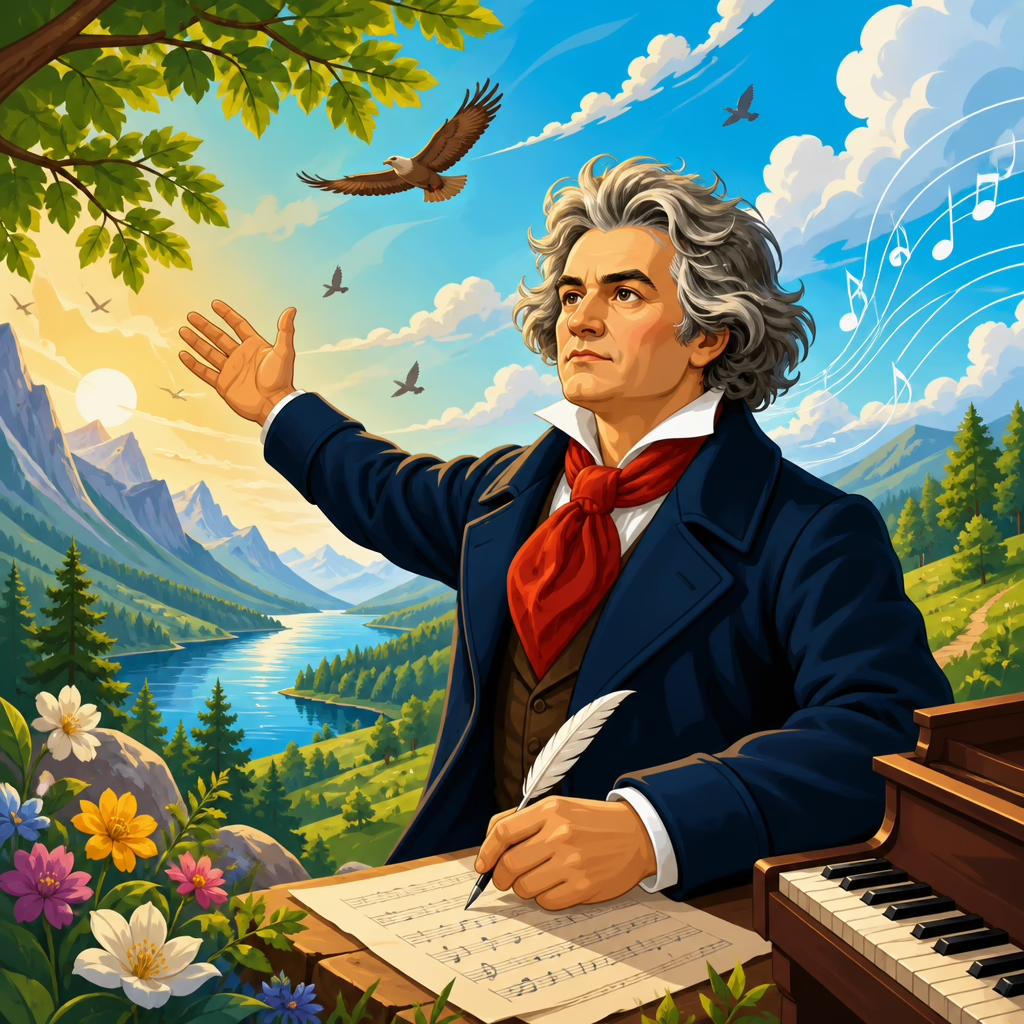
Nature and Freedom in Beethoven’s Artistic Ideals
Nature and freedom stand at the center of Beethoven’s artistic ideals because he treated both not as decorative themes but as conditions of truthful creation. In Beethoven’s world, nature meant more than countryside scenery, birdsong, or storms in music. It signified order without tyranny, vitality without artifice, and a realm in which feeling could unfold honestly. Freedom likewise was not mere independence or rebellion for its own sake. It meant inner autonomy: the moral and imaginative power to shape one’s life, art, and thought according to conviction rather than fashion, patronage, or fear. When these two ideals meet in Beethoven’s work, they reveal a composer who heard in natural processes a model for liberated expression and who pursued artistic freedom with unusual intensity.
This matters because Beethoven is often described through grand abstractions such as heroism, genius, and struggle, while the link between nature and freedom explains those abstractions in concrete terms. His sketchbooks, letters, conversation books, and the testimony of friends repeatedly show a man who walked for hours, sought solitude outdoors, and associated the natural world with restoration and creative clarity. I have found that once this connection is taken seriously, familiar works sound different. The “Pastoral” Symphony stops being a pleasant scene painting and becomes an argument about how a free human being listens, feels, and belongs in the world. The late quartets also gain another dimension: their spaciousness, abrupt shifts, and patient organic growth resemble thought released from social convention and tuned to deeper rhythms.
Beethoven’s ideals were shaped by his historical moment. He inherited Enlightenment language about liberty, reason, and human dignity, but he also lived through revolution, war, censorship, aristocratic control, and personal disability. In that setting, nature offered an alternative ground of value. It was not subject to court etiquette, and it did not flatter rank. At the same time, freedom for Beethoven was never simple escape into landscape. He did not flee society so much as measure society against a standard of inward truth that he experienced most powerfully in relation to nature. Understanding that standard is essential for reading his aesthetics, his working habits, and the expressive architecture of his music.
Nature as a moral and artistic standard
Beethoven repeatedly treated nature as a source of moral orientation, not merely sensory pleasure. Accounts from Anton Schindler, though requiring caution, and more reliable testimonies from contemporaries describe him stopping during walks, absorbing weather, light, and water with concentrated attention. In letters he speaks of trees seeming to speak to him of the divine. That phrase is important because it places nature above taste and fashion. For Beethoven, the natural world embodied truth that human institutions often failed to sustain. In practical artistic terms, this meant he distrusted prettiness, empty virtuosity, and formula when they did not arise from genuine expressive necessity.
His attachment to nature also reflected a wider intellectual tradition. Thinkers such as Rousseau had already linked nature with authenticity and freedom from corruption, while German idealist and early Romantic circles treated nature as spiritually significant rather than mechanically inert. Beethoven never wrote systematic philosophy, yet his choices align with this climate. He gravitated toward texts and subjects that emphasized dignity, inwardness, and liberation. Nature became a testing ground for these values because it presented complexity without artificial social masks. That helps explain why Beethoven’s representations of nature are usually dynamic and relational. He is less interested in static pastoral ornament than in processes: arrival, flowing motion, interruption, storm, recovery, thanksgiving.
One useful way to understand this is to compare Beethoven with eighteenth-century musical pastoral convention. Earlier pastoral music commonly used drones, lilting compound meter, and stylized simplicity to signal rustic calm. Beethoven uses some of those devices, but he enlarges them into something more structural. In the Sixth Symphony, for example, a murmuring accompaniment is not just local color; it sets up an experiential field in which themes breathe, expand, and coexist. Nature is not a painted backdrop. It is the condition under which musical freedom becomes audible.
Freedom as inner autonomy, not social pose
When Beethoven pursued freedom, he was not simply rejecting all limits. He relied on publishers, patrons, performers, and urban audiences, and he could be strategic about all of them. Yet he fiercely defended the independence of his artistic judgment. The famous moment when he scratched Napoleon’s name from the “Eroica” title page after Bonaparte declared himself emperor shows how deeply he objected to betrayed ideals. Freedom, in Beethoven’s practice, meant fidelity to principle over convenience. It also meant the right of the artist to organize musical time according to expressive truth rather than inherited expectation.
This inner autonomy appears in his style. Beethoven stretches forms from within instead of discarding them carelessly. A sonata movement may begin with startling economy, then generate vast consequences from a few motives. That compositional method mirrors freedom understood as disciplined self-determination. He is not free because nothing constrains him; he is free because he transforms constraint into necessity. In rehearsal reports and anecdotal evidence, contemporaries often found him demanding, abrupt, and uncompromising. Those traits can be unattractive in personal life, but artistically they reveal a refusal to let convention dictate substance.
His deafness intensified this ideal. Hearing loss isolated him socially and professionally, yet it also pushed him toward a more interior mode of creation. The Heiligenstadt Testament from 1802 makes clear that despair and vocation were intertwined. He considered ending his life, then resolved to continue for the sake of art. That decision is one of the clearest examples of freedom in Beethoven’s sense: not ease, but chosen perseverance under severe limitation. Nature remained crucial here because walking and outdoor solitude offered a space where damaged social communication could be temporarily replaced by a different kind of contact and order.
The “Pastoral” Symphony as Beethoven’s clearest statement
No work states the relation between nature and freedom more plainly than the Symphony No. 6 in F major, Op. 68, completed in 1808. Beethoven labeled its movements with descriptive headings, but he also insisted it was “more the expression of feeling than painting.” That sentence is central. He wanted listeners to understand that the point was not imitation for its own sake. The symphony dramatizes what happens to human feeling when it enters a natural environment openly and attentively.
The first movement, “Awakening of cheerful feelings on arrival in the countryside,” begins with a harmonic and rhythmic ease unlike the driven tension of the Fifth Symphony. Yet its freedom is highly crafted. Repeated figures create continuity without rigidity, and the phrases seem to discover space as they unfold. The “Scene by the brook” extends this poise. Its long lines and undulating accompaniment evoke duration, patience, and receptivity. Even the famous bird calls near the end are restrained within the movement’s larger equilibrium. They confirm presence rather than steal attention.
The storm changes everything, but not in a merely picturesque way. It introduces disruption, fear, and force, then yields to the “Shepherd’s song; cheerful and thankful feelings after the storm.” This sequence matters because freedom is not portrayed as untouched serenity. It is regained gratitude after trial. The pattern resembles Beethoven’s broader expressive logic in works from the Fifth Symphony to the late piano sonatas: conflict is real, but form can absorb it without losing integrity.
For readers interested in how Beethoven’s outdoor life informed this aesthetic, the main guide at https://lvbeethoven.com/beethovens-love-of-walking-and-what-it-meant-for-his-music/ provides broader context. Within the narrower frame of artistic ideals, the Sixth Symphony shows that nature gives Beethoven a language for freedom grounded in lived experience, emotional candor, and renewal rather than abstract program.
How walking shaped Beethoven’s creative freedom
Beethoven’s walking was not a biographical footnote. It was part of his method. Friends and secretaries describe him carrying sketchbooks on long walks around Vienna and in nearby rural areas such as Heiligenstadt, Döbling, and Baden. These excursions gave him distance from domestic strain, urban noise, and the formalities of patronage culture. In my experience reading his sketches alongside the testimony of contemporaries, the walks function less as breaks from work than as another stage of composition. Motion, solitude, and sensory openness seem to have helped him test musical continuity over time.
Walking also supported a specific kind of freedom: freedom from immediate social demand. Beethoven could leave behind conversation, obligation, and performance pressure and enter a setting where ideas could ripen at their own pace. That does not mean melodies were simply copied from natural sounds. The process was subtler. Outdoor experience encouraged patterns of attention that appear in the music: sustained pedal points, gradual thematic emergence, abrupt weather-like contrast, and the sense that form grows organically rather than mechanically.
| Element in Beethoven’s practice | Connection to nature | Effect on artistic freedom |
|---|---|---|
| Long walks with sketchbooks | Exposure to changing terrain, light, and atmosphere | Ideas developed away from social pressure and fixed routines |
| Preference for rural retreats | Regular contact with streams, fields, and wooded paths | Greater inward focus and resistance to urban fashion |
| Process-based composition | Attention to growth, interruption, and return in nature | Forms expanded through organic development rather than formula |
| Emphasis on gratitude after struggle | Storm, recovery, and seasonal renewal as experiential models | Freedom presented as hard won resilience, not simple ease |
This relationship between walking and freedom helps explain why Beethoven’s nature music seldom feels passive. Even at its calmest, it is alert. The listener senses a mind moving through space, testing orientation, discovering bearings. That is why the topic should not be reduced to pleasant landscape influence. Beethoven used nature to secure the independence of his own listening.
Nature and freedom beyond the “Pastoral” Symphony
Although the Sixth Symphony is the obvious focal point, the ideal extends further. The Violin Sonata in A major, Op. 47, known as the “Kreutzer,” is not about nature descriptively, yet its volatile contrasts and expansive rhetoric exemplify Beethoven’s insistence on liberated form. The Piano Sonata in D major, Op. 28, often called the “Pastoral,” uses a steady rhythmic ground and open textures that suggest breadth and continuity rather than salon polish. In the late period, the String Quartet in A minor, Op. 132, especially the “Holy Song of Thanksgiving,” reaches a rarer level of contemplative spaciousness. Its alternating slow hymn and “new strength” sections suggest recovery in terms deeply compatible with Beethoven’s nature-centered ideal of renewal.
The Missa solemnis also belongs in this discussion. While sacred rather than pastoral, it seeks transcendence through an ordering of vast forces that often feels elemental. Beethoven’s sense of freedom was never anti-structure. Instead, he wanted structure to feel earned, as if discovered in accordance with higher law rather than imposed externally. That is the same reason his late works can sound both severe and liberating. They ask performers and listeners to inhabit time differently, with patience, courage, and openness to transformation.
In the end, nature and freedom in Beethoven’s artistic ideals form one continuous principle. Nature gave him a model of truthful order, renewal, and unforced vitality. Freedom gave him the resolve to follow that model against convention, political disillusionment, personal suffering, and commercial pressure. Together they shaped not only programmatic works but his whole conception of what serious music should do. It should make inner life more honest, more spacious, and more resilient. For modern listeners, that is the enduring benefit of hearing Beethoven through this lens: the music becomes less a monument and more a living practice of attention. Return to the key works, listen for organic growth and recovered gratitude, and Beethoven’s ideals will become audible with new clarity.
Frequently Asked Questions
Why are nature and freedom so central to Beethoven’s artistic ideals?
Nature and freedom are central to Beethoven’s artistic ideals because he understood them as the essential conditions for truthful artistic expression. For Beethoven, nature was not simply a source of picturesque imagery or pleasant atmosphere. It represented a living order that existed without falseness, coercion, or decorative excess. In nature, he perceived a model of organic balance: movement without rigidity, energy without chaos, and beauty without artificial ornament. That made it profoundly important to his music, which often strives to sound inevitable, as though it grows from within rather than being mechanically assembled.
Freedom, in turn, was not merely social rebellion or refusal of authority. Beethoven’s deeper concern was inner freedom: the capacity of the individual spirit to remain morally and imaginatively self-governing. He valued the artist’s ability to shape experience according to truth rather than convention, fashion, or external pressure. When these two ideals come together, they form the core of Beethoven’s artistic worldview. Nature offers the image of authentic order, while freedom gives the human being the strength to participate in that order consciously and creatively. In this sense, Beethoven’s music often sounds like a struggle toward alignment between the inner self and a larger, more truthful reality.
What did Beethoven mean by “nature” in his music and artistic thinking?
When Beethoven invoked nature, he meant something far richer than fields, forests, storms, or birdsong, though those elements can certainly appear in his work. Nature, for him, suggested an underlying truthfulness in existence. It was a realm where feeling could unfold honestly, where form emerged from necessity rather than artifice, and where life retained its energy without being distorted by social pretension. This is why Beethoven’s connection to nature should not be reduced to musical imitation or pastoral mood. He was interested in nature as a principle of authenticity.
That principle shaped both the sound and structure of his music. Beethoven often builds a piece from small, concentrated ideas that develop organically, almost like living organisms. Themes do not simply repeat; they evolve, collide, intensify, and transform. This process mirrors a natural logic rather than a decorative one. Even in music that is dramatic or turbulent, there is often a sense that the emotional force is grounded in something real and necessary. Nature, in Beethoven’s artistic imagination, is therefore a model for how art should live: not artificially posed, but internally alive, truthful, and dynamically ordered.
How did Beethoven’s idea of freedom differ from simple rebellion or independence?
Beethoven’s idea of freedom was far more demanding than mere defiance. He did not treat freedom as the right to reject rules for its own sake, nor as a purely political slogan detached from personal responsibility. Instead, he saw freedom as inner autonomy: the ability to act, create, and judge according to one’s deepest convictions. This kind of freedom requires discipline, self-knowledge, courage, and moral seriousness. It is not impulsive. It is earned.
That distinction matters greatly when thinking about his music. Beethoven did challenge conventions, but his boldness was rarely arbitrary. He expanded form, intensified drama, and pushed emotional boundaries because he believed art had to answer to truth rather than habit. In other words, freedom in Beethoven is not chaos; it is fidelity to a higher necessity. A composition may break expectations, but it does so in service of a deeper coherence. This is why his most powerful works feel both liberated and purposeful. They embody the idea that true freedom is not the absence of structure, but the creation of form from within, guided by conscience and imagination rather than by passive obedience.
How do nature and freedom work together in Beethoven’s artistic vision?
In Beethoven’s artistic vision, nature and freedom are not separate ideals but mutually reinforcing ones. Nature offers a picture of living order, an existence shaped by intrinsic law rather than external coercion. Freedom allows the human artist to enter into relation with that order consciously, not by copying it mechanically, but by discovering equivalent truth within the self. This relationship is crucial to understanding Beethoven’s originality. He does not present nature as a retreat from human struggle, nor freedom as a refusal of all limits. Instead, he suggests that the freest art is the art most deeply aligned with what is real, vital, and inwardly necessary.
This helps explain the unusual combination of force and integrity in his music. Beethoven’s works often sound as if they are wrestling their way toward clarity, balance, or affirmation. That dramatic movement reflects the human search for freedom, while the eventual sense of coherence reflects a natural order that has been discovered rather than imposed. In this way, his music can feel both intensely personal and larger than the individual. It expresses a self striving to become fully itself, yet doing so in harmony with truths that transcend personal whim. Nature gives Beethoven a vision of authenticity; freedom gives him the means to realize it artistically.
Why does Beethoven’s view of nature and freedom still matter today?
Beethoven’s view of nature and freedom remains important because it offers a powerful alternative to modern misunderstandings of both ideas. Nature is often treated either as scenery to consume or as a sentimental escape from complexity. Freedom is often reduced to choice, self-assertion, or resistance without reflection. Beethoven invites a more serious and sustaining understanding. He presents nature as a source of truth, vitality, and non-artificial order, and freedom as the inner capacity to live and create with integrity. Together, these ideals speak directly to contemporary concerns about authenticity, moral agency, and the relationship between individual expression and larger realities.
His perspective also continues to matter artistically. In an age saturated with performance, branding, and surface effect, Beethoven’s example reminds us that great art is not built from ornament alone. It emerges when feeling, structure, and conviction become inseparable. His music still resonates because it does not merely display emotion; it transforms emotion into form through disciplined freedom. That achievement makes his artistic ideals enduringly relevant. They suggest that true creativity depends on honesty, that genuine freedom requires inward strength, and that the deepest works of art connect human struggle to something elemental, ordered, and alive.