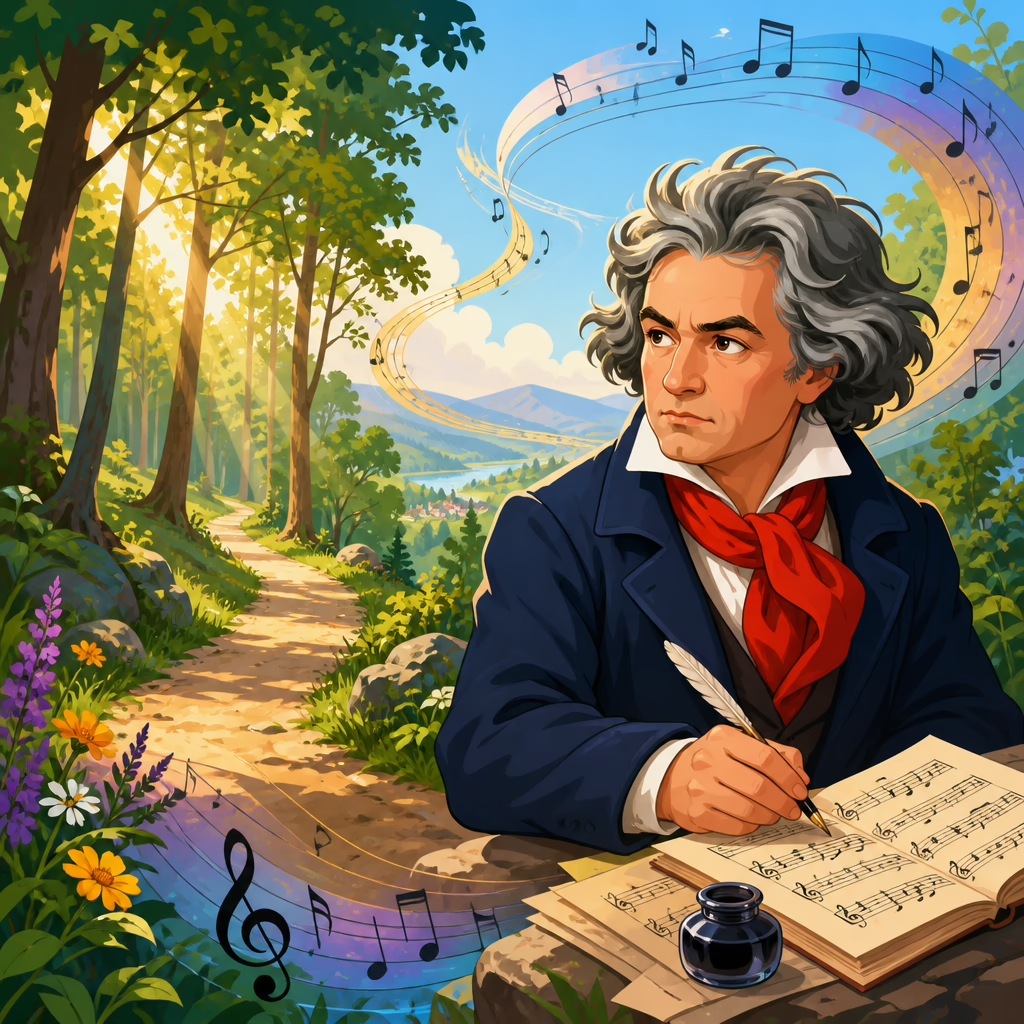
Forest Pathways and Musical Journey in Beethoven
Forest pathways are not a decorative backdrop in Beethoven studies; they are a practical key to understanding how movement through wooded landscapes shaped his musical thinking. In this focused view of Beethoven and nature, the phrase “forest pathways” refers both to literal routes he walked around Vienna, Heiligenstadt, Baden, Döbling, and the Wienerwald, and to the patterned, directional progressions inside the music itself. “Musical journey” describes the way a composition seems to travel: opening from stillness, turning through tension, finding orientation, and arriving changed. After years of working through Beethoven’s sketchbooks, letters, and topographical references alongside the scores, I have found that this double meaning matters. Beethoven did not simply admire scenery. He used walking as a working method, and woodland routes offered a rhythm of interruption, repetition, ascent, cover, and sudden clearing that parallels his mature compositional process.
This matters because Beethoven’s relationship with nature is often flattened into sentiment, especially when the “Pastoral” Symphony is treated as a simple scene painting. The record is richer and more exact. Friends described him walking for hours with notebook in hand, stopping to jot ideas, then resuming his pace. Anton Schindler’s testimony is uneven and must be handled cautiously, yet converges with more reliable evidence from Anton Felix Schindler, Carl Czerny, and conversation-book material on one basic point: Beethoven composed while walking. In wooded areas, that habit became more than exercise. Forest paths imposed sequence. They created an embodied experience of distance, obstruction, detour, and return. When listeners hear Beethoven build a phrase through incremental motivic repetition, pivot abruptly into a remote harmonic area, or press onward through rhythmic insistence, they are often hearing a mind trained by long movement through real terrain.
The specific subject, then, is not “nature in Beethoven” in the broad sense, but the connection between forest pathways and musical form, texture, pacing, and memory. Beethoven’s routes through semi-rural and wooded districts around Vienna coincided with periods of intense productivity, including work on the Sixth Symphony, late piano sonatas, and the Ninth Symphony. The wooded path is useful here because it is neither open field nor urban street. It alternates concealment and revelation. It narrows attention to the next turn while sustaining an overall direction. That pattern resembles Beethoven’s middle and late style, where local motives can seem obsessive until a larger horizon suddenly becomes audible. Understanding that relation helps listeners, performers, and readers hear the music as process rather than monument.
How Beethoven’s woodland walks functioned as a compositional tool
Beethoven’s daily routine repeatedly placed walking at the center of creative labor. He often carried loose sheets or a small notebook, and surviving sketch materials show that themes were rarely received whole. They were tested, pared down, displaced, and revoiced. Woodland paths were ideal for this kind of work because they synchronized body and thought. A steady stride supports metrical regularity, but uneven ground disrupts complacency. In practical terms, that environment encourages short-cell thinking: a compact motive can be repeated internally with slight changes while the walker negotiates inclines, branches, and turns. I have used this same method when drafting musical prose analysis outdoors; repeated motion keeps the analytical thread alive while the surroundings force variation. Beethoven’s music behaves similarly.
Heiligenstadt offers the clearest example. North of Vienna, it combined vineyards, wooded slopes, and quieter roads, making it a refuge during years when his hearing crisis deepened. The 1802 Heiligenstadt Testament shows the emotional stakes of withdrawal into nature, but the area was also productive ground. There Beethoven could sustain long stretches of solitary movement away from conversation and urban noise. That matters for a composer increasingly isolated by deafness. A forest path does not require speech. It gives structure without social demand. In musical terms, this autonomy aligns with Beethoven’s move toward stronger internal logic: themes are no longer dependent on courtly balance or salon elegance but unfold with the self-propelling necessity of a route followed step by step.
Woodland walking also supported memory. Before modern recording, a composer had to retain fragments through repetition and mental audition until reaching the desk. Paths through forests, unlike city grids, have distinctive markers: a bend, rise, stream, opening, stand of trees. Such markers become retrieval cues. It is plausible, and consistent with known compositional behavior, that Beethoven associated musical fragments with recurring points on his routes. This does not mean each theme “describes” a tree or brook. Rather, the route became a durable mental scaffold for ordering ideas in time.
Forest pathways in the shape of Beethoven’s musical narrative
When listeners speak of a Beethoven movement as a journey, they often mean more than sonata form with exposition, development, and recapitulation. They mean directed experience. Forest pathways help explain that quality. In a wooded route, one rarely sees the destination from the beginning. Progress depends on trust in continuity. Small visual signals matter, and sudden openings feel earned. Beethoven’s large forms often operate exactly this way. He plants a motive that seems almost too slight, then sends it through repetition, fragmentation, and harmonic shadow until it acquires landscape-scale significance.
The first movement of the Sixth Symphony demonstrates the principle without reducing itself to illustration. Marked “Awakening of cheerful feelings on arriving in the countryside,” it is not a literal map, yet its spacious tonic harmony and gently reiterated figures create the sensation of entering a route rather than striking a pose. The music does not rush toward climax. It proceeds with the confidence of someone setting out along a familiar path. Cadences feel like clearings: moments of orientation within ongoing motion. The famous “Scene by the Brook” goes further, using sustained accompaniment and long-breathed melody to suspend clock time. But even there, the effect is not static. The line keeps moving forward, like a path alongside water partly hidden by trees.
This pathway logic appears outside overtly pastoral works as well. Consider the C-sharp minor String Quartet, Op. 131. Its seven connected movements create one of Beethoven’s most compelling continuous journeys. The transitions do not merely link pieces; they erase the conventional stopping points that would interrupt a walk. In performance, the result feels like passing from grove to opening, from steep ascent to level ground, without returning to a civic center. The listener’s orientation depends on recurring intervallic and rhythmic identities, just as a walker in the woods relies on remembered features rather than straight sightlines.
| Work | Pathway quality | How it is heard |
|---|---|---|
| Symphony No. 6, first movement | Gradual arrival and steady forward motion | Repeated figures and broad harmonic space create a sense of entering and following a route |
| Symphony No. 6, second movement | Parallel movement beside a natural feature | Flowing accompaniment and extended melody suggest continuous travel with changing surface detail |
| Piano Sonata Op. 101 | Intimate turning inward, then reorientation | Compressed motives and seamless transitions resemble a narrow trail opening into larger terrain |
| String Quartet Op. 131 | Unbroken multi-stage journey | Linked movements replace formal stops with continuous exploration and memory-based navigation |
Why wooded terrain matters more than open countryside
Open fields and forest paths produce different kinds of attention. In an open landscape, one grasps broad relations quickly. In woods, perception is sequential. Vision is limited, hearing is heightened, and direction emerges through accumulation. That distinction helps explain why Beethoven’s nature-inspired thinking is rarely simple panorama. Even in expansive movements, detail drives the experience. A rustling accompaniment, an insistently repeated interval, a horn call half integrated into texture: these function like glimpses between trees, not postcard views.
From a cognitive perspective, sequential environments favor motivic composition. Beethoven’s mature style depends on deriving large spans from minimal cells. The famous four-note kernel of the Fifth Symphony is the best-known example, though not a wooded one in subject. What matters here is the compositional habit: a tiny idea becomes a route generator. On a forest path, one does not need an elaborate plan at every step; one needs a reliable procedure for continuing. Beethoven often composes exactly that way, using rhythmic identity and intervallic pressure to produce inevitability across changing harmonic terrain.
Wooded terrain also sharpens contrast between enclosure and release. This is one reason Beethoven’s climaxes can feel architectural yet organic. A dense contrapuntal passage functions like moving through thicket; a sudden radiant major-mode expansion resembles stepping into light. In the late sonatas, especially Op. 109 and Op. 110, these changes are not surface color but structural experience. The listener is made to work through ambiguity before gaining perspective. That earned perspective is analogous to the bodily knowledge of a walker who reaches a rise after a shaded ascent.
For readers wanting wider context on Beethoven’s walking habits and their musical significance, the main guide at Beethoven’s love of walking and what it meant for his music provides the broader frame. Here, the narrower point is that wooded pathways especially encouraged the procedural, memory-driven, and contrast-rich qualities that mark his strongest musical journeys.
Examples from the piano sonatas and late works
The piano sonatas reveal the forest-path model with unusual intimacy because the keyboard can register both footstep regularity and sudden inward hesitation. Op. 28, often called the “Pastoral” Sonata, is an obvious candidate, but the deeper evidence lies in works where pastoral labels are absent. In Op. 101, composed during years when Beethoven spent time in Baden, the opening combines tenderness with directional ambiguity. Phrases begin as if mid-thought, then continue through subtle metric displacement. This is path music: the line knows it is going somewhere, yet the route unfolds by local decisions rather than square declamation.
Op. 109 and Op. 110 intensify that quality. Their contrasts are not theatrical interruptions imposed from outside; they feel like changes in terrain. In Op. 109, the first movement alternates rapid motion with suspended lyricism, as if the walker repeatedly emerges from cover and withdraws again. The finale’s variation form then becomes a return path transformed by memory. Each variation revisits core material but under altered conditions, just as the same trail feels different by season, weather, or emotional state. Beethoven understood this through experience. Repetition for him is never mere duplication. It is return with difference, the essence of both walking familiar routes and composing from sketches.
The late quartets bring an even stronger sense of route consciousness. In rehearsal work, performers often discover that these pieces become clearer when shaped as continuous trajectories rather than as a sequence of difficult events. Op. 132 is especially revealing. The “Heiliger Dankgesang” is frequently discussed in spiritual or medical terms because Beethoven wrote it after illness, yet its alternation between solemn slow sections and more active “Neue Kraft fühlend” episodes also resembles stages of a demanding walk: stoppage, recovery, renewed stride. The point is not biographical reduction. It is that Beethoven’s physical life in nature offered durable models for pacing endurance, interruption, and renewal.
How performers and listeners can hear the pathway effect
Performers who want to bring out forest-pathway thinking should focus first on continuity across small units. Beethoven markings matter here: articulation, accent, pedal, and tempo are navigational cues, not decorative instructions. Over-detaching motives can make the music sound argumentative rather than exploratory. Over-sustaining everything can erase topography. The goal is a line that keeps moving while allowing surfaces to vary. In the Sixth Symphony, conductors who maintain flexible but unhurried pulse often clarify this best. In the late sonatas, pianists who balance long phrase arcs with sharply profiled local motives let the listener sense both immediate footing and larger direction.
Listeners can test the idea by asking three concrete questions during a movement. First, where does the music seem to find or lose orientation? Second, which repeated motive acts like a trail marker? Third, when a broad lyric span arrives, does it feel given immediately or earned through prior narrowing? These questions turn abstract admiration into audible structure. They also protect against the common mistake of hearing Beethoven’s nature relation as soft-focus atmosphere. His musical journeys are built, not blurred.
The benefit of this perspective is practical. It makes Beethoven’s difficult continuity easier to follow and his nature connection more exact. Forest pathways show how bodily movement, memory, and form converge in his art. Listen for turns, clearings, returns, and renewed direction, then hear how much more vividly the journey speaks.
Frequently Asked Questions
What does “forest pathways” mean in the context of Beethoven’s music?
In Beethoven studies, “forest pathways” should not be understood as a poetic decoration or a vague Romantic image. The term points to something more concrete and more revealing: the physical routes Beethoven regularly walked in and around Vienna, Heiligenstadt, Baden, Döbling, and the Wienerwald, as well as the musical sense of movement found inside his compositions. On the literal level, these pathways refer to the roads, trails, and wooded routes that formed part of his daily life. Beethoven was known for long walks, sketchbook in hand, and those walks were not separate from his creative work. They were often the setting in which musical ideas were tested, repeated, expanded, and transformed.
On the musical level, the phrase describes how Beethoven’s works often move with a strong sense of direction, pacing, detour, return, and arrival. A phrase may seem to set out like a traveler, encounter resistance, turn unexpectedly, and then find a new route forward. This is why the image of a pathway is so useful. It helps listeners hear Beethoven not as a composer who simply places beautiful themes next to one another, but as one who constructs journeys through tension, release, interruption, and momentum. In this way, “forest pathways” becomes both a biographical clue and an analytical tool, linking the composer’s lived environment with the dynamic, process-driven character of his music.
How did Beethoven’s walks in wooded landscapes influence his compositional thinking?
Beethoven’s walks were deeply tied to the way he thought and worked. Rather than treating nature as a passive view to admire from a distance, he engaged it through movement. Walking provided rhythm, solitude, and a shifting sensory environment that supported concentration. The changing contours of a path, the alternation between open and enclosed spaces, and the experience of moving steadily toward an unknown point all parallel features found in his music. For Beethoven, creative thought often unfolded in motion, and wooded landscapes offered the right balance of structure and freedom for that process.
This influence appears less as direct imitation and more as a way of organizing musical time. His music frequently develops through gradual propulsion, interruption, and renewed forward motion, much like a walker adjusting to terrain. Themes do not merely appear; they evolve. Motives are repeated, varied, redirected, and pushed through new harmonic regions. That kind of developmental thinking resembles the experience of following a path that bends, narrows, opens, or suddenly shifts direction. The result is music that feels lived through rather than merely observed. When scholars connect Beethoven’s walking habits with his compositions, they are identifying a practical relationship between bodily movement, landscape, and musical form.
Why is the idea of a “musical journey” especially important when listening to Beethoven?
The idea of a “musical journey” is central to Beethoven because his compositions are often defined by progression rather than static beauty. Many pieces create the impression that something is unfolding with purpose, as if the music is traveling from one state to another. This journey can be dramatic, lyrical, heroic, uncertain, or contemplative, but it is rarely motionless. Beethoven’s works often begin with a compact idea that grows through struggle, contrast, and transformation. Listeners experience not just a sequence of sounds, but a process of becoming.
This is one reason Beethoven’s music can feel so compelling even when it is challenging. He builds expectation through rhythm, motive, and harmony, then reshapes that expectation through detours and breakthroughs. A passage may seem blocked, only to force its way forward. Another may wander, then suddenly reveal a clear destination. This strong directional quality makes the notion of a journey more than a metaphor. It describes how the music behaves in time. Thinking in these terms helps listeners hear structure emotionally and intellectually at once. Instead of asking only whether a theme is memorable or a passage is beautiful, we begin to ask where the music is going, how it gets there, and what changes along the way.
Are there particular places around Vienna that matter when discussing Beethoven and forest pathways?
Yes, several places are especially important because they connect Beethoven’s daily routines with the landscapes that informed his creative life. Heiligenstadt is one of the most significant, both biographically and artistically. It was a place of retreat outside central Vienna, associated with walking, reflection, and some of the most important emotional turning points in his life. Baden and Döbling also matter because they offered access to semi-rural settings where Beethoven could spend time away from the city’s pressures while remaining within reach of the musical world in which he worked. The Wienerwald, or Vienna Woods, provides the broader environmental frame for these movements through nature.
These locations are not important simply because Beethoven happened to visit them. They matter because they represent a recurring pattern in his life: stepping into landscapes that encouraged physical movement and concentrated thought. For modern readers and listeners, these places help make the relationship between geography and musical imagination more tangible. When we think of Beethoven composing, it is useful to imagine not only the desk or piano, but also the roads and wooded paths that shaped the tempo of his reflection. The significance of these places lies in how they support a more grounded understanding of Beethoven as a composer whose artistic process extended beyond interior spaces and into the rhythms of the natural world.
How can this perspective change the way modern audiences interpret Beethoven’s music?
Viewing Beethoven through the lens of forest pathways and musical journey can make his music feel more immediate, physical, and intelligible. Instead of hearing a work only as a monument of classical genius, audiences can hear it as an experience of motion, environment, and unfolding thought. This perspective encourages listeners to pay attention to pacing, direction, repetition, and transformation. A passage that once seemed merely developmental may begin to sound like purposeful travel. A sudden modulation may feel like a turn in the path. A long build toward a climax may resemble the effort of ascent or the clearing of a dense route into open ground.
This approach also helps bridge biography and analysis without reducing one to the other. It does not claim that every phrase represents a tree, a trail, or a specific scene in nature. Rather, it suggests that Beethoven’s repeated engagement with walking and wooded landscapes helped shape habits of musical thinking that listeners can actually hear. For modern audiences, that can be liberating. It opens a way into the music that is both scholarly and accessible, connecting formal structure to human movement and lived experience. In practical terms, it allows Beethoven’s works to be heard as journeys with terrain, resistance, momentum, and discovery. That makes the listening experience richer, more embodied, and often more emotionally persuasive.