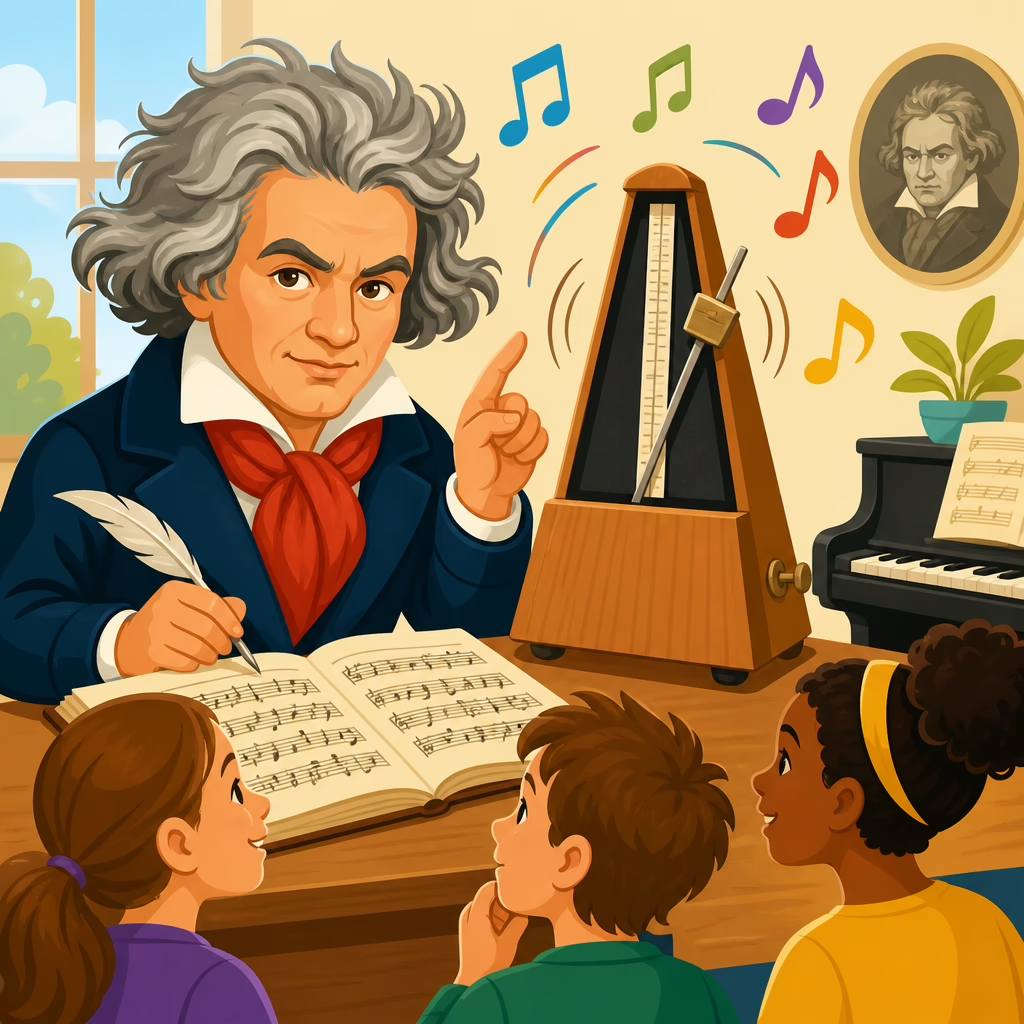
How to Teach Tempo Through Beethoven’s Metronome Markings
Teaching tempo through Beethoven’s metronome markings gives music educators a rare combination of historical evidence, practical listening work, and performance-based inquiry. Instead of presenting tempo as an abstract speed scale from largo to presto, teachers can anchor the concept in one composer’s documented decisions and let students test those decisions with their ears, bodies, and instruments. Beethoven matters here because he worked at the turning point when the metronome became a usable standard, and he embraced it publicly. His markings, though debated, are among the most discussed tempo indications in classical music, which makes them ideal for classroom investigation.
In practical terms, a metronome marking is a numerical instruction that identifies how many beats occur in one minute, usually shown as a note value equals a number, such as quarter note equals 120. Tempo is the rate of the pulse, while meter describes how beats are grouped and rhythm describes the pattern of durations laid over that pulse. Students often blur those terms. Using Beethoven helps separate them cleanly. When a class compares the opening of the Fifth Symphony at one speed and then another, students can hear that the rhythm stays the same while the tempo changes its character, urgency, and perceived difficulty.
From my own teaching, this topic works best when students are asked not simply to obey a metronome, but to question what a tempo marking means in sound. Beethoven’s markings matter because they connect notation, technology, and musical intention. They also show that tempo is not merely mechanical. A number on the page influences articulation, phrasing, breath, bow distribution, diction, and emotional impact. In other words, teaching tempo through Beethoven’s metronome markings trains students to make informed musical choices, not just faster or slower ones.
There is also a strong historical story students can grasp quickly. Johann Nepomuk Maelzel popularized the metronome in the early nineteenth century, and Beethoven became one of its highest-profile advocates. In 1817, Beethoven published metronome markings for symphonies and other works, offering unusual precision for the period. Those numbers still shape rehearsals, recordings, and scholarly debates today. For teachers in community and education settings, that means one focused topic can support ear training, music history, ensemble rehearsal, movement, notation literacy, and critical thinking within a single lesson sequence.
Why Beethoven’s metronome markings are so useful in tempo lessons
Beethoven’s markings are useful because they are specific enough to test and controversial enough to discuss. Many students think tempo directions are fixed truths. Beethoven shows something more interesting: a composer can be precise, performers can still disagree, and the disagreement can be musical rather than careless. That gives teachers a rich entry point. If a student asks, “Why not just play it the way the number says?” the answer is that the number matters, but so do acoustics, instrument design, articulation, room resonance, ensemble size, and what beat unit is being felt.
Take the first movement of the “Eroica” Symphony. A brisk pulse changes the entire rhetoric of the movement, making long lines feel tensile rather than monumental. In the Seventh Symphony, the Allegretto becomes especially revealing because slight tempo shifts can make it either trudge or flow. Students hear quickly that Beethoven’s numbers are not trivia; they govern the architecture of the phrase. That makes the markings ideal for teaching that tempo is a structural choice. The speed affects where cadences land emotionally, how much weight syncopations carry, and whether repeated motives sound obsessive, comic, noble, or relentless.
These markings also work well educationally because they invite measurement. Students can clap beats, walk pulse, conduct patterns, and compare thirty-second excerpts at two or three speeds. The result is concrete. Instead of saying, “This feels exciting,” ask, “What changed when we moved from quarter note equals 96 to 108?” Students may notice that rests feel shorter, phrase endings feel less final, and articulation must become lighter to preserve clarity. Those observations are exactly what strong tempo teaching should produce.
What Beethoven’s numbers can and cannot tell students
Beethoven’s metronome markings should be treated as evidence, not commandments detached from context. Teachers need to say that clearly. The numbers tell students the beat unit Beethoven likely wanted emphasized, the approximate pace he considered appropriate, and the relationship between musical gesture and pulse. They do not tell students everything about expressive timing, phrasing flexibility, or local rubato. In fact, one of the best lessons is that precision at the large scale can coexist with flexibility at the small scale.
There are also legitimate reasons scholars and conductors question some markings. Early metronomes were mechanical devices subject to setup error. Printed editions introduced transmission problems. Beethoven himself may have misread the pendulum scale in a few cases, and some marks seem unusually fast on modern instruments in modern halls. Yet dismissing the markings outright is poor pedagogy. Better to teach students that historical documents have weight even when interpretation remains open. That balance models responsible musicianship.
In class, I frame the issue with a simple rule: if a marking feels impossible, investigate before rejecting it. Ask which note value carries the beat. Ask whether students are over-accenting every beat. Ask whether articulation is too heavy. Ask whether the ensemble is trying to produce late-Romantic sonority in early nineteenth-century music. Often the tempo becomes more plausible once the style changes. This is one reason Beethoven’s markings are so powerful in education: they expose how tone production and tempo are linked.
Classroom strategies for teaching tempo through comparison
The most effective teaching sequence is comparative. Choose one short Beethoven excerpt, establish the notated rhythm, define the beat unit, then perform or play recordings at three different speeds: slower than the marking, at the marking, and faster than the marking. Have students identify what remains constant and what changes. The constant elements are rhythm and pitch content. The changing elements are character, breath space, articulation needs, and sometimes perceived meter. That last point is important. At certain fast tempos, students stop feeling subdivisions and begin feeling larger beat groups.
A movement-based approach is especially effective with younger learners and mixed-experience community classes. Ask students to step the beat while patting the rhythmic motive. Then switch to conducting two, three, or four depending on the meter. Finally, ask them to speak descriptive words at each speed: heavy, urgent, dancing, solemn, buoyant, clipped. This builds vocabulary and keeps the lesson anchored in sound rather than abstraction. For a broader sequence of age-appropriate activities, teachers can connect this focused lesson to the main planning resource at Beethoven lesson plans for elementary music classes.
When recordings are used, choose performances with clearly different tempo philosophies. Historically informed conductors often reveal how Beethoven’s faster markings can work when textures stay transparent and accents remain springy. More traditional symphonic recordings may demonstrate broader pacing and heavier phrasing. Students do not need a lecture on performance practice to hear the difference. They need guided questions: Which version keeps the phrase moving? Which makes the motive clearer? Which lets the harmony register most strongly? Which feels closest to the printed number?
| Teaching move | What students do | What they learn about tempo |
|---|---|---|
| Beat identification | Circle the note value that receives the pulse | Tempo depends on the correct beat unit |
| Three-speed comparison | Listen, clap, and describe excerpts at slow, marked, and fast speeds | Character changes without changing rhythm |
| Movement response | Walk beats and conduct meter patterns | Pulse and meter are physically felt |
| Articulation adjustment | Replay a passage with lighter or heavier attacks | Touch can make a fast tempo playable |
| Reflection | Defend a preferred tempo with musical evidence | Interpretation should be reasoned, not random |
Using specific Beethoven excerpts to build tempo understanding
Not every Beethoven excerpt teaches tempo equally well. The best choices have a strong pulse, a memorable motive, and clear character shifts when the speed changes. The opening of Symphony No. 5 works because nearly every student recognizes it, and the famous four-note motive reacts immediately to tempo adjustment. Played too slowly, it sounds oversized and loses tension between the motive and the sustaining harmony. Played too quickly, articulation blurs and the dramatic rests lose force. Near Beethoven’s intended pace, students hear propulsion without chaos.
The second movement of Symphony No. 7 is another strong option because students can compare tread, procession, and flow. They hear that tempo affects whether repeated accompaniment patterns feel like grief, dignity, or inertia. For keyboard classes, Bagatelles and selected sonata themes can be even better because students can test the numbers directly on instruments. The opening of the “Moonlight” Sonata is less useful for metronome-marking work than teachers often assume, because its issues center more on texture and sustain than on pulse clarity for beginners.
For ensemble classes, use excerpts with visible conducting implications. The finale of Symphony No. 1 or energetic passages from Symphony No. 8 can show when conductors shift from showing subdivisions to conducting in larger beats. That helps students understand an advanced but essential point: tempo instruction is partly about deciding what level of pulse must be physically shown. If a group cannot maintain internal subdivision, a mathematically correct tempo may still fail in rehearsal. Beethoven’s markings then become a goal reached through technical preparation, not a switch flipped instantly.
Addressing common misconceptions and performance challenges
The most common misconception is that metronome markings erase expression. In practice, the opposite is usually true. A stable underlying tempo gives students a frame inside which dynamics, articulation, agogic stress, and phrase shaping become intelligible. Without that frame, beginners often drag in long notes, rush repeated figures, and mistake inconsistency for feeling. Beethoven’s markings help correct that by making pulse audible and discussable.
Another misconception is that faster equals better or more advanced. Some Beethoven markings are indeed brisk, but the lesson is not speed worship. The lesson is appropriateness. If students cannot articulate sixteenth notes evenly, align releases, or maintain tone quality, they are not yet performing the passage at its true musical tempo, even if the metronome says they reached the number. A real tempo includes clarity. I tell students that unreadable notes do not count as accuracy, and breathless playing is not the same as energy.
Teachers should also prepare for the practical issue of modern instruments and spaces. A tempo that sounds clear on a fortepiano may smear on a heavily pedaled modern piano. A string section in a dry classroom can manage attacks differently than one in a reverberant church. Brass players need time for articulation to speak in certain acoustics. These are not excuses to ignore Beethoven; they are variables students should learn to evaluate. Good tempo teaching always includes the room, the instrument, and the player’s current technique.
Assessing whether students truly understand tempo
Assessment should go beyond asking students to define tempo or match a number on a device. Strong evidence of understanding appears when students can identify the beat unit, maintain a steady pulse, explain how a tempo changes character, and adjust technique to support that speed. In other words, assessment should test perception, execution, and reasoning together. Beethoven’s markings make that possible because they give students a concrete reference point for all three.
A simple formative assessment is to play an excerpt twice and ask which performance sits closer to the marked tempo and why. Better answers mention beat value, articulation clarity, phrase shape, and meter feel. A stronger summative task is a short performance plus verbal defense. Students perform a Beethoven excerpt, state the printed metronome marking, and explain one technical choice they made to realize it, such as lighter bow stroke, shorter pedal, clearer consonants, or grouped breathing. That kind of explanation proves they understand tempo as a musical system, not just a number.
Rubrics should reward evidence-based thinking. If a student chooses a slightly moderated tempo for a specific reason, such as maintaining clean entrances in a beginner ensemble, that can be a better musical decision than blindly forcing the printed number. The educational aim is disciplined judgment. Beethoven’s metronome markings provide the discipline; guided discussion develops the judgment.
Beethoven’s metronome markings give tempo teaching unusual clarity because they join history, notation, listening, and performance in one concrete lesson frame. Students learn what tempo is, how beat units work, why numerical markings matter, and where interpretation begins. They also learn a more durable musical habit: before choosing a speed, examine the composer’s evidence, test it in sound, and adjust technique until the music speaks naturally. That is a far more valuable outcome than memorizing Italian tempo words in isolation.
For community and education settings, this approach scales well. Younger students can walk the pulse and compare character words. Intermediate ensembles can test excerpts against the metronome and discuss articulation. Advanced students can evaluate editions, recordings, and historical assumptions. Across all levels, Beethoven’s markings turn tempo from a vague instruction into a teachable musical decision. They encourage students to hear structure, feel pulse physically, and connect interpretive choices to something visible on the page.
The main benefit is simple: students stop treating tempo as guesswork. They begin to hear why one speed clarifies the phrase while another distorts it, and they gain language for defending that judgment. Use one short Beethoven excerpt, one reliable metronome, and a comparison-based lesson this week. The results will sharpen listening, improve ensemble cohesion, and make tempo a concept students can actually own.
Frequently Asked Questions
Why are Beethoven’s metronome markings so useful for teaching tempo?
Beethoven’s metronome markings are especially valuable in the classroom because they turn tempo from a vague descriptive idea into something students can investigate directly. Instead of teaching only the traditional Italian terms such as allegro, andante, or adagio, educators can show students a specific numerical marking attached to a real musical passage and ask what that number actually does to phrasing, articulation, breathing, bowing, and overall character. This makes tempo easier to hear, measure, compare, and discuss.
They are also historically important. Beethoven composed at the moment when the metronome became a practical tool for musicians, so his markings offer rare evidence of a major composer’s own tempo intentions. That does not mean every number should be treated as unquestionable law, but it does mean teachers have a concrete starting point grounded in primary historical material. For students, that is powerful. They are not just learning a modern performance habit or a teacher’s preference; they are engaging with documented evidence from the composer’s world.
Pedagogically, these markings support active learning. Students can clap the beat, conduct, walk the pulse, compare recordings, and perform excerpts at several speeds to determine how tempo changes musical meaning. In that process, they begin to understand that tempo is not simply fast or slow. It affects energy, structure, drama, technical difficulty, and expressive shape. Beethoven’s markings therefore help teachers connect history, listening, analysis, and performance in one focused lesson.
Are Beethoven’s metronome markings always accurate, and how should teachers handle the debate around them?
Teachers should present Beethoven’s metronome markings as historically significant evidence, not as infallible commands. Scholars and performers have long debated some of the numbers because a few seem surprisingly fast, occasionally inconsistent with later tradition, or difficult to reconcile with certain performance conditions. There are several possible explanations: mechanical issues with early metronomes, copying errors, misunderstandings in transmission, differences in instruments and acoustics, or simply Beethoven’s own bold aesthetic preferences. Students benefit from hearing that this debate exists, because it shows that musical interpretation involves judgment as well as data.
In teaching, the most productive approach is to frame the markings as testable hypotheses. Rather than asking, “Is Beethoven right or wrong?” ask, “What happens if we trust this marking?” and “What musical results do we hear at this speed compared with a slower inherited tradition?” This opens the door to inquiry-based learning. Students can listen for clarity of harmony, momentum through transitions, intelligibility of rhythm, and the relationship between tempo and character. They can also notice when a tempo that seems extreme at first begins to make structural sense after repeated hearing.
This method helps students develop mature musicianship. They learn to respect historical evidence without becoming rigid, and they learn to question assumptions without dismissing the composer. In other words, the debate itself is educational. It teaches that performance practice is a conversation among notation, history, instruments, technique, acoustics, and interpretation. For an article or lesson on tempo, that is a much richer outcome than merely memorizing metronome numbers.
What are the best classroom strategies for teaching tempo through Beethoven’s markings?
The strongest strategies are multisensory and comparative. Begin with a short Beethoven excerpt that has a documented metronome marking and is rhythmically clear enough for students to grasp quickly. Have students first identify the pulse by clapping or stepping it, then set a metronome to Beethoven’s indicated number and repeat the activity. Before discussing whether the tempo feels “right,” ask them to describe what they notice: Is the line more urgent, dance-like, heavy, playful, or driven? Does the phrase breathe naturally? Does articulation become easier or more difficult to execute cleanly?
Next, compare at least three tempos: slower than Beethoven’s marking, at Beethoven’s marking, and faster than Beethoven’s marking. This simple exercise is extremely effective because it reveals that tempo choices alter more than speed. A slower tempo may bring out weight and detail but weaken momentum; Beethoven’s marking may sharpen rhythmic profile and long-line continuity; a faster one may increase excitement while reducing clarity. When students make those observations themselves, the concept of tempo becomes experiential rather than theoretical.
Performance-based tasks deepen the lesson further. Instrumentalists can try the passage with the exact metronome setting and reflect on technical challenges. Singers can test how text stress and breath function at the indicated speed. Conductors can practice giving a clear preparatory gesture at the correct pulse. More advanced students can compare score markings with commercial recordings and evaluate interpretive choices. In every case, the goal is not simply to obey the metronome, but to understand how a tempo marking interacts with musical structure, expressive intent, and practical execution.
How can teachers help students connect metronome markings to musical expression instead of treating them as just numbers?
The key is to pair every tempo number with a musical question. A metronome marking by itself can seem mechanical, but when students hear and feel how that speed shapes the music, the number becomes expressive information. Teachers can ask: What kind of motion does this tempo create? Does it suggest march, dance, conversation, proclamation, or lyric singing? Where does the phrase lean forward, and where does it release? How does the chosen speed affect accents, sforzandos, rests, and cadences? Questions like these move students beyond counting and into interpretation.
It also helps to connect tempo to physical embodiment. Have students walk the pulse, conduct the meter, or speak a rhythmic pattern at Beethoven’s indicated speed. Physical engagement often reveals expression more quickly than verbal explanation alone. A tempo that looks aggressive on the page may feel buoyant in the body; a tempo that seems comfortable numerically may feel too static to support a phrase. This is one reason Beethoven’s markings are so pedagogically rich: they encourage students to discover expression through action and listening, not just through terminology.
Teachers should also emphasize that expression does not disappear when tempo becomes precise. In fact, a specific tempo can clarify expression by defining the musical environment in which dynamics, articulation, and phrasing operate. Students begin to hear that the same crescendo feels different at different speeds, and that a staccato gesture can sound witty, brusque, or frantic depending on the pulse. Once they understand this, metronome markings stop being dry technical labels and become part of the expressive vocabulary of performance.
What should educators do if students find Beethoven’s marked tempos too fast or impractical to perform?
If students initially find Beethoven’s tempos too fast, that reaction should be treated as a teaching opportunity rather than a failure. First, distinguish between hearing a tempo, understanding a tempo, and being able to execute it immediately. Students may need time to internalize the pulse before they can perform cleanly at that speed. Start by having them listen, clap subdivisions, isolate difficult rhythmic cells, and perform smaller segments before attempting the full passage. Often the problem is not the marking itself but the absence of intermediate preparation.
It is also important to separate musical concept from current technical level. A class can still learn what Beethoven’s tempo implies structurally and expressively even if the ensemble cannot yet perform the entire excerpt at that exact speed. Teachers might rehearse at a reduced tempo while keeping the articulation, phrase direction, and character associated with the target marking in view. Then they can gradually increase the tempo as accuracy improves. This helps students understand that metronome work is developmental, not punitive.
Finally, educators should model thoughtful flexibility. If a marked tempo proves unrealistic for a particular age group, instrument setup, room acoustic, or ensemble ability, say so clearly while explaining why the original number still matters. The objective is not blind compliance but informed musicianship. Students should leave with the ability to ask intelligent questions: What did Beethoven likely want? What becomes vivid at his tempo? What must we preserve if we choose a practical adjustment? That balance of historical respect and practical wisdom is exactly what makes teaching tempo through Beethoven’s metronome markings so effective.