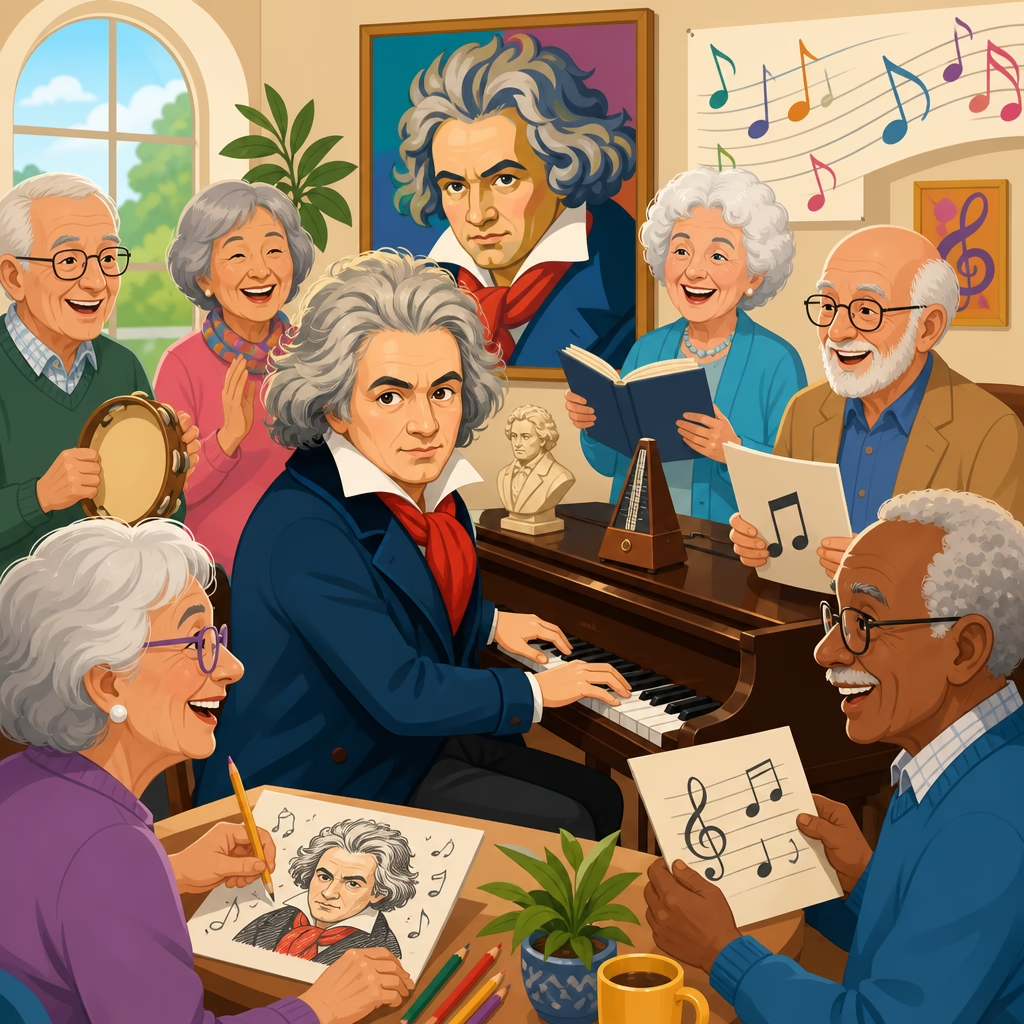
Beethoven Activities for Senior Centers and Lifelong Learners
Beethoven activities for senior centers and lifelong learners can turn a familiar composer into a practical tool for social connection, memory stimulation, and joyful learning. In community education settings, I have seen Beethoven work especially well because many older adults already recognize his name, a few famous melodies, and the dramatic story of his life. That built-in familiarity lowers the barrier to participation. People do not feel they are starting from zero, which matters in mixed groups where some members have strong musical backgrounds and others simply enjoy listening sessions. A focused Beethoven program can include listening, discussion, movement, art, journaling, and light performance, all without requiring formal music training.
In this context, “senior centers” includes independent living communities, parks and recreation programs, libraries, church groups, and adult day settings that offer cultural enrichment. “Lifelong learners” refers to adults who want structured learning experiences beyond school years, often through community classes, Osher programs, museum talks, or volunteer-led seminars. The goal is not to train professional musicians. The goal is to use Beethoven’s music and biography to support curiosity, cognition, confidence, and community. His catalog is broad enough to serve many levels: short piano bagatelles for beginners, symphonic movements for guided listening, and letters or historical anecdotes for discussion-based groups.
Why does this topic matter? First, music participation is strongly associated with improved mood and social engagement in older adults. Second, Beethoven’s work offers clear contrasts that help listeners notice structure: loud versus soft, tension versus release, minor versus major, solo versus ensemble. Third, his personal story creates natural entry points into resilience, hearing loss, persistence, and creativity in later life. A well-designed session gives participants something immediate to enjoy while also offering enough depth to feel intellectually satisfying. That combination is exactly what strong community education needs.
Why Beethoven works so well in senior learning programs
Beethoven is unusually effective for intergenerational and older-adult programming because his music balances accessibility with depth. Many participants know the opening of Symphony No. 5, “Ode to Joy” from Symphony No. 9, “Für Elise,” or the “Moonlight Sonata.” Recognition builds confidence fast. In practice, this means a facilitator can begin with a ten-second excerpt and ask, “What do you notice?” rather than opening with technical vocabulary. Even groups that say, “I don’t know anything about classical music,” usually respond with observations about emotion, pacing, or imagery. Those responses are musically valid and useful.
His biography also supports meaningful conversation. Beethoven was born in Bonn in 1770, built his career in Vienna, and continued composing even as his hearing declined. That fact alone invites reflective discussion about adaptation and identity. I have found that older adults often connect deeply with the practical side of his life: unreliable health, changing social networks, financial pressure, and the need to keep creating under difficult circumstances. When discussion connects music to lived experience, attendance improves because participants feel the program respects them as thinkers, not just listeners.
From an instructional standpoint, Beethoven’s music provides strong examples of motif, variation, form, and emotional contrast. The four-note opening of Symphony No. 5 is ideal for teaching motif because it is short, memorable, and easy to track. “Ode to Joy” is useful for singing or handbell activities because the melody is stepwise and widely known. Selections from the Pastoral Symphony can support visual art or nature writing. Piano sonatas offer advanced listeners a way to compare interpretation, tempo, and phrasing across recordings. In short, Beethoven gives facilitators material that scales up or down without losing substance.
How to design a Beethoven session that keeps older adults engaged
The strongest Beethoven activities for senior centers follow a simple structure: orient, listen, respond, and extend. Start by naming one clear objective. For example: “Today we will hear how Beethoven builds drama from a tiny musical idea.” Then give concise context, never a long lecture. A two-minute introduction is usually enough: date, genre, instrumentation, and one thing to listen for. Next, play a short excerpt, often sixty to ninety seconds. After listening, ask direct questions with no wrong answer: “Did the music feel steady or restless?” “What changed?” “Would you call this private or public music?” These prompts invite participation from everyone.
Pacing matters. Older-adult groups usually respond best to varied activity every ten to fifteen minutes. A ninety-minute class might include a welcome prompt, one listening exercise, a paired discussion, a visual element such as score fragments or portraits, and a final recap. If mobility allows, add simple movement like conducting patterns or tapping the pulse. If vision is limited, rely more on verbal cueing and high-quality audio. If hearing aids are common, test volume carefully and reduce background noise. These are not minor details. They determine whether participants feel included.
One practical rule I use is to teach fewer pieces more deeply. Trying to cover Beethoven’s entire life in one session usually creates overload. Focusing on one symphony movement, one piano work, and one biographical theme leads to better retention. If you want a broader teaching framework that connects this article’s focused ideas with classroom-style planning, see the main guide at Beethoven lesson plans for elementary music classes. While that resource serves a different audience, its sequence-based planning logic adapts well to community education.
High-value Beethoven activities that actually work
The best activities are simple to run, adaptable for different ability levels, and rich enough to support real discussion. I recommend building programs around listening, storytelling, and low-pressure participation rather than around heavy music theory. The table below summarizes formats I have seen work reliably in senior centers, libraries, and lifelong learning groups.
| Activity | How it works | Why it works for older adults |
|---|---|---|
| Guided listening to Symphony No. 5 | Play the opening movement in short segments and track the four-note motif as it returns and changes. | Clear repetition supports attention, memory, and discussion without requiring score reading. |
| Sing or hum “Ode to Joy” | Teach the melody by phrase, then add lyrics or simple percussion on the beat. | Familiar tune builds confidence and encourages group cohesion. |
| Compare “Moonlight” recordings | Use two pianists with different tempos and ask listeners which interpretation feels more convincing. | Encourages critical listening and validates personal response. |
| Biography and letters discussion | Read short excerpts about Vienna, hearing loss, or the Heiligenstadt Testament, then discuss resilience. | Connects music history to lived experience and reflective conversation. |
| Pastoral art response | Play Symphony No. 6 while participants sketch, color, or write brief nature memories. | Supports creativity for people who prefer hands-on or verbal expression over analysis. |
Guided listening is the foundation. For Symphony No. 5, do not start with the whole movement. Play the opening twenty seconds, ask participants to clap the rhythm, then replay it and ask what mood the motif creates. After that, play a later passage where the motif is transformed. People quickly hear that Beethoven is not merely repeating himself; he is developing the idea. This is a satisfying discovery because participants can hear the craft for themselves.
“Ode to Joy” works particularly well in groups that want active participation. You can sing on neutral syllables, hum, or use boomwhackers, hand chimes, or desk bells if available. The melody sits well for untrained singers and can be taught by echo. If lyric reading is difficult, display only one short phrase at a time in large print. The point is not polish. The point is shared success.
Comparison listening is another high-return activity. Select two respected recordings of the first movement of the “Moonlight Sonata” or a movement from a late string quartet. Ask participants which version sounds more intimate, more dramatic, or more spacious. This teaches interpretation in plain language. It also shows that classical music is not fixed in one “correct” performance. For lifelong learners, that insight often opens the door to deeper study.
Using Beethoven to support memory, conversation, and wellbeing
Music programming in senior settings should have cultural value, but it can also support broader wellness goals. Beethoven activities are especially useful for memory prompts because recurring themes are easy to track. Repetition helps listeners predict what comes next, and successful prediction feels rewarding. In practice, this can look like asking participants to raise a hand each time they hear the main motif return. That small action keeps attention focused and gives listeners a concrete task.
Conversation benefits are equally important. After a listening excerpt, ask participants to connect the music to an image, place, or memory. The Pastoral Symphony often brings up weather, gardens, walking trails, childhood farms, or travel. The “Moonlight Sonata” may prompt stories about first piano lessons, movies, or songs heard at home. These responses are not off-topic. They are evidence that the music is functioning as a social bridge. In community programs, that outcome is often as valuable as the musical content itself.
There are limits, and facilitators should state them clearly. A Beethoven session is not therapy, and instructors should avoid making medical claims. Still, it is accurate to say that structured music engagement can support mood, attention, and connection. The National Institute on Aging and many arts-in-health organizations recognize the value of meaningful arts participation for older adults. When programs are paced well, respectful, and sensory-accessible, they contribute to quality of life in tangible ways.
Practical tips for facilitators, volunteers, and program directors
Successful implementation depends less on budget than on preparation. Start with audio quality. A Bluetooth speaker may be enough in a small room, but larger groups need clear amplification without distortion. Use recordings from reliable labels or streaming services with consistent volume. Test every track before the session, and trim long silences at the start. Printed materials should use large, high-contrast fonts, ideally at least 16 to 18 point for lyric sheets or discussion prompts.
Choice of repertoire matters. For beginners, use “Für Elise,” “Ode to Joy,” Symphony No. 5, and Symphony No. 6. For advanced groups, add the “Eroica” Symphony, the Violin Concerto, the “Pathétique” Sonata, and late quartets such as Op. 131. Keep excerpts short unless the group has specifically requested full-movement listening. Most mixed groups stay engaged with segments under five minutes, especially when each segment has a clear listening task.
Facilitation style should be warm but disciplined. Ask open questions, then follow with evidence-based prompts: “What in the music made you say that?” This keeps discussion grounded in the listening. Avoid overloading participants with opus numbers unless the group enjoys them. Use names, nicknames, keys, and genres instead. Finally, document what works. Track attendance, note favorite pieces, and record which activities generated the most discussion. Over time, these notes become a practical curriculum tailored to your community.
Beethoven activities for senior centers and lifelong learners succeed when they combine familiarity, depth, and active participation. The most effective programs do not treat older adults as passive audiences. They invite people to listen closely, compare interpretations, sing memorable themes, and connect the music to their own experiences. Beethoven’s catalog supports all of that because it contains recognizable melodies, strong emotional contrasts, and a life story that still resonates with adult learners.
The key takeaways are straightforward. Choose one clear theme per session. Use short excerpts and direct listening prompts. Adapt for hearing, vision, and mobility needs. Favor activities with visible success, such as motif tracking, “Ode to Joy” singing, recording comparisons, and art or writing responses to the Pastoral Symphony. Keep discussion grounded in what participants actually hear, and give enough historical context to enrich the experience without turning the session into a lecture.
For senior centers, libraries, and community educators, the main benefit is not only appreciation of Beethoven. It is the creation of a program that strengthens attention, conversation, confidence, and connection through high-quality shared culture. Start with one ninety-minute session built around Symphony No. 5 or “Ode to Joy,” observe how your group responds, and build from there. A thoughtful Beethoven program can become a reliable cornerstone of lifelong learning.
Frequently Asked Questions
What kinds of Beethoven activities work best in senior centers and lifelong learning programs?
The most effective Beethoven activities are usually the ones that combine familiarity, low pressure, and active participation. In senior centers and lifelong learning settings, that often means guided listening sessions, lyric-free singalongs using recognizable melodies, simple rhythm activities, group discussions about Beethoven’s life, and creative response projects such as journaling, drawing, or storytelling inspired by the music. Programs do especially well when they start with pieces many participants may already know, such as “Ode to Joy,” “Für Elise,” or the opening of Symphony No. 5. These selections create an immediate sense of recognition and confidence.
Activities also work best when they are flexible enough for mixed backgrounds. Some participants may have formal musical experience, while others may simply remember hearing Beethoven in school, movies, or family life. A strong session does not require anyone to “know” classical music in an academic way. Instead, it invites people to respond personally: What emotions do they hear? What memories does the music bring back? What images come to mind? This makes Beethoven useful not just as a composer to study, but as a social and cognitive tool that supports conversation, reflection, and enjoyment.
Practical group formats can include “listen and discuss” circles, theme-based classes on Beethoven’s personality and historical period, movement-to-music sessions, and comparison activities where participants hear two different performances of the same piece and talk about what changed. These formats help keep the experience fresh while still grounded in recognizable material. In short, the best Beethoven activities are accessible, interactive, and structured around connection rather than performance pressure.
Why is Beethoven such a strong choice for older adult education and enrichment?
Beethoven is especially effective with older adults because he offers a rare combination of name recognition, emotional range, cultural familiarity, and inspiring life story. Many seniors and lifelong learners may not identify themselves as classical music enthusiasts, yet they often already know Beethoven’s name and can recognize at least a few signature melodies. That built-in familiarity lowers anxiety and makes participation easier. People are more willing to join an activity when they do not feel they are entering completely unfamiliar territory.
His music also gives facilitators a wide emotional and educational range to work with. Beethoven can be dramatic, joyful, reflective, triumphant, playful, and deeply expressive. That means one composer can support many different program goals, from relaxation and memory stimulation to conversation, movement, and historical learning. A single session might explore the determination in Symphony No. 5, the warmth of “Ode to Joy,” or the intimacy of a piano piece such as “Moonlight Sonata.” This variety helps educators tailor Beethoven activities to the mood, energy level, and interests of the group.
In addition, Beethoven’s life story resonates strongly in community settings. His perseverance, creativity, and continued work in the face of hearing loss often inspire meaningful conversation about adaptation, resilience, and identity. Participants are not just hearing music; they are engaging with a human story that feels relevant across generations. That combination of familiar music and personal meaning is a major reason Beethoven remains such a strong resource in senior centers and lifelong learning programs.
How can Beethoven activities support memory, social connection, and cognitive engagement?
Beethoven activities can support memory and cognitive engagement by encouraging participants to listen carefully, compare musical ideas, recall familiar themes, and connect what they hear to personal experiences. Recognition itself is powerful. When participants identify a melody they have heard before, it can trigger memories, associations, and discussion. Facilitators can build on that by asking questions like: Where have you heard this piece before? What does it remind you of? How does this section differ from the opening? These prompts gently engage attention, recall, pattern recognition, and verbal expression.
Social connection grows naturally when the music becomes a shared experience rather than a lecture topic. Beethoven works particularly well for this because people often have different but equally valid ways of responding to the same piece. One person may hear energy and determination, another may hear tension, and another may connect it to a childhood piano lesson or a film soundtrack. Group discussion gives participants a chance to be heard, compare perspectives, and discover common ground. That makes the activity feel communal, not isolating.
There is also value in the structure of the music itself. Repeated motifs, changes in dynamics, and emotional contrasts invite active listening and discussion. A facilitator can pause at key moments, replay short excerpts, or ask the group to notice what instruments or moods stand out. For participants who prefer less verbal engagement, drawing, tapping rhythms, humming melodies, or moving gently to the beat can provide equally meaningful cognitive involvement. The overall benefit comes from blending familiarity, focused listening, and social interaction in ways that feel enjoyable rather than clinical.
Do participants need any background in classical music to enjoy Beethoven activities?
No, and in fact the most successful Beethoven programs are often designed specifically for people with no formal background in classical music. The key is to present Beethoven as approachable and relevant rather than technical or intimidating. Participants do not need to understand musical terminology, historical theory, or composition structure to benefit from the experience. They simply need a welcoming format that encourages curiosity and personal response.
A strong facilitator helps by framing the session in plain, conversational language. Instead of asking participants to analyze sonata form, for example, it is often more effective to ask what they notice, how the music changes, or what feeling the piece creates. Brief context can be very helpful: who Beethoven was, why a piece is famous, or what listeners might listen for in the opening. But that context should support the experience, not overwhelm it. The goal is engagement, not expertise.
This is particularly important in mixed groups, where some learners may have extensive musical knowledge and others may feel hesitant. Good program design allows both to participate comfortably. Those with experience can add insight without dominating, while beginners can contribute personal impressions that are just as valuable. When Beethoven activities are structured around listening, reflection, storytelling, and shared discovery, prior musical education becomes unnecessary. What matters most is accessibility, warmth, and a clear invitation to participate.
How can facilitators make Beethoven activities inclusive, enjoyable, and easy to adapt for different ability levels?
Inclusivity starts with choosing activities that offer multiple ways to participate. In senior centers and lifelong learning environments, some individuals may prefer discussion, others may enjoy listening quietly, and others may respond best through movement, visual art, humming, or simple rhythm participation. A well-designed Beethoven session does not rely on one mode alone. It allows participants to engage according to their comfort, energy, and ability level. That flexibility makes the program more welcoming and more successful.
Facilitators can also improve accessibility by keeping instructions clear, pacing the session thoughtfully, and selecting excerpts of manageable length. Short listening segments often work better than very long pieces, especially when paired with a specific focus such as mood, tempo, or memory association. Printed materials with large text, high-contrast visuals, and straightforward prompts can help participants follow along more comfortably. If hearing varies across the group, strong audio quality and careful volume control matter as well. If mobility is limited, movement activities can be adapted for seated participation using hand gestures, breathing, or gentle upper-body motion.
Enjoyment increases when the atmosphere is nonjudgmental and conversational. It helps to treat every contribution as valuable, whether it is a historical insight, an emotional reaction, or a personal memory. Facilitators should avoid making the session feel like a test of knowledge. Instead, Beethoven can be presented as a shared resource for exploration and connection. With thoughtful adaptations, even a single topic—such as “Ode to Joy” or Beethoven’s story of persistence—can be shaped into discussion, listening, memory prompts, art response, or group participation. That adaptability is one of the main reasons Beethoven activities work so well across a wide range of senior and lifelong learning settings.