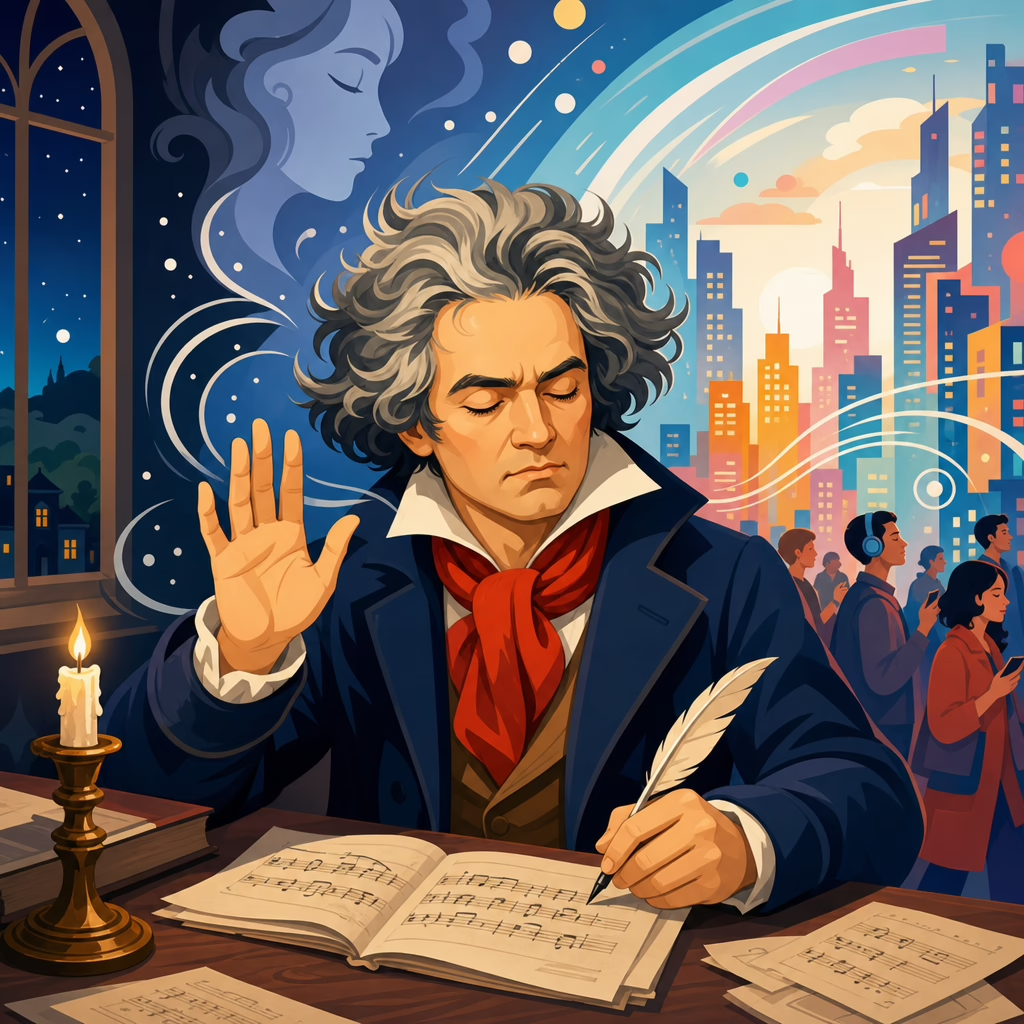
How Beethoven Made Silence Feel Modern
Silence in Beethoven is never empty space; it is pressure, structure, surprise, and meaning. That is why his pauses still feel startlingly modern to listeners raised on film scores, minimalist music, and sharp digital editing. In classical composition, silence does not simply mean the absence of sound. It can mean a rest written into the score, a break in texture, a sudden cutoff after a climax, or a gap that forces the ear to anticipate what comes next. Beethoven understood all of these functions and used them with unusual boldness. He treated silence as an active compositional material, not a passive interruption. That choice matters because it changed how audiences experienced musical time. Instead of hearing pauses as decorative breathing points, they began to feel them as dramatic events. In rehearsal rooms and score study sessions, that difference is unmistakable. Conductors shape those gaps with as much care as they shape crescendos. Players count them tensely, knowing the silence must speak. Beethoven made that possible by giving rests structural weight, emotional charge, and rhythmic definition. His example reaches far beyond his own era, influencing Romantic suspense, twentieth-century fragmentation, and modern cinematic pacing. To understand why Beethoven still sounds contemporary, it is not enough to admire his melodies or his power. You have to hear how he weaponized the unsounded moment.
Before Beethoven, silence already had important roles in Western art music. Haydn used surprise pauses for wit, and Mozart employed rests for elegance, breath, and dramatic timing. Opera composers had long understood that stopping the orchestra at the right instant could intensify a line or frame a revelation. Yet Beethoven expanded the scale and consequence of the device. He placed silence at the center of arguments that unfolded across phrases, movements, and whole forms. In practical terms, he made listeners aware of absence as form-bearing energy. This was radical in a culture shaped by balance, continuity, and predictable periodic phrasing. The innovation was not silence by itself, but the way Beethoven integrated it with rhythm, harmony, motive, and expectation. He often set up a clear pattern, then broke it with a rest that felt like a physical jolt. He also used silence to create ambiguity, delaying a cadence or suspending a pulse so that the return of sound arrived with multiplied force. Modern listeners recognize this instinctively because contemporary storytelling works the same way. A cut to black, a withheld beat before a punchline, or a dropped soundtrack before impact all rely on controlled absence. Beethoven discovered how to make that absence audible in the imagination.
Silence as a structural force, not a decorative pause
The most modern feature of Beethoven’s silence is that it helps build form. In many eighteenth-century works, rests clarify syntax much as commas organize speech. Beethoven often goes further. He turns them into hinges that redirect momentum. In the first movement of the Third Symphony, for example, rhythmic breaks and abrupt interruptions do not merely separate ideas; they intensify the sense that the music is struggling toward larger coherence. In the Fifth Symphony, the famous short-short-short-long motive gains part of its identity from what follows it: a charged gap, an intake of breath, a refusal to relax. Those tiny voids are inseparable from the motive’s force. Remove their tension and the figure loses much of its menace.
I have seen this most clearly in rehearsals of Beethoven overtures and symphonies, where ensembles can play every note accurately and still miss the architecture if the rests are treated casually. A Beethoven rest is often metrical, directional, and expressive at once. Players must count it exactly, but they also have to project its dramatic temperature. Is the silence a recoil, a suspension, a threat, a caesura before a new key area, or a dead stop that exposes the next entrance? Beethoven’s notation, dynamic markings, and surrounding texture usually answer that question. The point is that silence in his music behaves like structure. It determines proportion, emphasis, and narrative sequence.
That is one reason his music anticipates later modern practice. Twentieth-century composers such as Webern and Stravinsky would fragment texture and give rests equal status with notes. Film composers would use dropouts to magnify visual tension. Editors in contemporary media rely on interruption to control attention. Beethoven did not invent the dramatic pause, but he normalized the idea that an absent sound could do formal work comparable to a present one. That is a foundational modern insight.
How Beethoven manipulated expectation through sudden breaks
Beethoven’s silences feel contemporary because they exploit expectation with almost psychological precision. He knew listeners internalize patterns quickly. Once a rhythm, sequence, or dynamic trajectory is established, the mind predicts continuation. Beethoven repeatedly frustrates that prediction. The result is not confusion for its own sake. It is heightened attention. Sudden pauses make the audience lean forward because the musical argument has not ended; it has been strategically withheld.
A clear example appears in the Piano Sonata in C minor, Op. 13, the “Pathétique.” The Grave introduction uses charged stops and rhetorical gaps that make every resumed phrase sound more consequential. Beethoven is not simply pacing an introduction ceremonially. He is teaching the listener that discontinuity will matter. The same principle appears in smaller-scale keyboard works, string quartets, and symphonic movements, where a forceful gesture can be followed by startling emptiness. Because the silence interrupts momentum without resolving tension, the listener experiences it almost physically.
This technique resembles modern suspense design. In cinema, a director may mute ambient sound just before a reveal. In popular music production, a beat may drop out before the chorus to sharpen impact. In Beethoven, the mechanism is acoustic rather than electronic, but the cognitive effect is similar. The pause resets the listener’s frame of reference and increases sensitivity to the return. That return can confirm expectations, overturn them, or launch a new section. Beethoven uses all three possibilities. His silences are therefore not static gaps but engines of anticipation.
| Work | Type of silence | Effect on the listener |
|---|---|---|
| Symphony No. 5, first movement | Compressed rests after the opening motive | Turns rhythm into threat and keeps tension unresolved |
| Piano Sonata Op. 13 “Pathétique,” Grave | Rhetorical breaks between declamatory gestures | Creates theatrical gravity and heightened expectation |
| Symphony No. 3, first movement | Abrupt interruptions inside developmental momentum | Makes form feel unstable, searching, and expansive |
| String Quartet Op. 131 | Pauses within tightly connected contrapuntal writing | Sharpens attention to continuity and rupture simultaneously |
Silence, rhythm, and the physical sensation of time
One of Beethoven’s deepest innovations was rhythmic. He understood that silence can intensify pulse rather than weaken it. In performance, a well-shaped Beethoven rest often feels louder than the notes around it because the beat continues in the body. This is especially true when the music has strong metric identity. The silence does not stop time; it exposes time. That distinction is crucial to why Beethoven sounds modern. Much contemporary music, from groove-based genres to post-tonal concert music, depends on the listener sensing invisible continuities underneath audible events. Beethoven grasped that principle early and used it masterfully.
The opening of the Fifth Symphony demonstrates the point. Those famous notes are so condensed that every instant of non-sound becomes part of the rhythm’s identity. The motive bites because the silence after it is active. Conductors who let the phrase sag between attacks lose the motor force. Conductors who preserve strict inner pulse make the gap feel like compression. In that compressed silence, the listener mentally hears continuation before the orchestra confirms it. Beethoven thereby recruits the imagination into the rhythm itself.
This handling of time reappears in late works, where pauses can be even more unsettling. In the late quartets and piano sonatas, silence is sometimes less about attack and more about suspended thought. Yet the effect remains modern because Beethoven makes time palpable. Instead of filling every span with sound, he lets measured emptiness reveal duration, fragility, and concentration. Later composers from Mahler to Bartók to Shostakovich would exploit similar tension between sounding pulse and unsounded time. Beethoven’s contribution was to make that tension a central expressive resource rather than an occasional special effect.
Why Beethoven’s late style made silence feel psychologically charged
If Beethoven’s middle-period silences often feel dramatic and public, his late silences can feel inward, provisional, and searching. That shift is one reason modern audiences hear the late music as uncannily current. The pauses do not merely stop action; they suggest thought itself, with its hesitations, ruptures, and reorientations. In the late piano sonatas and string quartets, Beethoven frequently juxtaposes dense contrapuntal concentration with sudden openness. The result is a musical surface that seems aware of its own instability.
Consider the C-sharp minor String Quartet, Op. 131. Its continuity across seven connected movements is famous, yet within that continuity Beethoven uses pauses and clearings to sharpen perception of contrast. Silence can separate textures without fully breaking the thread. It can also make a return feel haunted rather than triumphant. In the Piano Sonata Op. 111, moments of suspension within the Arietta variations alter the listener’s sense of continuity. Time seems to stretch. The absence of sound becomes contemplative rather than merely theatrical.
This psychological use of silence anticipates later modern art in which fragmentation is expressive. Novelists leave narrative gaps; filmmakers cut away before resolution; painters use empty space as emotional field. Beethoven’s late music works comparably. The pauses ask listeners to participate in meaning-making. They do not explain themselves. Yet they are never arbitrary. They emerge from voice-leading, motivic compression, registral contrast, and harmonic pacing. That grounding is why the effect remains persuasive rather than mannered.
For readers interested in Beethoven’s broader formal innovations, the main guide at https://lvbeethoven.com/how-beethoven-reinvented-the-symphony/ gives useful context, but the distinctive point here is narrower: silence itself became one of his most advanced tools for making musical thought feel unfinished, dangerous, and alive.
Performance, notation, and the discipline required to make silence speak
Beethoven’s modernity is not just in the score; it emerges when performers realize the score with disciplined conviction. I have worked through passages where an ensemble’s first instinct was to “relax” into a rest, only to discover that Beethoven demands the opposite. The silence must be held, counted, and charged. This is why his music remains a test of ensemble maturity. A weak entrance after a pause is audible immediately because the silence has framed it like a spotlight.
Notation matters here. Beethoven often reinforces silence through dynamics, sforzandi, fermatas, and sharply profiled articulation. A rest after a fortissimo chord is different from a rest after a dissolving pianissimo line. The former can feel like an explosion’s shockwave; the latter can feel like a thought vanishing mid-sentence. Historically informed performance has sharpened our understanding of this language by restoring brisker tempos, leaner textures, and stronger articulation, all of which make Beethoven’s rests speak more vividly. But the principle is not limited to period instruments. Modern orchestras, quartets, and pianists succeed when they treat the pause as written expression, not empty bookkeeping.
There is also an ethical dimension to accuracy here. Beethoven’s rests are easy to sentimentalize or exaggerate. Stretch them arbitrarily and the form distorts. Underplay them and the rhetoric collapses. The most convincing performances trust the notation, the meter, and the harmonic context. That balance between exactness and intensity is a hallmark of serious Beethoven playing. It is also why his silences still feel fresh: they are precise enough to be repeatable and open enough to remain alive.
What modern listeners can learn by hearing Beethoven’s silence closely
Listening closely to Beethoven’s silence changes how his music is understood. Instead of hearing only monumental sound, you begin to hear design through interruption. Instead of experiencing pauses as absence, you hear them as active carriers of rhythm, tension, and emotional perspective. That shift explains why Beethoven can sound closer to modern ears than many of his contemporaries. He organizes attention the way modern art often does: by withholding, cutting, suspending, and forcing the audience to complete the gesture inwardly.
The practical takeaway is simple. When you listen to the Fifth Symphony, the “Pathétique,” the late quartets, or Op. 111, follow the rests as carefully as the themes. Notice whether the silence confirms a cadence, blocks it, or redirects energy. Ask whether the pulse continues underneath the gap. Listen for the difference between theatrical pause and contemplative suspension. These are not abstract musicological games. They are the mechanisms that make Beethoven’s language feel immediate now.
Beethoven made silence feel modern because he transformed it from background absence into foreground action. He used it to structure form, sharpen rhythm, manipulate expectation, and reveal inner life. Later composers expanded these possibilities, but Beethoven established the model with unmatched authority. The next time you hear one of his sudden stops or charged rests, do not wait passively for the notes to return. Listen to the silence itself. That is where much of the innovation lives, and hearing it clearly is one of the fastest ways to hear Beethoven anew.
Frequently Asked Questions
What makes Beethoven’s use of silence feel so modern?
Beethoven’s silences feel modern because they do much more than separate one musical idea from another. In his music, silence becomes an active force: it creates pressure, redirects momentum, sharpens contrast, and makes listeners aware of time itself. Instead of treating pauses as polite breathing spaces, he often uses them as dramatic events. A sudden stop after a powerful statement can feel almost cinematic, like a hard cut in film editing. A brief gap before the return of a theme can create suspense in the same way modern minimalism or suspense scoring does. That is why contemporary listeners, even those with little formal classical background, often respond so strongly to Beethoven’s rests and interruptions. They recognize the emotional logic immediately.
What also makes Beethoven sound modern is his confidence in letting silence carry meaning. Many composers before him used rests effectively, but Beethoven repeatedly turns them into structural and psychological turning points. He allows a pause to challenge expectations, to break a pattern just as the ear becomes comfortable, or to make the next entrance hit with greater force. In that sense, his music anticipates later artistic languages that depend on interruption, withholding, and negative space. Silence in Beethoven is not emptiness. It is design, tension, and communication.
How did Beethoven use silence differently from earlier classical composers?
Earlier classical composers certainly used rests, pauses, and dramatic breaks, but Beethoven tends to make silence more confrontational and architecturally important. In much eighteenth-century music, silence often helps organize phrases, clarify cadences, or provide elegant balance. Beethoven inherits those traditions, but he pushes them further. He expands the expressive role of silence so that it can destabilize rhythm, delay resolution, intensify a climax, or fracture a musical argument in ways that feel bolder and more theatrical.
One key difference is scale and emphasis. Beethoven does not simply insert silence within a phrase; he often makes the pause itself feel unforgettable. A sudden full stop can sound like a challenge to the listener: pay attention, something important is about to happen. He also uses silence to create muscular contrast between blocks of sound, making form feel more dramatic and less decorative. This is part of why his music can seem to speak with unusual urgency. The rests are not just technical notation. They become part of the rhetoric of the piece, almost like spoken emphasis, interruption, or refusal. That stronger sense of silence as argument is one of the clearest ways Beethoven reshaped classical language.
Why do Beethoven’s pauses create so much tension and anticipation?
Beethoven’s pauses create tension because they interrupt energy at exactly the moment the listener expects continuity. Music naturally trains the ear to predict what should come next: the completion of a phrase, the resolution of harmony, the return of rhythm, or the arrival of a climax. Beethoven frequently withholds that expected next step. When he inserts a rest, cuts off a texture, or suspends motion before a resolution, the listener is left in a state of heightened alertness. The silence becomes charged because the mind keeps listening through it, filling it with expectation.
This effect is especially powerful because Beethoven often places silence after strong musical momentum. A driving rhythm, a rising sequence, or a thunderous cadence creates physical and emotional force. If that force suddenly stops, the energy does not disappear; it hangs in the air. That suspended energy is what makes the silence feel tense rather than passive. In performance, even a very brief pause can seem enormous when it arrives at the right moment. Beethoven understood that the ear does not stop working when the instruments stop sounding. In fact, silence can intensify listening. It forces the audience to lean forward, mentally and emotionally, waiting for the next event.
Can silence in Beethoven shape the structure of a piece, not just its emotion?
Yes, absolutely. In Beethoven, silence often has a structural role as important as melody, harmony, or rhythm. It can mark divisions between sections, signal transitions, reset the listener’s sense of scale, or highlight the arrival of a new idea. A pause can function like a hinge in architecture: it separates spaces, but it also connects them. Beethoven uses these moments to clarify form while making that form feel dramatic rather than mechanical.
This structural use of silence is one reason his music remains so compelling on repeated listening. The rests are not random effects added for drama; they help organize the musical argument. A sudden cutoff may close one unit of thought and prepare another. A silence before a recapitulation or key return can enlarge the importance of what follows. A break in texture can make the listener hear familiar material in a new way. In other words, silence helps Beethoven control pacing. He knows when to accelerate, when to suspend, when to leave a gap, and when to make the next entrance feel inevitable. That command of timing is central to his style, and it shows that silence in his music is both expressive and formal at once.
Why does Beethoven’s treatment of silence still resonate with audiences today?
Beethoven’s treatment of silence still resonates because modern audiences are especially attuned to interruption, contrast, and dramatic timing. We live in a culture shaped by film cuts, streaming-era pacing, electronic production, and musical styles that often rely on dropouts, withheld beats, and carefully controlled space. When Beethoven uses a sudden rest or an abrupt break in texture, it does not feel remote or old-fashioned. It feels immediate. Listeners may not describe it in technical terms, but they feel its impact instinctively.
There is also a deeper reason his silences remain powerful: they reflect human experience. Silence can express hesitation, shock, grief, suspense, resistance, awe, or concentrated thought. Beethoven taps into those meanings with extraordinary precision. His pauses can sound like breath held in the chest, like a thought interrupted, or like the world stopping for a fraction of a second before moving again. That emotional intelligence keeps the music alive across centuries. Even in an age saturated with sound, Beethoven reminds listeners that absence can be more gripping than noise. His silences continue to feel modern because they reveal something timeless: what is not played can be just as meaningful as what is.