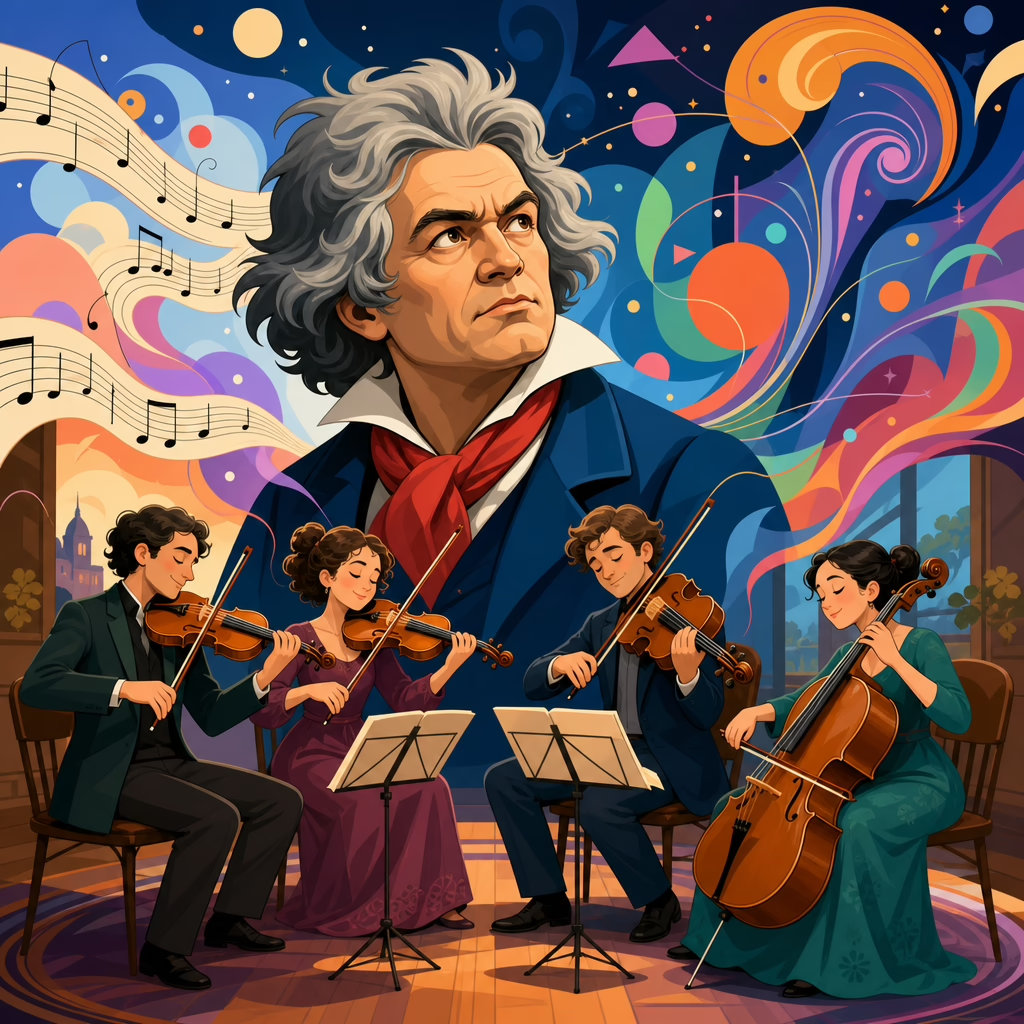
Why Beethoven’s Late Quartets Still Sound Ahead of Their Time
Beethoven’s late string quartets still sound ahead of their time because they stretch harmony, form, rhythm, texture, and emotional scope far beyond what early nineteenth-century listeners expected from chamber music. Written mostly between 1824 and 1826, the set usually includes Opp. 127, 130, 131, 132, 133, and 135, with the Große Fuge often treated as both the original finale to Op. 130 and a standalone summit of musical modernism. In practical terms, “ahead of their time” means these works anticipate techniques later associated with Wagner, Mahler, Bartók, Shostakovich, and even twentieth-century modernism, while remaining unmistakably Beethoven. I have spent years hearing performers rehearse these scores measure by measure, and the same reaction keeps returning: passages that look compact on the page open into worlds of startling ambiguity, volatility, and intimacy. These quartets matter not simply because they are difficult or revered, but because they redefine what a string quartet can say and how it can think. Instead of treating four instruments as polite conversation, Beethoven turns them into a laboratory for radical structure and raw introspection. That combination is why musicians, scholars, and first-time listeners alike continue to hear something uncannily contemporary in music composed two centuries ago.
Radical harmony makes the music feel perpetually unstable
One reason the late quartets sound modern is Beethoven’s handling of harmony. Earlier Classical quartet writing usually establishes a key, departs from it with clear logic, and returns with satisfying proportion. In the late works, Beethoven often keeps the listener uncertain about tonal ground for much longer. The C-sharp minor Quartet, Op. 131, opens with a fugue that avoids easy cadential reassurance; its lines pull chromatically against one another, creating a tension that sounds psychologically searching rather than merely decorative. The Heiliger Dankgesang movement of Op. 132 alternates archaic modal writing with more earthly, songlike episodes, making tonal identity itself part of the expressive drama. In rehearsals, players often speak less about “beautiful chords” than about harmonic pressure: where dissonance needs to bite, where a resolution arrives too late, or where a phrase lands in a key that feels emotionally strange. That delayed gratification is central to the music’s impact.
Beethoven also uses enharmonic reinterpretation and remote key relations with a boldness that later composers would expand. The opening movement of Op. 127 moves through harmonic regions that feel less like a tidy Classical excursion than a sequence of revealed possibilities. The Große Fuge pushes this further, making the quartet sound almost untethered from conventional tonal hierarchy during its densest episodes. Importantly, this is not harmonic chaos. Beethoven always controls the larger arc, but he refuses to make the route predictable. Modern listeners, raised on film scores, jazz extensions, and post-Romantic chromaticism, often recognize that feeling instantly. What shocked some early audiences now registers as daring coherence. The quartets teach the ear to accept tension as a permanent condition rather than a problem quickly solved.
Beethoven breaks inherited forms from the inside
The late quartets also sound ahead of their time because Beethoven treats form as a living argument, not a fixed template. Classical sonata form had conventions: exposition, development, recapitulation, and expected balances between themes. Beethoven knew those rules thoroughly, then began destabilizing them through proportion, continuity, and unexpected sequence. Op. 131 is the clearest example. Instead of four conventional movements, it unfolds in seven connected sections played without a full break, creating a continuous dramatic architecture that listeners today might compare to a concept album or through-composed narrative. The result feels modern because the piece evolves as a single organism. Each movement comments on the previous one and prepares the next.
Op. 130 offers another kind of formal audacity. Its six movements move between wit, dance, lyric inwardness, and colossal learned counterpoint. That range can seem discontinuous if measured against polite Classical symmetry, yet it makes deep expressive sense. Beethoven is no longer asking a quartet to maintain one social tone. He allows contradiction. The Cavatina from Op. 130 is among the most concentrated slow movements in all music, and when paired originally with the Große Fuge, the emotional and intellectual scale becomes almost shocking. The finale replacement Beethoven later wrote is more approachable, but the original ending reveals his larger formal imagination. If you want the broader context for how he repeatedly transformed inherited structures, the main guide at how Beethoven reinvented the symphony shows the same pattern in orchestral form, though the quartets take the experimentation to an even more intimate extreme.
Rhythm, meter, and silence create a startlingly modern drama
Another feature that keeps these quartets sounding new is rhythmic unpredictability. Beethoven does not rely only on memorable themes; he builds tension through interruption, hesitation, acceleration, and metric ambiguity. In Op. 135, gestures can seem deceptively simple until accents fall in destabilizing places. In Op. 131, transitions often feel as though one pulse dissolves and another pulse emerges from within it. That kind of rhythmic transformation became a major resource for later composers, but Beethoven was already using it to make time itself feel elastic. The music breathes, stalls, surges, and questions its own momentum.
Silence is equally important. In performance, the rests in these works are never empty. They function like charged spaces in a serious conversation, moments when what has just been said continues to resonate. The Große Fuge is a masterclass in this. Its explosive declarations and abrupt breaks create a rhetoric that can feel almost twentieth century, closer in spirit to modernist fragmentation than to smooth Classical continuity. This is one reason recordings alone never tell the whole story. In the hall or rehearsal room, those silences have physical force. Players must decide whether a pause feels suspended, defiant, grieving, or ironic. Beethoven writes the rest; performers complete its meaning. That interpretive openness is another modern trait, giving each generation room to hear the quartets through its own sensibility without exhausting the score.
Texture and counterpoint turn four instruments into a new medium
Beethoven’s late quartet texture is unlike the balanced conversational style many listeners associate with Haydn or Mozart. He still values dialogue, but he often thickens it into a network of independent lines with severe demands on ensemble precision and tonal control. The opening fugue of Op. 131 and the immense design of the Große Fuge show his late obsession with counterpoint, yet this is not academic display. He uses learned techniques to produce visceral intensity. Subjects are inverted, compressed, expanded, hurled across registers, and forced into collisions that make the quartet sound larger than four players. When rehearsing these pages, ensembles often talk like architects, mapping stress points and structural pillars rather than merely shaping melody.
The following comparison shows why listeners often hear these quartets as a leap beyond earlier chamber writing:
| Feature | Typical late Classical quartet expectation | Beethoven’s late quartet approach |
|---|---|---|
| Texture | Clear melody with accompaniment | Four highly independent voices competing and cooperating |
| Counterpoint | Used selectively for contrast | Structural engine of entire movements, especially fugues |
| Form | Symmetrical movement plans | Continuous, irregular, or radically expanded designs |
| Harmony | Strong tonal confirmation | Extended ambiguity, chromatic strain, remote key motion |
| Expression | Refined balance of moods | Abrupt extremes: humor, prayer, violence, detachment |
This textural complexity influenced later quartet traditions directly. Bartók’s quartets, for example, depend on equality among voices and on motivic cells transformed under pressure. Shostakovich likewise inherited the idea that a quartet could carry symphonic weight without orchestral resources. Beethoven did not merely write difficult parts; he reconceived ensemble writing so completely that later composers could treat the string quartet as a site for the most advanced musical thought of their age.
Extreme emotional range gives the music a modern inner life
Many older chamber works project sociability, elegance, or cultivated sentiment. Beethoven’s late quartets certainly include grace and humor, but they also expose states of mind that feel startlingly private. The slow movement of Op. 132, marked as a song of thanksgiving from a convalescent to the Deity, is a case in point. Beethoven had recently recovered from serious illness, and the movement’s alternating sections feel less like abstract contrast than lived experience: weakness, gratitude, relapse, renewal. Its modal language evokes older sacred styles, yet the emotional candor is unmistakably personal. Modern listeners often respond to this movement because it does not package suffering neatly. It allows fragility to remain audible.
The Cavatina from Op. 130 reaches a different kind of inwardness. Beethoven reportedly said it moved him to tears, and performers understand why. The melodic line seems to sing while simultaneously breaking under pressure, especially in the “beklemmt” passage, where choking intensity interrupts lyrical flow. That moment can sound almost like a crisis of speech itself, as if the music knows more than it can calmly articulate. This is one of the clearest reasons the late quartets still feel contemporary: they are psychologically layered. They do not present one stable emotion per movement. Instead, they let contradictory feelings coexist, shift abruptly, or fracture. That complexity aligns them less with salon entertainment than with the interior realism of later novels, late Mahler, or modern cinema.
The quartets were difficult for early audiences and prophetic for later ones
Historical reception helps explain their enduring aura of futurity. Some contemporaries admired the late quartets deeply, but many were baffled. Violinist Ignaz Schuppanzigh, Beethoven’s longtime collaborator, is linked to the famous complaint that the Große Fuge was incomprehensible, though the exact phrasing is filtered through anecdote. What matters is that listeners recognized the music as unusually hard to grasp. These works did not fail because they lacked craft; they exceeded prevailing listening habits. Beethoven was writing for players and audiences willing to follow highly compressed motives, delayed resolutions, abrupt contrasts, and counterpoint of extreme density. In that sense, the quartets anticipated the history of modern art, where initial resistance often accompanies innovation.
Later musicians heard their significance more clearly. Wagner admired Op. 131. T. S. Eliot alluded to the late quartets in “Four Quartets,” recognizing their meditative time sense. Twentieth-century performers and scholars increasingly treated the Große Fuge as a landmark rather than an aberration. Igor Stravinsky called it “an absolutely contemporary piece of music that will be contemporary forever,” a judgment repeated so often because it remains accurate. The phrase captures something essential: these quartets do not merely predict one later style. They renew themselves under different historical ears. Romantic listeners heard spiritual depth, modernists heard structural audacity, and current audiences hear fragmentation, ambiguity, and vulnerability. The music keeps meeting the future because it never settles into one period’s comfort zone.
Beethoven’s late quartets still sound ahead of their time because they combine radical means with lasting human urgency. Their harmonies resist easy settlement, their forms refuse inherited symmetry, their rhythms and silences reshape musical time, and their textures turn four instruments into a vehicle for symphonic thought and intimate confession at once. Just as important, they do not sound experimental for the sake of novelty. Every disruption serves expression. When Beethoven stretches a cadence, fractures a melody, or drives counterpoint to the edge, he is enlarging what chamber music can contain: prayer, irony, terror, recovery, memory, and hard-won joy.
That is the central benefit of returning to these works today. They train the ear to hear complexity without losing emotional contact. They show that innovation can be rigorous and deeply felt at the same time. If you want to understand why so many later composers treated the string quartet as their most searching medium, start with Opp. 131 and 132, then hear Op. 130 with the Große Fuge. Listen once for beauty, then again for risk. The future is already in the room.
Frequently Asked Questions
What does it really mean to say Beethoven’s late quartets were “ahead of their time”?
When people say Beethoven’s late string quartets were ahead of their time, they usually mean that these works seem to anticipate musical ideas, listening habits, and expressive ambitions that became much more familiar later in the nineteenth and even twentieth centuries. Written mostly between 1824 and 1826, the late quartets—typically Opp. 127, 130, 131, 132, 133, and 135—push far beyond what many early nineteenth-century listeners expected from chamber music. Instead of offering elegant conversation in a familiar classical mold, they often sound searching, disruptive, inward, and structurally unpredictable.
Part of that modern quality comes from harmony. Beethoven stretches tonal language to the edge, using abrupt key changes, unstable progressions, and passages that seem to suspend the feeling of a secure home key. Part comes from form: movements can unfold in unusual proportions, transitions may feel startlingly abrupt, and entire works can resist the neat balance associated with Haydn and Mozart. Op. 131, for example, links seven movements without the normal pauses, creating a large-scale arc that feels astonishingly original even now.
Rhythm and texture also matter. These quartets can sound fragmented, obsessive, weightless, or fiercely driven, with every instrument treated as an independent voice rather than a supporting layer beneath a melody. Add to that their emotional scope—humor, prayer, violence, serenity, irony, exhaustion, transcendence—and the result is music that feels psychologically expansive in a way many listeners associate with later modern art. In that sense, “ahead of their time” is not just praise. It is a practical description of music that asked questions audiences and musicians would spend generations learning how to hear.
Which musical features make the late quartets sound so modern to contemporary listeners?
Several specific features give Beethoven’s late quartets their strikingly modern profile. One of the most important is their harmonic boldness. Beethoven often treats tonality less as a stable framework than as a field of tension and possibility. He moves rapidly into remote keys, delays expected resolutions, and creates stretches where listeners may feel unmoored before the music regains balance. That sense of tonal instability is one reason the quartets can sound uncannily fresh even to audiences familiar with later composers.
Another major feature is formal experimentation. These works do not always behave according to standard expectations about sonata form, rondo shape, or movement order. Beethoven rethinks how a quartet can unfold over time. Op. 132 includes the famous slow movement marked “Heiliger Dankgesang,” a vast meditation that interrupts any simple sense of momentum and transforms the work into something spiritual and reflective. Op. 130 originally ended with the Große Fuge, a finale so monumental and uncompromising that it seemed to burst the boundaries of what a chamber piece could contain.
Texture is equally important. Rather than relying on a clear hierarchy of first violin melody with accompaniment below, Beethoven distributes material across all four instruments with unusual equality and complexity. Lines overlap, interrupt one another, and sometimes seem to argue from different angles at once. This creates a dense, intellectually alive texture that rewards repeated listening. Rhythmic unpredictability further sharpens the effect: sudden accents, pauses, metric dislocations, and obsessive motivic repetition can make the music feel startlingly contemporary.
Finally, the late quartets sound modern because they seem less concerned with pleasing surface beauty than with truthfulness of expression. They are willing to be difficult, austere, fragmented, and severe. Yet they are also capable of tenderness, wit, and extraordinary stillness. That refusal to stay within one emotional register is deeply modern. Contemporary listeners often recognize in these works a kind of artistic freedom that later became central to musical modernism.
Why is the Große Fuge so often singled out as one of the most radical pieces Beethoven ever wrote?
The Große Fuge, Op. 133, is often treated as a summit of Beethoven’s late style because it compresses many of his most daring ideas into one fiercely concentrated work. Originally composed as the finale to Op. 130, it was later published separately after early reactions suggested that audiences and players found it overwhelmingly difficult and severe. Even today it can sound less like a conventional quartet finale than like a challenge thrown across musical history.
What makes it so radical is first its scale and intensity. Instead of ending a quartet with a graceful release of tension, Beethoven offers a vast contrapuntal structure built from conflict, fragmentation, and relentless transformation. The fugue is not merely academic counterpoint. It is dramatic, physical, and at times almost violent in its energy. Themes collide, rhythms grind against each other, and textures thicken into something that can sound shockingly modern, even abrasive.
The piece is also radical in the way it joins learned technique to expressive extremity. Fugue had long been associated with discipline and intellectual craftsmanship, but Beethoven turns it into a vehicle for emotional and structural upheaval. The result anticipates later composers who treated musical form as a site of tension rather than reassurance. Many listeners hear in the Große Fuge foreshadowings of Brahmsian density, Bartók’s quartet writing, and even aspects of twentieth-century modernism.
Its reputation has grown partly because history caught up with it. What once seemed incomprehensible came to be admired as visionary. The Große Fuge still demands concentration, but that demand is exactly why it remains so compelling. It sounds radical not because it is merely difficult, but because it reimagines what a string quartet can say and how forcefully it can say it.
How did Beethoven’s late quartets challenge the expectations of audiences in the 1820s?
In the 1820s, chamber music was still widely associated with balance, refinement, and intelligible form, especially in the lineage of Haydn and Mozart. Beethoven had already expanded those traditions in his middle-period works, but the late quartets went much further. They challenged listeners not only with technical complexity but also with the feeling that familiar musical signposts had been rearranged or removed. Themes do not always unfold in predictable ways, cadences may be delayed or undermined, and movements can pursue unusual emotional or structural paths.
These quartets also demanded a new kind of listening. Instead of hearing the music as polished entertainment or aristocratic conversation, audiences were asked to follow long-range argument, abrupt contrasts, and intense inward reflection. Some passages seem almost private in character, as though the music were thinking aloud rather than performing for immediate approval. For listeners expecting clarity and proportion, that could be baffling.
The technical demands on performers added another layer of difficulty. Beethoven wrote with extraordinary independence for each instrument, meaning ensemble coordination, balance, articulation, and expressive precision all became more challenging. If performances were less than ideal—as they often were in the early reception of such demanding music—the quartets could seem even more opaque. That helps explain why some contemporaries regarded them as enigmatic or excessive rather than instantly canonical.
Yet the challenge was also the source of their lasting power. Beethoven was effectively redefining chamber music as a medium for philosophical depth, spiritual intensity, and formal risk. What initially sounded strange gradually came to be heard as profound. The late quartets challenged 1820s audiences because they required a broader idea of what music could communicate and how deeply it could engage the listener’s mind and emotions.
Why do Beethoven’s late quartets continue to influence composers, performers, and listeners today?
Beethoven’s late quartets continue to matter because they remain living works rather than historical monuments. Composers return to them for their fearless handling of form, their flexible treatment of tonality, their density of motivic development, and their willingness to place contradiction at the center of musical thought. These quartets show that a composition can be rigorously constructed and emotionally unpredictable at the same time. That lesson has resonated from the Romantic era through modernism and into contemporary music.
Performers are drawn to them because each quartet is both a technical challenge and an interpretive world. The music demands not only precision but maturity, patience, and deep ensemble trust. Every phrase can raise questions about character, pacing, balance, and large-scale architecture. For string quartets in particular, these works function almost like lifelong companions: pieces that reveal new structural relationships and emotional meanings over decades of study and performance.
Listeners continue to find them compelling because they reward repeated hearing. A first encounter may register intensity or strangeness; later hearings reveal extraordinary coherence beneath the surface unpredictability. The quartets can feel intimate and cosmic at once, speaking in a language that is personal yet astonishingly expansive. Their emotional range is unusually broad, moving from tenderness and humor to grief, austerity, exaltation, and hard-won release.
Most of all, the late quartets endure because they still sound like discoveries. They do not sit comfortably in one historical box. Even now, they can seem to open doors rather than close them. That is the deepest reason they still sound ahead of their time: they continue to create the sensation that music is becoming something new in the very moment we hear it.