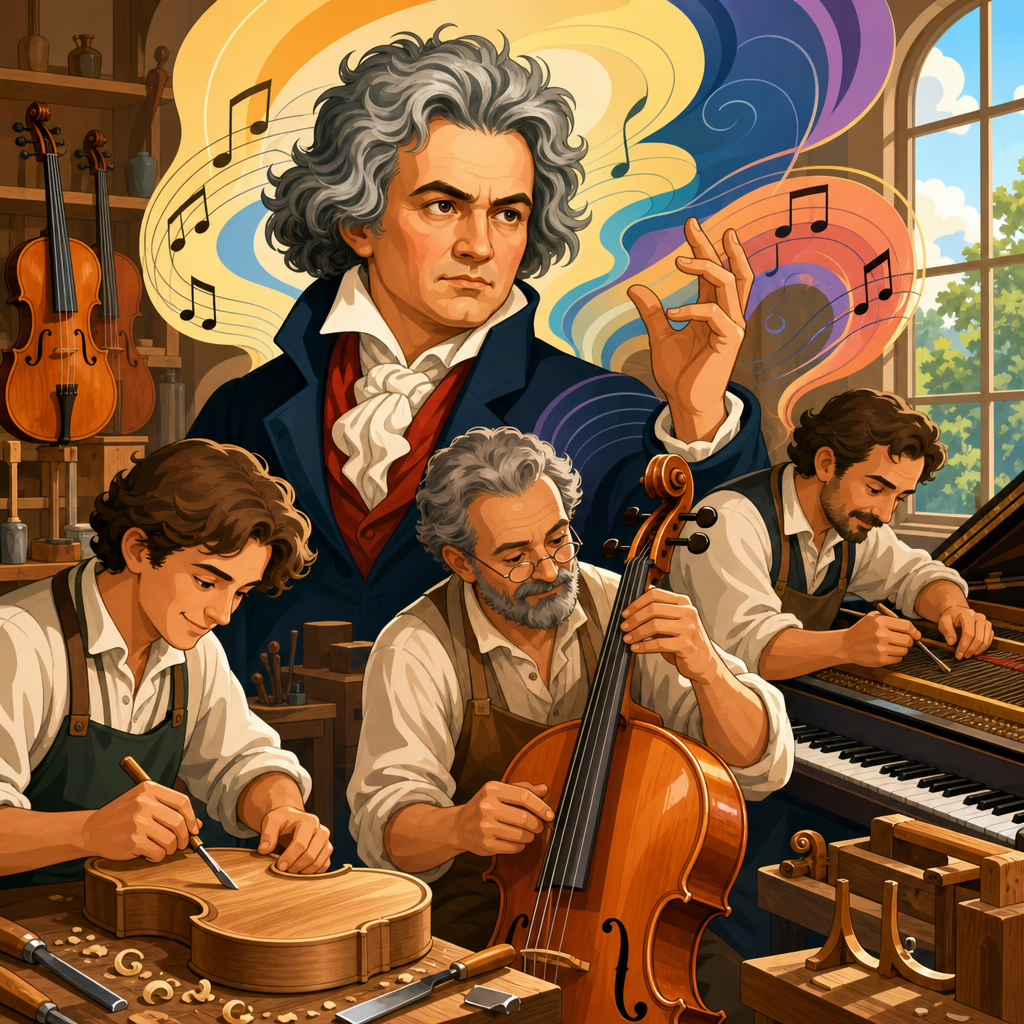
Beethoven’s Influence on Instrument Makers and Builders
Ludwig van Beethoven changed not only what composers wrote and audiences expected, but also how instruments were designed, built, and maintained. His music placed unprecedented demands on pianos, strings, winds, brass, and even concert spaces, forcing instrument makers and builders to solve practical problems in sound, strength, range, and projection. When discussing Beethoven’s influence on instrument makers and builders, the key idea is simple: his compositions exposed the limits of existing tools, and those limits inspired technical change.
That influence matters because early nineteenth-century instruments were still evolving rapidly. The piano was moving from a light Viennese action toward the stronger, louder concert instrument now familiar worldwide. Woodwinds were gaining additional keys to improve intonation and chromatic flexibility. Brass instruments still relied heavily on natural harmonics before valve technology became standard. String makers, bow makers, and piano builders were all balancing tone against durability. In workshops across Vienna, Paris, London, and later the German states, Beethoven’s music became a real-world stress test.
I have always found that builders reveal Beethoven’s importance most clearly when they describe specific failures: broken strings, weak soundboards, uneven key action, unreliable tuning, cramped compass, and wind instruments unable to execute the dynamic and tonal contrasts the score implied. Beethoven did not invent these problems, but he amplified them. His sonatas, quartets, concertos, and symphonies repeatedly asked for more volume, longer sustain, wider range, sharper accents, and greater expressive immediacy than many instruments of his youth could comfortably deliver.
To understand this process, it helps to define two terms. An instrument maker creates or refines the instrument itself: the piano builder, violin maker, flute maker, horn maker, or string manufacturer. A builder can also mean the architect or acoustician shaping the room in which the instrument is heard. Beethoven affected both groups. He pushed makers to improve the hardware musicians touched, and he pushed hall designers toward spaces that could support larger ensembles, stronger dynamic contrasts, and a more public style of listening. His influence was therefore mechanical, acoustical, and cultural at once.
The piano industry felt Beethoven’s pressure first and most intensely
No instrument was more directly shaped by Beethoven than the piano. He composed across a period when the fortepiano was transforming from a relatively intimate salon instrument into a stronger, broader-voiced machine. Early Viennese pianos by builders such as Anton Walter offered clarity, quick response, and transparent articulation, but they had lighter frames, thinner strings, and a more limited sustaining power than later nineteenth-century instruments. Beethoven admired those qualities, yet he also wrote music that constantly tested their outer edge.
His thirty-two piano sonatas document this pressure in audible form. The early sonatas can still sit comfortably on late eighteenth-century Viennese instruments, but the middle and late sonatas demand more from the action, compass, and tonal mass. In works such as the “Waldstein” Sonata, Op. 53, and the “Appassionata,” Op. 57, repeated chords, rapid register changes, and extreme dynamic contrasts expose weakness in lightly built pianos. Builders had to respond with stronger cases, improved stringing, better hammer coverings, and more reliable actions that could survive forceful playing without losing control.
Beethoven’s relationship with instrument makers was personal as well as artistic. He knew and used pianos from Johann Andreas Stein’s circle, Anton Walter, Sébastien Érard, and later Conrad Graf. The 1803 Érard piano sent from Paris is especially significant because it offered a more robust construction and an expanded range. Beethoven valued such instruments not as luxury objects but as necessary tools. He wanted more notes, more resonance, and more mechanical stability. Every time he praised a piano’s power or criticized its weaknesses, builders received direct feedback from one of Europe’s most demanding users.
The extension of keyboard range is one of the clearest examples of his practical influence. Beethoven’s keyboard writing increasingly reached into extreme registers, and builders followed the market by extending the compass from roughly five octaves toward six and beyond. This was not done for Beethoven alone, but his repertoire helped normalize the expectation. Once major works required those notes, professional players and wealthy amateurs needed instruments capable of delivering them. Repertoire drove demand, demand shaped manufacture, and manufacture in turn widened what composers considered possible.
Structural reinforcement followed the same pattern. Before full iron frames became standard later in the century, builders experimented with heavier wooden structures, improved bracing, and altered string scaling. The aim was to support higher tension and a larger sound without sacrificing responsiveness. Beethoven’s forceful attack, often mentioned by contemporaries, made these issues urgent. A piano suitable for elegant drawing-room variations could not always survive the repeated accents and orchestral textures implied by his middle-period writing. His music rewarded strength, but only if that strength preserved nuance.
Strings, bows, and setup evolved to match Beethoven’s expressive scale
Beethoven also reshaped expectations for string instruments and their accessories. He did not trigger a complete redesign of the violin family in the way later industrial piano building transformed keyboard instruments, yet his quartets, sonatas, and symphonic string writing pushed makers and players toward setups that favored projection, tension, and a wider dynamic range. In practical workshop terms, that meant reconsidering string materials, bridge cutting, neck angle, fingerboard dimensions, and bow characteristics.
At the turn of the nineteenth century, string players were already moving through important changes. François Tourte’s bow design, with its concave curve, standardized balance, and stronger stick, gave performers greater control over legato, articulation, and sustained pressure. Beethoven’s writing benefited enormously from this development. Long crescendos, sudden sforzandi, and broad singing lines all speak more effectively through a bow capable of consistent tension across the stroke. In rehearsal, players quickly discover that older bow types can produce elegance, but Tourte-style bows better support Beethoven’s rhetorical force.
String tension and setup mattered too. Gut strings remained standard, yet makers and performers increasingly pursued combinations that projected more clearly in larger rooms and against more assertive wind and brass writing. Beethoven’s Razumovsky Quartets, Op. 59, and later quartets ask for marked contrasts of texture and weight. These pieces sound best when instruments can speak quickly in soft passages but also carry in dense writing. That requirement encouraged attention to bridge response, soundpost adjustment, and neck modernization trends that became more widespread later in the century.
Even the cello’s role changed under Beethoven’s pressure. In piano trios and sonatas, the cello ceased to be merely supportive and became a more equal, exposed voice. Builders and players responded by valuing instruments with stronger upper-register projection and clarity. This did not mean inventing a new cello, but it did affect setup preferences and market tastes. Repertoire often changes instruments indirectly by changing what buyers seek, and Beethoven consistently elevated the expressive and structural importance of every string voice.
Woodwinds and brass needed new mechanisms, accuracy, and power
If Beethoven challenged piano builders through touch and range, he challenged wind makers through intonation, chromatic writing, and orchestral balance. Classical-era woodwinds and brass were highly coloristic but mechanically limited compared with modern instruments. The flute, oboe, clarinet, bassoon, horn, and trumpet all relied on key systems or natural harmonic patterns that constrained certain passages and affected tuning consistency. Beethoven wrote with deep awareness of these characteristics, yet he also pressed against them.
His orchestral writing often places winds in dramatically exposed roles. The clarinet, newly rising in status, becomes a carrier of distinctive color and expressive individuality. Horns and trumpets are no longer mere ceremonial signals; they define structure, tension, and release. In the “Eroica” Symphony and Fifth Symphony, the brass writing helped establish a new expectation of power and presence. Natural horns and trumpets could achieve this brilliance, but instrument makers were under pressure to improve reliability, hand-stopping options, crook systems, and eventually valve mechanisms so that composers and players could operate with greater freedom.
Woodwind keywork advanced for similar reasons. Beethoven’s music did not singlehandedly invent the multi-key woodwind, but it accelerated the professional need for instruments that could play chromatic lines more evenly and in tune across registers. Flute makers in particular confronted demands for stronger tone and more secure fingering patterns. Clarinet makers faced pressure to improve response in crossing the break and to stabilize intonation in orchestral contexts where Beethoven’s denser textures left less room for compromise.
| Instrument family | Pressure created by Beethoven’s writing | Typical maker response |
|---|---|---|
| Piano | More volume, wider range, heavier attack, longer sustain | Expanded compass, stronger cases, revised actions, tougher stringing |
| Strings | Broader dynamics, sustained phrasing, stronger projection | Tourte-style bows, setup adjustments, projection-focused preferences |
| Woodwinds | Chromatic passages, exposed tuning, greater orchestral weight | Additional keys, bore refinements, improved fingering systems |
| Brass | Structural prominence, high-impact entries, greater flexibility | Refined crooks, hand technique adaptations, later valve adoption |
For readers tracking the broader transformation of Beethoven’s orchestral thinking, this focused technical story connects directly with his larger musical ambitions, which are explored in the main guide at https://lvbeethoven.com/how-beethoven-reinvented-the-symphony/. The crucial point here is that instrumental innovation was not abstract progress. Builders changed instruments because Beethoven and his contemporaries made older designs feel insufficient in rehearsal, performance, and saleable prestige.
Concert hall builders and acoustic planners adapted to Beethoven’s scale
Beethoven’s influence extended beyond the workshop bench into the design of performance spaces. His music belongs to the period when public concert life was expanding, aristocratic patronage was evolving, and the symphony was becoming a civic event rather than a courtly diversion. Larger orchestras, stronger brass presence, and bolder dynamic architecture required rooms that could project impact without turning detail into blur. Hall builders therefore became part of the same innovation chain as instrument makers.
In practical acoustic terms, Beethoven rewards clarity plus power. The opening of the Fifth Symphony needs concentrated rhythmic punch. The slow movements need bloom and sustain. The choral finale of the Ninth demands balance among orchestra, soloists, and chorus. Rooms that are too dry reduce grandeur; rooms that are too reverberant swallow articulation. Nineteenth-century hall design did not emerge solely because of Beethoven, but his repertory quickly became one of the benchmarks for whether a space could handle modern musical drama.
This pressure also influenced instrument placement and stage design. As orchestras grew and wind and brass parts gained importance, builders and conductors had to consider sightlines, risers, and ensemble communication. Beethoven’s expanded orchestral rhetoric exposed weak logistics as much as weak acoustics. A hall suitable for lighter Classical repertory might not support the sonic architecture of the Seventh or Ninth Symphony with equal success. In that sense, builders of venues were responding to the same challenge as piano makers: preserving detail while expanding scale.
Beethoven’s legacy lives in reconstruction, historically informed building, and modern manufacturing
One of the most revealing aspects of Beethoven’s influence is that it continues in two opposite directions at once. Modern manufacturers still build instruments designed to meet the power, projection, and reliability that his repertoire helped normalize. At the same time, specialist makers of historical replicas study surviving Walter, Érard, Graf, and early nineteenth-century wind instruments to recover the exact mechanical world Beethoven knew. Both movements prove his continuing authority over how builders think.
In my experience working with performers and studying historical setups, replica instruments teach an essential lesson: Beethoven was neither simply writing for primitive tools nor secretly imagining today’s concert grand. He wrote for evolving instruments and actively exploited their strengths and weaknesses. Builders who recreate period pianos learn how transparency, quick decay, and differentiated registers shape phrasing. Modern builders, by contrast, must ensure that those same works function in large halls under modern expectations of tuning stability, repetition speed, and tonal homogeneity. The two approaches serve different truths, yet both descend from Beethoven’s pressure on design.
That is why Beethoven’s influence on instrument makers and builders remains a living subject rather than a closed historical chapter. He transformed instruments by demanding more than routine craftsmanship could offer. Piano builders strengthened frames and expanded ranges. String specialists favored setups and bows that could sustain rhetorical intensity. Wind and brass makers pursued greater flexibility, accuracy, and projection. Hall designers sought spaces capable of carrying unprecedented dynamic drama. The lasting benefit is clear: Beethoven helped turn musical imagination into mechanical innovation. If you want to understand why instruments sound, feel, and project the way they do today, study Beethoven’s demands closely, then listen for the builders answering them.
Frequently Asked Questions
How did Beethoven push piano makers to redesign their instruments?
Beethoven’s piano writing exposed the limits of the early nineteenth-century keyboard more clearly than almost any other composer of his era. He wanted greater volume, a broader dynamic range, longer sustain, stronger bass sonorities, and more dramatic contrast than many existing instruments could reliably provide. As his style evolved, his sonatas and concert works began to demand thunderous chordal passages, powerful accents, rapid repeated notes, and singing melodic lines that needed both clarity and projection. Those demands encouraged piano makers to strengthen cases, improve stringing, refine hammer action, and gradually expand the keyboard compass.
Builders responded because performers needed instruments that could survive and communicate Beethoven’s music in larger rooms and public concert settings. Viennese pianos, prized for nuance and light action, could be ideal for clarity, but Beethoven’s more forceful writing often highlighted their structural and tonal limits. English pianos, with heavier construction and a more robust sound, appealed to him for precisely that reason. Over time, this pressure helped move piano design toward sturdier frames, thicker strings, more dependable action mechanisms, and eventually the larger, more resonant instrument associated with the nineteenth-century concert tradition. In that sense, Beethoven did not invent the modern piano, but his music accelerated the need for one.
What specific challenges did Beethoven create for string instrument makers and players?
Beethoven transformed string writing by expecting more power, greater expressive range, and sharper contrasts from violins, violas, cellos, and basses. His quartets, symphonies, and sonatas required instruments and bows capable of handling abrupt changes in articulation, intense accents, long lyrical lines, and increasingly weighty ensemble textures. This did not necessarily mean that violin makers suddenly built entirely new instruments because of Beethoven alone, but it did mean that setup, maintenance, and playing equipment had to evolve in response to the new demands. Stronger projection, better balance across strings, and more reliable response became increasingly important as performances moved into larger halls.
One major area of development was the bow. The modern Tourte-style bow, with its greater strength, elasticity, and control, was perfectly suited to the kind of articulation and dynamic force Beethoven expected. Likewise, string setup, neck angle, bass bar design, and tension gradually adapted over the nineteenth century to produce a more projecting and stable tone. Beethoven’s orchestral writing also pushed string sections to function with greater collective intensity, which increased the importance of consistency in instrument maintenance and setup. His influence was therefore both direct and indirect: he challenged performers immediately, and in doing so he encouraged makers and restorers to optimize instruments for a bolder, more public style of music making.
Did Beethoven influence the development of wind and brass instruments as well?
Yes, very much so. Beethoven wrote for winds and brass with unusual independence, weight, and expressive purpose, and that exposed the practical limitations of the instruments available to him. In earlier orchestral traditions, wind and brass parts often supported harmony or color, but Beethoven increasingly treated them as essential voices in the musical argument. He expected stronger projection, more secure intonation, and wider expressive flexibility. Natural horns and trumpets, for example, were still constrained by the harmonic series, which limited the notes they could play cleanly without technique-dependent workarounds. When composers like Beethoven asked more of these instruments, instrument makers had strong incentive to improve their design.
Woodwinds faced similar pressure. Beethoven relied on flutes, oboes, clarinets, and bassoons not just for ornament or blending, but for thematic prominence, dramatic dialogue, and structural importance. That meant mechanisms, key systems, tone-hole placement, and bore design became increasingly significant issues for builders trying to improve tuning, agility, and tonal consistency. Although many innovations fully matured later in the nineteenth century, Beethoven’s repertory became one of the proving grounds that showed where instruments fell short. His music made audiences and performers hear the difference between an instrument that merely functioned and one that could meet the dramatic scale of a new orchestral language.
How did Beethoven’s music affect concert hall design and instrument projection?
Beethoven’s influence extended beyond the instruments themselves into the spaces where they were heard. His symphonies, overtures, concertos, and choral works required greater sonic impact than many earlier venues were designed to support. As public concerts became more important and audiences grew, builders of both instruments and halls had to think seriously about projection, balance, and resonance. Beethoven’s music demanded that instruments carry over larger ensembles and through larger rooms without losing clarity. That challenge encouraged makers to create more powerful instruments and encouraged venue designers to consider acoustics in a more deliberate way.
This mattered especially for pianos and orchestras. A keyboard instrument suitable for a salon was not automatically sufficient for Beethoven’s increasingly expansive sonatas or concertos in larger public settings. Similarly, orchestral instruments had to blend while still retaining enough individual presence to articulate his sharply profiled textures. Concert spaces therefore became part of the technological story. Better projection from instruments, improved durability under more forceful playing, and a growing awareness of acoustic design all developed together. Beethoven’s music did not singlehandedly invent the modern concert hall, but it undeniably contributed to the transition from intimate courtly listening environments to larger, more projection-conscious public performance culture.
Why is Beethoven considered so important in the history of instrument making if he was not an instrument builder himself?
Beethoven is considered crucial because he functioned as a powerful source of creative pressure. Instrument history does not advance only through inventors working in workshops; it also advances when composers and performers force those inventors to solve new problems. Beethoven’s scores repeatedly asked for more sound, more endurance, more expressive contrast, more range, and more structural reliability than existing instruments could comfortably deliver. When a composer of his stature writes music that performers want and audiences revere, makers cannot ignore the technical implications. His influence came through demand: demand for stronger pianos, more responsive bows, better wind mechanisms, more dependable brass technique, and instruments capable of filling larger spaces.
What makes Beethoven especially significant is that his demands were not isolated effects or novelties. They were central to his musical language. The force, scale, and expressive intensity of his writing became part of the core repertory, which meant instrument makers had to build not just for one passing fashion but for music that would be played repeatedly for generations. That is why his impact lasted. He helped redefine what a serious instrument needed to do. In practical terms, he pushed builders to think about sound production, materials, structural strength, mechanical efficiency, and projection in new ways. In historical terms, he stands as one of the clearest examples of how artistic ambition can drive technological change in musical instruments.