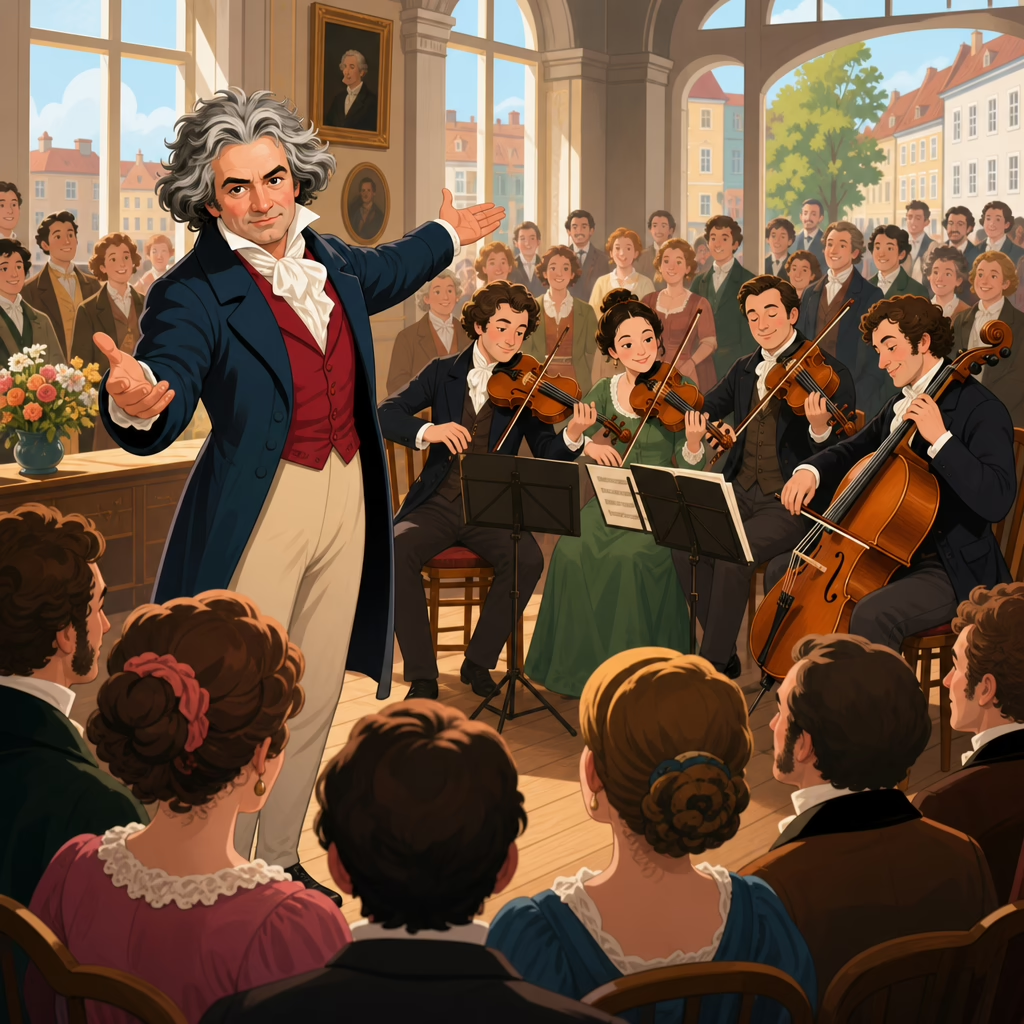
How Beethoven Made Chamber Music More Public
How Beethoven made chamber music more public can be understood only by seeing how radically he changed both the music itself and the conditions under which it was heard. Chamber music traditionally meant music for a room: intimate works for small ensembles, usually played in salons, aristocratic homes, or private gatherings where the audience was limited and socially defined. Before Beethoven, the string quartet, piano trio, and sonata were often shaped by conversation, decorum, and cultivated leisure. Beethoven did not abandon those roots, but he stretched the genre until it could address a broader public with unprecedented force.
When musicians and historians say Beethoven made chamber music more public, they mean several connected things at once. He expanded its scale, intensified its drama, raised its technical demands, and gave it a seriousness previously associated more strongly with symphonies and sacred music. He also worked in a changing economy of patronage, publication, and concert life in Vienna, where music increasingly circulated beyond courtly settings. In practice, that meant chamber works could be purchased, discussed, reviewed, performed by professionals, and received by listeners who were not members of a single noble household. The result was not mass culture in the modern sense, but a decisive move from private utility toward public artistic statement.
This shift matters because it helps explain Beethoven’s larger cultural position. He is often described as a revolutionary in orchestral music, yet some of his boldest experiments happened in genres with only two, three, or four players. In my own work with Beethoven scores and nineteenth-century concert documents, I have found that the chamber works reveal the transition especially clearly: what begins as music for cultivated insiders becomes music that invites public interpretation, criticism, and reverence. The “Razumovsky” Quartets, the “Kreutzer” Sonata, the Archduke Trio, and the late quartets did not merely entertain a room. They created events, debates, and reputations. That is the central innovation this article explores.
From aristocratic room to public artwork
In the late eighteenth century, chamber music largely served sociable function. Haydn and Mozart elevated the string quartet artistically, but many performances still took place in domestic or semi-private contexts. A prince, count, or wealthy amateur might commission pieces for use within a household. The players often knew one another personally, and the listeners were close enough to observe every detail. In that environment, refinement mattered more than projection. Musical ideas could be subtle because the audience was small, attentive, and socially homogeneous.
Beethoven entered this world but did not remain confined by it. Vienna around 1800 was developing a more mixed musical marketplace, with subscription concerts, printed editions, reviews in journals, and a growing public of serious listeners. Beethoven understood that chamber music could participate in that shift. He wrote works for patrons such as Prince Lobkowitz and Count Razumovsky, yet he composed them as enduring artistic statements rather than disposable house pieces. Publication spread them across Europe. Professional violinists, cellists, and pianists adopted them. Critics wrote about them as difficult, profound, and original. Those responses are signs of public culture, not merely private use.
His transformation of genre parallels developments heard in larger forms; readers interested in that wider context can compare this chamber shift with his orchestral breakthroughs in the main guide, How Beethoven Reinvented the Symphony. The important point here is that chamber music became a site for public artistic ambition. Beethoven treated the quartet and sonata as vehicles for ideas that demanded repeated hearings, analysis, and debate. Once that happened, the social identity of chamber music changed.
He enlarged the expressive scale of small ensembles
The most direct way Beethoven made chamber music more public was by making it sound larger than its performing forces. Earlier chamber music often prized balance and elegant exchange. Beethoven retained conversational interplay, but he loaded it with conflict, extreme dynamics, structural surprises, and emotional breadth. A string quartet could now carry the weight of tragedy, heroism, introspection, or spiritual searching on a scale audiences associated with public genres.
Take the String Quartets, Op. 59, known as the “Razumovsky” set, first published in 1808. Contemporary listeners were startled by their length, complexity, and symphonic energy. The first quartet in F major opens with a cello theme of unusual breadth, then unfolds through dense motivic development more akin to large-scale orchestral argument than to genteel drawing-room diversion. The slow movement of the first quartet creates a grave, suspended atmosphere that asks for concentrated listening. The finale releases that tension with contrapuntal drive and rhythmic insistence. This is chamber music, but it behaves like public art.
The same principle appears in the Sonata for Violin and Piano in A major, Op. 47, the “Kreutzer.” Its dimensions, technical ferocity, and dramatic contrast made it exceptional. The opening Adagio sostenuto is almost theatrical in its sense of arrival; the Presto that follows is aggressive, expansive, and physically demanding. Performers must project not just accuracy but character and tension over a long span. Even in domestic settings, such a work turns listeners into an audience. It creates spectacle and concentrates attention in a way earlier salon repertory often did not.
Beethoven also made silence, fragmentation, and sudden contrast central expressive tools. These devices read strongly in performance because they provoke collective reaction. A whispered transition, an abrupt sforzando, or a disruptive modulation can be felt instantly by a roomful of listeners. In that sense, his style was public not only because it circulated widely, but because it activated audience awareness. It demanded active listening rather than passive sociability.
He changed the role of performers and listening habits
Beethoven’s chamber music also became more public because it required a new level of professional execution and a new mode of listening. In many eighteenth-century domestic settings, skilled amateurs could participate meaningfully in chamber repertory, especially keyboard-accompanied sonatas or moderately demanding quartets. Beethoven did write some approachable music, but his major chamber works increasingly favored players with advanced technique, endurance, rhythmic precision, and interpretive authority.
That change had social consequences. As works became harder, public performance by specialists became more important. Ignaz Schuppanzigh’s quartet, closely associated with Beethoven, is a crucial example. This ensemble played Beethoven’s quartets repeatedly and helped establish the idea that chamber music merited serious, quasi-public presentation by dedicated professionals. Rehearsal time mattered. Ensemble identity mattered. Listeners were no longer just overhearing refined conversation; they were witnessing artistic interpretation.
The “Archduke” Trio, Op. 97, illustrates this evolution well. Its piano writing is expansive and orchestral, the string parts are fully integrated, and the long variation movement asks performers to sustain architectural clarity while shaping minute changes of tone and texture. This is not music that functions best as background. It rewards attentive audiences who can follow transformation across extended duration. Beethoven effectively trained his listeners to hear chamber music as a serious formal experience.
| Work | Public-facing innovation | Why it mattered |
|---|---|---|
| String Quartets, Op. 59 | Expanded length, symphonic development, heightened drama | Turned quartet performance into a major cultural event |
| “Kreutzer” Sonata, Op. 47 | Virtuosic scale and theatrical contrast | Blurred the line between chamber recital and public concert display |
| “Archduke” Trio, Op. 97 | Monumental form with integrated ensemble writing | Demanded concentrated listening and professional collaboration |
| Late Quartets, Opp. 127, 130–135 | Philosophical depth, formal experimentation, extreme nuance | Made chamber music central to critical discourse and legacy culture |
Reviews and memoirs from the period confirm that these works often puzzled early audiences. That reaction is important. Difficulty itself can be a sign that music has entered public discourse. Listeners argued over Beethoven because the music no longer served only immediate social pleasure. It carried claims about artistic truth, innovation, and seriousness. Public culture thrives on such claims, and Beethoven’s chamber music generated them repeatedly.
Publication, patronage, and the wider circulation of chamber music
Another reason Beethoven made chamber music more public lies in how he navigated the economics of music. He still depended on aristocratic support, but he was not simply a servant-composer producing pieces for one household. He negotiated with publishers in Vienna, Leipzig, London, and Paris; tracked editions; and understood the long-term value of his works in print. Chamber music, because it involved few performers and appealed to skilled players across Europe, was especially suitable for circulation through publication.
Printed music changed the audience. A quartet dedicated to Count Razumovsky could move far beyond Razumovsky’s palace once published. Musicians in Prague, Paris, or London could study it, perform it, and form opinions about it. Teachers used Beethoven’s works to train students in ensemble discipline and structural hearing. Collectors bought scores as symbols of taste and seriousness. In this way, the chamber repertory developed a public afterlife independent of any single premiere.
Patronage still mattered, but Beethoven redefined the patron’s role. A dedication honored social support, yet the music often exceeded the private function implied by the gesture. Count Razumovsky did not receive pleasant quartets designed merely to flatter his salon. He received large, challenging compositions that carried his name into European musical history. Patronage became a launch platform for public significance rather than a limit on it.
The growth of criticism amplified this process. Periodicals and critics increasingly evaluated instrumental works in print, discussing originality, coherence, and expressive meaning. Beethoven’s chamber music attracted exactly that kind of commentary because it invited analysis. Once critics write about a quartet as though it were a major statement, the quartet enters public intellectual life. That transition was one of Beethoven’s greatest cultural achievements.
The late quartets and the idea of chamber music as a public legacy
Beethoven’s late quartets completed the transformation. Works such as Op. 127, Op. 131, and Op. 132 are often described as inward, private, or visionary, and in one sense that is true. Their fugues, discontinuities, modal inflections, and long-form structures can feel like deeply personal speech. Yet paradoxically, these works made chamber music more public than ever because they became monuments of listening culture. They demanded not casual use, but reverent engagement, repeated performance, and collective interpretation across generations.
Consider the Heiliger Dankgesang movement in Op. 132. Beethoven marks contrasting sections “with the most intimate feeling” and sets them within a structure that alternates chorale-like gravity with renewed strength. The music is inward in emotion, but public in claim. It asks any audience, however small, to encounter illness, recovery, gratitude, and transcendence as serious artistic subjects. The quartet becomes a forum for shared reflection.
Op. 131 goes further by linking seven movements without break, creating a continuous argument that resists conventional entertainment logic. This format asks listeners to submit to a long-range design rather than consume separate attractive pieces. That is a public aesthetic demand. It assumes that chamber music can command sustained concentration equal to the highest forms of art. By the later nineteenth century, these quartets were treated almost like sacred texts by performers and connoisseurs. That reception history is proof of Beethoven’s success. He had elevated chamber music from cultivated pastime to a central repository of artistic value.
Beethoven made chamber music more public by changing its scale, its audience, its performers, and its cultural function. He wrote for rooms, but not only for rooms. His quartets, trios, and sonatas turned private genres into vehicles for public seriousness, debate, and legacy. Through expanded form, dramatic rhetoric, technical rigor, professional performance, strategic publication, and uncompromising artistic ambition, he ensured that small-ensemble music could stand at the center of musical life rather than its margins.
The lasting benefit of this transformation is still visible today. When a string quartet appears on a major concert series, when conservatories treat Beethoven chamber works as core training, or when listeners gather in silence for Op. 131, they are participating in the public culture he helped create. Chamber music remains intimate in means, but Beethoven proved it could be monumental in meaning. To hear these works with that history in mind is to understand why they continue to command audiences far beyond the rooms where the genre began.
If you want to explore Beethoven’s innovation more deeply, start with the “Razumovsky” Quartets, the “Kreutzer” Sonata, and Op. 132, then compare how each work turns intimacy into public statement. Few composers changed the social reach of a genre so decisively, and nowhere is that achievement clearer than in Beethoven’s chamber music.
Frequently Asked Questions
What does it mean to say that Beethoven made chamber music more public?
It means Beethoven helped move chamber music away from being primarily a private, elite art and toward becoming something that could carry public significance. Traditionally, chamber music belonged to intimate spaces: drawing rooms, salons, and aristocratic homes where small groups of invited listeners heard refined, socially contained performances. In that setting, the music was often understood as cultivated conversation among equals, elegant rather than confrontational, and shaped by the expectations of a narrow social circle.
Beethoven dramatically expanded that model. He wrote chamber works that demanded sustained attention, emotional involvement, and a level of seriousness more often associated with public artistic statements than with background music for polite company. His quartets, sonatas, and trios often sound as though they are addressing not just a handful of listeners in a room, but a broader imagined audience. They are larger in scale, more intense in feeling, more structurally ambitious, and more willing to surprise or challenge their hearers. Even when still performed in domestic settings, they carried the force of works that seemed to belong to a wider cultural world.
Just as important, the culture of listening was changing around him. Public concerts were becoming more prominent, music publishing was expanding, and a growing middle-class audience was engaging with serious instrumental music. Beethoven’s chamber music fit and accelerated these changes. He treated the genre not as a minor social pastime but as a site for major artistic thought. In that sense, he made chamber music more public both aesthetically and socially: the music itself became more outward-facing, and the conditions of listening increasingly moved beyond private patronage into broader civic and commercial life.
How was chamber music typically heard before Beethoven?
Before Beethoven, chamber music was usually experienced in relatively small, controlled environments. The very term “chamber” points to its setting: a room rather than a hall. Works for string quartet, trio, or sonata were commonly performed in courts, aristocratic residences, and cultivated homes, often among people who knew one another socially. The audience was limited, and listening could be attentive, but it was also shaped by manners, hierarchy, and the customs of private entertainment.
That does not mean the music was simple or unimportant. Composers such as Haydn and Mozart gave chamber music enormous sophistication, especially in the string quartet. But much of the genre still operated within a world of refinement and social balance. It was closely tied to patronage, amateur participation, and the ideal of musical conversation. A skilled noble amateur might play alongside professionals, or a host might present music as part of an evening’s cultured sociability. The setting itself mattered: chamber music was often integrated into the rhythms of domestic or courtly life rather than separated off as a public event requiring concentrated silence from a large anonymous audience.
That older model helps explain why Beethoven’s impact was so striking. He inherited forms already made rich by earlier masters, but he pushed them toward greater dramatic weight and public seriousness. As concert life expanded in the late eighteenth and early nineteenth centuries, chamber music began to leave the exclusive room without entirely losing its intimacy. Beethoven stands at the center of that transition. To understand how revolutionary he was, it is essential to remember that chamber music had long been associated with closeness, privacy, and social selectivity before he infused it with a new kind of artistic and public ambition.
What did Beethoven change in the music itself that made it feel more public?
Beethoven changed the scale, expressive range, and rhetorical force of chamber music. Earlier chamber works often emphasized balance, wit, and graceful exchange among instruments. Beethoven kept the idea of interaction, but he intensified it. His chamber music frequently unfolds like argument, struggle, proclamation, or discovery. Themes are not merely presented; they are tested, fractured, transformed, and driven through processes that can feel almost symphonic in power. This gives the listener the sense of witnessing an artistic event with larger stakes than private entertainment usually implied.
He also expanded duration and formal ambition. Many of his chamber works ask listeners to follow long arcs of tension and release, subtle motivic development, and stark contrasts in mood. A late string quartet movement, for example, can sound inward and intimate one moment, then visionary or unsettling the next. That breadth of expression suggests a public seriousness because it assumes an audience ready to engage deeply and reflectively. These are not pieces designed only to please the room; they are works that challenge, unsettle, and demand interpretation.
Another crucial shift was the changing role of instrumental voices. In Beethoven’s hands, the members of a quartet or trio do not simply maintain elegant decorum. They confront one another, collaborate intensely, interrupt, resist, and unite with dramatic urgency. The result is still chamber music in medium, but it often feels expansive in meaning. Rather than preserving the genre as a polished miniature of social order, Beethoven made it capable of expressing conflict, individuality, and collective purpose on a much broader human level. That is one reason his chamber music could resonate so strongly with emerging public culture.
Did Beethoven’s chamber music actually move into public concert spaces, or was the change mostly symbolic?
The change was both symbolic and practical. Beethoven did not single-handedly invent the public performance of chamber music, but his career unfolded at a moment when musical life in Europe, especially in cities like Vienna, was becoming less dependent on exclusive aristocratic patronage and more open to mixed public audiences. Public concerts, subscription events, music publishing, and professional performance networks were all growing. In that environment, chamber music could increasingly circulate beyond private households.
Beethoven’s works were especially important because they seemed to justify and even require this broader circulation. Their difficulty and depth encouraged performance by highly skilled professionals, and their artistic stature made them worthy of public presentation and critical discussion. They became objects not just of performance, but of study, review, and cultural prestige. As a result, chamber music was no longer merely something cultivated people did in private; it became something audiences attended, debated, and valued as serious art.
At the same time, the symbolic aspect should not be underestimated. Even when performed in private, Beethoven’s chamber works often carried a public spirit. They projected significance beyond the immediate room. They seemed to speak into larger questions about individuality, freedom, suffering, transcendence, and artistic authority. That enlarged sense of what chamber music could mean helped transform the expectations surrounding the genre. So yes, Beethoven’s chamber music increasingly entered public spaces in a literal sense, but its deeper revolution lay in changing how people imagined chamber music’s purpose, audience, and cultural role.
Why does Beethoven’s transformation of chamber music still matter today?
It still matters because modern listeners and performers largely inherit Beethoven’s expanded idea of what chamber music can be. Today, chamber music is certainly still associated with intimacy and close listening, but it is also central to public concert life, conservatory training, festival culture, and the broader canon of serious art music. When audiences attend a string quartet recital in a concert hall and expect an experience of depth, concentration, and emotional consequence, they are responding to a tradition that Beethoven helped solidify.
His influence also remains strong in the way chamber music is interpreted. We do not usually hear the genre merely as elegant background for social gatherings. We hear it as a medium capable of philosophical reflection, dramatic conflict, personal confession, and formal innovation. That expectation was not inevitable. Beethoven played a major role in establishing chamber music as a place where composers could make bold, lasting artistic statements equal in importance to symphonies or operas.
More broadly, Beethoven’s example shows how artistic forms can change when social conditions change. He did not just compose differently; he responded to and accelerated shifts in audience, patronage, professionalism, and listening habits. That makes his chamber music historically important in a larger cultural sense. It marks a turning point when a genre rooted in private sociability became part of public musical culture without losing its intimacy. That combination of inwardness and public relevance is one of the reasons Beethoven’s chamber music continues to feel so powerful and so modern.