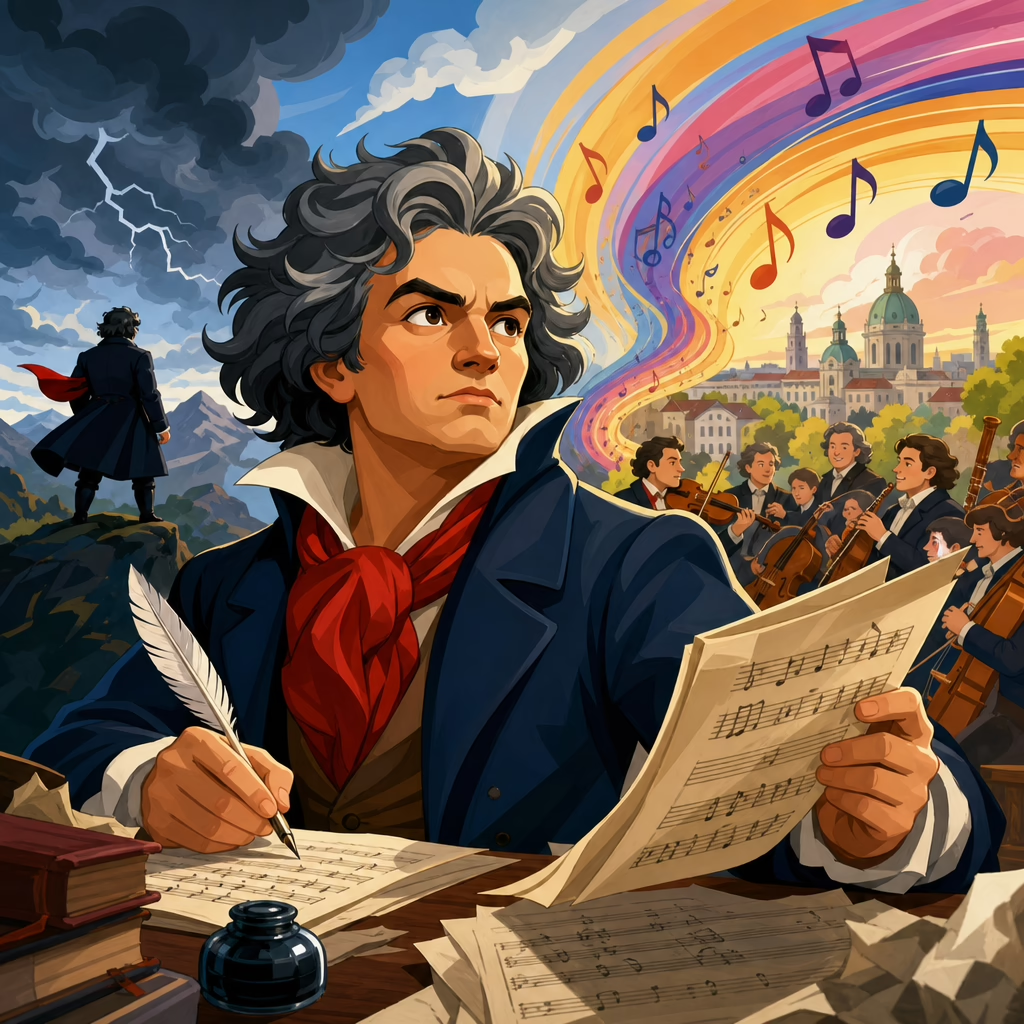
Beethoven and the Transformation of the Heroic Style
Beethoven and the transformation of the heroic style marks one of the decisive turning points in Western music, because it changed heroism from a decorative topic into a structural force. In eighteenth-century practice, “heroic style” usually meant a recognizable musical rhetoric: bright major keys, fanfare-like figures, martial rhythms, public grandeur, and an elevated emotional tone associated with triumph, nobility, and civic ceremony. Beethoven inherited that vocabulary from Haydn, Mozart, French Revolutionary music, and the broader theatrical culture of his time, but he did not simply intensify it. He rebuilt it from the inside, making struggle, resistance, expansion, and hard-won resolution shape the entire design of a movement or work. That shift matters because it altered not only how composers represented greatness, but how listeners understood narrative, character, and conflict in instrumental music.
When I study Beethoven’s middle-period scores with performers, the same pattern appears again and again: passages that seem merely loud or energetic on first hearing are actually carefully engineered dramatic events. The heroic in Beethoven is not reducible to brass-like gestures or vigorous themes. It arises from pressure on form, from abrupt harmonic detours, from rhythmic insistence, from strategic silences, and from coda expansions that feel like a second development. In practical terms, Beethoven transformed the heroic style by fusing rhetoric with architecture. A heroic opening no longer served as a splendid facade; it became the seed of a process that tested itself, fractured, recovered, and claimed victory only after genuine instability.
This focused question sits at the center of Beethoven’s broader innovations, especially in the symphony, but the issue here is narrower and more revealing: how did Beethoven turn inherited signs of grandeur into a new model of musical agency? The answer lies most clearly in works such as the Third Symphony, the Fifth Symphony, the “Waldstein” Sonata, the “Appassionata,” the “Razumovsky” Quartets, and the “Egmont” music. Across these pieces, Beethoven enlarged scale, intensified motivic work, dramatized tonal conflict, and gave codas unprecedented narrative weight. The result was a heroic style no longer based on static splendor, but on becoming. That transformation influenced Berlioz, Brahms, Wagner, and Mahler, and it still shapes how orchestras, scholars, and audiences hear the sound of struggle turned into form.
What the heroic style meant before Beethoven
Before Beethoven, the heroic style was already legible to eighteenth-century listeners. Composers used trumpets, drums, dotted rhythms, unison proclamations, and broad triadic themes to evoke military command, royal ceremony, or public celebration. In opera seria and festive symphonies, that language signaled rank and dignity quickly. French overtures offered one model, with imposing dotted rhythms and ceremonial breadth. Mannheim orchestral writing contributed another, emphasizing brilliance, dynamic surge, and collective force. Haydn and Mozart could write magnificently in this manner, but in many cases the affect functioned as one topic among others within a balanced classical discourse.
The crucial limitation of this earlier heroic mode is that it often remained external. A movement could sound noble without placing its themes under extraordinary stress. Tension and contrast certainly existed in Haydn and Mozart, sometimes at profound levels, yet heroic signifiers did not usually reorganize the grammar of sonata form itself. The listener heard grandeur, but not necessarily a sustained drama of becoming heroic. Beethoven recognized that instrumental music could imply action without text if musical materials behaved as if they possessed will. That insight moved heroism from costume to character.
The Eroica as the decisive breakthrough
The Third Symphony, completed in 1804 and later called the “Eroica,” is the clearest case of Beethoven’s transformation of the heroic style. The opening two E-flat major chords do more than announce a key. They establish a world of blunt, public assertion, then immediately release a main theme whose syncopations and unstable phrasing prevent easy ceremonial confidence. Even at the start, heroism is active, not posed. What follows is unprecedented not just in scale, but in behavior. The development section pushes motivic fragments through remote keys, cumulative dissonance, and relentless contrapuntal pressure. The famous horn entrance before the recapitulation is not a decorative surprise; it heightens the sense that formal boundaries themselves are under strain.
Equally important is the funeral march second movement. Beethoven places grief at the center of heroic discourse, making loss inseparable from greatness. Earlier public styles often celebrated victory directly. Here the heroic contains mourning, collective memory, and tragic cost. The scherzo then reanimates energy, while the finale uses variation procedures to demonstrate resilience through reinvention. In rehearsal, conductors often discover that the symphony fails if treated as mere monumentality. Its force depends on volatility, dangerous transitions, and the feeling that each regained stability has been earned. For a broader view of how this work fits Beethoven’s larger redesign of symphonic thought, see this guide to how Beethoven reinvented the symphony.
| Work | Heroic Feature | Why It Matters |
|---|---|---|
| Symphony No. 3 “Eroica” | Expanded development and monumental coda | Heroism becomes a long-form process of conflict and recovery |
| Symphony No. 5 | Motivic compression from the four-note cell | Determination is heard as relentless continuity across movements |
| Piano Sonata Op. 53 “Waldstein” | Propulsive rhythm and radiant harmonic destination | Heroic drive is translated into keyboard texture and space |
| Piano Sonata Op. 57 “Appassionata” | Extreme dynamic and registral conflict | Heroism becomes perilous, unstable, and darkened from within |
| Egmont, Op. 84 | Political struggle resolved in victory symphony | Instrumental rhetoric embodies resistance and moral triumph |
From grand gestures to motivic struggle
One of Beethoven’s most radical changes was to base heroic character on motivic discipline rather than surface splendor alone. In the Fifth Symphony, the famous short-short-short-long figure is not just a memorable opening motto. It infiltrates accompaniment, transition, sequence, development, and even large-scale continuity between movements. This creates a sense of implacable drive. The heroic is heard not because trumpets sound brilliant, though they do, but because the music refuses passivity. A tiny cell behaves like concentrated will.
That principle appears across genres. In the “Waldstein” Sonata, repeated chords, directional scales, and rhythmic propulsion generate a heroic kinetic field at the keyboard. The pianist cannot merely produce volume; the line must sound as if pushing against the instrument’s physical limits. In the “Appassionata,” motivic concentration produces a harsher result. Here Beethoven shows that heroic style is not always victorious or extroverted. It can be fierce, destabilized, and nearly catastrophic. This nuance matters. Beethoven did not invent a one-dimensional language of triumph. He created a spectrum in which heroism includes endurance under pressure.
How Beethoven reshaped form to carry heroic meaning
Beethoven’s transformation of the heroic style depended on formal innovation. Sonata form in his hands became less a balanced plan of exposition, development, and recapitulation than a theater of consequence. He expanded development sections, delayed expected returns, intensified transitions, and used codas as climactic arguments rather than polite endings. Analysts from A. B. Marx onward recognized that Beethoven’s forms feel goal-directed because return itself is dramatized. The heroic subject does not simply come back; it fights its way back.
A clear example is the first movement of the “Eroica,” where the coda is so extensive and charged that it functions almost like an additional developmental arena. Another appears in the Fifth Symphony, where the transition from the scherzo to the finale creates suspense on a scale rare in earlier symphonic writing. The long crescendo, the whispered timpani pulse, and the eventual C-major blaze turn formal linkage into narrative transformation. In chamber music, the “Razumovsky” Quartets apply similar logic. Themes are not displayed and varied decoratively; they are subjected to labor. I have found that students understand Beethoven’s heroism best when they trace not melody alone, but where a motif reappears under altered harmonic pressure. Form is the biography of the idea.
Harmony, rhythm, and orchestral force
The heroic style in Beethoven is also inseparable from harmonic risk and rhythmic insistence. Eighteenth-century heroic topics often relied on stable tonic affirmation, but Beethoven repeatedly stages instability at the heart of grandeur. In the “Eroica,” shocking dissonances and abrupt turns disturb any simple reading of E-flat major as secure imperial space. In the Fifth, the journey from C minor to C major has often been described as darkness to light, but that shorthand is only partly correct. The achievement lies in how persistently Beethoven withholds uncomplicated release, making eventual radiance feel transformed rather than merely brighter.
Rhythm is equally central. Sforzandi, syncopations, off-beat accents, obsessive repetitions, and long-range metric tension make Beethoven’s heroic music feel muscular. Performers know that if these accents are softened into generic energy, the style collapses. Beethoven’s orchestration supports that rhythmic purpose. Horns often function as agents of distance and command; trumpets and timpani can crown decisive moments; lower strings create thrust through repeated patterns; winds increasingly participate in thematic argument rather than simple color. In “Egmont,” the closing Victory Symphony demonstrates this vividly: orchestral brilliance matters, but its effect depends on the work’s preceding struggle and liberation.
The moral and political dimensions of Beethoven’s heroism
Beethoven’s heroic style cannot be separated from the political and ethical climate of the early nineteenth century. The French Revolution, Napoleonic upheaval, ideas of civic virtue, and the emerging ideal of the autonomous individual all shaped the expressive field in which he worked. Yet Beethoven’s response was never straightforward propaganda. The often-retold story of his withdrawing the original dedication of the Third Symphony to Napoleon after the latter crowned himself emperor is important not because it proves a simple political message, but because it reveals Beethoven’s investment in moral heroism over mere power.
That distinction explains why struggle is indispensable in these works. Heroism in Beethoven is validated not by status, but by trial, persistence, sacrifice, and transformation. The “Egmont” music, based on Goethe’s drama, makes this explicit: oppression, resistance, death, and ultimate victory form a sequence in which liberation is purchased at a cost. The funeral march of the “Eroica” and the defiant trajectory of the Fifth similarly suggest that greatness requires confrontation with mortality and defeat. Later composers inherited this moralized model of the heroic. They could reject Beethoven’s style, but they could not ignore his redefinition of musical grandeur as ethical drama embodied in sound.
Why the heroic transformation still matters
Beethoven transformed the heroic style by making musical struggle generate form, meaning, and memory. Instead of relying on inherited signs of nobility, he built works in which themes act, resist, break apart, and return changed. The “Eroica” established the model, the Fifth compressed it with unmatched intensity, and works from the “Waldstein” to “Egmont” proved that the approach could animate piano, chamber, and orchestral music alike. Harmony became riskier, rhythm more forceful, codas more consequential, and victory more difficult to earn. That is why Beethoven’s heroism still sounds modern: it is dynamic, not static.
For listeners, the benefit of hearing Beethoven this way is clarity. The music stops seeming merely monumental and starts revealing its inner logic. Every sforzando, derailment, and hard-won cadence participates in a larger argument about agency under pressure. For performers and students, that insight changes practical decisions about tempo, articulation, balance, and pacing. If you want to understand Beethoven’s innovation at its most concentrated, return to the “Eroica” and Fifth with this question in mind: how does the music make heroism happen rather than simply display it? Follow that thread, and Beethoven’s transformation of the heroic style becomes unmistakable.
Frequently Asked Questions
What does “heroic style” mean in music, and how was it understood before Beethoven?
In eighteenth-century music, the “heroic style” referred to a recognizable set of musical signals associated with nobility, triumph, ceremony, and public grandeur. Composers often used bright major keys, bold fanfare-like motives, strong rhythmic profiles, march patterns, and an elevated emotional tone to evoke ideas of courage, dignity, or civic celebration. In that earlier context, heroism was usually treated as a topic or rhetorical surface. It was something listeners could identify quickly because it sounded public, festive, and authoritative, much like the musical equivalent of a triumphal procession or formal state occasion.
Before Beethoven, this style was already highly effective in the hands of composers such as Haydn and Mozart, who could deploy it with elegance, wit, and power. But in many cases, it remained one expressive option among many rather than the organizing principle of an entire work. Heroic gestures might appear at moments of climax, in ceremonial overtures, in finales, or in passages meant to suggest military brilliance or social prestige. The rhetoric was clear, but it did not always determine the deep structure or dramatic logic of the composition.
That distinction is essential. Earlier heroic music often announced itself through recognizable gestures, whereas Beethoven increasingly made heroism into a dynamic process. Instead of merely presenting a grand musical topic, he used conflict, striving, resistance, expansion, and transformation to shape entire movements and large-scale forms. In other words, he inherited the sound of heroism from the eighteenth century, but he radically changed what that sound could do inside a composition.
How did Beethoven transform the heroic style into a structural force?
Beethoven’s great innovation was to move heroism from the level of musical decoration to the level of musical architecture. Rather than using fanfares, march rhythms, and brilliant major-key sonorities simply as outward signs of grandeur, he built entire works around dramatic struggle and resolution. Themes in Beethoven often seem to strive, collide, fragment, and re-form. Harmonic progressions push forward with unusual intensity. Development sections become arenas of conflict rather than just places for technical elaboration. As a result, heroic style becomes something enacted over time, not just something displayed at the surface.
This structural transformation can be heard in the way Beethoven handles form. Sonata form, for example, becomes far more than a balanced Classical layout of exposition, development, and recapitulation. In his hands, it becomes a dramatic field in which opposing materials can confront one another and where return is earned through struggle. The feeling of heroism comes not merely from a triumphant theme but from the hard-won process by which the music overcomes instability, tension, or crisis. That is why Beethoven’s heroic works often feel larger than their immediate musical materials. The rhetoric is magnified by the experience of conflict and transformation.
He also expanded scale in a way that supported this new conception. Movements became longer, transitions more consequential, codas more decisive, and motivic cells more generative. A small musical idea could drive an entire movement through relentless working-out, giving the impression of focused will and sustained purpose. This is one reason Beethoven’s heroic style feels so different from eighteenth-century ceremonial brilliance. The listener is not just hearing symbols of greatness; the listener is hearing a drama of becoming.
Why is Beethoven’s “Eroica” Symphony so important to the history of heroic style?
The Symphony No. 3 in E-flat major, commonly known as the “Eroica,” is often treated as the central monument of Beethoven’s heroic style because it demonstrates on a massive scale how heroism can shape every level of a composition. Even from its opening, the work signals a new world. The music is bold, expansive, and unusually assertive, but what makes it revolutionary is not simply its power. It is the way that power is organized across a vast symphonic argument. Themes are not merely presented; they are tested. Tonal stability is not assumed; it is fought for. Momentum is not decorative; it is the engine of the entire work.
The first movement is especially significant because it reimagines symphonic form as a dramatic journey of struggle, disruption, and reconstitution. The development section is unusually intense and exploratory, and the coda functions not as a polite closing gesture but as a further stage of resolution and affirmation. This alone marked a decisive break with established expectations. Beethoven was showing that a symphony could embody an almost epic narrative of conflict and emergence without relying on a literal story.
The other movements deepen that achievement. The Funeral March introduces grief, loss, and public mourning into the heroic sphere, suggesting that heroism includes sacrifice and tragedy, not just triumph. The scherzo restores energy through speed, tension, and release, while the finale transforms variation form into a culminating statement of creative and structural mastery. Taken together, the symphony expands the meaning of heroism into something morally and psychologically complex. That is why the “Eroica” remains so important: it does not simply sound heroic, it redefines what heroic music can be.
How does Beethoven’s heroic style differ from the styles of Haydn and Mozart?
Beethoven’s music grows directly out of Haydn and Mozart, so the difference is not a rejection of Classical style but an intensification and transformation of it. Haydn and Mozart already possessed a sophisticated command of drama, contrast, wit, and expressive depth. They could write music of grandeur and force, and both used ceremonial and martial topics with great skill. However, their handling of those materials generally remains within a framework of proportion, elegance, and rhetorical balance that reflects late eighteenth-century norms.
Beethoven takes many of the same formal procedures and expressive topics but pushes them toward greater weight, continuity, and psychological pressure. His openings often feel more declarative, his transitions more charged, his climaxes more prolonged, and his codas more structurally consequential. Where Haydn and Mozart frequently delight in balance, surprise, and clarity, Beethoven often emphasizes persistence, expansion, and struggle. The result is a style that feels more process-driven. Musical ideas in Beethoven seem to possess an inner necessity, as though they must be developed until their full dramatic implications have been exhausted.
Another key difference is the role of conflict. In Haydn and Mozart, conflict can certainly be vivid, but Beethoven tends to turn it into the central organizing principle. Dissonance, rhythmic drive, abrupt dynamic contrasts, and motivic insistence become means of generating a heroic trajectory. This gives his music a sense of urgency that listeners often describe as revolutionary. He does not merely inherit the Classical heroic vocabulary; he retools it so that form itself becomes a record of resistance, perseverance, and transformation.
Why does Beethoven’s transformation of the heroic style still matter today?
Beethoven’s transformation of the heroic style still matters because it changed how composers, performers, and listeners understood the expressive power of instrumental music. After Beethoven, music could be heard not just as elegant design or pleasing rhetoric, but as a medium capable of embodying struggle, aspiration, moral seriousness, and historical weight. His heroic works helped establish the idea that a symphony or sonata could feel like a profound human statement even without words. That concept became foundational for the nineteenth century and remains influential in concert life today.
His impact can be traced through later composers who treated musical form as a site of drama and transformation, from Berlioz and Brahms to Wagner, Bruckner, and beyond. Even when later musicians reacted against Beethoven, they did so in relation to a standard he helped create: the expectation that large-scale instrumental works might carry emotional, philosophical, or even cultural significance. In that sense, Beethoven did not simply contribute memorable heroic music; he altered the horizon of what serious music could mean.
For modern listeners, this transformation also matters because it helps explain why Beethoven’s music continues to feel urgent and compelling. The heroic element is not limited to loudness or grandeur. It lies in the sense of motion through difficulty, in the shaping of tension into purpose, and in the conviction that form itself can express human striving. That is why Beethoven remains central to discussions of musical modernity. He turned heroism into a living process, and that process still speaks powerfully across time.