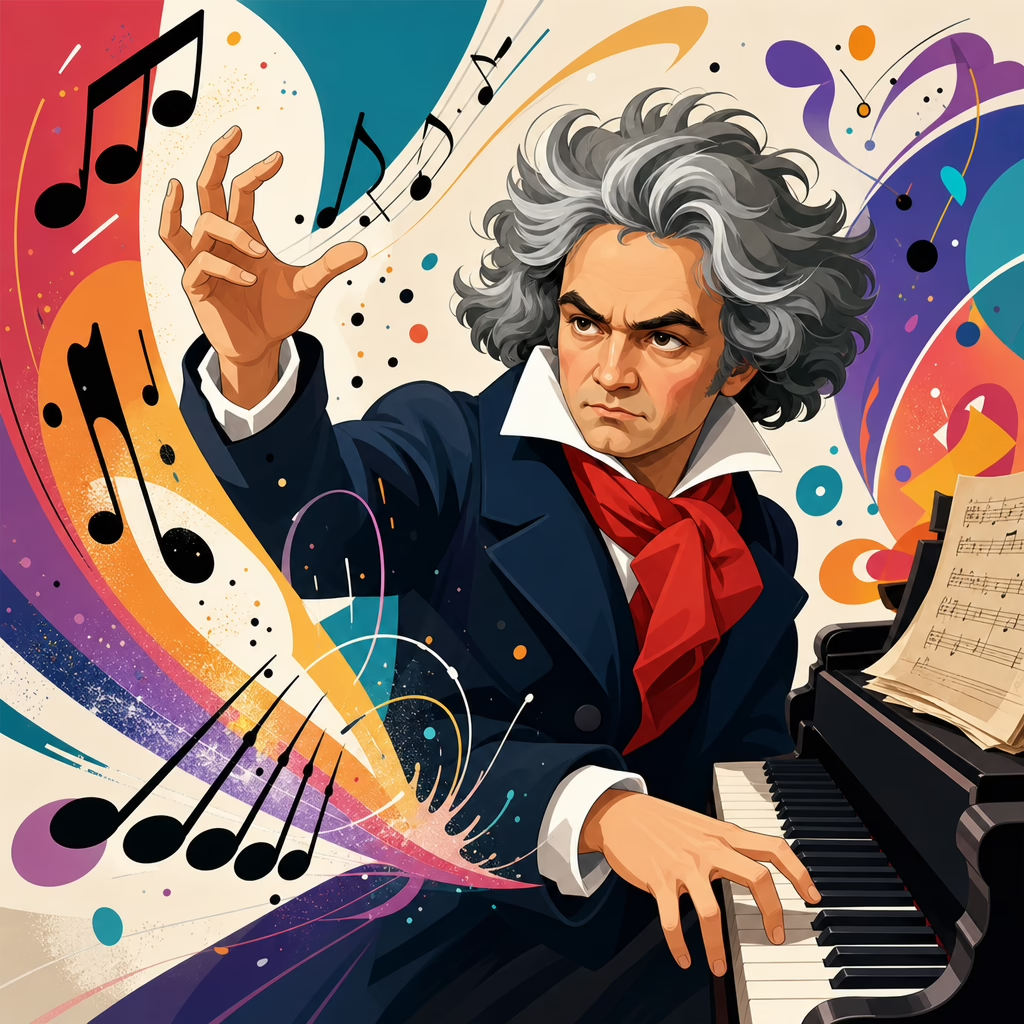
Beethoven’s Radical Treatment of Opening Gestures
Opening gestures in Beethoven are rarely mere beginnings; they are acts of definition, confrontation, and propulsion that shape the listener’s understanding of everything that follows. In classical instrumental music, an opening gesture means the first audible idea that establishes pulse, character, register, harmonic tension, and rhetorical stance. Haydn and Mozart already knew how much could be implied by a single chord, a unison, or a melodic turn, yet Beethoven treated the opening with unusual dramatic pressure. He used it not simply to start a piece, but to compress conflict into the first seconds, to make syntax feel unstable, and to force the ear into a heightened state of attention. That radical treatment matters because it helps explain why Beethoven’s music can feel instantly recognizable even before a theme fully unfolds. In my own listening and score study, the shock is consistent: the opening often behaves like an argument already underway. Instead of easing the audience into a tonal environment, Beethoven frequently begins with an interruption, a command, a puzzle, or a fragment pregnant with consequences. His first bars are not decorative portals. They are structural seeds.
To understand why this is innovative, it helps to define the norm he inherited. Late eighteenth-century openings often clarified meter, key, and phrase balance with admirable economy. A listener could quickly grasp where “home” was, how the phrase might answer itself, and what level of decorum the movement would maintain. Beethoven did not abandon those conventions entirely; he manipulated them. He intensified sforzando accents, widened registral spans, delayed confirmation of key, converted accompanimental figures into primary material, and transformed tiny rhythmic cells into governing agents. This is why an opening in Beethoven is best heard as a compositional engine rather than a prefatory surface. The first sonority can establish a problem that the whole movement must solve. The first rhythm can become a fate-like recurrence. The first silence can be as important as the first note. By radicalizing beginnings in this way, Beethoven changed expectations for sonata form, symphonic rhetoric, and listener psychology. The opening gesture became a place where structure, narrative, and identity converge with unprecedented force.
From Announcement to Argument
One of Beethoven’s boldest moves was to turn the opening from an announcement into an argument. In many predecessors, the first phrase presents itself with social clarity: the music enters, introduces its tone, and invites continuation. Beethoven often sounds as though continuation has been made urgent from the start. Consider the “Eroica” Symphony, whose opening consists of two blunt E-flat major chords followed immediately by a cello theme that seems already in motion. Those two chords are not a courtly curtain-raiser. They function like pillars driven into the ground, establishing force before melody. Then the theme enters not with polished symmetry but with kinetic pressure, and the notorious C-sharp soon destabilizes the tonal surface. In performance, that single pitch changes the room. The opening tells us that heroism in this work will not be a settled style but a field of struggle.
A similar effect appears in the Piano Sonata in C minor, Op. 13, the “Pathétique.” The Grave introduction begins with a sharply profiled chordal figure punctuated by silence. Beethoven weaponizes pause itself. The rests do not relax tension; they magnify it, forcing the ear to dwell on harmonic weight and rhetorical menace. Then the Allegro di molto e con brio does not erase that darkness but converts it into motion. This is a recurring Beethovenian strategy: the opening gesture is not local color. It installs a dramatic premise that remains active after the surface changes. In practical terms, performers cannot treat these bars as atmospheric decoration. Their articulation, timing, and dynamic scale determine whether the movement’s architecture makes sense.
The Fifth Symphony offers perhaps the most famous example of opening as argument. The four-note motto is often described in poetic terms, but analytically its power lies in compression. Rhythm, contour, and insistence fuse into a cell capable of saturation across the movement. Beethoven does not provide a spacious introductory frame; he attacks with material so concentrated that the distinction between opening and thematic core nearly disappears. The result is radical because it minimizes the distance between first gesture and long-range structure. The beginning is already the method.
Ambiguity, Shock, and Tonal Instability
Beethoven’s openings are also radical because they often resist immediate tonal or formal comfort. This does not mean they are chaotic. On the contrary, their ambiguity is meticulously controlled. The first movement of the String Quartet in C-sharp minor, Op. 131 begins with a fugue whose very choice as an opening is startling in a late quartet of such inward intensity. Instead of launching with a clear sonata-type declaration, Beethoven begins with counterpoint that feels suspended between old style discipline and intensely personal expression. The opening gesture here is less a blow than an absorption into a preexisting interior world. It is radical precisely because it rejects public ceremonial logic.
For a more overtly destabilizing opening, the Piano Sonata in E-flat major, Op. 31 No. 3 provides another lesson. Beethoven opens with apparent good humor, yet the phrase design and harmonic timing undercut easy certainty. He loved to let a beginning seem straightforward while embedding asymmetry inside it. The surprise can be harmonic, rhythmic, or textural. In the First Symphony, the very first sonority is a dissonant dominant seventh pointing away from the home key of C major. Contemporary listeners heard that immediately. Beethoven begins a symphony by refusing to let tonic speak first. This is not a trivial prank. It announces that tonal arrival will be earned, not granted.
That kind of opening instability would become central to nineteenth-century symphonic thought. Beethoven showed that listeners could be hooked not only by memorable themes but by unresolved premises. He trusted the audience to feel suspense at the level of harmony itself. For composers after him, from Schubert to Brahms, the opening became a site where tonal identity could be staged as a process. Beethoven made that process unavoidable.
Rhythmic Cells as Structural Destiny
Another aspect of Beethoven’s innovation is the way opening rhythms govern an entire movement. Earlier composers certainly used motivic unity, but Beethoven pushed rhythmic compression to a new level of structural consequence. In the Fifth Symphony, the short-short-short-long cell infiltrates accompaniment, transitions, developmental sequences, and closing material. The opening gesture is not just repeated; it is metabolized. When I teach this movement, the crucial point is that the listener keeps hearing the rhythm even when melody and harmony change. Beethoven creates identity through recurrence under transformation.
The same principle appears in the Piano Sonata in F minor, Op. 57, the “Appassionata.” Its opening does not shout like the Fifth, yet the murmuring low-register arpeggiation and tense dotted rhythm immediately establish a field of latent violence. What seems understated is actually tightly coded. Beethoven plants intervallic and rhythmic implications that later erupt at larger dynamic and formal scales. This is one reason his openings reward repeated hearing: they sound inevitable in retrospect because so much later material is already hiding inside them.
Rhythmic opening gestures in Beethoven often serve three functions at once: they define character, organize memory, and regulate large-form continuity. A concise comparison shows how differently he could deploy this technique across genres.
| Work | Opening gesture | Radical effect | Long-range consequence |
|---|---|---|---|
| Symphony No. 5 in C minor, Op. 67 | Four-note rhythmic motto | Eliminates distance between opening and core theme | Rhythm saturates the movement’s entire syntax |
| Symphony No. 3 in E-flat major, Op. 55 | Two tonic hammer blows plus urgent cello theme | Turns beginning into declaration and destabilization | Heroic rhetoric remains tied to harmonic conflict |
| Piano Sonata No. 8 in C minor, Op. 13 | Grave chords with charged silences | Makes pause a dramatic force | Introduction’s tension governs Allegro character |
| Symphony No. 1 in C major, Op. 21 | Dominant-focused dissonant opening | Withholds tonic at the symphonic threshold | Frames classical decorum as something to question |
Silence, Register, and Physical Impact
Beethoven’s treatment of opening gestures is radical not only in notes and harmony but in physical design. He understood that beginnings are embodied events. Register, spacing, attack, and silence all affect how music lands in the body before the mind names it. In the “Pathétique,” low-register weight and sudden pauses create a kind of architectural mass. In the “Hammerklavier” Sonata, Op. 106, the opening leap and fortissimo B-flat major chords produce a startling breadth, as though the instrument has to expand instantly to meet the idea. Beethoven repeatedly writes openings that feel pianistic or orchestral in a tactile sense, demanding an immediate commitment of energy from performers.
This physicality distinguishes him from composers whose openings prioritize graceful thematic exposition. Beethoven often begins with material that tests the instrument’s resonance or the ensemble’s unanimity. The opening of the Ninth Symphony is a famous case: tremolando strings and open-fifth ambiguity create emergence rather than arrival. The music seems to condense out of mist, but this is not vague impressionism. It is a disciplined control of register and sonority that delays full definition. When the main material finally asserts itself, the listener experiences not just thematic entry but ontological clarification. The world of the movement has come into focus.
Such openings are radical because they exploit the concert space itself. A unison attack, a bare octave, a pregnant rest, or an unresolved tremolo can reorganize the audience’s breathing. Beethoven composes those bodily reactions into form. Modern recordings sometimes flatten this effect, but in live performance the opening gesture can feel almost theatrical without any staging at all.
Why These Beginnings Changed Musical History
Beethoven’s opening gestures altered compositional practice because they redefined what first bars were expected to accomplish. After him, a beginning could be fragmentary yet complete in implication, unstable yet authoritative, terse yet structurally exhaustive. Composers learned that an opening could carry philosophical weight. Brahms’s First Symphony, for example, inherits Beethoven’s idea that the first sounds can establish a historical problem as much as a local theme. Wagner absorbed the lesson that beginnings could suspend resolution and generate large-scale desire. Even Bruckner’s monumental symphonic openings depend on the Beethovenian premise that first sonorities can be world-making.
This influence is easiest to grasp when tracing how Beethoven links openings to developmental logic. In his hands, the beginning is rarely left behind. It is recalled, reinterpreted, fragmented, opposed, or fulfilled. That practice strengthened the organic ideal of form, the notion that a work grows from a generative seed. If you want a broader view of how this method affected the symphony as a whole, see the main guide on how Beethoven reinvented the symphony. Within the narrower question of openings, the key point is simple: Beethoven made the first gesture answerable for the entire movement.
He also changed listening habits. Audiences became trained to attend immediately, to suspect that any accent, rest, or harmonic sidestep at the outset might matter later. That heightened accountability is one reason Beethoven still sounds modern. His openings assume an active listener. They do not flatter passive hearing; they recruit analytical attention through sensation. The first bars are where he teaches you how to listen to the piece.
Beethoven’s radical treatment of opening gestures lies in his ability to make beginnings function simultaneously as drama, structure, and prophecy. He inherited classical clarity but refused to let the first bars remain merely introductory. Instead, he condensed tension into shocks, motives, silences, dissonances, and physical attacks that determine the identity of an entire movement. Whether through the hammer blows of the “Eroica,” the compressed rhythmic destiny of the Fifth Symphony, the charged pauses of the “Pathétique,” or the tonic-deferring wit of the First Symphony, he turned openings into generative acts. They do not simply present music; they create conditions the music must negotiate.
The lasting value of studying these openings is practical as well as historical. For listeners, they reveal how Beethoven communicates at maximum density from the very first instant. For performers, they clarify why articulation, pacing, balance, and silence in the opening bars are never minor details. For composers and analysts, they demonstrate how local material can govern long-range form with extraordinary efficiency. Beethoven’s innovation was not just that he wrote memorable beginnings. It was that he made the beginning the site where meaning becomes unavoidable.
If you return to these works with that idea in mind, the first bars will sound different. Listen for what the opening refuses, what it withholds, what it compresses, and what it silently predicts. Beethoven’s radicalism begins before the theme has fully arrived, and once you hear that, the rest of the movement follows with new inevitability. Start with the “Eroica,” the Fifth, the “Pathétique,” and the First Symphony, and let their opening gestures explain the revolution for themselves.
Frequently Asked Questions
What does “opening gesture” mean in Beethoven’s music, and why is it so important?
In Beethoven’s music, an opening gesture is not simply the first theme or the first few notes of a piece. It is the initial musical event that establishes the work’s world: pulse, energy, register, texture, harmonic pressure, rhetorical tone, and even a sense of conflict or direction. In other words, the opening tells the listener how to hear everything that follows. A single chord, an exposed interval, a burst of rhythm, or a stark unison can function as a declaration of identity. Beethoven understood that listeners orient themselves immediately, so he used the beginning of a work as a place of maximum consequence.
What makes this especially important in Beethoven is that his openings often do more than introduce material. They define the terms of the drama. They can feel like a challenge, a summons, a disruption, or an act of propulsion already underway. Rather than presenting a neutral starting point, Beethoven frequently begins with a musical gesture that seems to demand continuation, clarification, or resistance. That is why his openings are often described as radical: they do not merely begin the piece, they activate it. The listener is drawn at once into a process of becoming, where the implications of those first sounds unfold across the entire movement.
How did Beethoven’s approach to opening gestures differ from Haydn and Mozart?
Haydn and Mozart were already masters of meaningful beginnings. Haydn could turn a simple opening into a witty structural game, and Mozart could establish elegance, tension, or pathos with extraordinary economy. In their hands, the opening often communicated genre, key, mood, and proportion with great clarity. Beethoven inherited that tradition, but he intensified it. He treated openings less as balanced introductions and more as acts of force. His first gestures frequently seem compressed with potential energy, as though they already contain a problem the music must work through.
The difference is not that Beethoven abandoned Classical logic, but that he pushed its expressive and structural possibilities much further. A Beethoven opening may feel more abrupt, more confrontational, more rhythmically insistent, or more harmonically unstable than a typical opening in earlier Classical practice. He often strips away ornament and context so that the first event stands with unusual starkness. This can create a heightened sense of necessity: every note seems consequential from the start. In many works, the opening motive is not just memorable but generative, becoming the seed from which large spans of the movement grow. That ability to make a compact opening gesture shape the entire argument is one of Beethoven’s defining innovations.
Why are Beethoven’s opening gestures often described as confrontational or dramatic?
They are described that way because Beethoven often makes the beginning sound like an intervention rather than an invitation. Instead of easing the listener into a stable musical environment, he may start with a striking rhythmic cell, a forceful dynamic contrast, a bare unison, or a gesture that leaves something unresolved. The result is rhetorical intensity. The opening can feel like a public statement, a challenge issued into silence, or the first move in a struggle. Even when the material itself is brief, it often carries a strong sense of urgency and consequence.
This dramatic quality also comes from how Beethoven uses incompleteness and tension. An opening may seem to promise resolution but delay it; it may suggest a key while destabilizing it; it may create momentum before the listener fully knows where the music is going. That combination of clarity and pressure is central to Beethoven’s style. He gives us something unmistakable, but he also makes it problematic. The listener is not allowed to remain passive. From the first moments, one is compelled to ask: where is this heading, what must be answered, and how will this energy be transformed? That is why Beethoven’s openings so often feel dramatic even before any large formal development has begun.
How do Beethoven’s opening gestures influence the structure of an entire movement?
One of Beethoven’s most remarkable achievements is that his openings often function as structural DNA. The initial rhythm, interval, texture, or harmonic tension does not remain confined to the opening bars; it tends to echo, mutate, and reappear throughout the movement. This means the beginning is not just introductory but generative. A short motive may organize transitions, shape themes, drive development sections, and even affect the nature of the recapitulation and coda. The opening therefore becomes a lens through which the listener understands continuity across the whole form.
This is a crucial reason Beethoven’s treatment of openings feels radical. In some earlier Classical practice, an opening could be memorable without necessarily dominating the entire movement’s logic. Beethoven increasingly compresses so much identity into the first gesture that later events seem to grow out of it organically or contend with it dramatically. The opening may establish a conflict between stability and motion, lyricism and insistence, or assertion and doubt, and the movement can then be heard as the unfolding of that opposition. In this way, the first gesture is not simply the start of the narrative; it is the source of the narrative’s central forces.
What should listeners pay attention to when hearing a Beethoven opening gesture?
A good way to listen is to ask what the first audible idea establishes immediately. Notice the rhythm first: is it steady, disruptive, marching, searching, hesitant, or driving? Then listen to register and texture: does Beethoven begin with a bare line, a thick chord, a unison statement, or a sudden contrast between extremes? Harmonic implication matters as well. Does the opening confirm the key confidently, or does it create uncertainty? Also pay attention to rhetoric, which is especially important in Beethoven. Does the music sound like a proclamation, a question, an interruption, a command, or a release of pent-up energy?
It is also helpful to listen forward from the opening and ask how later material relates back to it. Does a rhythm return in a new context? Does an interval expand into a theme? Does the opening tension remain unresolved for a long time? Beethoven rewards this kind of active listening because his openings are often concentrated statements of the work’s deepest concerns. If you hear the first gesture not as a decorative beginning but as a decisive act of definition, confrontation, and propulsion, the rest of the movement becomes clearer. You begin to understand that in Beethoven, the opening is rarely just where the music starts; it is where the musical argument declares itself.