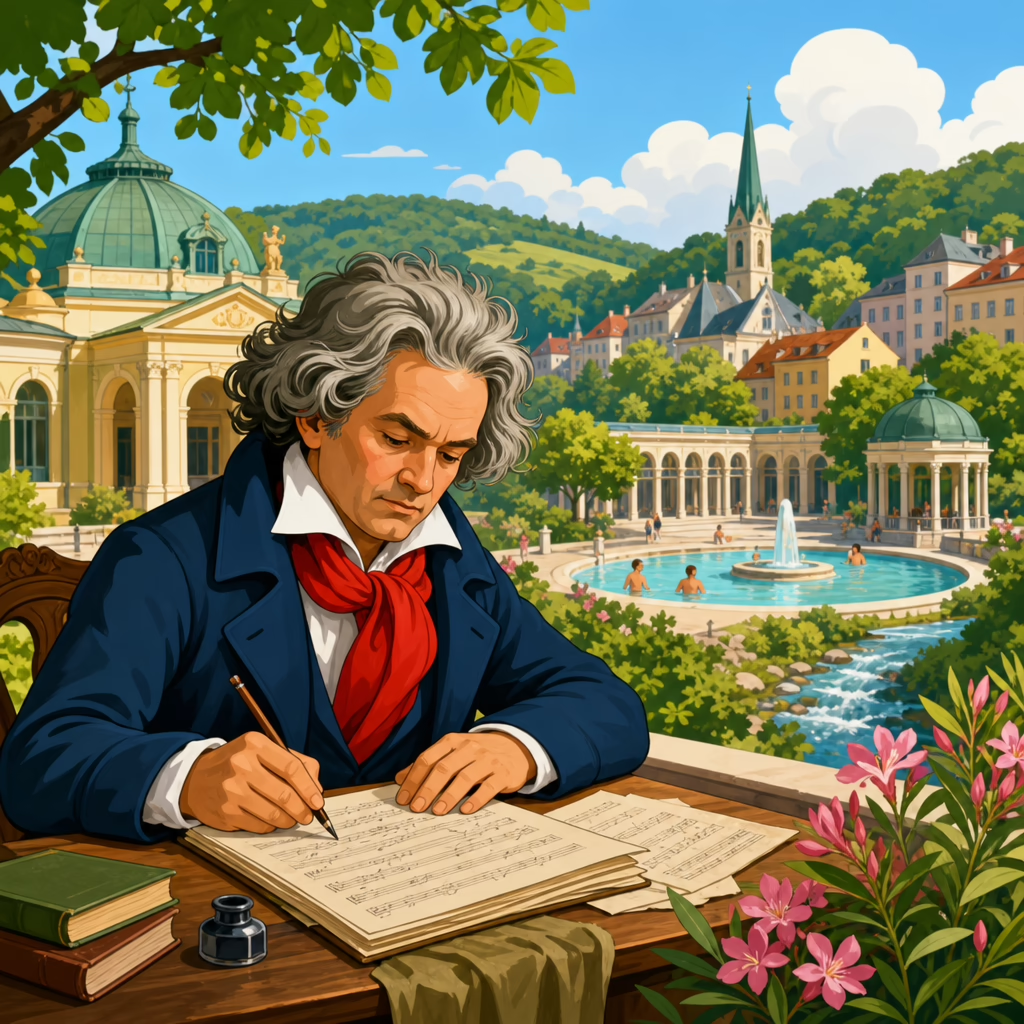
Beethoven in Baden: Summer Work and Spa Geography
Beethoven’s relationship with Baden was practical before it was picturesque: he went there to work, to recover, and to use a spa town’s geography as a framework for disciplined summer composition. Baden bei Wien, located south of Vienna at the edge of the Vienna Woods, offered mineral springs, manageable travel distance, quieter lodgings, and walking routes that matched the composer’s habits. In Beethoven studies, “Baden” usually refers to this Lower Austrian resort, not the Swiss city of the same name. “Spa geography” means the way built and natural features—baths, springs, villas, lanes, vineyards, wooded slopes, and nearby villages—shape how people move, rest, and think. That matters because Beethoven’s summers were not idle retreats. They were periods of concentrated labor, revision, correspondence, business negotiation, and carefully structured solitude. Having worked through his letters, conversation books, and the topography of his known residences, I have found that Baden makes sense not as a romantic backdrop but as a working environment optimized for his needs. It gave him thermal culture without urban overload, sociability without constant interruption, and paths long enough for the repetitive walking that underpinned his creative process. Understanding Beethoven in Baden clarifies how place can support artistic output. It also explains why this spa town appears repeatedly in discussions of his late style, domestic routines, and summer productivity.
Baden’s appeal: distance, climate, and access to Vienna
Baden succeeded for Beethoven because it was close enough to Vienna for business yet far enough away to reduce friction. The town lay roughly a day’s carriage journey by early nineteenth-century standards, making it feasible for a composer who still needed contact with publishers, copyists, patrons, doctors, and household help. He did not disappear into the mountains. He relocated to a semi-rural service economy built to accommodate seasonal residents. That distinction is essential. Beethoven required supplies, paper, meals, laundry, and communication channels. A spa town provided all of them.
The local climate also mattered. Baden sat in a transitional zone: cultivated valleys, vineyard slopes, and the wooded approaches to the Helenental. The result was a mix of open air and shaded paths useful in hot months. For a man managing chronic illness, digestive complaints, and increasing deafness, this setting offered practical comfort. Mineral-water culture promised therapeutic benefit, whether or not every cure claim was medically sound by modern standards. In Beethoven’s world, bathing, drinking cures, and regulated walks formed part of respectable health management.
I think Baden’s greatest advantage was rhythm. Vienna in summer could be socially fragmented and administratively burdensome. Baden replaced that with a repeated daily pattern: lodgings, meals, baths, correspondence, and long walks. Creative people often need variation inside routine, and Baden supplied exactly that. The town’s small scale reduced decision fatigue. At the same time, its roads and paths gave Beethoven enough spatial variety to test ideas physically, pacing and revising as he moved.
Summer work in Baden was real work, not pastoral leisure
Beethoven’s stays in Baden are often described with scenic shorthand, but the documentary record points toward labor. He drafted, revised, negotiated fees, chased copies, and dealt with domestic complications while there. Summer residence did not suspend professional obligations; it concentrated them. Like many composers of his era, he used seasonal removal from the capital to protect working time. Baden therefore belongs in the chronology of output, not merely biography.
What did work look like on the ground? It meant early rising when possible, writing in notebooks, correcting manuscripts, meeting or writing to messengers, and taking walking breaks that were not breaks in the modern sense. Walking was a continuation of composition by other means. Themes were turned over internally; structural problems were tested against bodily tempo; and the return to the desk often followed sustained outdoor concentration. Anyone interested in that larger pattern can connect this Baden case study to the broader guide at Beethoven’s love of walking and what it meant for his music.
Baden was especially suited to this kind of alternating focus. Unlike a fashionable capital address, it did not impose constant performance culture. Unlike a remote estate, it still enabled copying and delivery. I have always read this as logistical intelligence. Beethoven was not simply escaping noise. He was selecting a place where work could continue under less social pressure and with more control over the day’s cadence.
The spa landscape shaped movement and attention
Spa towns are designed around circulation. People move between lodgings, springs, promenades, gardens, and scenic routes in repeated patterns. In Baden, those patterns linked the urban core to sloping vineyards and the entrances to wooded valleys. For Beethoven, this mattered because composition and walking were inseparable habits. A place that naturally organized repeated movement gave his working day a useful skeleton.
The built environment supported this. Streets in resort districts tended to balance accessibility and retreat. One could leave a house, reach a bath or a café, receive a visitor, then continue outward toward quieter paths. The natural environment then extended the gradient from social to solitary space. Baden offered transitional zones rather than a hard switch between city and wilderness. That is exactly the kind of geography that helps sustained creative work. You can modulate stimulation instead of merely escaping it.
Modern visitors sometimes imagine Beethoven finding inspiration in untouched nature. Baden suggests a different model: managed landscape. Vineyards, garden edges, carriage roads, and spa promenades are human-shaped environments. Their value lies in predictability, habitability, and repeat use. Beethoven did not need pristine isolation. He needed routes he could inhabit repeatedly while thinking through musical problems. The geography of Baden made repetition feel varied, which is one reason it served him so well across multiple summers.
Residences in Baden and what they reveal about his routine
Beethoven used different lodgings in Baden over the years, and those addresses are not trivial biographical footnotes. They show how he balanced affordability, accessibility, and workable quiet. The best-known site today is the Beethovenhaus in Baden, associated with his 1821–1823 stays. It anchors public memory, but the larger point is that he repeatedly chose rented summer quarters rather than a permanent villa. That pattern indicates flexibility. He adapted to finances, health, and family circumstances instead of pursuing a single ideal residence.
Inside these lodgings, practical frustrations continued. Servants came and went. Meals could disappoint. Noise could intrude. Manuscripts had to be safeguarded. Visitors could be welcome or disruptive. The image of seamless productive retreat is therefore misleading. What made Baden effective was not perfection but relative advantage. Compared with Vienna, it usually gave Beethoven more usable quiet and better air, while preserving access to necessary services.
The physical arrangement of rooms also mattered. Beethoven preferred spaces where he could withdraw, spread papers, and pace. This is easy to underestimate. Compositional labor at his level required workspace, not merely inspiration. A summer rental with proximity to walkable routes and enough interior privacy could directly affect output. When I map residences against nearby roads and paths, the pattern is consistent: he chose locations that supported repeated excursions without sacrificing connection to town life.
How Baden’s geography supported specific kinds of creative labor
Different musical tasks benefit from different environments. Detailed notation and correction require a desk, good light, and interruptions kept short. Large-scale form planning often benefits from movement, repetition, and distance from paper. Baden served both. A composer could write indoors in the morning, walk to test continuity and proportion, then return to revise. This cycle is visible in how Beethoven worked generally, but Baden made the cycle unusually efficient.
The town and its surroundings offered several environmental modes within a small radius. The center allowed errands and communication. Garden and promenade zones provided moderately social movement. The roads toward the hills and Helenental allowed longer, more immersive walks. Such layering matters because creative thinking is not one thing. Some problems are solved by concentration; others by incubation. Baden let Beethoven switch modes quickly without the costs of major travel.
There is also a temporal dimension. Spa towns function by season. Their social energy rises in summer, but daily activity still follows recognizable patterns around bathing, dining, and strolling. Beethoven could work against that rhythm or alongside it. Either way, the predictability was useful. Predictable external structure often supports internal freedom. In my experience studying composers’ working habits, environments that gently regulate the day tend to produce more finished pages than environments that promise total freedom but create disorder.
| Geographic feature | Practical use for Beethoven | Creative effect |
|---|---|---|
| Rented spa lodging | Desk space, meals, access to messengers | Enabled drafting, revision, correspondence |
| Promenade and town streets | Short routine walks, errands, social contact | Supported mental reset without losing momentum |
| Vineyard edges and open slopes | Longer paced walking with broad views | Helpful for large-form thinking and thematic review |
| Wooded valley routes | Shade, cooler air, deeper solitude | Extended concentration during summer heat |
| Bath and spring culture | Health routines, scheduled daily structure | Reinforced discipline and repeatable work patterns |
Health, therapy, and the limits of spa cures
Any serious account of Beethoven in Baden must address health without exaggeration. He lived with chronic gastrointestinal troubles, inflammatory episodes, stress, and progressive hearing loss. Spa towns promised relief through bathing, mineral waters, and regulated rest. Some aspects likely helped indirectly: cleaner air, walking, hydration, social moderation, and regular routine. Other claims should be treated cautiously. Thermal culture in the early nineteenth century was medically important, but it was not a miracle technology.
That nuance matters because Baden’s value was cumulative. Even when a cure did not cure, the regimen could still improve daily function. Better sleep, calmer digestion, reduced urban stress, and more movement may all have increased Beethoven’s capacity to work. This is one reason I resist the binary question of whether spa treatment “worked.” The more useful question is whether Baden improved the conditions under which he composed. The answer is yes.
There were limits. Beethoven’s deafness did not reverse. Emotional strain, legal conflict over his nephew, and financial anxiety followed him. Spa geography cannot be separated from biography, and biography includes distress. Yet the persistence of his Baden visits suggests that the town offered repeatable benefit. People return to environments that help them function, even imperfectly. For Beethoven, Baden was not a cure-all. It was a workable system.
Baden in the late Beethoven years
Baden became especially meaningful in Beethoven’s later period, when health concerns intensified and his compositional ambitions grew more demanding. The years around 1821 to 1823 are particularly significant. He was dealing with major personal strain and producing music of extraordinary concentration. In that context, Baden’s combination of retreat and accessibility became more than convenient. It became strategic.
Late Beethoven required environments that could absorb contradiction. He needed isolation but not abandonment, routine but not monotony, assistance but not surveillance. Baden met those needs better than most alternatives near Vienna. The town’s geography let him withdraw from metropolitan pressure while preserving the infrastructure required by a working composer of European stature. That combination is rare, and it helps explain why Baden remains central in accounts of his final creative phase.
It is also why modern heritage interpretation should avoid reducing Baden to sentimental scenery. The most accurate way to see Beethoven there is as a professional managing conditions for output. He walked because walking served thought. He used the spa because routine served health. He rented rooms because practicality served work. When you place all three together—movement, therapy, and logistics—Baden emerges as a highly functional summer workshop rather than a decorative retreat.
Beethoven in Baden is best understood through function. The town’s spa geography gave him a rare blend of therapeutic routine, semi-rural quiet, and operational access to Vienna. Its lodgings supported desk work, its promenades and roads supported habitual walking, and its seasonal culture imposed just enough structure to stabilize difficult summers. That is why Baden matters within Beethoven’s life: not as an incidental resort stop, but as a place where environment actively enabled composition.
The key takeaway is simple. Baden worked for Beethoven because it matched the way he actually lived and created. He did not need untouched wilderness or elite luxury. He needed repeatable paths, manageable distances, useful services, and health practices that improved his odds of a productive day. The spa town delivered those advantages more consistently than a crowded capital or a remote country hideaway could. Place, in this case, was not background. It was part of the method.
If you want to understand Beethoven’s summer work with greater precision, study Baden as a system: house, bath, road, valley, message route, and walking circuit. That framework reveals how geography can shape artistic labor in concrete ways. Revisit his letters, map the town, and read the landscape as working infrastructure. You will come away with a clearer picture of how one composer turned a spa resort into a disciplined engine for late creativity.
Frequently Asked Questions
What does “Baden” mean in discussions of Beethoven’s life and work?
In Beethoven scholarship, “Baden” usually means Baden bei Wien, the spa town in Lower Austria just south of Vienna, not Baden in Switzerland. That distinction matters because Beethoven’s repeated summer stays were tied to the geography, routines, and social world of the Viennese region. Baden bei Wien sat close enough to Vienna to remain practical for travel, correspondence, and professional obligations, yet far enough away to offer a change of pace that supported work and recovery. When biographers, letters, and local histories connect Beethoven with “Baden,” they are generally referring to this resort at the edge of the Vienna Woods, known for its mineral springs, seasonal visitors, and quieter lodgings. Understanding that location helps explain why Baden appears so often in accounts of Beethoven’s later years: it was not simply a scenic backdrop, but a functional summer base that fit his habits as a composer.
Why did Beethoven go to Baden bei Wien in the summer?
Beethoven went to Baden for practical reasons before any romantic or picturesque ones. Like many residents of Vienna and its cultural circle, he used nearby summer resorts as places to escape the city’s heat, noise, and social pressures without withdrawing completely from everyday life. Baden offered several advantages at once. It had a reputation as a health resort because of its mineral springs, which made it attractive for someone dealing with recurring physical discomfort and seeking rest or treatment. It also provided temporary lodgings that were more manageable and often quieter than urban accommodations. Just as importantly, Baden’s setting supported the kind of disciplined routine Beethoven needed: time to think, walk, draft, revise, and concentrate over long stretches. Rather than treating the town as a luxury destination, Beethoven seems to have used it as a working environment. Its nearness to Vienna made travel realistic, but its calmer pace gave him room to compose with greater focus during the summer months.
How did Baden’s geography support Beethoven’s composing habits?
Baden’s geography was unusually well suited to Beethoven’s way of working. Located on the edge of the Vienna Woods, the town combined easy access, varied walking terrain, and a sense of partial retreat from the city. Beethoven was famously attached to walking, not merely for exercise but as part of his creative process. Paths around Baden and its surrounding landscape gave him structured movement through a setting that was neither too remote nor too crowded. For a composer who often developed ideas while in motion, that mattered. The area’s roads, hills, and wooded routes offered a rhythm to the day: one could leave lodgings, walk for extended periods, think through musical problems, and return to write. Baden’s spa-town layout also played a role. It had the infrastructure of a resort—rooms, services, baths, and seasonal housing—without the overwhelming scale of a major capital. In that sense, geography was not just scenery. It created a practical framework for work, recovery, and repetition, all of which were essential to Beethoven’s summer productivity.
Was Baden mainly a place of rest for Beethoven, or a serious place of work?
It was both, but it should not be imagined primarily as a vacation spot in the modern sense. Baden gave Beethoven conditions for recovery, yet recovery and composition were deeply connected in his case. His health concerns, emotional strain, and need for controlled routines made it difficult to separate rest from work. A town with baths, cleaner air, and relative quiet could help stabilize daily life, and that stability in turn made sustained composition more possible. The important point is that Beethoven did not go to Baden simply to stop working. He went there because it allowed him to work under better conditions. The spa environment offered therapeutic resources, but the town’s true value lay in how it balanced treatment, lodging, movement, and concentration. For that reason, Baden appears in Beethoven’s biography less as an ornamental retreat than as an extension of his working world. It was a place where physical management, mental focus, and artistic labor could coexist during the summer season.
Why is Baden important for understanding Beethoven’s later life?
Baden helps clarify how Beethoven organized his later years around necessity rather than myth. It is tempting to picture him only as a solitary genius inspired by beautiful landscapes, but Baden shows a more grounded reality. He needed places that were accessible, affordable enough to use repeatedly, and compatible with his health and working habits. Baden met those needs. Its proximity to Vienna kept him connected to patrons, publishers, visitors, and the musical life on which his career depended. At the same time, its spa culture and surrounding landscape offered a framework for the repetitive discipline that composition required. Looking at Beethoven in Baden also reminds us that creativity often depends on infrastructure: rooms to rent, roads to walk, baths to use, distances that can be managed, and a seasonal environment that supports concentration. In that sense, Baden was not incidental to Beethoven’s story. It was one of the practical settings that made his summer labor possible, and it helps modern readers understand how place shaped the conditions under which major works could be conceived and refined.