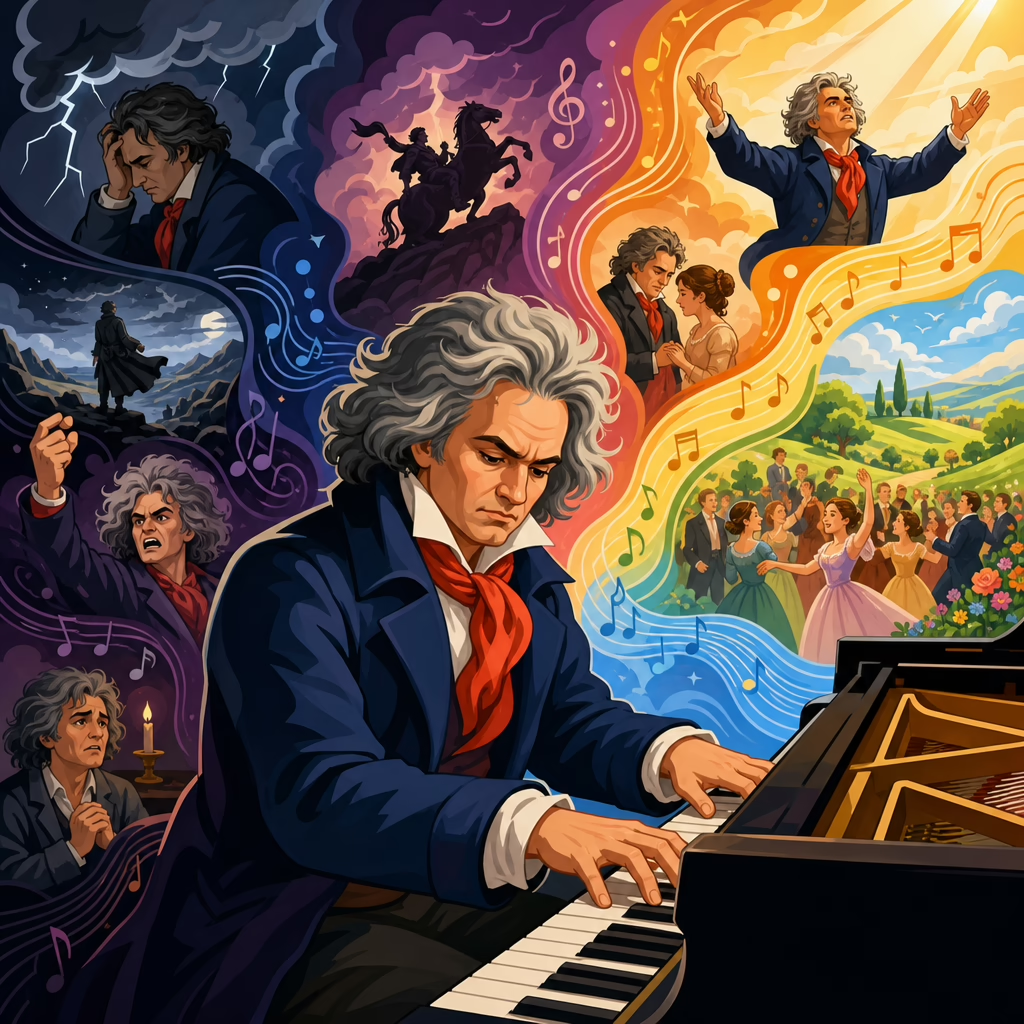
How Beethoven Expanded the Emotional Range of Piano Music
Ludwig van Beethoven transformed piano music by turning the instrument into a stage for psychological drama, private confession, and explosive public rhetoric. Before his mature work, keyboard composers certainly expressed emotion, but the usual range stayed bounded by courtly elegance, symmetrical phrase structure, and relatively stable character types. Beethoven expanded that range in every direction at once: toward intimacy, terror, grief, defiance, transcendence, wit, and hard-won consolation. When musicians ask how Beethoven changed piano writing, the clearest answer is that he made the piano sonata, variation set, bagatelle, and concerto movement carry emotional weight previously associated with opera and symphony while preserving the direct physical contact of a single player at a keyboard.
That achievement matters because the piano became the central domestic and concert instrument of the nineteenth century. The emotional possibilities Beethoven unlocked did not remain isolated in his own scores; they shaped Schubert’s inwardness, Chopin’s narrative rubato, Liszt’s orchestral textures, Brahms’s structural intensity, and even modern expectations that piano music can communicate a full human story without words. In practical terms, Beethoven changed not only what composers wrote but how pianists touch the keys, shape time, pedal harmony, and imagine form. His music asks for a broader spectrum of color and a larger tolerance for contrast than most eighteenth-century keyboard repertory demanded.
Key terms help sharpen the discussion. By emotional range, musicians mean more than mood variety. The phrase includes the depth, speed, and extremity of feeling a work can project; the ability to move convincingly between states; and the capacity to suggest mixed emotions rather than one fixed affection. Piano music here refers chiefly to Beethoven’s solo keyboard works, especially the thirty-two sonatas, the Diabelli Variations, the bagatelles, and selected sets of variations, though his concertos and chamber music inform the same expressive language. Expanded means both intensified and diversified: louder climaxes, softer inward passages, sharper dissonance, longer suspense, more flexible pacing, and more radically contrasted formal plans.
He replaced polite affect with conflict, tension, and resolution
In late eighteenth-century keyboard music, emotion often operated through stable character. A movement might be gracious, playful, melancholy, or brilliant, but it generally maintained a clear social profile. Beethoven disrupted that expectation by building entire movements around struggle. I hear this most immediately in the “Pathétique” Sonata, Op. 13, where the grave introduction is not decorative preface but emotional thesis. Dotted rhythms, thick chords, and dramatic silences establish danger before the allegro even begins. Then the fast movement does not simply continue one mood; it stages resistance. Jagged motives collide with lyric countersubjects, and the recapitulation feels earned because tension has been accumulated, redirected, and only partially resolved.
This approach enlarged emotional range because conflict allows music to travel. Instead of presenting sadness as a static color, Beethoven dramatized instability: hesitation becoming urgency, confidence breaking into anxiety, tenderness interrupted by force. Sonata form became a medium for emotional argument. In Op. 31 No. 2, often called “Tempest,” recitative-like openings suspend time, then rapid figurations release pent-up energy. The movement feels unsettled not because it is uniformly stormy but because it repeatedly asks whether speech, song, or motion can dominate. That uncertainty is emotional content. Beethoven’s listeners were not merely hearing expressive surfaces; they were following a mind under pressure.
The same principle appears in smaller works. Even a compact bagatelle can pivot from humor to poignancy within a few bars. This compression was new in degree. Haydn had wit and surprise, Mozart had pathos and dramatic turn, but Beethoven made abrupt contrast into a core expressive engine. He trusted listeners to perceive emotional contradiction as meaningful rather than improper. That trust opened the door to romantic piano writing, where ambivalence became central rather than exceptional.
He broadened the piano’s dynamic and sonorous world
Beethoven’s emotional expansion depended on sound as much as structure. He wrote for a piano evolving rapidly in his lifetime, with broader compass, stronger frame, improved action, and greater sustaining power than earlier Viennese instruments. He exploited those advances aggressively. Markings such as sforzando, fortissimo, pianissimo, subito piano, and long crescendos are not ornamental details in Beethoven; they are dramatic instructions. In performance, they create a scale of utterance closer to speech and theater than salon entertainment.
Consider the opening of the “Moonlight” Sonata, Op. 27 No. 2. Popular culture often treats it as generalized calm, but the movement’s emotional force depends on controlled sonority. The triplet accompaniment blurs the harmonic field while the melody hovers with restrained grief. Beethoven’s pedaling indication, controversial on modern instruments because of their stronger resonance, suggests he wanted a veiled, almost disembodied sound. The result is not simply soft playing. It is a new kind of inward resonance, one that turns the piano into an acoustic space of memory and unease. At the opposite extreme, the finale unleashes velocity and attack that make the first movement’s suppression feel psychologically consequential.
I have found in teaching that students often underestimate how radical Beethoven’s dynamic writing was. In the “Appassionata” Sonata, Op. 57, soft passages are rarely passive. They often feel compressed, as though energy is being stored under pressure. Then an eruptive fortissimo arrives not as pleasant contrast but as the breaking point of an argument. Registers matter too. Beethoven pushes bass lines downward for menace and isolation, then throws treble figures upward for glare or desperation. These vertical extremes gave the piano a more orchestral emotional vocabulary, preparing the way for later virtuoso and poetic repertory alike.
| Work | Technique | Emotional effect |
|---|---|---|
| Sonata Op. 13 “Pathétique” | Grave chords, silences, sudden dynamic shifts | Threat, declamation, instability |
| Sonata Op. 27 No. 2 “Moonlight” | Blurred pedaling, restrained melody, dark register | Suppressed grief, distance, introspection |
| Sonata Op. 57 “Appassionata” | Compressed pianissimo, explosive fortissimo, tremor figures | Contained fury, panic, catastrophic release |
| Sonata Op. 111 | Harsh diminished harmonies, trills, registral space | Struggle yielding to transcendence |
He made silence, pause, and rhythm emotionally active
One of Beethoven’s least appreciated innovations is his use of time itself as emotional material. Earlier keyboard writing certainly employed rests and syncopation, but Beethoven turned interruption into drama. A pause in his music often feels like an intake of breath, a refusal to answer, or a cliff edge before continuation. In the first movement of Op. 111, silences after violent gestures carry as much expressive weight as the notes. They force the listener to remain inside the shock rather than skimming past it.
Rhythm is equally important. Beethoven’s obsessive motives, repeated notes, syncopations, and displaced accents can generate anxiety more effectively than melody alone. In the “Appassionata,” the persistent rhythmic drive creates something like inevitability. In Op. 81a, “Les Adieux,” rhythmic profile supports narrative feeling: the farewell motive itself, based on the spoken syllables of “Le-be-wohl,” turns rhythm into human utterance. The result is specific emotion rather than generic sadness. Departure, absence, and reunion each receive distinct temporal treatment.
This matters because emotional range is not only about louder climaxes or darker harmonies. It is also about pacing. Beethoven could suspend motion until listeners felt exposed, then restart with transformed meaning. He could push relentlessly forward until the player and audience felt trapped inside momentum. Those temporal strategies taught later composers that piano music could manipulate expectation with near-theatrical precision.
He deepened lyricism without relying on words
Beethoven is sometimes described primarily as a dramatic or heroic composer, but his expansion of emotional range also depended on a new kind of singing line. His slow movements often project inward speech, consolation, prayer, or memory with remarkable specificity. The Adagio cantabile of the “Pathétique” Sonata is a useful example. Its melody is simple enough to remember after one hearing, yet the accompaniment and harmonic shading prevent it from becoming merely pretty. The movement offers tenderness touched by vulnerability, as though warmth exists under the shadow of earlier conflict.
In lessons and rehearsals, I often describe Beethoven’s lyric writing as earned song. Unlike decorative cantabile in some earlier keyboard music, it usually emerges from tension or exists beside it. The Arietta of Op. 111 is among the clearest cases. Its opening theme is almost bare, but each variation enlarges its emotional implications. What begins as simplicity becomes serenity, then rhythmic play, then visionary stillness. Beethoven proves that transcendence on the piano need not come from virtuosic display; it can arise from patient reimagining of a humble idea.
This lyrical depth influenced nearly every major nineteenth-century pianist-composer. Chopin’s nocturnes and Brahms’s late intermezzi differ greatly in surface style, yet both inherit Beethoven’s conviction that keyboard melody can suggest inner speech of great seriousness. He showed that piano music could console without sentimentality and mourn without theatrical excess.
He used harmony to portray ambiguity, pain, and release
Harmony was another essential tool in Beethoven’s emotional expansion. He inherited functional tonal practice, but he stretched its expressive timing and psychological implication. Delayed resolutions, remote key relations, diminished seventh intensification, modal mixture, and stark tonal juxtapositions all become expressive resources in his piano works. He does not abandon tonal clarity; he makes clarity harder won and therefore more moving.
The first movement of the “Moonlight” Sonata demonstrates this perfectly. Its harmony drifts with unusual slowness, creating uncertainty about where emotional ground actually lies. In Op. 110, the descent into the Arioso dolente and fugue combines structural rigor with palpable suffering. The lamenting arioso uses harmonic weight to convey exhaustion, then the fugue does not merely display contrapuntal craft. It becomes recovery enacted through discipline. When the fugue returns inverted after collapse, listeners hear resilience, not abstraction.
For readers exploring Beethoven’s wider innovations across genres, the companion guide how Beethoven reinvented the symphony shows the same habit of using form and harmonic direction to expand emotional stakes on a larger canvas. In the piano music, however, the effect is more intimate because every harmonic disturbance feels physically connected to a player’s hands. You hear thought turning into touch.
Beethoven’s late works especially demonstrate that ambiguity itself can be expressive. Op. 109 and Op. 111 repeatedly blur whether a passage expresses resignation, peace, fragility, or ecstatic release. That complexity is part of the expansion. Real emotion is rarely singular, and Beethoven’s harmonies often allow several states to coexist.
He fused technical challenge with emotional meaning
Beethoven did not treat virtuosity as display detached from content. Passagework, leaps, trills, repeated chords, and thick textures usually serve emotional ends. This fusion matters historically because it changed what pianists were expected to do. Technical difficulty became a means of embodying risk, urgency, or exaltation. In the “Waldstein” Sonata, the rapid repeated-note energy and broad keyboard span create brightness that borders on the overwhelming. In the “Hammerklavier,” Op. 106, colossal architecture and athletic writing generate not just grandeur but a sense of human will confronting its own limits.
As a performer, I find Beethoven most convincing when technical instructions are read as emotional cues. A leap can feel like rupture. A trill can suggest agitation, radiance, or suspension. Thick chordal writing can imply public proclamation, while a bare line can sound exposed. This seems obvious now because Beethoven helped make it normal. Before him, keyboard brilliance often signaled elegance or dexterity; after him, it could signify existential stakes.
That legacy persists in concert life. Audiences still experience Beethoven sonatas as journeys rather than collections of pleasing keyboard effects. His expansion of the emotional range of piano music lies precisely there: he made the instrument capable of representing the unstable, contradictory, and transformative nature of feeling with unprecedented force. Listen closely to the sonatas from Op. 13 to Op. 111, and the pattern is unmistakable. Conflict becomes form, sonority becomes psychology, rhythm becomes breath, harmony becomes uncertainty and renewal, and technique becomes meaning. Beethoven did not simply write expressive piano music. He permanently redefined what expression at the piano could include, from whispered vulnerability to overwhelming struggle to a final, luminous sense of release. If you want to hear the modern piano imagination begin, start with Beethoven and follow the emotions wherever he pushes them.
Frequently Asked Questions
How did Beethoven change the emotional possibilities of piano music?
Beethoven changed piano music by treating the instrument not just as a vehicle for elegance or entertainment, but as a medium for profound human experience. Earlier keyboard music could certainly be expressive, but it often stayed within polished conventions: balanced phrases, clear formal symmetry, and emotional worlds shaped by refinement rather than psychological volatility. Beethoven stretched those conventions until the piano could suggest conflict, longing, rage, tenderness, solitude, triumph, and spiritual struggle within a single work.
One of his greatest innovations was the sense of drama he brought to the keyboard. In Beethoven’s hands, a sonata or set of variations could feel like a lived emotional journey rather than a decorative sequence of pleasing ideas. Sudden dynamic contrasts, violent accents, silences, unexpected harmonic turns, and shifts in texture all helped him create music that sounds inwardly driven, almost like thought unfolding in real time. This gave listeners the impression that the piano was speaking with a new urgency and individuality.
He also expanded emotional range by dignifying extremes. Delicacy became more private and intimate; intensity became more confrontational; grief became weightier and less ceremonial; joy became harder won and more convincing because it often emerged from struggle. That combination of vulnerability and force is central to Beethoven’s achievement. He made piano music feel capable of carrying the full complexity of human feeling, and later composers inherited a keyboard tradition permanently altered by that expansion.
What makes Beethoven’s piano music feel more dramatic than what came before it?
What makes Beethoven’s piano music feel especially dramatic is his ability to turn musical structure itself into a source of tension and release. Rather than presenting themes as elegant objects to be admired, he often treats them as unstable material that can be challenged, fragmented, interrupted, and transformed. A simple motif may begin almost innocently and then be driven through conflict, resistance, and expansion, creating the sense that the music is actively wrestling with its own ideas.
His use of contrast is crucial here. Beethoven often places quiet against thunderous sound, lyricism against rhythmic insistence, stillness against propulsion, and clarity against harmonic uncertainty. These oppositions produce the feeling of argument and drama. Even small gestures can become psychologically charged: a pause can feel like hesitation, a repeated chord like insistence, a sforzando like outrage, and a sudden modulation like emotional disorientation. The result is music that often seems theatrical without needing words.
Another reason his piano writing feels more dramatic is that he enlarges the role of time. He delays resolutions, intensifies anticipation, and allows emotional states to develop through process rather than simply presenting them fully formed. This gives his music narrative force. A Beethoven movement can sound as though it is striving toward something difficult to achieve, whether serenity, victory, acceptance, or release. That sense of striving, so central to his style, is one of the key reasons his piano works marked such a decisive break from older keyboard traditions.
Did Beethoven only make piano music more powerful and heroic, or did he also deepen its intimacy?
Beethoven did far more than make piano music louder, more forceful, or more heroic. He also deepened its capacity for introspection, fragility, and private confession. This is one of the most important aspects of his legacy. Although he is often associated with struggle and monumentality, many of his most revolutionary moments are quiet ones, where the piano seems to think aloud, hesitate, remember, console, or speak in a voice so inward that it feels almost overheard.
His slow movements are especially revealing in this respect. In them, melody can unfold with extraordinary simplicity, yet the emotional atmosphere is often complex: serene on the surface, unsettled underneath; tender but shadowed; consoling yet aware of suffering. Beethoven understood that intimacy in music does not mean sentimentality. Instead, it can mean emotional honesty, a willingness to remain with vulnerability rather than decorating it. He often creates this effect through sparse textures, suspended harmonies, long singing lines, and carefully controlled pacing.
This inwardness helped redefine what audiences could expect from piano music. The instrument became a place not only for public declaration but also for solitude and reflection. Beethoven showed that emotional power is not limited to thunderous climaxes. Sometimes it lies in restraint, in unfinished gestures, in the sensation of someone searching for meaning. By expanding the piano’s intimate voice as fully as its heroic one, he made the instrument capable of representing both the outer drama and inner life of human experience.
How did Beethoven use form and harmony to expand emotional expression at the piano?
Beethoven’s expansion of emotional expression was not just a matter of stronger feeling; it was built into the way he handled musical form and harmony. He inherited Classical structures such as sonata form, variation form, and rondo, but he treated them as flexible frameworks rather than fixed containers. Instead of allowing form to guarantee balance and predictability, he used it to create instability, suspense, rupture, and transformation. This meant that emotion could emerge through the unfolding architecture of a piece, not just through surface melody.
For example, Beethoven often intensifies the development section of a sonata movement so that it becomes a real arena of conflict. Themes are broken apart, tossed between registers, driven through distant keys, or hammered into obsessive repetition. Harmonic movement becomes a psychological tool: remote modulations can evoke estrangement, delayed cadences can create longing or anxiety, and sudden returns to the home key can feel either triumphant or devastating depending on the context. In his hands, harmony stopped being merely a support system and became an emotional engine.
He also manipulated expectations in ways that made listeners feel the stakes of musical events more strongly. Openings might begin ambiguously, recapitulations might arrive with unusual force or understatement, and codas might continue the argument instead of simply ending it. This reshaped the listener’s emotional experience of time. Rather than moving through a stable sequence of formal landmarks, one feels drawn into a process of uncertainty, resistance, and eventual revelation. That is a major reason Beethoven’s piano music still feels so alive: its emotion is inseparable from its formal imagination.
Why is Beethoven’s influence on later piano composers so important?
Beethoven’s influence is so important because he permanently redefined what piano music could mean. After him, the piano was no longer just a refined domestic or courtly instrument associated primarily with charm, taste, and formal clarity. It became a serious vehicle for artistic individuality and emotional depth. Composers who came later inherited not only his technical innovations but also his larger idea that a piano work could embody struggle, memory, irony, spiritual aspiration, and psychological contradiction.
This influence can be felt across the nineteenth century and beyond. Schubert absorbed Beethoven’s expanded sense of emotional scale and depth, even while taking it in more lyrical directions. Chopin inherited the idea that piano music could sustain profound inwardness and subtle emotional gradation. Liszt built on Beethoven’s dramatic and orchestral use of the keyboard. Brahms drew from his structural power and emotional seriousness. Even later composers who reacted against Beethoven were still responding to the world he created, because he had raised the expressive expectations attached to the instrument.
Perhaps most importantly, Beethoven helped establish the modern belief that instrumental music can reveal truths about inner life with extraordinary directness. He demonstrated that the piano could convey not just moods, but evolving states of consciousness: conflict turning into resolve, grief turning into acceptance, agitation dissolving into stillness, or darkness giving way to hard-won consolation. That vision shaped the future of piano literature and remains central to why Beethoven’s keyboard music continues to feel historically decisive and emotionally immediate.