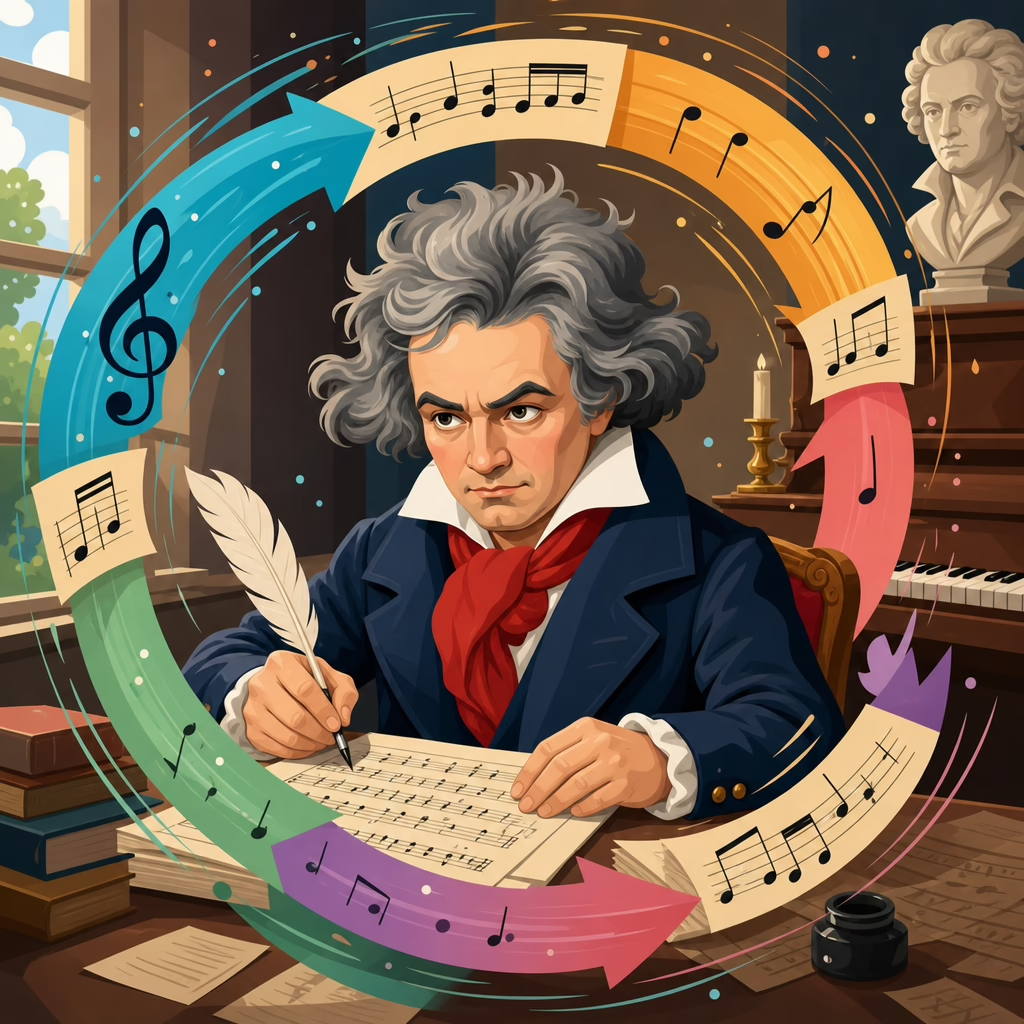
Beethoven’s Experiments with Cyclic Thinking
Beethoven’s experiments with cyclic thinking mark one of the most important shifts in the history of large-scale musical form. In this context, cyclic thinking means designing a work so that motives, themes, tonal plans, or expressive ideas recur across multiple movements, creating unity beyond the boundaries of a single section. Earlier composers sometimes recalled material between movements, but Beethoven treated recurrence as an active structural force rather than a decorative echo. That distinction matters because it changed how listeners hear coherence, drama, and memory in instrumental music. In my own score study and rehearsal work, Beethoven’s cross-movement links consistently prove to be more than clever references: they reshape pacing, expectation, and meaning. Understanding these experiments helps explain why his middle and late works feel so inevitable, even when their forms appear disruptive on the surface. Cyclic design became a path toward organic unity, and Beethoven explored it with unusual boldness.
To grasp Beethoven’s approach, it helps to define the musical materials involved. A motive is a small, recognizable cell, often rhythmic as much as melodic. A theme is a more extended idea. Cyclic thinking can involve literal quotation, transformed return, tonal recollection, shared accompaniment figures, recurring intervals, or a persistent expressive problem resolved only at the end of a work. Beethoven uses all of these. He also exploits what analysts call processive unity: a listener remembers earlier material and interprets later events through it, even when the resemblance is partial. This is why a simple pattern can carry enormous weight. The famous short-short-short-long rhythm is the standard example, but Beethoven’s cyclic imagination is broader than any single motive. Across sonatas, quartets, and symphonies, he tests how far repetition and transformation can bind a whole composition together without collapsing contrast. The result is innovation at the level of listening itself.
What cyclic thinking meant in Beethoven’s hands
Before Beethoven, Haydn and Mozart certainly connected movements through key relationships, thematic affinities, and occasional recall. Yet Beethoven intensified the practice by making intermovement memory central to narrative design. He often composes as though a work poses a question in its opening pages and answers it only at the end. In performance, this creates a palpable long-range tension. The listener may not identify every technical link, but the architecture registers intuitively. Beethoven’s innovation lies in combining local contrast with global unity. A scherzo can feel radically different from a slow movement while still belonging to the same dramatic organism.
This approach is especially striking because Beethoven did not rely on one formula. Sometimes the link is motivic, as in the Fifth Symphony, where rhythmic identity reaches across movements. Sometimes it is tonal and rhetorical, as in the “Pathétique” Sonata, where grave, tragic framing gestures define the whole. Sometimes it involves direct transition, eliminating the pause that would normally separate movements. These methods all serve one purpose: making the listener hear the composition as a single unfolding argument. For a broader view of how this strategy fits his orchestral legacy, see the main guide on how Beethoven reinvented the symphony.
The Fifth Symphony as a laboratory of recurrence
The Symphony No. 5 in C minor, Op. 67, remains the clearest demonstration of Beethoven’s cyclic thinking because its unity is both audible and technically rigorous. The opening four-note cell dominates discussion for good reason. It is not merely a theme; it is a generative rhythmic identity. Variants of its profile animate transitions, subordinate ideas, accompaniment figures, and developmental textures. Crucially, the motive’s force does not end with the first movement. The scherzo introduces a different thematic surface, yet its rhythmic insistence and compressed contour preserve the symphony’s fundamental character. Beethoven teaches the ear to hear family resemblance across contrast.
The transition from the third movement to the finale is where cyclic design becomes theatrical. Beethoven sustains a mysterious bridge over hushed repeated notes and fragmentary recollections, then drives toward the C-major breakthrough of the last movement. This is not a simple mood change. It is the culmination of a multi-movement process in which C minor struggle is transformed rather than abandoned. Many conductors emphasize this by shaping the bridge as psychological suspense, not dead time. The return of scherzo material within the finale confirms the cyclic plan. Beethoven recalls the past inside the new triumph, implying that victory has memory and that resolution must absorb earlier conflict.
| Work | Cyclic device | How Beethoven uses it | Effect on the listener |
|---|---|---|---|
| Symphony No. 5, Op. 67 | Rhythmic motive across movements | Transforms the opening cell into later textures and recalls scherzo material in the finale | Creates a sense of struggle carried through to triumph |
| Piano Sonata Op. 13 | Recurring grave rhetoric | Reintroduces the opening dramatic idea at major structural points | Frames the sonata as one emotional argument |
| Symphony No. 9, Op. 125 | Review and rejection of earlier material | Finale revisits prior movements before presenting a new solution | Makes the whole symphony feel self-aware and cumulative |
| String Quartet Op. 131 | Continuous multi-movement chain | Links seven movements without normal separation and with thematic kinship | Encourages hearing the quartet as one immense arc |
From framing gesture to structural memory in the “Pathétique”
The Piano Sonata No. 8 in C minor, Op. 13, shows Beethoven exploring cyclic thought before the mature symphonic examples. The “Grave” introduction is the key. Introductions were not new, but Beethoven treats this one as a defining rhetorical presence that returns at critical moments in the first movement. Those returns do more than add drama. They establish a memory trace that colors everything around them. The sonata’s identity depends on the listener retaining the weight of that opening gesture. In practice, pianists who underplay the introduction often weaken the entire structure because they reduce the force of later recollection.
There is also a deeper continuity between movements than casual hearing suggests. The Adagio cantabile seems to offer relief, yet its poised lyricism gains meaning against the tension of the outer movements. The finale’s restless drive restores the sonata’s original energy, and Beethoven’s tonal planning keeps C minor as the work’s gravitational center even when temporary warmth intervenes. Analysts differ on how strongly to label the sonata “cyclic” in a strict thematic sense, but the broader point stands: Beethoven is already thinking beyond isolated movement form. He uses recurrence, tonal memory, and rhetorical framing to make the sonata behave like a unified dramatic statement.
The Ninth Symphony and the invention of retrospective form
If the Fifth Symphony demonstrates motivic cyclic thinking, the Ninth demonstrates reflective cyclic thinking. The finale begins with a startling gesture: it seems to review and reject material from earlier movements before introducing the “Ode to Joy” theme. This is one of Beethoven’s most radical formal experiments. Instead of merely recalling earlier ideas, he stages a judgment on them. Cellos and basses answer each instrumental reminiscence with recitative-like interruptions, as if the symphony itself were searching for a satisfactory conclusion. The final theme therefore arrives not as another episode but as a solution to a work-wide problem.
This design changes the listener’s role. We are asked to remember what we have heard, compare possibilities, and recognize the necessity of the new theme. Cyclic thinking here becomes philosophical. The earlier movements are not simply connected; they are incorporated into a narrative of insufficiency and fulfillment. Beethoven then extends this logic by allowing the finale to absorb and transform symphonic, vocal, variation, march, and fugato procedures. The whole work behaves like a single expanding argument. Later composers such as Liszt, Berlioz, Franck, and Mahler would build on this principle, but Beethoven’s Ninth remains singular in the clarity with which memory becomes form.
Late quartets and the most advanced cyclic experiments
Beethoven’s late quartets push cyclic thinking furthest because they blur the line between separate movements and continuous thought. The C-sharp minor Quartet, Op. 131, is the crucial example. Its seven movements proceed without the standard break pattern, compelling the listener to hear continuity even when tempo and character change abruptly. This continuity is not only physical. Beethoven binds the work through tonal logic, intervallic kinship, contrapuntal density, and thematic resonance. The opening fugue establishes an inward, searching world whose gravity affects every later episode, including the dance-like and virtuosic ones. Nothing feels disposable because everything belongs to one psychological landscape.
In rehearsal, Op. 131 reveals how carefully Beethoven controls proportion. Short movements act as hinges rather than independent miniatures. The central variations expand memory by repeatedly reinterpreting a single thematic source. The finale does not erase what came before; it gathers unresolved tensions from the whole chain. This is cyclic thinking at its most mature: not obvious quotation, but an organic network of reminders, correspondences, and delayed consequences. The effect can be disorienting on first hearing because traditional closure points are withheld. Yet that very instability is the point. Beethoven composes continuity as a lived experience, asking listeners to hold a long emotional thread across constant transformation.
How Beethoven’s cyclic methods changed musical innovation
Beethoven’s experiments mattered because they expanded what instrumental form could communicate. Cyclic design let him join coherence and conflict without choosing between them. A work could remain dramatically varied while still feeling like one necessity-driven whole. That model became foundational for the nineteenth century. Berlioz’s idée fixe in the Symphonie fantastique, Franck’s thematic return across movements, Liszt’s transformation technique, and Wagner’s network of recurring motives all owe something to Beethoven’s demonstration that memory can be structural. Even Brahms, often presented as more conservative, relies on long-range recall and motivic saturation in unmistakably Beethovenian ways.
There are, however, important limits and tradeoffs. Cyclic thinking can become mechanical when recurrence is too literal or too frequent. Beethoven avoids this by varying scale, context, and function. A motive may return as background rather than foreground, as rhythm rather than melody, or as tonal implication rather than quotation. He also preserves contrast. The point is not sameness but intelligible transformation. That is why his best cyclic works still surprise us. They feel coherent because the relationships are deep, not because the surface is repetitive. For anyone studying musical innovation closely, Beethoven’s achievement lies in making remembrance audible without sacrificing momentum, mystery, or formal freedom.
The central lesson of Beethoven’s experiments with cyclic thinking is that unity in music does not require uniformity. By carrying motives, tonal tensions, rhetorical gestures, and unresolved expressive questions across movements, he taught listeners to hear an entire work as a connected act of thought. The Fifth Symphony shows recurrence as propulsion, the “Pathétique” reveals framing memory at work, the Ninth turns recall into formal argument, and the late quartets transform continuity into an immersive experience. These are not isolated tricks. They are deliberate strategies for enlarging musical meaning.
For modern listeners, performers, and students, this matters because cyclic design explains why Beethoven’s works feel so compelling over long spans of time. We sense that early events continue to matter, that nothing important is simply left behind, and that endings earn their authority by answering what openings set in motion. That is Beethoven’s real innovation here: he composes memory into structure. If you want to hear his originality more sharply, revisit one of these works and listen specifically for what returns, what changes, and what finally resolves. That single shift in attention opens the architecture from within.
Frequently Asked Questions
What does “cyclic thinking” mean in Beethoven’s music?
In Beethoven’s music, “cyclic thinking” refers to the idea that a large work can be unified by connections that reach across multiple movements rather than remaining confined within each movement on its own. Those connections may involve recurring motives, related themes, shared rhythmic cells, tonal plans, or even a continuous expressive argument that unfolds from beginning to end. The key point is that recurrence is not merely ornamental. Beethoven increasingly uses repetition and transformation across movements as a structural principle, allowing listeners to hear an entire sonata, quartet, or symphony as a single, evolving organism.
This marks an important development in the history of form because earlier composers certainly created coherence, but often did so through balance, proportion, and conventional tonal design within individual movements. Beethoven pushes beyond that model. He explores ways in which an idea introduced early in a work can return later with altered meaning, deeper dramatic weight, or a new formal function. As a result, the identity of one movement can shape the interpretation of another. That is the essence of cyclic thinking in Beethoven: the work remembers itself, and those memories help generate its larger architecture.
How was Beethoven’s approach different from earlier uses of thematic recall between movements?
Earlier composers occasionally linked movements by recalling a theme, reusing a similar gesture, or maintaining a related tonal atmosphere, but these connections were often secondary to the self-contained design of each movement. In many eighteenth-century works, the primary formal logic remains local: each movement presents its own themes, follows its own conventions, and reaches its own cadence with relative independence. Inter-movement resemblance might be pleasing, elegant, or expressive, yet it does not always determine the deeper structure of the whole composition.
Beethoven’s innovation lies in making recurrence an active force in the construction of a work. Instead of treating a return as a decorative nod or a clever reminiscence, he often allows recurring material to reshape the listener’s understanding of what came before. A motive can migrate into a new movement, be transformed rhythmically or harmonically, and acquire a broader dramatic function. Similarly, tonal relationships between movements can feel purposeful rather than merely customary, as if the whole piece is driven by a single long-range plan. This shift is historically significant because it helps redefine the multi-movement work as a unified dramatic and structural journey rather than a sequence of adjacent but largely separate panels.
Why are Beethoven’s experiments with cyclic thinking considered so important in the history of musical form?
They are considered important because they expand the very idea of what a large-scale composition can be. Beethoven demonstrates that unity in music does not need to depend only on symmetry within a movement or on traditional genre conventions. It can also arise through memory, transformation, and long-range relationships that bind the beginning, middle, and end of a work into a single argument. That insight had enormous consequences for the development of the symphony, sonata, and string quartet, since it encouraged composers to think on a broader structural horizon.
Beethoven’s experiments also changed expectations about musical narrative. When ideas recur across movements, listeners do not simply hear repetition; they hear development over time. A motive may return in a more urgent, more lyrical, more triumphant, or more destabilized form, and that return can suggest struggle, resolution, irony, or transcendence. In this way, cyclic thinking supports the heightened sense of continuity and drama often associated with Beethoven’s mature style. Later nineteenth-century composers would build extensively on this model, but Beethoven’s role is pivotal because he treats cross-movement unity as a central compositional problem and a powerful expressive resource.
What kinds of musical elements does Beethoven connect across movements to create cyclic unity?
Beethoven can create cyclic unity through several different means, and one of the reasons his approach is so compelling is that he rarely relies on only one. Motives are especially important: a small rhythmic or melodic cell can recur in altered contexts, giving different movements a shared musical DNA. Themes may also be related more broadly, whether through contour, interval pattern, or expressive character. Sometimes the connection is obvious to the ear; at other times it is subtler, operating beneath the surface but still contributing to the coherence of the whole.
He also uses tonal design as a unifying tool. The key relationships between movements may suggest a long-range trajectory, so that harmonic destinations feel interconnected rather than arbitrary. Beyond that, texture, rhythm, gesture, and expressive atmosphere can all serve cyclic purposes. A sharply profiled accompaniment pattern, a recurring sense of propulsion, or a persistent contrast between tension and release can link movements even when literal thematic repetition is limited. In Beethoven, cyclic thinking is therefore not just about hearing the exact same theme come back. It is about recognizing a network of relationships that gives the entire work internal consistency and cumulative force.
How did Beethoven’s cyclic thinking influence later composers and listeners?
Beethoven’s example strongly influenced the nineteenth century by encouraging composers to imagine large forms as integrated wholes shaped by recurring ideas and long-range dramatic planning. After Beethoven, it became increasingly natural to ask how movements relate to one another in thematic, harmonic, and expressive terms. Composers who sought greater unity in symphonies, sonatas, chamber music, and later programmatic works found in Beethoven a model for turning recurrence into structure. His music helped legitimize the notion that a composition could unfold like a narrative in which earlier events continue to resonate and return with transformed significance.
For listeners, this changed the listening experience itself. A multi-movement work could now be heard not simply as a succession of contrasting sections, but as a single argument in which memory plays a central role. When an idea returns, the listener is invited to compare, interpret, and reassess. That dynamic deepens emotional engagement because recurrence can signal continuity, conflict, healing, culmination, or revelation. Beethoven’s cyclic thinking therefore matters not only as a technical innovation, but also as a way of intensifying how musical form is perceived. It trains audiences to hear relationships across time and to experience structure as something alive, cumulative, and dramatically meaningful.