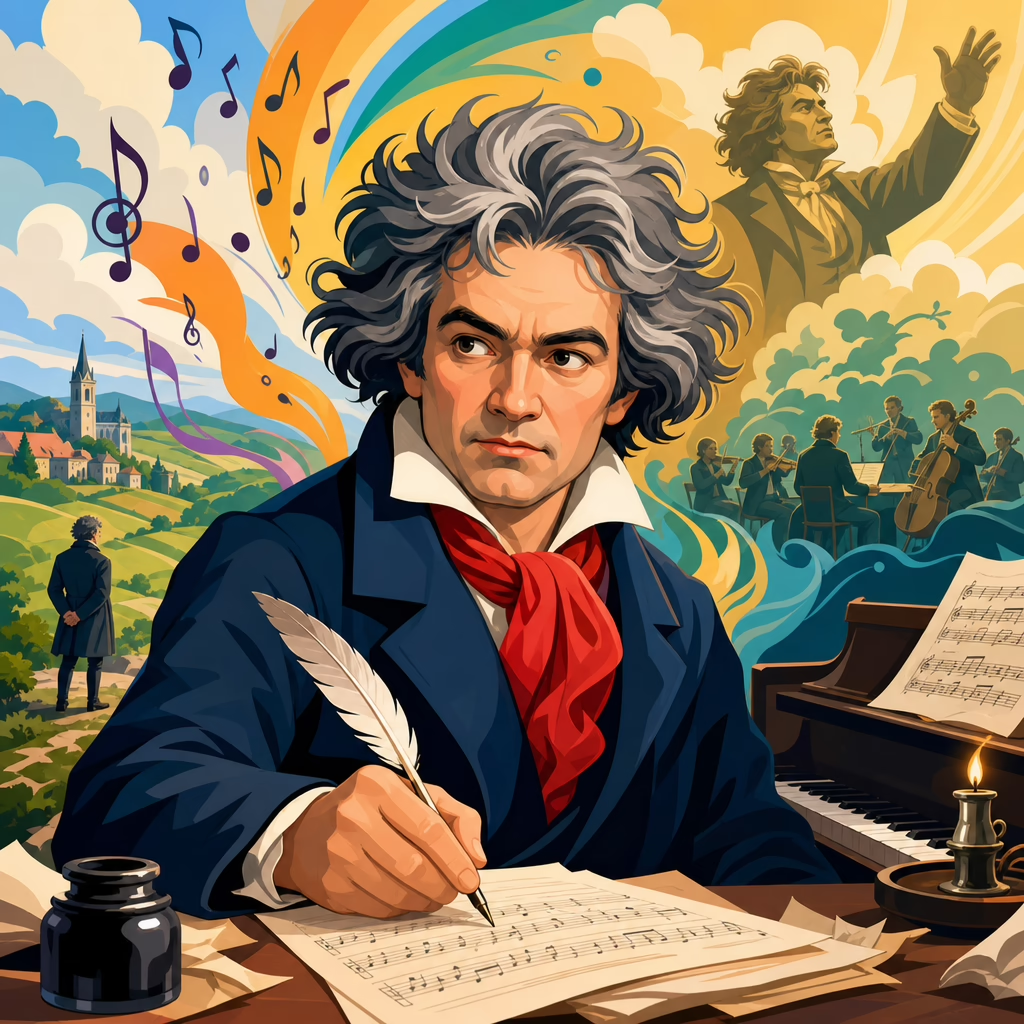
Beethoven and the New Idea of the Original Genius
Beethoven changed the meaning of musical originality by turning the composer from a skilled craftsman into a figure identified with inner necessity, struggle, and singular vision. Before him, European art music certainly valued invention, but originality usually meant mastery within inherited forms, not the public display of a personality that seemed to create its own rules. The phrase “original genius” names this newer ideal: an artist whose authority comes not from obedience to convention alone, but from the power to reshape convention so completely that later generations hear the old forms differently. In Beethoven’s case, this shift was not merely a Romantic myth imposed after the fact. It was built from his working methods, his reception, his self-presentation, and the unprecedented way listeners experienced his music. Understanding Beethoven and the new idea of the original genius matters because it explains why modern culture still treats composers, novelists, and even entrepreneurs as innovators whose value lies in uniqueness rather than polish alone. When I have taught Beethoven’s middle-period works, this is the point students grasp first: they are hearing not just notes, but a new cultural claim about what a creator is.
Originality before Beethoven: invention within rules
To see what changed, it helps to start with the late eighteenth-century musical world Beethoven entered. Haydn and Mozart were astonishingly inventive, yet they worked in a culture that prized decorum, genre expectations, patronage, and rhetorical clarity. A symphony, piano sonata, or string quartet was judged partly by how skillfully it fulfilled recognizable conventions. Originality existed, but it was usually discussed as wit, learned technique, tasteful surprise, or expressive refinement. Even C. P. E. Bach’s highly individual keyboard writing did not create the full modern cult of the autonomous genius. Composers were still often understood as serving church, court, theater, or public entertainment. Their social role mattered as much as their private interiority.
Philosophically, the groundwork for a new concept had already been laid. Edward Young’s eighteenth-century reflections on “original composition” and Immanuel Kant’s claim that genius gives the rule to art helped redefine creativity as something irreducible to imitation. In German-speaking lands, the Sturm und Drang movement amplified admiration for force, individuality, and emotional intensity. Yet these ideas remained unevenly distributed until Beethoven embodied them in a way audiences could hear. What made him decisive was not that he invented originality from nothing. It was that his career fused intellectual currents, new public concert culture, expanding music criticism, and radically compelling works into one durable model. After Beethoven, originality was no longer a secondary compliment. It became the central test of artistic greatness.
Beethoven’s self-fashioning and the break from service
Beethoven’s biography reinforced this new image. Born in Bonn in 1770 and settled in Vienna by the early 1790s, he knew perfectly well how patronage worked, but he resisted being defined by it. Unlike many earlier court musicians, he cultivated a degree of independence through publication, subscriptions, public performance, teaching, and support from aristocratic admirers who treated him as an exceptional artist rather than household staff. The famous 1809 annuity agreement with Archduke Rudolph, Prince Kinsky, and Prince Lobkowitz is revealing. They paid him to remain in Vienna without binding him to ordinary service. That arrangement symbolized a changing status: the composer as cultural authority, not merely employee.
His personal manner mattered too. Contemporary reports describe an abrasive, uncompromising figure, difficult in social settings yet commanding unusual respect. Some of that image was romanticized later, but enough evidence survives to show that Beethoven actively projected seriousness and autonomy. He chose ambitious dedications, negotiated with publishers aggressively, and defended artistic decisions with unusual confidence. I have always found the Heiligenstadt Testament central here. Written in 1802 and never sent, it frames deafness not simply as misfortune but as the crucible through which artistic mission becomes absolute. Beethoven presents himself as someone preserved by art for a purpose larger than ordinary life. That text helped later generations read the music as testimony of a singular spirit under pressure, and that reading became essential to the ideal of genius.
How the music itself sounded unprecedented
The strongest case for Beethoven’s originality lies in the scores. He did not discard Classical forms; he intensified them until they seemed to disclose hidden reserves of energy. Sonatas, quartets, concertos, and symphonies became arenas of conflict, expansion, interruption, and transformation. In practical musical terms, Beethoven enlarged codas, destabilized tonal expectations, developed tiny motives obsessively, and treated rhythm as a structural force rather than decoration. A famous example is the opening of the Fifth Symphony. Four notes generate an entire movement and cast a shadow across the whole work. That kind of motivic saturation made listeners feel that the music possessed inevitability, as though every event were compelled by an underlying idea.
The “Eroica” Symphony, first performed in 1805, was even more disruptive. At roughly twice the scale of many earlier symphonies, it stretched what the genre could contain. Its first movement turns a simple triadic idea into a vast argumentative process. The Funeral March imports a level of tragic public gravity unusual for a symphony. The finale transforms variation form into a culminating philosophical statement. For audiences used to elegant proportion, this was not novelty for novelty’s sake. It was a redefinition of symphonic ambition. If you want the broader context of how this transformation fits into Beethoven’s larger orchestral achievement, the main guide at how Beethoven reinvented the symphony maps that development clearly.
The workshop of genius: sketches, revision, and labor
One reason Beethoven’s originality became so persuasive is that it was visibly earned. Thousands of pages of sketch material survive, showing that his most “inevitable” ideas were often hammered into being through revision. This matters because the older stereotype of genius suggested effortless inspiration. Beethoven complicated that image. He remained a genius, but one whose authority came from relentless transformation of raw material. In my own work with student composers, Beethoven’s sketchbooks are often the most useful corrective to the myth of instant brilliance. They show false starts, recomposition, rhythmic experiments, and large-scale planning.
Scholars such as Lewis Lockwood and William Kinderman have demonstrated how central this process was to Beethoven’s style. Motives were tested across multiple formal possibilities before reaching final shape. The Diabelli Variations offer a late example: a seemingly trivial waltz becomes the seed for thirty-three variations of extraordinary range, including parody, fugue, learned counterpoint, and visionary lyricism. Originality here is not ex nihilo invention. It is the ability to hear latent potential where others hear banality. That is one of Beethoven’s enduring lessons. The original genius is not simply the person with unprecedented ideas, but the artist who can convert common material into something no one else could have imagined.
Why Beethoven became the model of the original genius
Beethoven’s reception in the nineteenth century turned these musical and biographical facts into a cultural archetype. Critics like E. T. A. Hoffmann described instrumental music, especially Beethoven’s, as opening access to the infinite. This was a profound shift in language. Music was no longer merely pleasing arrangement or expressive entertainment; it became a revelation of depths beyond words. Beethoven’s works encouraged that interpretation because they often seemed to exceed functional explanation. Why is the late style so fractured, compressed, and searching? Why do the final quartets combine learned counterpoint with startling discontinuity? Listeners felt they were confronting the mind of a creator who answered to inner law rather than public expectation.
Several conditions made this model stick. Print culture expanded criticism and biography. Public concerts created larger, more anonymous audiences who could revere composers they did not personally know. Canon formation encouraged repeated performance of the same masterpieces, which elevated composers above occasion-based consumption. Beethoven sat at the center of all three changes. By the mid-nineteenth century, he was treated less as one excellent master among many than as a benchmark against whom originality itself was measured. Brahms struggled under that weight, Wagner reinterpreted it, and later modernists either claimed or resisted it. The figure of the artist who must invent from inward necessity is unintelligible without Beethoven’s example.
| Element | Before Beethoven was canonized | After Beethoven’s model took hold |
|---|---|---|
| Composer’s role | Skilled master serving court, church, theater, or public taste | Autonomous creator defined by personal vision |
| Meaning of originality | Freshness within established forms | Transformative reimagining of inherited forms |
| Public image | Professional artisan or Kapellmeister | Heroic, suffering, singular artistic personality |
| Value of difficulty | Potential flaw if it obscured decorum | Evidence of depth and uncompromising thought |
| Legacy | Works tied strongly to occasion | Masterpieces preserved in a permanent canon |
The paradoxes behind the myth
The idea of Beethoven as original genius is powerful, but it needs careful handling. First, he depended on tradition more than the myth sometimes admits. Without Haydn, Mozart, Handel, Bach, and the conventions of Viennese Classicism, Beethoven’s innovations would be unintelligible. He did not escape history; he wrestled with it. Second, the heroic narrative can distort collaboration and mediation. Performers, copyists, patrons, instrument makers, publishers, and critics all shaped how Beethoven’s music was composed, circulated, and understood. Third, “genius” language can hide how uneven the works are on a local level. Beethoven occasionally writes awkward textures, extreme demands, and deliberately rough transitions. Yet these are often part of the point. He preferred structural and expressive force over surface polish.
It is also important to note that the model of original genius had exclusions. Nineteenth-century institutions celebrated singular male creators while minimizing women composers and many musicians working outside elite European frameworks. Beethoven did not invent those inequities, but his canonization helped stabilize a hierarchy in which originality was recognized selectively. A responsible account therefore separates Beethoven’s genuine achievements from the narrower cultural habits that grew around them. The best way to honor him is not to repeat the myth uncritically. It is to understand exactly why the music made the myth plausible in the first place.
What Beethoven’s example still means
Beethoven remains the clearest historical case for originality as transformation under pressure. His music shows that innovation does not require abandoning form; it can mean using form so intensely that it becomes newly expressive. His life shows that artistic authority can emerge from independence, disciplined craft, and refusal to reduce art to service. His reception shows how audiences learn to hear difficulty, scale, and even roughness as signs of seriousness. That combination still shapes conservatory training, concert programming, film portrayals of artists, and everyday language about creativity. When someone says a writer, director, or founder is a genius because they “changed the rules,” they are often repeating a template Beethoven helped solidify.
The key takeaway is simple. Beethoven mattered not only because he wrote great music, but because he changed what greatness meant. He made it plausible to believe that a composer’s deepest obligation is to an inner artistic truth strong enough to reorganize inherited language. That is the new idea of the original genius in its most durable form. If you want to understand innovation in Western music, start here, then follow the argument into the symphonies, sonatas, and quartets themselves. Listen closely, compare early and middle works, and notice how often Beethoven turns convention into discovery. That act of transformation is why he still defines originality for modern listeners.
Frequently Asked Questions
What does “original genius” mean in the context of Beethoven?
In the context of Beethoven, “original genius” refers to a new cultural ideal of artistic authority. Earlier composers were certainly admired for talent, invention, and command of form, but they were generally understood as masters working within established traditions. Their greatness was often measured by how skillfully they handled inherited genres such as the sonata, symphony, concerto, string quartet, or sacred mass. With Beethoven, originality came to mean something more personal and more dramatic: the sense that a composer’s music issued from an inner necessity, a singular vision, and a force of character that could not be reduced to convention alone.
This does not mean Beethoven ignored tradition. In fact, he knew it deeply and worked intensely through it. What changed was the way his music was heard and presented. Listeners increasingly understood Beethoven not just as an expert craftsman, but as a creator whose works seemed to remake the terms of the tradition from within. His music projected struggle, tension, breakthrough, and resolution in a way that made audiences feel they were encountering a powerful artistic personality. The composer was no longer merely someone who supplied excellent works for courts, churches, or public concerts; he became a figure whose individuality itself carried cultural authority.
The phrase “original genius” therefore captures a shift in artistic values. It points to the belief that true originality lies not only in novelty of surface, but in the ability to transform inherited forms into vehicles for a distinctive inner life. Beethoven became central to this idea because his music seemed to embody necessity rather than mere compliance, vision rather than routine, and self-defining artistic purpose rather than simple adherence to expectation.
How did Beethoven change the meaning of musical originality?
Beethoven changed the meaning of musical originality by making it inseparable from personality, struggle, and artistic independence. Before him, originality was often understood as fresh invention within known boundaries. A composer might be praised for melodic beauty, contrapuntal skill, elegant variation, or bold handling of form, but the framework itself remained socially and aesthetically stable. Beethoven inherited those frameworks, yet he pushed them so forcefully that originality began to seem like an act of inner compulsion rather than polished competence.
One of the clearest ways he did this was by expanding the expressive and structural ambitions of major genres. His symphonies, piano sonatas, and string quartets often give the impression that form is being discovered through conflict rather than simply filled out according to plan. Themes are not always presented as graceful material to be developed decoratively; they can feel charged with energy, resistance, and transformation. This made listeners hear composition as a dramatic process. The work no longer seemed like a well-made object alone, but like the record of a mind wrestling with musical ideas until they achieved necessary shape.
Just as important was Beethoven’s public image. He came to represent the artist as someone not fully defined by patronage, social obedience, or courtly function. Even when he depended on aristocratic support, he was increasingly perceived as an autonomous creator whose authority rested on the depth of his artistic insight. That perception helped redefine originality itself. It was no longer simply the ability to write impressively within convention, but the power to make convention answer to an individual artistic will. In that sense, Beethoven did not merely compose original music; he helped create the modern expectation that great art should bear the unmistakable stamp of a singular creator.
Was Beethoven completely different from earlier composers, or did he build on existing traditions?
Beethoven was revolutionary, but he was not isolated from the past. He built his achievements on a deep foundation of existing traditions, especially those associated with Haydn and Mozart, as well as broader European practices in counterpoint, formal design, variation, and instrumental writing. To understand Beethoven clearly, it is important not to imagine him as someone who simply rejected all rules. His originality mattered precisely because he knew the rules so well and could transform them from within.
In many works, Beethoven starts from familiar materials: established genres, recognizable phrase structures, conventional tonal relationships, and inherited formal expectations. What distinguishes him is the intensity with which he develops and reinterprets those materials. He could take a compact motive and generate from it a large-scale movement of extraordinary coherence and force. He could stretch proportions, deepen contrast, disrupt symmetry, and intensify transitions so that the listener feels a stronger sense of narrative and necessity. These procedures did not erase tradition; they made tradition seem newly alive and dramatically charged.
So Beethoven’s importance lies not in absolute rupture, but in redefinition. He made it possible for later audiences to hear continuity and innovation differently. After Beethoven, working in traditional forms did not necessarily imply submission to convention. It could instead signal a profound encounter between inherited structures and personal vision. That is one reason he stands at such a pivotal moment in music history: he became the model of an artist who proves his originality not by abandoning the past, but by making the past speak with unprecedented urgency and individuality.
Why is Beethoven so closely associated with struggle and inner necessity?
Beethoven is closely associated with struggle and inner necessity because both his music and his cultural reputation encouraged that interpretation. Many of his major works create a vivid sense of tension, confrontation, persistence, and hard-won resolution. This quality can emerge through rhythmic drive, motivic compression, harmonic instability, dramatic silence, sudden dynamic extremes, or the feeling that musical ideas are being tested under pressure. As a result, listeners often experience Beethoven’s music as purposeful and urgent, as though it must become what it becomes.
That impression was reinforced by the story of Beethoven’s life, especially the narrative surrounding his deafness, independence, difficult temperament, and refusal to function merely as a decorative servant of society. Over time, biography and musical style were woven together into the image of Beethoven as the heroic artist: isolated, uncompromising, and inwardly compelled. Whether or not every detail of that image is historically simple, it was enormously influential. It shaped how people understood not only Beethoven himself, but the very nature of artistic greatness.
The idea of inner necessity is especially important. It suggests that Beethoven’s decisions are not arbitrary experiments or displays of eccentricity. Instead, they seem justified by the internal logic of the work and by the expressive demands of the musical material. That is part of what gave his originality such authority. His music does not merely appear different; it appears necessary in its difference. For later generations, this became a defining mark of the true genius: someone whose art follows a law that seems to arise from within the work, and from within the artist, rather than from external convention alone.
How did Beethoven’s idea of originality influence later composers and modern views of art?
Beethoven’s impact on later composers and modern aesthetics was immense because he helped establish the expectation that serious art should express an individual vision of exceptional depth. After Beethoven, composers were increasingly judged not only by technical skill, but by whether they seemed to possess a distinctive voice, a compelling artistic identity, and the ability to reshape tradition. His example contributed to the rise of the Romantic image of the artist as an autonomous creator whose work reveals inner truth rather than simply fulfilling public function.
This influence can be seen across the nineteenth century and beyond. Later composers felt both inspired and burdened by Beethoven’s legacy. On one hand, he offered a model of how inherited forms could be transformed into vehicles of personal expression and large-scale meaning. On the other hand, his stature made originality itself seem more demanding. It was no longer enough to write elegant, competent music; one was increasingly expected to say something necessary, individual, and historically significant. That pressure shaped the ambitions of composers from Schubert, Berlioz, and Brahms to Wagner, Mahler, and many others, each of whom had to define a position in relation to Beethoven’s example.
More broadly, Beethoven helped shape a modern view of art in which the artist is valued as a singular consciousness rather than just a skilled professional. Museums, concert culture, criticism, biography, and education all absorbed this ideal. We still tend to admire works that seem unmistakably personal, transformative, and formally persuasive at once. In that sense, Beethoven’s “original genius” was not just a historical label. It became a lasting cultural model for what originality itself is supposed to mean: not novelty for its own sake, but the power to make form, feeling, and vision converge in a way that seems uniquely one’s own.