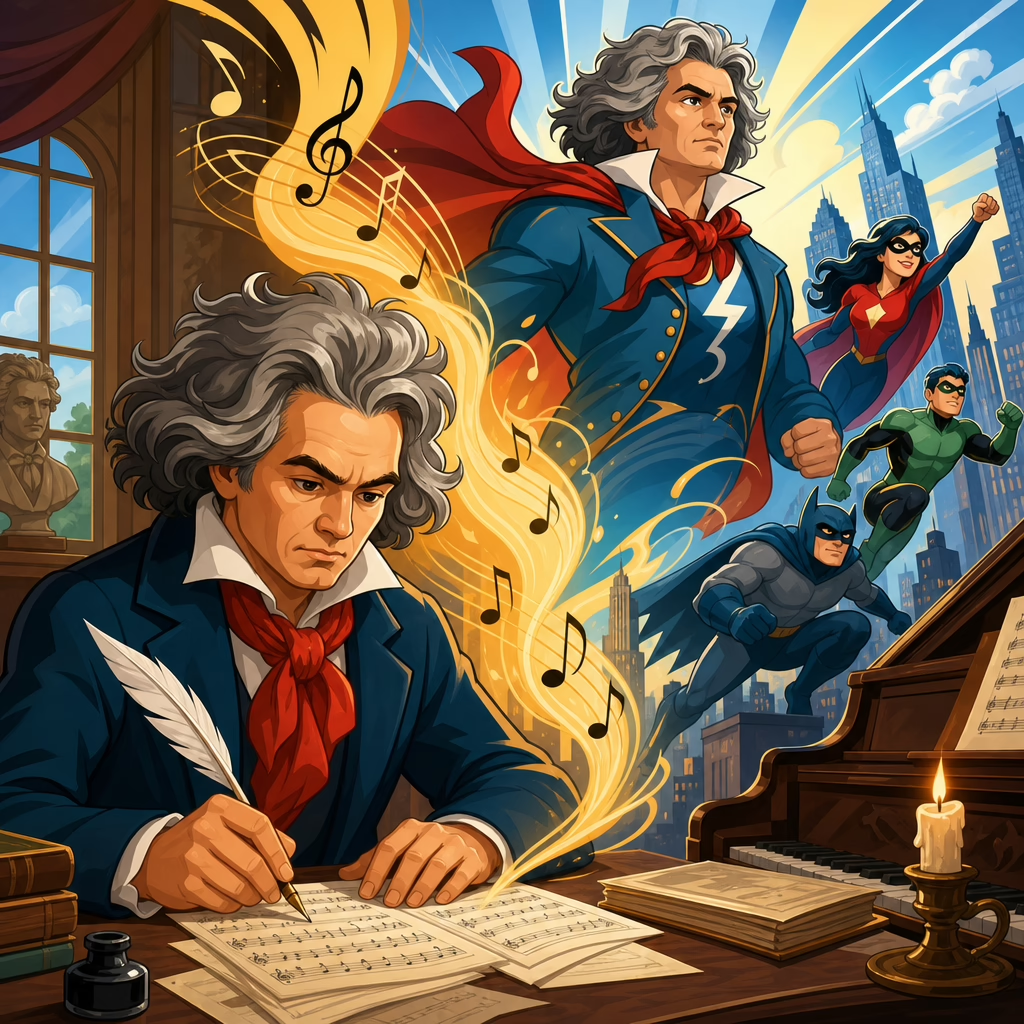
How Beethoven Entered the World of Superhero Storytelling
Ludwig van Beethoven did not become part of superhero storytelling by accident; he entered it because modern heroic narratives need music that signals struggle, moral scale, psychological depth, and eventual transformation in seconds. In film, television, comics, animation, and game adaptations, creators repeatedly reach for Beethoven when they want a hero to feel larger than life without sounding generic. His music carries a cultural charge that audiences recognize even when they cannot name the exact piece. That charge comes from several linked qualities: rhythmic drive, sharp contrasts, public familiarity, and a biography associated with endurance against suffering. In practical storytelling terms, Beethoven functions as emotional shorthand for conflict becoming purpose.
That makes him unusually suited to superheroes. A superhero story typically turns on duality: ordinary person and exceptional figure, private pain and public duty, individual will and collective stakes. Beethoven’s music is built on similar tensions. The Fifth Symphony moves from terse, fateful insistence toward hard-won release. The “Moonlight” Sonata can imply interiority, obsession, or mourning. The Ninth Symphony can represent human solidarity, triumph, or dangerous grandiosity depending on context. Because these works are so structurally strong and culturally legible, they can support scenes of origin, training, revelation, sacrifice, or catastrophe. I have seen editors temp-track action footage with Beethoven precisely because it gives shape before dialogue or effects are finished.
Superhero storytelling also depends on recognizable symbols that can travel across media. A cape, emblem, skyline, or leitmotif must communicate instantly. Beethoven belongs to that system of symbols. He is not used simply as “classical music.” He often appears as a sign of intellect, destiny, discipline, old-world authority, or the burden of greatness. Sometimes the music dignifies the hero. Sometimes it ironizes violence by placing refined art against destruction. Sometimes a villain uses Beethoven to claim superiority, forcing the hero to reclaim the moral meaning of power. To understand how Beethoven entered this world, it helps to look at the mechanics of superhero narrative, the history of adaptation, and the specific musical functions his works perform on screen and on the page.
The result is not a trivial borrowing from concert culture. Beethoven has become part of the grammar of superhero storytelling. His music helps frame what a hero fights for, what a villain misunderstands about transcendence, and why audiences instinctively read some battles as more than spectacle. For broader context on Beethoven’s symbolic reach across politics, advertising, education, and mass entertainment, see the main guide at why Beethoven became a global cultural icon. Within superhero media specifically, his presence reveals how classical music can do narrative work that dialogue, visual effects, and franchise lore cannot do alone.
Why Beethoven fits superhero stories so well
Beethoven fits superhero storytelling because his music dramatizes force meeting resistance. That is the engine of nearly every superhero arc. Heroes encounter limitation, absorb pressure, and convert it into action. Beethoven’s mature style is famous for motivic compression, dynamic extremes, abrupt transitions, and cumulative momentum. These are not abstract musicological points; they map directly onto cinematic and comic-book pacing. When a scene needs tension that feels purposeful rather than merely loud, Beethoven provides architecture. A director can cut to the rhythmic insistence of the Fifth, or echo the choral sweep of the Ninth, and the audience immediately senses scale and direction.
His life story matters too. Popular culture has long framed Beethoven as the artist who wrestled with deafness, isolation, and social instability while producing works of immense power. That biographical image resembles the superhero template of the wounded but unbroken figure. Bruce Wayne, Matt Murdock, Charles Xavier, and many others are defined by loss transformed into mission. Beethoven’s public image, even when simplified, supports that same emotional logic. Writers and composers therefore use him not just for beauty, but for the idea of disciplined struggle. In a genre built on origin trauma and moral testing, that idea is invaluable.
There is also a practical reason: Beethoven is globally recognizable. A few notes can do the job of exposition. Studios prefer signals that cross language barriers, and Beethoven’s most famous works are among the strongest nonverbal signals in world culture. They can imply nobility, danger, destiny, or cultural prestige without stopping the plot. That efficiency is why his music survives changes in audience taste. Superhero franchises are expensive and densely packed with information. Anything that communicates quickly is useful. Beethoven communicates quickly while retaining enough complexity to reward repeat viewing.
From prestige culture to pop myth
Beethoven’s route into superhero storytelling passed through twentieth-century mass media, especially film scoring, animation, and prestige drama. Before superheroes dominated the box office, Beethoven had already become a cinematic resource for representing ambition, chaos, civilization, and genius. Directors learned that familiar classical works could either enlarge a scene or complicate it through contrast. By the time comic-book adaptations matured in the late twentieth and early twenty-first centuries, Beethoven was available as a ready-made mythic language. He no longer belonged only to the concert hall; he belonged to audiovisual storytelling.
Comics themselves helped prepare the ground. Superhero comics have always borrowed from high and low culture alike, mixing pulp adventure with mythology, science, religion, and canonical art. Beethoven appears in that ecosystem as a marker of seriousness. A villain with refined musical taste signals calculation or elitism. A hero associated with Beethoven signals introspection or ethical gravity. Even when a specific comic panel does not quote a score, references to Beethoven can shape characterization through dialogue, cover art, issue titles, or scene construction. Once adaptations translate those cues into sound, the association becomes even more powerful.
Importantly, superhero storytelling rarely uses Beethoven in a historically pure way. It repurposes him. Orchestral excerpts may be rearranged, electronically processed, or woven into modern scores. Trailers often mimic Beethovenian rhythm without quoting him directly. Composers trained in the post-Wagner, post-Holst, post-Williams blockbuster tradition absorb Beethoven’s methods of motif development and dramatic contrast even when no licensed recording appears. In that sense, Beethoven entered superhero culture both literally and structurally: as music audiences hear, and as a compositional model shaping how heroism sounds.
How specific Beethoven works function in superhero scenes
Different Beethoven pieces solve different storytelling problems. The Fifth Symphony is the most obvious example because its opening four-note motive is perhaps the most recognizable rhythmic cell in Western music. In superhero contexts, it can suggest impending conflict, implacable pursuit, or the conversion of fear into resolve. The “Eroica” Symphony carries a different meaning. Because of its historical connection to heroism, disillusionment, and redefined greatness, it suits stories about public ideals under pressure. The Seventh Symphony, especially the second movement, often supports scenes of sacrifice or aftermath because its pulse feels ceremonial without becoming sentimental.
The piano sonatas offer more interior tools. The “Moonlight” Sonata is frequently used, and frequently misread, as a generic sad piece. In practice, it works best when a scene needs concentrated inwardness: a hero alone after failure, a vigil over damage, or a villain’s self-dramatizing melancholy. The “Pathétique” Sonata can underline anger held under control. The late quartets and late piano sonatas are less commonly quoted in mainstream superhero media because they are more demanding, but when referenced they signal exceptional seriousness, alienation, or visionary thinking. Those choices are rarely accidental.
| Beethoven work | Common superhero use | Narrative effect |
|---|---|---|
| Symphony No. 5 | Confrontation, pursuit, awakening power | Urgency, inevitability, struggle turning active |
| Symphony No. 3 “Eroica” | Public heroism, fallen ideals, legacy | Moral scale, historical weight, heroic ambiguity |
| Symphony No. 7, II | Funeral, sacrifice, ruined city aftermath | Grief with forward motion |
| Symphony No. 9 | Apotheosis, unity, or dangerous excess | Transcendence, collective stakes, grandeur |
| “Moonlight” Sonata | Isolation, reflection, secret lair scenes | Interior tension, sorrow, obsession |
| “Pathétique” Sonata | Controlled rage, moral conflict | Dignity under emotional pressure |
These associations work because Beethoven’s music has a clear dramatic profile. It is rarely passive background. Even quieter passages imply motion beneath the surface. That is ideal for superhero stories, which are fundamentally about latent capacity becoming visible. When creators choose Beethoven carefully, they do not merely decorate a scene; they clarify what kind of heroism, loss, or power the audience is supposed to perceive.
Heroes, villains, and the politics of cultural prestige
One of the most revealing aspects of Beethoven’s place in superhero storytelling is that both heroes and villains claim him. Heroes use Beethoven to anchor conscience, endurance, and sacrifice. Villains use him to project superiority, distance from ordinary people, or belief in their own historical importance. That dual use is not a contradiction. It reflects the unstable cultural prestige surrounding classical music in modern mass media. Beethoven can represent democratic aspiration through the Ninth Symphony’s ideal of brotherhood, but he can also represent hierarchy when a character uses elite taste as armor.
In practice, this creates sharp characterization fast. If a villain conducts an operation while Beethoven plays, the scene may imply cold control or self-mythologizing grandeur. If a battered hero returns to Beethoven after defeat, the same composer can imply discipline, memory, and recommitment. I have worked on analyses where the difference came down to framing: is the music shared with the audience as sincere emotion, or presented as a character’s cultivated image? Superhero storytelling thrives on such contrasts because it constantly asks what separates noble power from narcissistic power.
This is why Beethoven often appears around morally complicated figures. Antiheroes, fallen champions, and authoritarian saviors all benefit from his ambiguity. The music is elevated enough to suggest vision, but severe enough to suggest danger. That severity matters. Beethoven is less ornamental than Mozart and less sensuous than Tchaikovsky in popular perception. He sounds like structure, will, and consequence. For superhero narratives dealing with surveillance, collateral damage, or the temptation to dominate for the greater good, those qualities make him especially useful.
What Beethoven adds that original scores sometimes cannot
Modern superhero films rely heavily on original scores, and many are excellent, yet Beethoven offers advantages that even strong new themes do not always provide. First, he brings historical depth instantly. A fresh cue can tell viewers how to feel inside the film’s world, but Beethoven connects that feeling to two centuries of cultural memory. Second, his music arrives pre-loaded with public recognition. A composer introducing a new heroic motif needs time and repetition; Beethoven may establish gravity on first contact. Third, his music can create productive friction with futuristic settings, reminding audiences that questions of power and morality are older than technology.
There are limits. Familiar Beethoven can overwhelm a scene or make it feel borrowed rather than earned. Overuse can slip into cliché, especially if the placement depends only on prestige. Rights, recording choices, tempo, and orchestration also matter. A brittle archival recording communicates differently from a modern, heavy, cinematic performance. Still, when used with precision, Beethoven does something rare: he expands the interpretive field. A battle underscored by generic percussion feels immediate; a battle underscored by Beethoven can feel historical, philosophical, or tragic. That added dimension is exactly why superhero creators keep returning to him.
Beethoven entered superhero storytelling because the genre needed a musical language for extraordinary effort under moral pressure, and his work already supplied it. His symphonies, sonatas, and public image offer a set of meanings that filmmakers, comic writers, editors, and composers can deploy quickly yet richly. He can elevate a hero, expose a villain, dignify sacrifice, or complicate triumph. Most importantly, he reminds audiences that superhero stories are not only about powers. They are about will, suffering, responsibility, and the cost of becoming symbolic in public.
That is Beethoven’s real function in the genre. He turns spectacle into significance. When used well, his music tells viewers that what they are watching is not just a fight scene or a franchise beat, but a contest over what strength means. For anyone studying Beethoven and culture, superhero storytelling offers a sharp case study in how canonical art survives by changing use without losing identity. Watch the next cape story closely, listen for rhythmic insistence, heroic ambiguity, or choral transcendence, and you will hear why Beethoven still belongs in the age of superheroes.
Frequently Asked Questions
Why does Beethoven appear so often in superhero storytelling?
Beethoven shows up in superhero storytelling because his music instantly communicates stakes, struggle, and emotional magnitude. Superhero narratives often need to establish, in a matter of seconds, that a character is not dealing with ordinary problems but with moral conflict, inner fracture, sacrifice, and transformation. Beethoven is uniquely useful for that purpose. His symphonies, sonatas, overtures, and quartets carry a sense of confrontation and movement that fits the architecture of heroic stories: tension builds, forces collide, something is lost, and some form of hard-won resolution emerges.
Creators also return to Beethoven because his music does not merely sound “classical” in a decorative sense. It sounds urgent. Even audiences who cannot identify a specific work often recognize that the music means something serious is happening. That cultural recognition matters in film, television, animation, comics adaptation, and games, where shorthand is powerful. A few familiar Beethoven gestures can make a hero feel larger than life without making the scene feel emotionally empty or generic.
Another reason is that Beethoven’s music carries both public and private weight at the same time. It can suggest epic scale for a battle, a city, or a cosmic threat, but it can also imply the hero’s inner turmoil, loneliness, and resilience. That combination is extremely valuable in superhero storytelling, which depends on balancing spectacle with psychology. In practical terms, Beethoven helps creators signal that the hero’s journey is not just about action, but about becoming.
What makes Beethoven’s music especially effective for heroes compared with other classical composers?
Many classical composers can add grandeur, elegance, mystery, or emotional color, but Beethoven is especially effective for heroes because his music feels driven by conflict and change. Superhero stories are built around pressure: a hero is tested, fails or suffers, confronts fear, and emerges altered. Beethoven’s music often seems to enact that same process. It does not simply sit in one mood. It pushes forward, resists obstacles, erupts, rebuilds, and transforms. That dramatic momentum aligns naturally with the shape of heroic storytelling.
He is also associated, culturally and historically, with ideas that fit the superhero genre: struggle against limitation, creative force, individuality, defiance, and transcendence. Those associations have grown over generations of listening, criticism, performance, and popular reuse. As a result, when creators use Beethoven, they are not just borrowing notes; they are borrowing an entire aura. The audience may sense resolve, fate, burden, triumph, or moral gravity before a character even speaks.
Compared with music that sounds merely noble or beautiful, Beethoven often feels more hard-earned. That distinction is crucial. Superheroes are most compelling when their power comes with cost. Beethoven’s music can make heroism sound less like effortless superiority and more like a difficult ascent. That is why it works so well for scenes involving origin stories, moral decisions, redemptive turns, and climactic confrontations where the emotional meaning matters as much as the visual scale.
Does Beethoven usually represent triumph in superhero stories, or something darker and more complicated?
In superhero storytelling, Beethoven rarely signifies simple victory alone. More often, he represents a layered emotional field where triumph is inseparable from struggle, doubt, sacrifice, and consequence. That complexity is one of the main reasons creators keep using him. Superhero narratives are strongest when they treat power as morally demanding, and Beethoven’s music is well suited to that kind of seriousness. It can elevate a heroic moment while still reminding the audience that the character has paid a price or is carrying a burden.
This is why Beethoven can work in scenes of preparation, loss, revelation, confrontation, and aftermath—not just in moments of celebration. A heroic entrance underscored by Beethoven may feel majestic, but it often also feels haunted or pressured. The music suggests not only that something great is happening, but that greatness has been forged through ordeal. That emotional duality gives scenes more texture and prevents the hero from seeming flat or invulnerable.
It is also important to remember that modern superhero storytelling often blurs the line between heroism and obsession, justice and vengeance, destiny and damage. Beethoven’s music can support those ambiguities because it is emotionally expansive and structurally dramatic. It can frame a hero as inspiring while simultaneously hinting at instability, isolation, or overwhelming responsibility. In that sense, Beethoven is not just the sound of triumph. He is often the sound of transformation under pressure.
How do film, television, comics, animation, and games use Beethoven differently in superhero-related storytelling?
Each medium uses Beethoven according to its strengths, but all of them rely on the same core effect: his music gives heroic material instant scale and depth. In film, Beethoven is often used as a direct emotional amplifier. A scene can move from intimate to mythic very quickly when a recognizable Beethoven passage enters. Directors and editors use that shift to frame a hero as operating on a larger moral or symbolic plane than ordinary characters.
In television, where episodes must establish tone efficiently, Beethoven can function as a shorthand for gravity, ambition, or psychological intensity. A show may use it to elevate a pivotal confrontation, define a character’s interior life, or signal that a particular episode is reaching beyond routine action into something more operatic. Because television often revisits characters over time, Beethoven can also deepen recurring themes such as sacrifice, corruption, or redemption.
In comics and graphic storytelling, Beethoven is typically invoked through reference rather than actual sound. Writers may name a piece, artists may structure a sequence around musical rhythm, or the story may allude to Beethoven as a cultural symbol of force and emotional scale. Readers bring their own understanding of Beethoven to the page, and that recognition can enrich the tone of a scene even in silence.
Animation often uses Beethoven with a heightened sense of contrast. Because animation can move fluidly between stylization, humor, abstraction, and intensity, Beethoven can either dignify a hero with enormous seriousness or create an ironic tension between visual playfulness and emotional grandeur. In both cases, the music helps clarify that the stakes are larger than the surface might suggest.
In games, Beethoven can support boss encounters, origin moments, morally charged cutscenes, or themes related to destiny and escalation. Interactive storytelling benefits from music that feels consequential, and Beethoven provides that feeling almost immediately. Whether used directly, adapted, or echoed through original scoring inspired by his energy, the goal is often the same: to make the player feel that the hero’s path is not just action-driven, but mythic and psychologically significant.
What does Beethoven add to a superhero character that modern scoring alone sometimes does not?
Modern scoring can be highly effective, but Beethoven adds a layer of cultural memory that newly composed music does not automatically possess. When audiences hear Beethoven, they are not encountering a neutral sound. They are encountering centuries of association with genius, conflict, endurance, seriousness, and artistic monumentality. That gives a superhero scene a kind of inherited authority. The character can feel connected to ideas bigger than the immediate plot: fate, history, moral will, and human striving.
Beethoven also helps distinguish a hero from generic spectacle. Contemporary action music can create excitement, speed, and impact, but it can sometimes blur into a familiar cinematic language. Beethoven, by contrast, often cuts through that sameness. His music can make a scene feel singular, intentional, and charged with meaning. Even a brief quotation or stylistic echo can imply that the hero is part of a deeper emotional and symbolic tradition rather than just another figure in another effects-driven sequence.
Most importantly, Beethoven gives creators a way to express transformation with unusual force. Superhero stories depend on the idea that people can become more than they were, but that becoming is often painful and morally demanding. Beethoven’s music makes that process audible. It suggests strain turning into momentum, fracture turning into form, and limitation turning into vision. That is why he did not enter superhero storytelling by accident. He entered because modern heroic narratives need a musical language that can signify struggle, moral scale, psychological depth, and eventual transformation almost instantly, and Beethoven remains one of the most powerful ways to do exactly that.