Why Beethoven Became a Global Cultural Icon
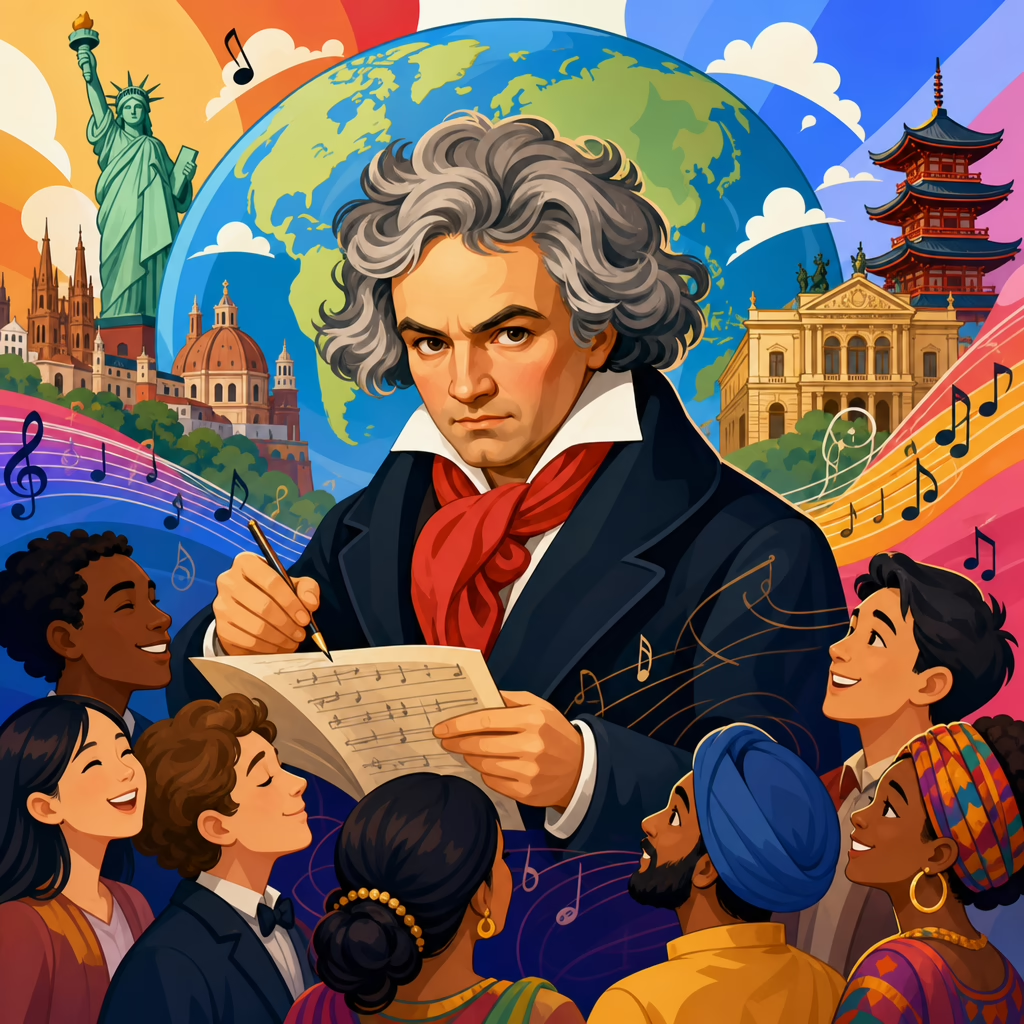
Ludwig van Beethoven became a global cultural icon because his music, life story, and symbolic meaning have traveled far beyond the concert hall into politics, education, cinema, popular memory, and everyday language. Few composers are recognized by surname alone across continents, yet Beethoven is. His image appears in textbooks, advertising, films, public monuments, and streaming playlists; his symphonies mark revolutions, memorials, Olympic ceremonies, and intimate moments of personal reflection. To understand why Beethoven became a global cultural icon, it is necessary to look at more than his most famous works. The answer lies in how his compositions changed musical history, how his biography invited mythmaking, and how institutions repeatedly used his legacy to express ideals of freedom, genius, struggle, and human dignity.
Beethoven and culture is a broader subject than classical music appreciation. It includes how societies assign meaning to artists, how works circulate through publishing and performance, and how later generations reinterpret inherited symbols. In Beethoven’s case, culture means both elite and popular forms: conservatory training and cinema soundtracks, scholarly editions and cartoon references, political speeches and social media clips. I have worked with Beethoven’s music in classrooms, program writing, and performance preparation, and one consistent pattern stands out. Even people who think they do not know Beethoven can usually identify the opening of the Fifth Symphony, the “Ode to Joy” melody from the Ninth, or the nickname “Moonlight Sonata.” That level of recognition is not accidental. It is the result of historical timing, artistic innovation, and two centuries of global transmission.
Beethoven matters because he sits at the center of several major cultural narratives. He is presented as the heroic artist who overcame adversity, especially hearing loss. He is treated as the composer who expanded music into a vehicle for philosophical and moral expression. He is also a flexible symbol: democrats, nationalists, European institutions, educators, and filmmakers have all claimed him for different purposes. This adaptability helps explain his worldwide reach. A cultural icon must be legible in many contexts, and Beethoven’s legacy supports multiple readings without losing its core identity.
Another reason this topic matters is that Beethoven became a benchmark for artistic seriousness. Since the nineteenth century, orchestras, piano teachers, critics, record labels, and universities have used him as a reference point for excellence. His music is central to the canon of Western art music, but his influence extends into jazz arrangements, electronic remixes, anime scores, and protest culture. The durability of his reputation raises useful questions: How does a composer become universal? What role do institutions play? Why do some artists remain local while others become global symbols? Beethoven offers one of the clearest case studies.
In practical terms, studying why Beethoven became a global cultural icon helps explain modern cultural infrastructure itself. The rise of the public concert, music publishing, celebrity biography, national heritage, recording technology, and international education all intersect with his afterlife. When listeners ask why Beethoven is so famous, the short answer is this: he wrote unforgettable music at a moment when Europe was redefining art, and later generations built powerful stories and institutions around that music. The fuller answer requires examining his sound, his persona, and his constant reuse across changing media and political systems.
Table of Contents
1. Beethoven’s historical moment and musical revolution
2. The works that entered global memory
3. The myth of genius, struggle, and deafness
4. Institutions that carried Beethoven around the world
5. Beethoven in politics, media, and everyday culture
6. Why his legacy still feels current
Beethoven’s historical moment and musical revolution
Beethoven was born in Bonn in 1770 and built his career in Vienna, a city already shaped by Haydn and Mozart. He entered musical life at a transitional moment. The Enlightenment had elevated ideas of reason, individual worth, and public debate, while the French Revolution and Napoleonic era disrupted old political assumptions across Europe. In music, patronage by aristocrats still mattered, but public concerts, music publishing, and a broader middle-class audience were becoming more important. Beethoven benefited from this shift and helped accelerate it. He was not simply a servant-composer in the old court model. He negotiated with publishers, cultivated patrons strategically, and wrote with a public historical audience in mind.
His major innovation was not that he invented every form he used, but that he intensified them. He expanded the scale of the symphony, increased the expressive range of the piano sonata, deepened the dramatic stakes of chamber music, and made thematic development feel like argument. In rehearsal and teaching, I often describe Beethoven’s style as purposeful inevitability. Small motifs generate large structures. The famous four-note opening of the Fifth Symphony is the textbook example: a compact rhythmic cell drives the entire movement and shapes the work’s psychological momentum. This kind of concentrated motivic thinking gave listeners something memorable while also rewarding repeated hearing.
Beethoven also changed what audiences expected music to do. Before him, instrumental music was often admired for elegance, wit, or craft. After him, it was increasingly discussed in moral, philosophical, and autobiographical terms. Critics heard struggle, victory, tragedy, contemplation, and transcendence. Some of that language reflects nineteenth-century Romanticism, but Beethoven’s scores encouraged it through their extreme contrasts, long-range architecture, and emotional intensity. The “Eroica” Symphony, first associated with Napoleon before Beethoven withdrew the dedication, redefined the symphony’s scale and ambition. It was longer, more disruptive, and more conceptually weighty than audiences expected. That set a precedent: Beethoven became the composer who proved that instrumental music could carry the stature of epic thought.
His appeal was also practical. Beethoven wrote for genres that traveled well: symphonies for orchestras, sonatas for domestic piano culture, string quartets for advanced chamber players, and overtures and concertos for public display. As pianos spread through middle-class homes in Europe and later beyond, Beethoven’s keyboard works entered private life. Students encountered simplified arrangements; virtuosos performed complete sonatas; amateurs learned fragments. Cultural icons become global when their work exists at several levels of difficulty and prestige at once. Beethoven’s catalog does exactly that.
The works that entered global memory
Not every famous composer becomes universally recognizable, and not every masterpiece becomes part of mass memory. Beethoven crossed that threshold because several of his works contain striking, repeatable musical ideas that function almost like cultural shorthand. The Fifth Symphony signifies fate, urgency, and determination. The Ninth Symphony signifies unity and exaltation. “Für Elise” signifies beginner piano culture and instant recognizability. The “Moonlight” Sonata signifies introspection and romantic melancholy, even though the nickname was added after Beethoven’s death. These associations are historically layered rather than fixed, but they matter because they allow the music to circulate outside specialist settings.
The Ninth Symphony has had exceptional global reach. Premiered in 1824, it combines symphonic form with Friedrich Schiller’s “Ode to Joy,” turning a major orchestral work into a public statement about human brotherhood. The finale’s melody is simple enough to be sung widely and noble enough to support ceremonial use. It has appeared at moments as different as the fall of the Berlin Wall, Japanese year-end choral traditions known as Daiku, and the adoption of the tune as the anthem of the European Union. This is one reason Beethoven became a global cultural icon: he wrote music that institutions could ritualize without exhausting its emotional force.
Beethoven’s piano music has been just as important culturally, though in a different way. “Für Elise,” probably composed in 1810, became one of the most disseminated pieces in music history through lesson books, anthologies, toys, ringtones, and digital keyboards. Many people encounter Beethoven first not in a symphony hall but in a living room, school practice room, or online tutorial. The “Pathétique,” “Moonlight,” “Waldstein,” and “Appassionata” sonatas also helped define the idea of the piano as an instrument of inner drama. By the late nineteenth century, public piano recitals and conservatory systems had turned Beethoven into essential repertory from Moscow to Buenos Aires, from New York to Seoul.
His string quartets and late piano sonatas became another pillar of iconic status: depth. Global icons must satisfy broad audiences, but they also need inexhaustibility for experts. Beethoven’s late works provide that. Op. 131, Op. 132, the “Missa solemnis,” and the late sonatas continue to generate scholarship, debate, and new interpretations because they challenge listeners structurally, spiritually, and technically. They are not famous in the same immediate way as “Für Elise,” yet they reinforce Beethoven’s authority among musicians, critics, and institutions. Mass recognition and specialist reverence strengthen each other.
| Work | Date | Why It Matters Culturally | Typical Modern Association |
|---|---|---|---|
| Symphony No. 5 | 1808 | One of the most recognizable openings in music; repeated in film, radio, and public discourse | Struggle, destiny, resolve |
| Symphony No. 9 | 1824 | Global ceremonial use; choral finale adapted for civic and international ideals | Unity, hope, humanity |
| Für Elise | 1810, published later | Entered beginner piano culture worldwide through lessons and mass publishing | Familiarity, childhood study |
| Piano Sonata No. 14 “Moonlight” | 1801 | Popularized through nickname, recordings, and film use | Melancholy, introspection |
| Symphony No. 3 “Eroica” | 1804 | Established the symphony as a serious public statement | Heroism, modern ambition |
Recording technology amplified these works on a scale Beethoven himself could never have imagined. In the twentieth century, conductors such as Arturo Toscanini, Wilhelm Furtwängler, Herbert von Karajan, Leonard Bernstein, and Carlos Kleiber attached interpretive prestige to Beethoven cycles. The LP, CD, radio broadcast, and now streaming platforms made his music permanently available. Today a listener can move from historically informed performances on period instruments to large modern symphonic readings in seconds. That constant availability keeps familiar works alive and continuously recruits new listeners.
The myth of genius, struggle, and deafness
Music alone does not create a global icon. Biography matters, especially when it can be condensed into a compelling narrative. Beethoven’s life offered one of the strongest stories in cultural history: an uncompromising creator, difficult but principled, wrestling with isolation and progressive hearing loss while producing works of towering ambition. The Heiligenstadt Testament of 1802, a document in which Beethoven described despair over his deafness and his decision to continue living for his art, became central to this narrative. It gave later generations a vivid script of suffering transformed into achievement.
That script is powerful because it is both true and simplified. Beethoven did experience serious hearing impairment that became profound deafness. He did face practical, emotional, and professional strain because of it. Yet the popular image often reduces his identity to the phrase “the deaf composer,” as if disability alone explains his stature. In reality, his icon status comes from the interaction of adversity and accomplishment. The deafness intensified the legend, but the legend endured because the music justified it. Cultural memory preserves stories that seem to reveal meaning in achievement, and Beethoven’s biography appears to dramatize resilience in its purest form.
Nineteenth-century writers amplified this image. Anton Schindler, despite serious reliability problems, helped shape a portrait of Beethoven as storm-tossed genius. Later biographers, painters, sculptors, and educators reinforced the visual code: wild hair, stern face, inward concentration, manuscript in hand. This is one of the earliest durable celebrity-brand identities in serious music. Even people who cannot name a single Beethoven opus often recognize the canonical portrait. The image supports the music’s reputation for intensity and moral seriousness.
There is also a social reason the genius myth attached so strongly to Beethoven. He emerged when European culture increasingly valued originality and individual expression. Haydn and Mozart were admired enormously, but Beethoven became the emblem of the autonomous artist who answers to inner necessity rather than external decorum. That model influenced later understandings of composers, writers, and painters. The modern expectation that great art should express a singular inner voice owes much to the Beethoven story as it was told in the nineteenth century.
Still, the myth has limitations. It can obscure collaboration, patronage networks, copyists, publishers, performers, instrument makers, and the material labor required for cultural fame. It can also flatten Beethoven’s personality into pure heroism, ignoring his contradictions: generosity and abrasiveness, idealism and suspicion, ambition and social dependence. A balanced account strengthens rather than weakens his importance. Beethoven became a global cultural icon not because he was superhuman, but because he was vividly human in ways that institutions, audiences, and later artists could continually reinterpret.
Institutions that carried Beethoven around the world
No cultural icon becomes global by merit alone. Transmission depends on institutions, and Beethoven benefited from nearly every major mechanism of cultural circulation developed since the early nineteenth century. Music publishers issued his works in formats that could reach professionals and amateurs. Conservatories built curricula around his sonatas, quartets, and symphonies. Orchestras treated Beethoven cycles as a marker of seriousness. Universities made him central to music history surveys. Competitions required Beethoven as a test of technique and interpretation. Museums, archives, and complete editions stabilized the repertory and gave it documentary authority.
The canonization process was especially important. By the late nineteenth century, Beethoven occupied a privileged place in the Austro-German repertory just as concert life was becoming more standardized internationally. Programs in London, Paris, Leipzig, New York, and later Tokyo and Shanghai repeatedly returned to the symphonies and overtures because they attracted audiences and conferred prestige. Once that cycle began, each generation inherited the expectation that musical literacy included Beethoven. When I have planned educational repertoire, Beethoven functions almost like a shared language: teachers assume students need him, presenters trust audiences to recognize him, and institutions rely on him to connect history with performance.
Technology multiplied this institutional power. The player piano, phonograph, radio, film soundtrack, television broadcast, and digital streaming service each redistributed Beethoven to new publics. During World War II, for example, the opening rhythm of the Fifth Symphony became associated in Allied propaganda with the Morse code for the letter V, standing for victory. This was not a neutral musical event; it was a case of existing recognition being repurposed through mass media. Later, the Ninth Symphony became one of the first works chosen for major long-playing record projects because labels knew it combined prestige and demand.
International education systems also explain Beethoven’s reach. The conservatory model, developed in Europe, spread globally through colonial networks, missionary schools, urban modernization, and national cultural policy. As piano study expanded in East Asia, Latin America, North America, and parts of Africa, Beethoven’s educational footprint expanded with it. Examination boards such as ABRSM and similar systems elsewhere placed his music in graded syllabi, ensuring that generations of students encountered him directly. This kind of structured repetition matters more than casual fame. It creates durable familiarity.
Tourism and heritage culture added another layer. Bonn’s Beethoven-Haus, Vienna’s Beethoven sites, anniversary festivals, complete edition projects, and international competitions all convert historical memory into public experience. Major anniversaries, especially 1970 and 2020, generated exhibitions, documentaries, scholarly conferences, and global marketing. Even debates over how to commemorate him kept his name current. That is a hallmark of true icon status: the figure remains central not only through praise but through renewed interpretation.
Beethoven in politics, media, and everyday culture
Beethoven’s symbolic flexibility is one of the main reasons he transcended music history. Political movements and states have repeatedly used his works to project legitimacy, aspiration, or moral seriousness. The “Eroica” Symphony has been tied to heroic politics since its complicated relationship with Napoleon. The Ninth Symphony has served causes that are not always compatible with one another: democratic celebration, postwar reconciliation, national ceremony, and official internationalism. Because the music is emotionally expansive and textually idealistic, it can be adopted by very different groups. That adaptability is a source of strength, though it also means Beethoven’s legacy has sometimes been appropriated for purposes that distort his context.
In Europe after 1945, Beethoven often symbolized a high culture that could outlast catastrophe. In divided Germany, both East and West claimed him. The 1989 performances around the fall of the Berlin Wall, especially Leonard Bernstein’s symbolic substitution of “Freiheit” for “Freude” in one performance, showed how Beethoven could be repositioned at a moment of historic transformation. In Japan, annual large-scale performances of the Ninth became a distinctive tradition with thousands of amateur singers in some events, demonstrating that Beethoven could be deeply localized without ceasing to be global.
Film and television have broadened his cultural code even further. Stanley Kubrick’s A Clockwork Orange used Beethoven to unsettling effect, linking exalted music with violent psychology and forcing viewers to confront the gap between aesthetic refinement and moral behavior. Immortal Beloved popularized a romanticized version of his life for broad audiences. Countless advertisements, cartoons, and educational programs have used the Fifth Symphony opening or “Für Elise” to signal “classical music” instantly. These uses may simplify Beethoven, but they also keep him legible to audiences who never attend a recital.
Everyday culture matters here as much as prestige media. Doorbells, toys, hold music, viral remixes, and comedy sketches have all recycled Beethoven themes. In digital culture, short-form familiarity can work in his favor because his motifs are distinctive within seconds. A global cultural icon needs recognizability at low attention spans as well as at high levels of study. Beethoven succeeds at both. A listener can experience the Fifth Symphony as a four-note meme or as a forty-minute formal journey; the same work supports both levels.
This broad presence has tradeoffs. Repetition can turn Beethoven into cliché, and oversimplified narratives can detach the music from its historical texture. But reduction is often the price of wide transmission. The significant point is that Beethoven survives reduction better than most artists because the original works sustain return. People may enter through a ringtone-level encounter, then later discover the symphonies, quartets, or piano sonatas in depth. Cultural icons endure when surface familiarity leads, sooner or later, to deeper engagement.
Why his legacy still feels current
Beethoven remains current because the values attached to him are still culturally active: perseverance, artistic integrity, emotional candor, and belief in human possibility. His music also aligns well with modern listening habits. It offers immediate hooks, strong contrasts, and large emotional arcs. At the same time, it rewards analysis through form, counterpoint, harmonic strategy, and interpretive ambiguity. That combination is rare. Many works are either instantly accessible or endlessly rich; Beethoven’s best-known music is both.
Contemporary performance practice has helped renew him rather than fossilize him. Historically informed ensembles such as the Orchestre Révolutionnaire et Romantique or conductors influenced by period research have challenged older, heavier traditions and reminded audiences that Beethoven can sound urgent, risky, and fresh. At the other end of the spectrum, major symphony orchestras continue to present complete cycles as flagship events. New recordings, urtext scholarship, manuscript studies, and digital archives keep the repertory alive in professional circles while streaming and video platforms make it easy for curious listeners to compare interpretations.
Beethoven’s relevance also persists because global culture still needs shared references. In an age of fragmented media, only a small number of historical artists remain widely recognizable across education levels and national borders. Beethoven is one of them. He occupies that role not by accident or mere tradition, but because his music and story meet several cultural needs at once. He represents excellence without seeming remote, struggle without defeatism, and idealism without naivety. Even when people debate the Western canon, Beethoven remains central precisely because he is such a revealing example of how canons are made, maintained, challenged, and renewed.
For anyone exploring Beethoven and culture, the main lesson is clear. Beethoven became a global cultural icon through an unusual convergence of artistic power, historical timing, memorable works, compelling biography, and centuries of institutional reinforcement. His fame is not just about genius in the abstract. It is about circulation, adaptation, and repeated public use. The Fifth Symphony, the Ninth, the piano sonatas, the portraits, the myths of struggle, the conservatory syllabus, the film soundtrack, the civic ceremony, and the student practice book all belong to the same story.
That story still matters because it shows how art can move through the world and keep acquiring meaning. Beethoven’s legacy demonstrates that a composer becomes global when great works meet durable cultural systems and emotionally resonant narratives. Listen again to the symphonies, revisit the sonatas, or compare how different cultures have used the Ninth. The more closely you look, the clearer it becomes why Beethoven remains one of the most powerful cultural symbols ever created.
Frequently Asked Questions
Why is Beethoven recognized around the world more than most other classical composers?
Beethoven is globally recognized because his fame rests on several powerful layers at once: unforgettable music, a dramatic personal story, and a symbolic role that different cultures have continually reused. Musically, he wrote works that became central to concert life across Europe and then across the world, especially the Fifth Symphony, the Ninth Symphony, the “Moonlight” Sonata, and “Für Elise.” These pieces are not only admired by specialists; they are also instantly identifiable to millions of listeners who may know little else about classical music. That level of recognition is rare.
His life story also helped make him memorable. Beethoven came to represent the idea of artistic struggle and triumph: a fiercely independent composer confronting personal suffering, social change, and, most famously, hearing loss. The image of a deaf composer creating monumental music has enormous emotional power. It turns him from a historical figure into a human legend people remember, teach, and repeat.
Just as important, Beethoven has traveled far beyond the concert hall. His music appears in films, television, advertising, political ceremonies, school curricula, public memorials, and digital playlists. His surname alone functions almost like a cultural shorthand for “great composer,” “genius,” or even “serious music.” That broad symbolic reach explains why Beethoven is not simply a major musician in music history; he is a globally circulating cultural icon whose name and sound have become part of common memory.
How did Beethoven’s life story contribute to his iconic status?
Beethoven’s life story played a major role in transforming him from a celebrated composer into a universal symbol of perseverance, genius, and creative independence. Audiences have long been drawn to the contrast between his internal struggles and the scale of his artistic achievement. He lived during a time of revolution and political upheaval, moved within changing social worlds, and increasingly positioned himself as an artist who answered not just to patrons but to his own artistic ideals. That helped create the modern image of the composer as an autonomous genius rather than a servant of elite taste.
The most enduring part of that story is his hearing loss. The fact that Beethoven continued composing despite progressive deafness has inspired generations of listeners, students, artists, and writers. Whether people understand the full medical or historical details, they grasp the emotional core immediately: a man losing one of the senses most essential to his profession, yet producing music of immense force and beauty. That narrative has made him an emblem of resilience in classrooms, biographies, documentaries, and public culture.
There is also a mythic quality to the way he has been remembered. Portraits often emphasize his intense expression, wild hair, and stormy temperament, reinforcing the idea of a creator driven by inner fire. Even when simplified, these images were powerful in building his legend. Over time, Beethoven became more than a historical composer; he became a story people tell about what human determination, suffering, and imagination can achieve.
Why does Beethoven’s music appear so often in politics, ceremonies, and major public events?
Beethoven’s music appears in major public events because it carries extraordinary symbolic weight while remaining emotionally accessible. Certain works project dignity, struggle, victory, mourning, hope, and collective aspiration in ways that large audiences can feel immediately, even without formal musical training. That makes his music especially useful for state occasions, memorials, anniversaries, revolutions, and international ceremonies.
The clearest example is the Ninth Symphony, especially its final movement based on Schiller’s “Ode to Joy.” Over time, that music came to symbolize ideals such as unity, human brotherhood, and shared destiny. It has been used in contexts ranging from celebrations of political change to expressions of continental identity and public reconciliation. Because the music feels both grand and inclusive, it can serve many causes, sometimes even conflicting ones. Different groups have claimed Beethoven because his works seem to speak to universal human emotion while remaining open to interpretation.
Other pieces, such as the Fifth Symphony, have also gained public meaning beyond their original composition. Its famous opening motive has been heard as fate, resistance, urgency, or determination, depending on the historical moment. Beethoven’s music therefore functions not just as art but as a public language. Leaders, institutions, and communities turn to it when they want to connect present events to ideals of depth, seriousness, and historical importance.
How did Beethoven become part of everyday culture outside classical music?
Beethoven entered everyday culture through repetition, adaptation, and visibility across many forms of media. His melodies have been quoted in cartoons, movies, commercials, ringtones, educational programs, and popular arrangements for well over a century. Because of this constant circulation, many people encounter Beethoven long before they ever attend a symphony concert. They may recognize the opening of the Fifth Symphony, the melody of “Für Elise,” or the choral ending of the Ninth without knowing exactly where they first heard it.
His image has spread in similar ways. Busts, portraits, postage stamps, schoolbooks, posters, monuments, and parody versions of his likeness all helped turn Beethoven into a recognizable visual brand. Once a historical figure becomes that visually and aurally familiar, he enters popular memory in a deeper way. He can be referenced quickly in jokes, advertisements, classroom lessons, and casual conversation without needing much explanation.
There is also a linguistic dimension to his fame. In many places, “Beethoven” is used almost as shorthand for supreme musical genius. That kind of surname recognition is a marker of true cultural saturation. He is not confined to conservatories or specialist audiences; he lives in public language and mass media. This is why Beethoven remains continuously present even in cultures where few people regularly engage with classical music as a formal tradition.
Does Beethoven’s global reputation still matter in the streaming and digital age?
Yes, Beethoven’s reputation still matters enormously in the digital age, and in some ways it has become even more flexible and far-reaching. Streaming platforms, social media, video essays, film soundtracks, and algorithm-driven playlists have introduced his music to new audiences who may not approach it through traditional concert culture. A listener can move from a dramatic film score to Beethoven’s Seventh Symphony, or from a piano-study playlist to “Moonlight” Sonata, without crossing a hard boundary between elite and everyday listening. That fluidity helps sustain his relevance.
Digital culture also favors instantly recognizable material, and Beethoven has an advantage there. Short musical excerpts from his best-known works remain highly effective in clips, trailers, educational content, and cultural commentary. His story also adapts well to contemporary themes: disability, artistic identity, mental resilience, personal expression, and the relationship between individual creativity and public life. Each generation finds new reasons to revisit him.
Most importantly, Beethoven still offers something rare: he connects personal emotion with collective meaning. People turn to his music for study, mourning, celebration, introspection, and historical ceremony alike. That range explains why he continues to function not only as a major composer from the past but as an active cultural presence in the present. In a fragmented global media environment, very few figures retain that level of artistic authority and emotional reach, and Beethoven is one of them.