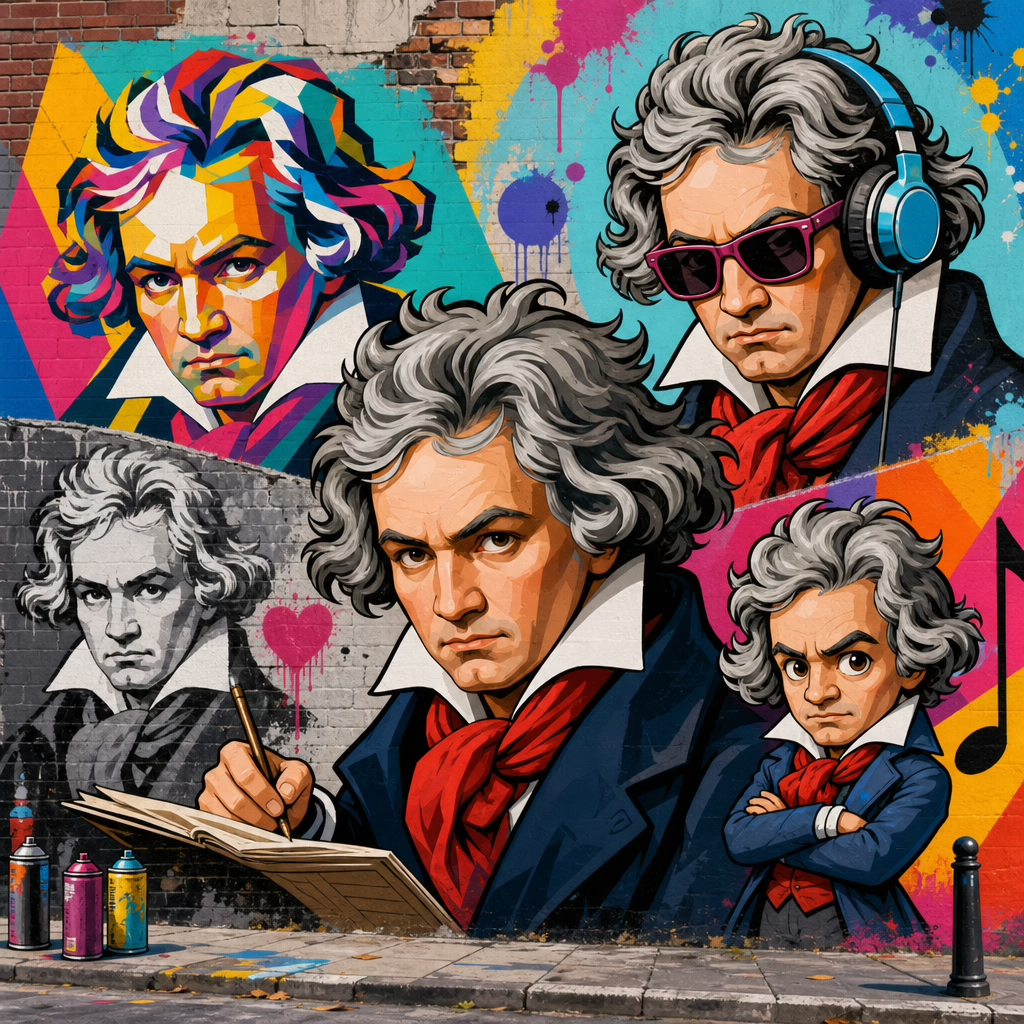
The Many Faces of Beethoven in Street Art
Beethoven’s face appears on city walls across the world because street art turns cultural memory into public conversation. In murals, stencils, paste-ups, and legal commissioned walls, Ludwig van Beethoven is no longer only the composer of symphonies and sonatas; he becomes a symbol of rebellion, discipline, European heritage, local pride, and even pop irony. “Street art” here means visual work made in public space, from unauthorized graffiti pieces to city-approved murals, while “iconography” refers to the repeated visual cues that make a figure instantly recognizable. In Beethoven’s case, those cues are unusually strong: the stormy hair, severe brow, formal coat, and the familiar aura of genius. That recognizability matters because street artists need images that read in seconds from a moving car, a passing tram, or a phone camera.
I have spent years tracking how canonical figures migrate from museums and textbooks onto exterior walls, and Beethoven is one of the clearest examples of that shift. Artists return to him because he carries multiple meanings at once. He can stand for artistic excellence, German-speaking cultural history, perseverance through deafness, or the democratization of “high art” when elite symbols are moved into everyday neighborhoods. In places connected to his life, especially Bonn and Vienna, his image also supports local identity and cultural tourism. Elsewhere, he is used more loosely, often remixed with headphones, sunglasses, spray cans, comic-book colors, or contemporary political references. The result is not one Beethoven but many Beethovens, each adjusted to a wall, a district, and an audience.
This subject matters because street art is one of the fastest ways a society reveals what it still values, what it wants to mock, and what it wants to reclaim. When Beethoven appears in public art, the wall asks direct questions: Who owns classical music? Is genius sacred, marketable, or shareable? Can a composer associated with concert halls still speak in neighborhoods shaped by migration, tourism, inequality, and youth culture? Looking closely at these images shows how urban art reshapes a historical figure without erasing him. Instead, it puts him back into circulation. To understand why he remains such a durable image beyond the concert hall, it helps to see how street art edits his likeness, message, and meaning in plain sight. For broader context on his symbolic reach, see this guide to why Beethoven became a global cultural icon.
Why Beethoven Works So Well on Walls
Not every classical composer translates effectively into street art, but Beethoven does for practical visual reasons. His best-known portraits, especially Joseph Karl Stieler’s 1820 likeness, provide a ready-made template with high contrast and emotional charge. The wild hair creates a strong silhouette. The intense expression survives simplification into stencil form. Even when artists reduce him to black lines and two or three color blocks, viewers still identify him immediately. That instant recognition is the first requirement for successful public imagery, and Beethoven offers it more reliably than Haydn, Schubert, or Bruckner.
There is also a narrative advantage. Street art often compresses biography into a single glance, and Beethoven’s life supplies vivid themes artists can use without explanatory text. He is the composer who lost his hearing yet kept writing. He represents struggle transformed into creation. He carries the weight of the Fifth Symphony’s “fate” motif and the Ninth Symphony’s association with freedom, solidarity, and official ceremony. Artists do not need viewers to know all the details; they only need them to sense intensity, resistance, and achievement. In visual culture, Beethoven arrives preloaded with emotional metadata.
That does not mean every mural treats him reverently. In fact, his visual authority makes him ideal for parody and remix. I have seen Beethoven painted with boom boxes, rendered as a punk, or fused with graffiti lettering so that his hair becomes aerosol cloud and motion line. These works succeed because the source image is so stable. An artist can distort it heavily and still preserve recognition. That flexibility explains why Beethoven appears in both commemorative mural programs and unauthorized interventions. He can anchor official heritage messaging or anti-elitist subversion with equal force.
Local Identity, Heritage, and the Beethoven City Brand
In cities linked to Beethoven’s biography, street art often performs a civic function. Bonn, his birthplace, has repeatedly used his image in festivals, anniversary programming, public campaigns, and temporary visual installations. While not every public image in Bonn qualifies as street art in the narrow illegal-graffiti sense, many wall-based works borrow street art aesthetics because they are legible, photogenic, and youth-facing. Beethoven’s portrait becomes a place marker: you are in Beethoven territory. In urban branding terms, he serves the same function that Frida Kahlo does in parts of Mexico City or David Bowie does in Brixton, though with a more institutional cultural infrastructure behind him.
Vienna presents a related but different case. There, Beethoven belongs to a crowded field of musical memory that includes Mozart, Schubert, Mahler, and the Strauss family. Street artists who choose Beethoven in Vienna often emphasize severity and resistance rather than tourist sweetness. The city’s official music branding can drift toward polished nostalgia, so wall-based interpretations gain power when they roughen that image. A mural with cracked textures, oversized brows, and defiant posture can push Beethoven away from souvenir-shop elegance and back toward struggle. That visual correction matters because it resists reducing him to a safe decorative logo.
In both cities, commissioned and semi-legal works reveal a basic truth: heritage only survives if each generation can restage it in its own visual language. A bronze statue may command respect, but a mural invites interaction, selfies, reposts, and neighborhood recognition. Street art does not replace monuments; it updates them. When a city allows Beethoven to appear in aerosol, wheatpaste, or large-format portraiture, it is acknowledging that cultural memory now circulates through social media as much as through museums and concert brochures.
Rebellion, Accessibility, and the Rewriting of “High Culture”
One of the strongest tensions in Beethoven street art is the clash between elite cultural status and democratic urban space. Beethoven is often presented in institutions as a pinnacle of serious art, surrounded by ticketing tiers, etiquette, and historical prestige. Street art strips away those gatekeeping signals. Once his face is on a free public wall, available twenty-four hours a day, the meaning changes. The composer no longer waits behind the architecture of a concert hall; he confronts commuters, teenagers, skaters, workers, and tourists on equal terms.
This shift is not just symbolic. It changes who feels addressed by the image. In community mural projects, Beethoven may appear beside local motifs, multilingual text, or neighborhood color palettes, implying that classical music belongs in ordinary civic life rather than in isolated institutions. I have seen projects where the point was not to teach viewers a musicological lesson but to make a familiar “great man” figure less intimidating. A spray-painted Beethoven with bright graphic treatment can signal that cultural inheritance is something to use, not something to tiptoe around.
At the same time, there is an edge to these interventions. Some artists deliberately exploit the friction between conservatory culture and graffiti culture. By placing Beethoven inside a visual language associated with rule-breaking, they challenge assumptions about what refinement looks like and where genius can appear. The gesture says that complexity is not owned by elite spaces. It can live on concrete, underpasses, utility boxes, and warehouse districts. That message is one reason Beethoven remains useful in street art long after other canonical faces have faded from urban walls.
Common Visual Strategies in Beethoven Street Art
Although styles vary widely, several recurring strategies shape how artists reinterpret Beethoven. The table below summarizes the most common approaches I have encountered and the meanings they usually carry in public space.
| Visual strategy | Typical features | Common meaning |
|---|---|---|
| Classical portrait adaptation | Reference to Stieler portrait, dark coat, manuscript, stern gaze | Authority, continuity, heritage |
| Pop remix | Neon colors, sunglasses, headphones, comic outlines | Accessibility, irony, youth appeal |
| Graffiti fusion | Hair blended with wildstyle letters, drips, spray textures | Rebellion, urban energy, anti-elitism |
| Political appropriation | Slogans, broken symbols, protest context | Resistance, freedom, cultural critique |
| Monumental mural realism | Large scale, detailed facial rendering, civic location | Local pride, memorialization, tourism |
The classical portrait adaptation is the most conservative form, but it should not be mistaken for passive copying. Scale alone can transform meaning. A familiar half-length portrait expanded across a multistory facade acquires a public assertiveness that no framed reproduction can match. Context matters too. The same face painted near a conservatory, a market square, or an industrial district will be read differently. Street artists understand this and often rely on location as part of the composition.
Pop remixes are especially effective online because they collapse the distance between canonical art and everyday visual habits. Headphones imply modern listening culture; sunglasses suggest celebrity and cool detachment. These additions are not random jokes. They are tools that relocate Beethoven from historical time into perpetual present tense. Graffiti fusion works differently. Instead of accessorizing him, it dissolves him into the language of the wall itself. The portrait becomes inseparable from tags, fills, outlines, and drips, making Beethoven look less like an honored guest and more like a native inhabitant of the city surface.
Politics, Protest, and the Use of Beethoven as a Public Symbol
Because Beethoven’s music has long been tied to political ceremony, his image in street art often inherits political charge. The “Ode to Joy” theme from the Ninth Symphony has served causes ranging from European unity to democratic aspiration, and that symbolic history leaks into wall imagery even when no musical notation appears. Artists know that Beethoven can evoke freedom, fraternity, and moral seriousness. In protest settings, that resonance gives a mural more weight than a purely decorative portrait would carry.
Yet the politics are not one-directional. Beethoven has also been appropriated by states, institutions, and official culture, so some street artists use him critically. A mural may present him fractured, masked, silenced, or overprinted with consumer imagery to question who gets to claim cultural greatness. In neighborhoods facing displacement, a polished “heritage” mural can be read as beautification tied to gentrification. That is a real tension, and ignoring it leads to shallow interpretation. Public art can celebrate shared culture while also increasing property-market visibility. Beethoven’s prestige can be part of that process, intentionally or not.
The strongest works acknowledge this ambiguity. They neither worship nor dismiss him. Instead, they use his face as a site of negotiation between culture from above and culture from below. That is why Beethoven remains more compelling in street art than many safer historical subjects. He brings prestige, but he also brings friction, and friction is what makes public images worth reading.
What These Images Reveal About Beethoven Now
The many faces of Beethoven in street art reveal a figure still active in public imagination, not embalmed by history. On walls, he can be teacher, rebel, mascot, critic, brand asset, neighborhood symbol, and meme without losing his core recognizability. That range explains his unusual durability. Street artists keep returning to him because his face is visually strong, his biography is emotionally legible, and his cultural reputation is flexible enough to support both homage and challenge.
For viewers, the main benefit of reading these works closely is simple: they show how culture actually moves. It does not stay inside archives or concert halls. It gets copied, argued with, brightened, commercialized, localized, and sometimes rescued by people with spray cans and wall space. If you want to understand Beethoven’s place in contemporary life, look beyond statues and programs to the city surface. Start noticing which version of Beethoven a wall presents, who placed him there, and what neighborhood conversation he has entered. That is where his image becomes most alive.
Frequently Asked Questions
Why does Beethoven appear so often in street art?
Beethoven appears so often in street art because he is instantly recognizable and culturally loaded in a way few historical figures are. His face, especially with the wild hair, intense expression, and severe profile familiar from portraits and busts, translates exceptionally well into murals, stencils, wheatpaste posters, and graffiti-inspired portraiture. For street artists, that visual familiarity matters: the public can identify him in seconds, even when the image is stylized, fragmented, ironic, or fused with contemporary symbols.
Just as important, Beethoven carries multiple meanings at once. He can represent artistic genius, discipline, struggle, European cultural heritage, and the idea of the uncompromising creator. But in the language of street art, those meanings are rarely left untouched. Artists often recast him as a rebel, a witness to urban change, a symbol of local cultural identity, or even a pop-cultural joke. His image can be used sincerely to honor classical music, or playfully to question who gets remembered in public space and why. That flexibility is exactly why he survives so well on city walls: he is both canonical and adaptable, prestigious and remixable.
What does Beethoven symbolize when artists place his face on public walls?
On public walls, Beethoven usually symbolizes more than music alone. In many works, he stands for rebellion shaped by discipline. He is not typically treated as a passive monument, but as a charged cultural figure whose life and legacy can be mapped onto urban experience. Artists may use him to suggest resistance, creative intensity, persistence through hardship, or the collision between elite culture and everyday city life. Because his biography includes struggle, ambition, deafness, and artistic determination, his image can carry emotional and political weight even when the artwork does not directly reference a specific composition.
His symbolism also changes depending on context. In one neighborhood, Beethoven may signal civic pride, especially in places where classical music heritage is part of local identity. In another, he may be used ironically, wearing headphones, sunglasses, or streetwear, to blur the line between high culture and mass culture. Some murals frame him as a guardian of European memory; others treat him as a shared public icon who belongs outside concert halls and museums. That is the key to understanding his street-art iconography: Beethoven is not fixed. He becomes a visual shorthand through which artists discuss memory, class, education, cultural inheritance, and who has access to the symbols of prestige.
How does street art change the way people understand Beethoven?
Street art changes the way people understand Beethoven by removing him from the formal environments where he is usually encountered. In museums, conservatories, textbooks, and concert programs, he often appears as a monumental genius of classical music. On a wall, however, he enters everyday life. He becomes visible to commuters, schoolchildren, tourists, residents, and passersby who may never attend a symphony performance. That shift in setting matters. It transforms Beethoven from a protected historical figure into part of a public conversation, where his image can be questioned, reinterpreted, celebrated, or satirized.
This public relocation also democratizes cultural memory. Street art suggests that Beethoven is not the property of institutions alone. When artists repaint him in bold colors, combine his portrait with local references, or place him among contemporary urban symbols, they invite viewers to see him as active rather than distant. He becomes a figure who can speak to modern themes such as identity, inequality, cultural access, and the meaning of tradition in changing cities. In that sense, street art does not simply repeat Beethoven’s image; it updates it. It asks audiences to encounter him not as a frozen monument, but as a living symbol still capable of provoking reaction and debate.
Are Beethoven murals and stencils usually respectful, or are they meant to be ironic?
They can be both, and often they are both at once. One of the defining strengths of street art is its ability to mix homage with critique, sincerity with humor, and respect with visual disruption. A Beethoven mural may clearly honor his importance as a composer while still presenting him in a way that feels contemporary, unexpected, or mischievous. For example, an artist might preserve the gravitas of his expression but add graphic elements drawn from pop culture, political commentary, or local street aesthetics. That combination does not necessarily diminish him; instead, it can make his image more legible and relevant to modern viewers.
Irony is especially common when artists want to challenge the divide between “high” and “low” culture. Turning Beethoven into a stencil, a paste-up, or a graffiti character can question why classical music is often treated as exclusive, elite, or institutionally controlled. At the same time, many such works remain deeply respectful of his cultural power. The point is not always to mock Beethoven himself, but to play with the systems of meaning around him. In practice, the most compelling street-art versions of Beethoven tend to resist a simple category. They honor the icon while exposing how icons function in public life.
What makes Beethoven especially effective as a subject in murals, graffiti, and other street art forms?
Beethoven is especially effective as a street-art subject because he works on both visual and symbolic levels. Visually, his face is distinctive enough to survive the simplifications and exaggerations common in public art. Artists can render him photorealistically on a large commissioned wall, reduce him to a stencil with a few bold contrasts, or distort him into a graphic emblem without losing recognizability. His hair, brow, posture, and familiar historical styling give artists a strong base from which to experiment. That makes him ideal for media that depend on quick impact in open, often crowded urban environments.
Symbolically, he offers remarkable range. He can stand for genius, seriousness, defiance, heritage, education, and emotional intensity, but he can also be reimagined through local politics, neighborhood identity, or contemporary irony. Unlike a less familiar composer or historical figure, Beethoven arrives with built-in recognition, yet unlike a purely sacred or untouchable icon, he is flexible enough to be reinvented. That balance is rare. It allows street artists to create work that is accessible to broad audiences while still layered enough for deeper interpretation. In short, Beethoven thrives in street art because he is both a face people know and a meaning people can still argue about.