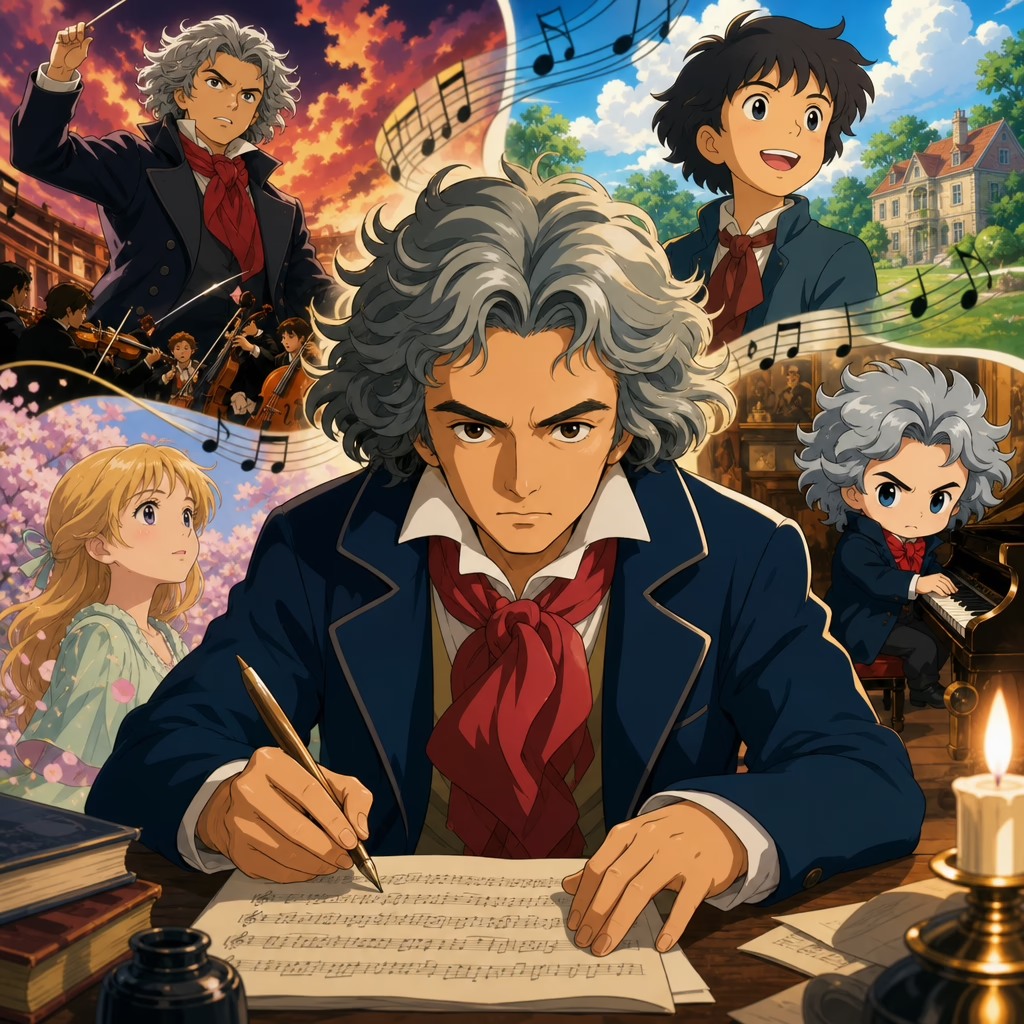
Beethoven in Anime and Animated Film
Ludwig van Beethoven has become one of the most recognizable composers in screen culture, and anime plus animated film have used his music with unusual intensity. In these works, Beethoven is rarely background decoration. He signals conflict, genius, discipline, fate, revolution, grief, or transcendence in seconds. That shorthand matters because animation depends on compressed visual storytelling, and few musical references carry as much narrative weight as the opening of the Fifth Symphony, the choral finale of the Ninth, or the moonlit stillness associated with the “Moonlight” Sonata. After years of tracking music cues in anime, production notes, soundtrack credits, and scene construction, I have found that Beethoven appears most often when creators need immediate emotional authority combined with cultural breadth.
Beethoven in anime and animated film can mean three related things. First, it can mean direct use of a Beethoven composition in the soundtrack, whether in original recording, rearrangement, or quotation. Second, it can mean a story about performers practicing Beethoven, with the score functioning as a plot device rather than a cue. Third, it can mean visual or thematic invocation of Beethoven’s public image: the storm-tossed genius, the deaf artist, the heroic individual confronting society. These uses overlap. A scene may show a pianist rehearsing a sonata while also framing the performer as a rebel or visionary, borrowing from the long cultural mythology that surrounds the composer.
This topic matters because animation has played a major role in how younger audiences encounter classical music. For many viewers, a first emotional experience of Beethoven does not come from a concert hall, a school curriculum, or a streaming service playlist. It comes from an anime recital scene, a mecha battle scored with symphonic grandeur, or a children’s film that repurposes a famous melody for wonder or melancholy. Studying those moments reveals not only how Beethoven travels across media, but also how Japanese and international animators use inherited Western canon material to express highly local ideas about ambition, class, education, trauma, romance, and modernity.
It also reveals a practical truth about animation production. Beethoven is useful because he is both specific and flexible. Specific, because his best-known works carry instantly identifiable motifs; flexible, because those motifs can be reorchestrated for piano, strings, electronic textures, school ensembles, or full orchestra without losing identity. That adaptability has made Beethoven especially valuable in animated stories centered on music students, elite conservatories, and emotionally heightened competition. For a wider perspective on how he gained this kind of worldwide symbolic power, see the main guide at why Beethoven became a global cultural icon.
Why Beethoven fits anime’s emotional grammar
Anime often relies on rapid movement between tonal extremes: comedy to heartbreak, stillness to catastrophe, private longing to public spectacle. Beethoven’s music suits that grammar because it is built on tension, contrast, and release. The Fifth Symphony turns a tiny rhythmic cell into relentless forward motion. The “Pathétique” Sonata balances rhetorical drama with lyrical vulnerability. The Ninth Symphony moves from struggle toward communal affirmation. These are not vague associations imposed later; they are structural qualities that animators and music directors can map onto narrative beats with precision.
In practice, creators use Beethoven when they need emotional legibility across audiences. A viewer unfamiliar with sonata form can still feel the severity of repeated chords, the lift of a major-key arrival, or the ceremonial force of a chorus. Animation amplifies this by synchronizing gesture and sound. A bow stroke, a close-up of a trembling hand, a city skyline at dawn, or a battlefield montage gains extra force when paired with a composition already coded as monumental. Because anime frequently embraces earnestness without irony, Beethoven’s moral seriousness can be presented directly, not as parody but as conviction.
There is also a historical layer. Japanese music education has long included Western classical repertoire, and Beethoven holds a special place within that system. School performance culture, piano examinations, and year-end choral traditions have made certain works deeply familiar even outside specialist circles. That means an anime audience in Japan may catch references that are both emotional and social: a difficult sonata suggesting elite training, a choral excerpt implying ceremony, or a symphonic quotation invoking national concert traditions. Animated films made for international release can draw on the same repertoire because Beethoven remains globally legible.
Performance anime and the discipline of Beethoven
The clearest use of Beethoven appears in performance-centered anime, where the music is not decorative but inseparable from character development. In series about pianists, violinists, orchestras, or conservatory life, Beethoven often marks the threshold between competence and seriousness. Teachers assign him to test technique, stamina, interpretation, and emotional maturity at once. That is believable. His keyboard writing exposes uneven touch, rushed transitions, weak voicing, and shallow phrasing immediately. His chamber and orchestral works likewise reveal whether players can coordinate structure, not just execute notes.
From my own experience watching recital episodes and comparing them with score expectations, Beethoven is often chosen because he dramatizes labor on screen. Repetition scenes make sense with his music. Slow practice of arpeggiated accompaniment, metronome work on dotted rhythms, sectional rehearsal of scherzo passages, and debate over tempo all feel authentic when attached to Beethoven. A Chopin nocturne can stage intimacy beautifully, but Beethoven stages process. He lets animators show how a young musician wrestles with the score, with a mentor, and with the self-image of becoming “worthy” of a canonical composer.
One reason titles such as Nodame Cantabile, Your Lie in April, and other music-driven anime resonate is that classical repertoire is treated as social language. A Beethoven selection tells the audience something before the character speaks. It may announce rigor, inherited expectations, rebellion against softness, or a desire to be taken seriously. When a gifted but unstable performer reaches for Beethoven, the choice can suggest overidentification with struggle. When a disciplined student masters Beethoven cleanly but fails to move listeners, the story can contrast accuracy with interpretation. Animation can visualize these distinctions through color, framing, and subjective cutaways.
| Beethoven work | Typical animated use | What it communicates quickly |
|---|---|---|
| Symphony No. 5 | Conflict, pursuit, revelation, high-stakes montage | Fate, urgency, inevitability |
| Symphony No. 9 | Finale, collective action, spiritual or social climax | Scale, unity, transcendence |
| “Moonlight” Sonata | Nocturnal reflection, grief, isolation | Interior sorrow, suspended time |
| “Pathétique” Sonata | Recital challenge, emotional self-assertion | Drama, seriousness, technical control |
| “Für Elise” | Introductory lesson, ironic familiarity, childhood memory | Accessibility, recognition, training |
Beethoven as character shorthand in animated storytelling
Even when Beethoven is not heard in full, his cultural profile shapes character design and narrative stakes. Animation likes archetypes, and Beethoven provides one of the strongest in music history: the uncompromising creator who turns suffering into form. That image can be used sincerely or critically. A conductor obsessed with perfection, a pianist alienated by talent, or a composer figure struggling with hearing, illness, or loneliness may be framed through Beethovenian cues without any direct biography lesson. Wild hair, severe manuscripts, storm imagery, and explosive rehearsal scenes all participate in that shorthand.
What makes this effective is the contrast between animation’s visual stylization and Beethoven’s cultural solidity. A fantastical setting can still borrow his aura of authenticity. In magical-school anime, a recital of Beethoven can ground the world with real artistic standards. In science-fiction animation, a Beethoven motif can link futuristic spectacle to a deep human past. Stanley Kubrick demonstrated the power of classical quotation in film generally, but animation has pushed it further by making music physically visible through metamorphosing spaces, symbolic debris, and exaggerated body language. Beethoven thrives in that environment because his public image already invites hyperbole.
There is a limitation here, and responsible criticism should state it clearly. The “tormented genius” frame can flatten both Beethoven and the animated characters who reference him. It risks implying that cruelty, isolation, or emotional damage are the price of artistic greatness. Better works avoid this trap by showing technique, collaboration, and listening, not just suffering. When anime uses Beethoven well, it does not merely paste prestige onto a scene. It demonstrates why a performer chooses this music, what interpretive problem the piece poses, and how the surrounding community responds.
How specific works function in anime and animated film scenes
Different Beethoven pieces do different jobs. The Fifth Symphony is the most efficient cue for externalized struggle. Its famous opening works in action, satire, sports training, and psychological confrontation because the rhythmic profile is unmistakable. Editors can cut to it aggressively. Animators can time impacts, glances, and reveals to the motif without losing coherence. The Ninth Symphony, especially the “Ode to Joy,” does almost the opposite. It expands the frame. It turns an individual scene into a collective one, whether the emotion is hopeful, ironic, militarized, or apocalyptic. Because the melody is so public-facing, it can unify crowds on screen instantly.
Piano sonatas serve more intimate purposes. The “Moonlight” Sonata is frequently over-associated with sadness in popular media, but in animation that simplification can still work if the scene needs suspended inwardness. The “Pathétique” offers more rhetorical bite, especially in audition or competition contexts. “Für Elise,” though lighter and often reduced to beginner familiarity, is valuable when a story wants to show the gap between casual recognition and real musicianship. A child pecking out its opening communicates one level of musical contact; a trained performer shaping inner voices and pedaling in a late sonata communicates another entirely.
Arrangements matter too. Anime sound departments rarely treat Beethoven as fixed. A classroom string version, jazz reharmonization, electronic remix, or sparse solo piano reduction can alter meaning sharply while preserving recognition. I have seen scenes where a fragment is enough: two measures quoted under dialogue to suggest a whole world of discipline or inherited taste. That flexibility explains Beethoven’s durability in animated film, where budget, runtime, and target audience vary widely. A family-oriented feature might soften him into warmth and familiarity, while an adult-oriented animated drama may use the same composer to convey severity or historical weight.
Japanese cultural context and global circulation
Any deep dive into Beethoven in anime must account for Japan’s own relationship with his music. Beethoven is not simply imported prestige. He has been localized through education, broadcasting, amateur performance, and seasonal concert customs. The most famous example is the Japanese year-end performance tradition surrounding the Ninth Symphony, often called “Daiku.” Large community choruses and professional ensembles have made the work part of public life in a way many non-Japanese viewers do not immediately realize. When an anime references the Ninth, domestic audiences may hear not abstract Europe but a familiar civic ritual.
This context changes interpretation. A Beethoven cue in anime can signify aspiration toward elite Western art, but it can also signal ordinary institutional life: school choir culture, exam preparation, youth orchestra hierarchy, or the emotional memory of annual concerts. That dual status helps explain why Beethoven travels so well inside Japanese animation. He belongs to high culture and mass familiarity at the same time. Animated films distributed abroad then export that localized Beethoven back into the global media ecosystem, where international viewers read the same scenes through their own educational or cinematic associations.
Global circulation also encourages feedback loops. An anime performance scene can send viewers to recordings by Glenn Gould, Wilhelm Kempff, Mitsuko Uchida, Alfred Brendel, or Herbert von Karajan, depending on the work. Those recordings then shape how audiences imagine the animated moment should sound. Streaming platforms, fan edits, and soundtrack uploads intensify this process. Beethoven becomes not just a cited composer but a discovery pathway. That is one reason animated uses of his music deserve close attention: they are often entry points into long-term listening habits, not fleeting references.
What these uses reveal about animation itself
Beethoven’s persistence in anime and animated film reveals that animation is exceptionally good at translating abstract music into visible narrative. Live action can stage performances powerfully, but animation can literalize rhythm, memory, and interpretation without breaking tone. It can turn a crescendo into flooding light, a fermata into suspended motion, or a harmonic shift into architectural transformation. Beethoven benefits because his music invites structural metaphors: knocking motives, heroic ascent, destabilizing silence, and communal release. Animators can make those metaphors concrete.
The strongest examples understand that Beethoven is not valuable merely because he is famous. He is valuable because his works contain clear formal tensions that match the medium’s needs. When a scene succeeds, viewers do not feel that the film borrowed prestige from the canon. They feel that sound and image solved a storytelling problem together. That is the central insight. Beethoven in anime and animated film is not an odd niche; it is a precise case study in how cultural memory, music education, and audiovisual design combine to create meaning across borders.
For viewers, the payoff is simple. Rewatch the scenes that use Beethoven and ask three questions: which work appears, what character problem it frames, and how the animation changes your hearing of the music. That method quickly reveals why these references endure. Beethoven gives animators a vocabulary for struggle, tenderness, discipline, and transformation, while animation gives Beethoven new bodies, new settings, and new audiences. Follow those connections, and the next anime recital, finale, or dream sequence will sound richer and mean more.
Frequently Asked Questions
Why does Beethoven appear so often in anime and animated film?
Beethoven appears so often in anime and animated film because his music communicates meaning almost instantly. Animation relies on compression: a few images, a short musical phrase, and a carefully timed cut often have to deliver character psychology, emotional scale, and narrative momentum all at once. Beethoven is especially useful in that environment because his best-known works already carry strong cultural associations. The opening of the Fifth Symphony suggests inevitability, struggle, crisis, and confrontation within seconds. The “Moonlight” Sonata can imply introspection, sorrow, loneliness, or haunted beauty. The “Ode to Joy” from the Ninth Symphony can evoke triumph, unity, idealism, or irony, depending on how it is staged.
In anime, where symbolism and emotional intensity are often heightened, Beethoven’s music becomes more than a soundtrack choice. It functions as narrative shorthand. A director can use it to frame a character as disciplined, obsessive, tragic, visionary, or revolutionary without lengthy explanation. In animated films more broadly, the same pieces can elevate scenes beyond realism and into mythic or psychological territory. That is one reason Beethoven is rarely used as neutral background decoration. When he enters the soundtrack, viewers tend to read the moment as important, conflicted, or transformative.
There is also a practical reason for his recurring presence: Beethoven is one of the most globally recognized composers in Western classical music. Even audiences with limited classical training often recognize key themes immediately. That recognition helps directors and composers build emotional clarity across cultures. In short, Beethoven persists in anime and animation because his music is dramatic, iconic, and flexible enough to support everything from battle scenes and breakdowns to satire and transcendence.
What does Beethoven usually symbolize in animated storytelling?
In animated storytelling, Beethoven usually symbolizes forces that are larger than ordinary life. Most often, he stands for struggle, destiny, genius, discipline, rebellion, grief, or spiritual ascent. The exact meaning depends on the piece chosen and the way it is placed in the scene, but his music nearly always adds weight. A Beethoven cue tells the audience that what is happening matters on a moral, emotional, or existential level.
One of the most common associations is conflict transformed into form. Beethoven’s music often sounds driven, structured, and hard-won, which makes it ideal for scenes about intense effort or confrontation. In anime especially, that can map onto rivalries, training arcs, psychological duels, social rebellion, or apocalyptic stakes. His work also frequently signals genius under pressure. A character linked with Beethoven may be portrayed as brilliant but burdened, controlled yet volatile, or isolated by talent.
Another important symbolic use is irony. Because Beethoven carries such grandeur, animators can deploy him against absurd or grotesque imagery to create contrast. A majestic choral passage paired with chaos, vanity, or destruction can suggest hypocrisy, delusion, or the collapse of noble ideals. Likewise, quieter Beethoven pieces can underscore emotional fracture beneath a calm surface. This range is part of his power in animation: he can represent sincerity and parody, heroism and tragedy, civilization and collapse.
What remains consistent is that Beethoven is seldom casual. His presence tends to push a sequence into a higher register of meaning. Whether the story is serious, comic, dystopian, or fantastical, Beethoven usually tells viewers to look beyond the literal action and pay attention to the deeper symbolic stakes.
Which Beethoven works are most commonly referenced in anime and animated films, and why?
The most commonly referenced Beethoven works in anime and animated films are the Fifth Symphony, the Ninth Symphony, and the “Moonlight” Sonata, though other works such as the “Pathétique” Sonata, “Für Elise,” the Seventh Symphony, and the “Emperor” Concerto also appear. These pieces recur because they are instantly identifiable and already loaded with emotional and cultural meaning.
The Fifth Symphony is perhaps the strongest example of narrative shorthand in all of classical music. Its famous opening motif is concise, unmistakable, and dramatically charged. In animation, it can suggest looming fate, a declaration of conflict, an impending clash, or the force of historical inevitability. Because anime often thrives on heightened emotional stakes and sudden tonal escalation, the Fifth is an ideal fit.
The Ninth Symphony, especially “Ode to Joy,” is used for different but equally potent reasons. It can represent triumph, collective hope, civilization, human aspiration, or overwhelming spectacle. At the same time, many filmmakers use it ironically. In those cases, the music’s idealism is set against violence, corruption, or absurdity, making the contrast even more powerful. That double function has made the Ninth especially durable in screen culture.
The “Moonlight” Sonata serves another purpose altogether. It is intimate rather than public, inward rather than monumental. In animated storytelling, it often marks melancholy, memory, loneliness, fragility, or nocturnal reflection. It can deepen quieter scenes or give emotional shading to a character who cannot fully express what they feel.
These works are favored not simply because they are famous, but because each one arrives with a distinct emotional profile. Directors do not need to build that profile from scratch. They can rely on audience recognition, then shape the meaning through context, editing, voice acting, and visual design. That efficiency makes Beethoven especially valuable in animation, where every second of storytelling counts.
How is Beethoven used differently in anime compared with live-action film?
Beethoven is often used more boldly in anime than in live-action film because animation can externalize emotion and symbolism with fewer constraints. In live action, Beethoven may underscore prestige, seriousness, historical setting, or psychological complexity, but the visual world usually remains tied to the physical credibility of actors and environments. Anime, by contrast, can match the scale and intensity of Beethoven’s music with stylized motion, impossible imagery, sudden tonal shifts, and overt metaphor. That gives directors more freedom to make the music feel fused with the world of the story rather than simply layered onto it.
Another difference is that anime frequently treats music as a visible force. A Beethoven passage may shape the rhythm of editing, the choreography of combat, the framing of transformation, or the inner state of a character in ways that are explicitly theatrical. Emotional experiences can become landscapes, symbolic objects can take over the frame, and a familiar classical theme can become part of a character’s mythos. In that sense, Beethoven in anime often feels declarative. It does not merely accompany intensity; it announces it.
Anime is also more willing to blend reverence and exaggeration. Beethoven can be used sincerely to convey transcendence, but he can also appear in hyper-stylized, comic, or self-aware scenes that play with his cultural prestige. This elasticity suits an art form comfortable with sudden movement between parody and emotional gravity. Live-action cinema certainly uses Beethoven ironically as well, but animation can push that contrast further because its visual language is less bound by realism.
Most importantly, anime often uses Beethoven to condense interiority. Characters who are emotionally repressed, intellectually isolated, or consumed by ambition can be defined through a musical citation faster than through dialogue alone. In a medium built on expressive shorthand, Beethoven becomes a highly efficient storytelling device—one capable of carrying psychology, theme, and tone at the same time.
Does using Beethoven in anime and animated film change how audiences understand his music?
Yes, repeated use of Beethoven in anime and animated film can absolutely shape how audiences understand his music. For many viewers, screen media is their most frequent encounter with classical repertoire. That means Beethoven is often heard first not in a concert hall, but in scenes of crisis, revelation, conflict, mourning, or triumph. Over time, those associations can become so strong that the music feels inseparable from particular moods or visual conventions.
This influence can be limiting in one sense. A famous piece like the Fifth Symphony may become reduced to a simple code for danger or fate, while “Ode to Joy” may be heard only as victory music or grand irony. Beethoven’s real musical complexity is broader than those clichés. His works contain ambiguity, formal experimentation, wit, intimacy, and contradiction that go far beyond the most familiar screen uses. When animation repeatedly leans on his most iconic gestures, it can flatten public perception.
At the same time, animation can also deepen appreciation. A well-chosen Beethoven cue often sends viewers back to the original work with fresh curiosity. Anime and animated films can make listeners notice structure, mood, and emotional architecture in a new way. Because these media are so strong in visual metaphor, they can illuminate aspects of Beethoven’s music that might otherwise seem abstract to newcomers. A scene of transformation, collapse, or yearning can provide an emotional entry point into the score.
In that respect, screen use does not simply borrow authority from Beethoven; it actively participates in his modern cultural meaning. Each new appearance adds another layer to how audiences hear him. Today, Beethoven is not just a canonical composer from the past. He is also a living symbol within popular media, especially in animation, where his music continues to signify intensity, significance, and the possibility of transcendence.