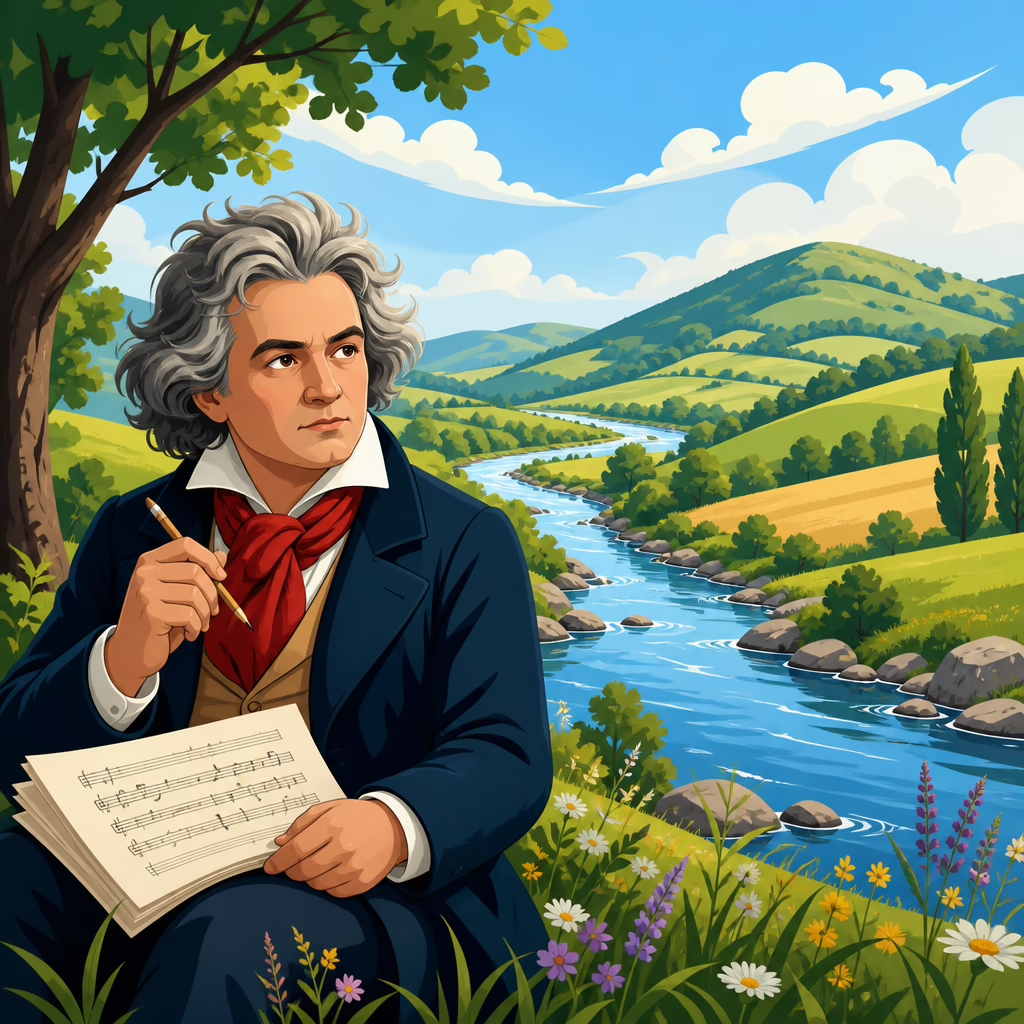
Beethoven’s Relationship to Rivers Fields and Hills
Ludwig van Beethoven’s relationship to rivers, fields, and hills was not a decorative background to his life; it was a working environment, a source of emotional regulation, and a practical stimulus for composition. When discussing Beethoven and nature, these landscape features should be understood literally as places he walked through, listened within, and measured his inner life against. Rivers offered motion and sonic variety, fields provided open space and changing light, and hills gave vantage, exertion, and a sense of distance. Together, they formed the recurring terrain of his daily routines around Vienna and in rural retreats such as Heiligenstadt, Döbling, Baden, Mödling, and the villages bordering the Wienerwald.
This matters because Beethoven’s music, notebooks, and reported habits show that he did not treat nature as a poetic abstraction in the way some later artists did. He used it. Friends, pupils, and early biographers repeatedly describe long walks, sudden stops to jot ideas, and deep attentiveness to weather, running water, birds, and the contour of the land. The key term here is not simply inspiration, which is too vague, but environmental immersion: repeated exposure to specific natural settings that shaped mood, physical rhythm, and patterns of thought. To understand Beethoven’s rivers, fields, and hills is to understand how his compositional life functioned on the ground, hour by hour, step by step.
Vienna around 1800 made this relationship possible. The city was large enough to sustain a major musical career yet still close to cultivated land, vineyards, streams, floodplains, and rising wooded edges. Beethoven could move quickly from urban rooms into semi-rural terrain. That accessibility was crucial, especially as his hearing deteriorated and social life became more difficult. Outdoor movement gave him relief from confinement, but it also offered a setting where vibration, visual pattern, and bodily motion could replace the ease of ordinary conversation. In that sense, rivers, fields, and hills were not merely scenic preferences. They became part of the structure by which he kept working.
The evidence is strongest when we stay close to documented habits rather than romantic myth. Beethoven carried sketchbooks, took lengthy walks in all seasons, favored lodgings with easy access to open country, and was remembered as noticing natural detail with unusual intensity. His famous “Pastoral” orientation does not exhaust the subject. Even outside explicitly programmatic works, his attachment to rolling ground, paths beside water, and broad agricultural spaces helps explain the tension in his music between restless forward motion and hard-won repose. Those landscapes gave him both movement and stillness, and he returned to them because they answered concrete needs of body, mind, and craft.
Rivers as moving sound and mental framework
Beethoven’s experience of rivers and streams around Vienna was practical before it was symbolic. Waterways structured walking routes, connected villages, cooled summer air, and created a continuous field of changing sound. Anyone who has worked outdoors with ideas knows the value of such sound: unlike speech, running water masks interruptions without demanding attention. In Beethoven’s case, that mattered more as deafness advanced. He could still sense environmental motion visually and physically, and earlier in life he had absorbed the tonal and rhythmic irregularity of brooks, currents, and riverbanks. Water offered continuity without mechanical sameness, a useful analogue for musical development.
The second movement of the Sixth Symphony, “Scene by the Brook,” is the obvious example, but it should be read as evidence of long familiarity rather than a one-off depiction. Beethoven did not invent a brook from literary convention; he translated repeated observation into musical terms. The undulating accompaniment, patient harmonic pacing, and bird calls near the end show selection and stylization, not mere imitation. He knew that water never repeats exactly, yet it maintains identity across variation. That is also how many of his middle-period developments work: a figure persists while surface detail changes. Rivers taught constancy within flux.
Local geography supports this reading. In and around Vienna, Beethoven encountered the Danube and its branches, smaller streams, and waters near spa towns where he often stayed. Baden, for example, combined therapeutic routines with nearby natural routes. Mödling and Heiligenstadt likewise placed him close to paths shaped by drainage, creeks, and valleys. These were not dramatic Alpine torrents but accessible Central European waters integrated into lived landscapes of mills, vineyards, gardens, and roads. That mix matters. Beethoven’s response to rivers was rarely wilderness worship. He valued inhabited nature, where cultivated life and natural process coexisted.
Water also solved a compositional problem I have seen repeatedly in music manuscripts from outdoor-working composers: how to keep ideas moving without forcing them. Beethoven’s notebooks suggest he generated motifs rapidly, then tested them through repetition and alteration. A riverside walk supports exactly that mental process. The eye follows a line; the ear receives varied but continuous input; the body settles into a pace. Under those conditions, thematic fragments can circulate until a workable form appears. This helps explain why Beethoven so often paired walking with sketching. The landscape did not compose for him, but it stabilized the cognitive conditions in which composition could proceed.
Fields as openness, light, and productive solitude
Fields mattered to Beethoven because they created a different kind of attention from rivers. Where water organizes space through a line, fields open it into breadth. Open agricultural land around Vienna offered long sightlines, changing cloud cover, wind in grasses, and visible seasonal labor. In practical terms, fields reduced sensory crowding. There were fewer walls, fewer enclosed echoes, and fewer social demands. Beethoven, often irritable in cramped domestic settings and increasingly isolated by hearing loss, appears to have used such spaces to recover equilibrium. Open ground gave him room to think without the friction of interior life.
That breadth has a musical counterpart. In many Beethoven works, especially from the middle period onward, one hears a struggle to create expansion without losing coherence. Fields model expansion visually. A field looks spacious, but it is not empty; it is organized by furrows, boundaries, paths, and crop patterns. Beethoven’s musical large-scale thinking often behaves similarly. He broadens a movement through repetition, registral spread, and harmonic delay, yet underlying structures remain firm. When contemporaries described him wandering through country lanes or standing motionless in thought, they were observing a composer using visible spatial order to support abstract form.
Fields also linked Beethoven to ordinary rural labor. This is easy to miss if one treats his nature preference as refined sentiment. The landscapes near Vienna were worked landscapes: haymaking, grazing, viticulture, cart traffic, and seasonal maintenance shaped what he saw. That realism enters the “Pastoral” Symphony’s peasant dance movement, but the relationship goes deeper. Beethoven admired dignity in effort, persistence under strain, and the rhythms of repeated task. Agricultural fields embodied those values. They showed productivity tied to season, patience, and recurrence, all concepts deeply aligned with his working method of drafting, revising, and testing materials over time.
For a broader view of how regular outdoor movement fed Beethoven’s creative life, see the main guide at Beethoven’s love of walking and what it meant for his music. Within that larger pattern, fields stand out because they offered solitude without total isolation. A walker in farmland may see distant workers, cottages, church towers, or wagons while remaining psychologically separate. Beethoven appears to have preferred exactly that balance. He was neither a hermit nor a salon creature. Open fields let him remain inside human territory while escaping conversational pressure.
Hills, exertion, and the value of vantage
Hills contributed something rivers and fields could not: effort joined to perspective. The rising ground around Vienna, especially in the vineyard districts and wooded approaches to the Wienerwald, demanded physical exertion and rewarded it with views. Beethoven was a committed walker, and uphill movement would have intensified circulation, breathing, and bodily awareness. For a composer who thought through motion, that mattered. Climbing imposes phrase-like energy patterns: push, pause, resume, arrive. It is difficult not to hear a kinship between that bodily pattern and Beethoven’s characteristic handling of tension, especially his use of incremental ascent, delayed release, and sudden panoramic opening.
Views from hills also changed scale. A valley floor gives detail; a hilltop gives relation. Beethoven needed both. In sketching, composers often move between local problem and whole design: a motive here, a transition there, then the architecture of an entire movement. Elevated ground offers a physical metaphor for that shift. Accounts of Beethoven outdoors frequently stress absorption, abrupt mood changes, and intense self-dialogue. From experience studying creative routine, I would argue that hills aided not by supplying picturesque feeling but by enabling structural thinking. Looking outward from height encourages the mind to sort parts into wholes.
Heiligenstadt is especially important here. The area combined vineyards, uneven ground, and access to expansive outlooks, and it was there in 1802 that Beethoven confronted the crisis documented in the Heiligenstadt Testament. Although the document itself is not a landscape description, its setting matters. He was living in a place where cultivated hillsides and paths could support withdrawal, reflection, and difficult resolve. The hill country did not cure despair, but it offered a stage on which endurance became physically enactable. To walk uphill despite pain and isolation was not a cure. It was practice in perseverance.
The same logic applies to later summer stays in Baden and nearby districts. Beethoven sought lodgings that let him step quickly into terrain with gradient and prospect. He did not choose such places accidentally. Hills provided controlled difficulty. Unlike urban confinement, they asked something of him and returned something measurable: distance covered, elevation gained, horizon expanded. That transaction helps explain why nature remained central even when deafness worsened. As auditory confidence declined, the body’s dialogue with slope, path, and balance became more important. Hills let Beethoven think through resistance, and resistance was the element he turned more consistently than any other into art.
What these landscapes reveal about Beethoven’s working method
When rivers, fields, and hills are considered together, a clear pattern emerges. Beethoven selected environments that matched different stages of thought. Rivers supported flow and iterative variation. Fields supported breadth, calm, and sustained concentration. Hills supported exertion, overview, and the conversion of struggle into order. This is not speculative psychology detached from sources; it aligns with known habits of walking, sketching, seasonal relocation, and sensitivity to natural setting. It also explains why references to nature in Beethoven are so often concrete. He was not collecting pretty impressions. He was using terrain as a compositional tool.
| Landscape feature | Practical effect on Beethoven | Likely musical parallel | Representative setting |
|---|---|---|---|
| Rivers and streams | Steady walking routes, changing ambient sound, mental continuity | Flow, variation within sameness, sustained motion | Brooks near Heiligenstadt, Baden waterways, Danube environs |
| Fields | Open sightlines, reduced crowding, productive solitude | Expansion, spacious phrasing, ordered breadth | Agricultural land around Vienna and summer villages |
| Hills | Physical exertion, elevated views, reflective distance | Ascent, tension and release, structural overview | Vineyard slopes, Wienerwald edges, Heiligenstadt heights |
There are limits to what can be claimed. No serious scholar should say a given hill produced a given sonata theme. Beethoven’s compositional process was too complex, and documentary evidence is uneven. Yet it is equally mistaken to reduce his outdoor habits to anecdote. Repeated behavior across decades, consistent testimony from people around him, and strong correspondence between environment and musical character justify firmer conclusions. Landscapes influenced Beethoven less as a catalogue of symbols than as a matrix of routines. They shaped when he walked, how he thought, what sensations accompanied work, and how he bore the pressure of his own ambition and illness.
Beethoven’s relationship to rivers, fields, and hills shows nature operating at the exact scale where creative life is lived: not in grand theory, but in routes taken, slopes climbed, pauses held, and ideas caught before they vanished. Rivers gave him moving continuity, fields gave him spacious clarity, and hills gave him perspective earned through effort. Those landscapes were companions to labor, not escapes from it. If you want to understand Beethoven more precisely, stop treating nature as a romantic backdrop and start treating terrain as part of his method. Read the places around Vienna as seriously as the scores, and the music becomes more human, disciplined, and legible.
Frequently Asked Questions
How did rivers, fields, and hills actually shape Beethoven’s daily life and creative process?
For Beethoven, rivers, fields, and hills were not symbolic accessories to his reputation as a “nature-loving” composer. They were part of the physical structure of his working life. He regularly walked outside Vienna and in nearby rural areas, using the landscape as a place to think, observe, regulate his emotions, and develop musical ideas. Rivers mattered because they offered movement, irregular rhythm, and layered sound: flowing water, shifting currents, echoes, wind, and changing acoustic textures. Fields gave him breadth and visual openness, which likely supported the kind of long-form concentration needed for composition. Hills added elevation, distance, and changing perspective, allowing him to move between immersion in detail and a broader mental outlook.
These places also helped him maintain a practical routine. Beethoven was known for long walks, and those walks were often inseparable from musical labor. He carried sketchbooks, stopped to note ideas, and used outdoor motion as part of the compositional process itself. Rather than sitting indoors waiting for inspiration, he worked through ideas while moving through real terrain. In that sense, rivers, fields, and hills functioned almost like an external studio: a place where perception, memory, and musical invention could interact. This makes his relationship to landscape deeply concrete. Nature was not simply something he admired; it was something he used.
Why are rivers especially important when discussing Beethoven’s connection to nature?
Rivers are especially important because they combine motion, sound, and unpredictability in a way that aligns closely with Beethoven’s musical imagination. A river is never static. It changes pace, density, texture, and volume depending on weather, season, and terrain. For a composer so attuned to transformation and development, that kind of environment would have provided both sensory stimulation and a living model of continuous variation. The sound of water is not a single sound but a complex field of sonic events: rushing, splashing, murmuring, striking banks or stones, blending with birds, wind, and distant human activity. Beethoven, who thought intensely in terms of dynamic contrast and evolving material, would have encountered in rivers a naturally unfolding musical environment.
There is also an emotional dimension. Rivers can calm, but they can also agitate; they can suggest order, flow, and continuity, or power and turbulence. That duality fits Beethoven remarkably well. His music often moves between control and force, repose and unrest, lyrical continuity and dramatic interruption. A river is therefore more than a picturesque image in relation to his life. It represents a real environment in which he could listen, reset his mind, and test his own emotional states against something larger and constantly in motion. When scholars and readers discuss Beethoven’s love of nature, rivers deserve attention not merely as scenery but as dynamic acoustic and psychological spaces.
What role did fields and open countryside play in Beethoven’s emotional and mental life?
Fields and open countryside offered Beethoven a kind of release that urban interiors and social obligations often could not. Open land creates room for distance, silence, changing light, and uninterrupted walking, all of which would have mattered to someone with Beethoven’s temperament. He was capable of intense concentration and equally intense frustration. Wide outdoor spaces likely helped him regulate that pressure. In a field, the eye can travel without obstruction; the body can move without confinement; the mind can work without the same kind of immediate social interference found in domestic or city settings. That spaciousness is not trivial. For a composer managing creative strain, physical discomfort, and increasing hearing difficulties, openness itself could be restorative.
Fields also offered subtle forms of variation that suit Beethoven’s sensibility. They are not empty in a simplistic sense. They change with season, weather, cultivation, color, and light. Morning and evening transform them. Wind moves through grasses and crops with shifting rhythmic patterns. Paths cut across them in irregular lines. This kind of quiet variation parallels the way Beethoven could build large expressive effects from modest, repeated, or slowly altered material. The countryside, then, was not merely a place to “escape.” It was a setting in which he could recover emotional balance while remaining mentally active. That combination of calm and stimulation helps explain why landscape was so important to him as a working composer, not just as a private individual.
How did hills and elevated views influence Beethoven’s experience of the natural world?
Hills provided Beethoven with something distinct from rivers and fields: vantage, contour, and a felt sense of ascent. Climbing or walking along elevated ground changes how a person experiences time, effort, and space. It creates pauses, exertion, and moments of expanded view. For Beethoven, who often measured his inner life through struggle, release, and transformation, hills would have carried a particular experiential weight. They made the body work differently, and that bodily experience may have reinforced patterns of thought central to his music: tension followed by breakthrough, difficulty followed by breadth, closeness followed by distance.
Elevated views also help organize perception. From a hill, one sees relationships rather than isolated fragments: the course of a river, the spread of fields, the shape of roads, villages, weather fronts, and changing light across larger spaces. That broader perspective resonates strongly with Beethoven’s architectural sense in composition. He was a master of large-scale form, of understanding how parts belong within a whole. While it would be too simplistic to say a hill directly “caused” a symphonic idea, elevated landscapes likely supported a mental habit of perceiving structure across distance. Hills therefore mattered not just because they were beautiful, but because they offered a physical analogue to perspective, effort, and expanded vision—qualities deeply consistent with Beethoven’s artistic character.
Was Beethoven’s relationship to these landscapes mainly emotional, or did it have direct musical consequences?
It was both emotional and directly musical, and separating the two too sharply can be misleading. Beethoven’s emotional life and compositional practice were tightly linked. When rivers, fields, and hills helped him regulate mood, restore concentration, or create mental clarity, they were already affecting the conditions under which music could be made. But the influence goes beyond general well-being. These environments supplied rhythm, pacing, contrast, atmosphere, and forms of attentive listening that could feed compositional thought. Outdoor walking encourages patterns of repetition and variation; changing terrain creates bodily rhythms; natural soundscapes train the ear to notice layers, interruptions, continuities, and dynamic shifts. All of these are musically relevant experiences.
At the same time, it is important to avoid reducing Beethoven’s music to literal landscape description. His relationship to nature was not a simple matter of turning a river into a melody or a hill into a chord progression. Rather, the landscapes became part of how he thought, felt, and worked. They influenced his responsiveness to motion, stillness, expansiveness, and organic change. In that sense, the musical consequences were deep rather than superficial. Nature did not merely decorate his imagination; it sharpened it. Rivers, fields, and hills gave Beethoven real places in which to listen outwardly and inwardly at once, and that dual listening was central to the force and originality of his art.