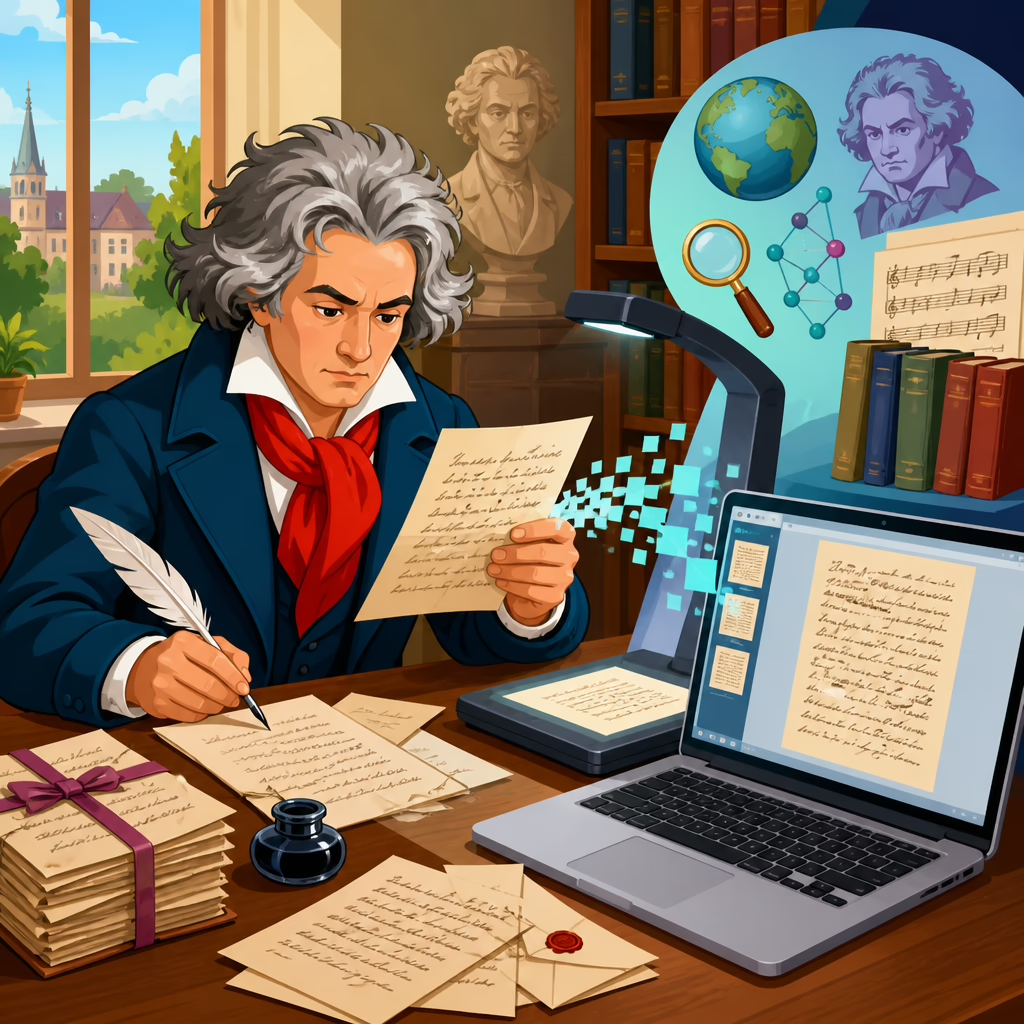
Digitizing Beethoven Letters for New Research
Digitizing Beethoven letters for new research is no longer a niche archival task; it is a foundational method for reshaping how scholars study the composer’s life, networks, business dealings, and creative process. In this context, digitizing means far more than scanning paper. It includes high-resolution imaging, metadata creation, transcription, text encoding, translation support, rights management, and the design of searchable scholarly interfaces. Beethoven letters are especially important because they preserve evidence that scores alone cannot supply: deadlines requested by publishers, complaints about copyists, references to patrons, details of health, reactions to political events, and remarks that illuminate the circumstances around specific compositions. When these documents remain dispersed across archives, auction catalogs, private collections, and older print editions, researchers lose time locating sources and may miss meaningful patterns entirely.
I have worked with music-historical document collections where the largest obstacle was not interpretation but access. A letter may be known from a nineteenth-century transcription, partially reproduced in a thematic catalog, and later rescanned from the autograph, yet these versions often disagree in punctuation, dates, damaged words, or recipient names. Digitization creates the conditions for comparison at scale. It allows a researcher to place an autograph image beside diplomatic and normalized transcriptions, compare editorial interventions, and search hundreds of references to publishers such as Breitkopf & Härtel or Artaria in seconds. For Beethoven studies, this matters because the documentary record is fragmented and multilingual, with German, French, and Italian material appearing across different repositories and editions.
The phrase new research is equally significant. Digital access does not simply speed up traditional biography; it enables questions that were previously impractical. Scholars can trace correspondence networks over time, measure seasonal bursts of letter writing, identify recurring intermediaries, or map references to payment, illness, travel, and composition. Conservators can inspect ink flow and paper damage at magnifications unavailable in print facsimiles. Editors can revise dating arguments by comparing watermarks, postal marks, and handwriting features across corpora. Students and performers also benefit because well-built digital editions reduce the distance between archival evidence and interpretive understanding. The result is a richer, more testable view of Beethoven as a working musician navigating social and commercial systems, not just an isolated genius preserved in anecdote.
Why Beethoven’s correspondence demands careful digitization
Beethoven’s letters are unusually challenging sources. Many survive only in copies, excerpts, sale descriptions, or early editions prepared under editorial assumptions that no longer satisfy current standards. Some autographs are damaged, cropped, or split across collections. Others were dated retrospectively by scholars using internal clues such as mentions of rehearsals, patrons, housing changes, or works in progress. Even when the physical document survives, old catalog records may use inconsistent spellings for names and places. A digital project that simply scans pages without reconciling these problems produces an attractive but weak resource. Serious digitization requires item-level metadata, controlled vocabularies, provenance notes, and transparent editorial policies.
In practice, the first major decision is whether the project aims to create a preservation surrogate, a reading edition, or a research dataset. Those goals overlap, but they are not identical. A preservation surrogate prioritizes faithful imaging and stable storage. A reading edition may normalize spelling and silently expand abbreviations for usability. A research dataset must capture uncertainty, variant readings, and links among entities such as correspondents, works, places, and repositories. For Beethoven letters, the best projects usually combine all three layers. They preserve the document image, provide a readable transcription, and expose structured data that supports computational analysis. Without that layered model, researchers are forced to choose between legibility and evidentiary rigor.
The letters also demand contextual linking. A note to a publisher becomes more useful when it is connected to the relevant work catalog number, known publication negotiations, and parallel documents from copyists or patrons. If Beethoven complains that a set of parts was delayed, the letter should be searchable not only by date and recipient but by composition title, genre, and business topic. This is why a focused correspondence database should connect to broader digital Beethoven resources, including work catalogs and score-centered tools. For readers interested in how documentary evidence complements musical analysis, the main guide at how AI tools can help analyze Beethoven scores provides that larger frame.
Building a reliable workflow from archive to searchable text
A dependable workflow begins with imaging standards. Archives typically capture master files in TIFF at high resolution, often 400 to 600 ppi, with color targets and raking light used where paper texture, erasures, or watermarks matter. Derivative JPEG or JPEG 2000 files support web delivery, while persistent identifiers ensure each image remains citable. In Beethoven projects, recto and verso imaging is essential because endorsements, seals, fold patterns, and routing marks can affect dating and provenance. I have seen verso notes by later owners clarify recipient history more decisively than the main text itself. Skipping these features weakens later scholarship.
After imaging comes metadata. At minimum, each letter should record sender, recipient, probable date, place of origin, repository, shelfmark, language, physical description, and rights information. Better records also include associated persons, organizations, mentioned works, paper type, watermark data, and links to prior editions. Standards such as Dublin Core can handle basic description, but richer scholarly projects often rely on TEI for transcription and descriptive encoding because it can represent deletions, insertions, uncertain readings, supplied text, and editorial notes. TEI is especially valuable for Beethoven letters because his manuscripts often contain revisions, emphatic underlining, abrupt syntax, and idiosyncratic spelling that should not be flattened into plain text.
Transcription is where many projects succeed or fail. Optical character recognition is weak on nineteenth-century German handwriting, and even the best handwriting text recognition systems need careful training and review. Platforms such as Transkribus have improved dramatically for historical scripts, but performance still depends on model quality, image clarity, and the regularity of the hand. Beethoven’s own hand can be difficult, especially in hurried notes or late documents. The practical solution is a hybrid method: machine-assisted recognition to accelerate first-pass transcription, followed by human correction from trained editors. Diplomatic transcription should preserve lineation, cancellations, abbreviations, and punctuation as written; a normalized layer can sit beside it for readers who need cleaner text.
| Workflow Stage | Main Task | Typical Tools or Standards | Why It Matters for Beethoven Letters |
|---|---|---|---|
| Imaging | Create preservation-quality master files | TIFF, color targets, IIIF delivery | Captures ink, damage, folds, and endorsements used for dating and provenance |
| Metadata | Describe each item consistently | Dublin Core, authority files, repository IDs | Prevents confusion over names, dates, and dispersed holdings |
| Transcription | Convert handwriting into searchable text | Transkribus, TEI, editorial review | Makes difficult manuscripts searchable without losing original features |
| Entity Linking | Connect people, places, works, and events | VIAF, GeoNames, work catalogs | Enables network analysis and links letters to compositions and business records |
| Publication | Deliver images and text to users | IIIF viewers, APIs, faceted search | Supports citation, comparison, and reuse across institutions |
What new research becomes possible once the letters are digital
The immediate gain is discoverability, but the larger gain is methodological range. Once correspondence is encoded and linked, scholars can ask structured questions. Which recipients dominate in the years around major commissions? When do financial disputes peak? How often does Beethoven mention hearing problems compared with domestic logistics or legal matters? A searchable corpus can reveal, for example, whether references to copyists cluster around specific publication campaigns or whether certain patrons appear primarily in periods of housing instability. These are not abstract possibilities. Similar approaches in other correspondence projects have revised chronologies, corrected attributions, and identified overlooked intermediaries who shaped artistic production.
Network analysis is one of the strongest use cases. Beethoven’s world included publishers, noble patrons, performers, copyists, instrument makers, family members, housekeepers, and legal officials. In print, that ecosystem is difficult to hold in view. In a digital corpus, each person can be treated as an entity with variant names resolved to a single identifier. That makes it possible to visualize changing relationship intensity over time. A researcher may discover that a supposedly marginal figure appears repeatedly at moments connected to publication delay or concert planning. Such findings sharpen biographical claims because they rest on documented interaction patterns rather than isolated anecdotes.
Digital correspondence also strengthens source criticism. When multiple witnesses of a letter exist, scholars can compare image, transcription, and prior print readings line by line. If an early editor silently modernized a verb or expanded an abbreviation incorrectly, that decision can be exposed and corrected. Watermark databases, handwriting comparison, and postal evidence can further support re-dating. In Beethoven research, where even a small shift in chronology may affect interpretation of a sketchbook entry or publication sequence, that precision matters. A letter placed in March rather than May can change how we understand negotiations around a work and who influenced revisions.
Another important outcome is interdisciplinary reuse. Historians of medicine can study references to treatment and symptoms. Economic historians can track fees, subscriptions, and publishing terms. Linguists can examine register shifts across correspondents. Digital humanists can test named-entity recognition on multilingual nineteenth-century texts. Performers and editors gain practical value too. If a letter mentions preferred tempi, instrumentation concerns, rehearsal conditions, or dissatisfaction with copied parts, that evidence can shape editions and historically informed performance decisions. The letters become not just biographical artifacts but active research infrastructure.
Limits, risks, and editorial choices scholars must confront
Digitization improves access, but it does not eliminate uncertainty. A common misunderstanding is that a searchable database is automatically definitive. In reality, every digital edition embodies editorial judgment: how to date an undated letter, whether to preserve original spelling, how to encode illegible characters, when to separate annotation from transcription, and how to distinguish autograph from later copy. Those choices should be documented openly. Beethoven scholarship has long wrestled with doubtful attributions, reconstructed texts, and missing originals; a responsible digital project makes those status differences visible instead of hiding them behind smooth interfaces.
Rights and sustainability are equally important. Some repositories permit open images, while others restrict download or reuse. Private owners may allow exhibition but not full publication. If a project lacks durable funding, links rot, interfaces age, and data exports disappear. The strongest model is to publish interoperable assets, including IIIF manifests, downloadable metadata, and stable citations, so the scholarly value survives beyond any single website design. Version control also matters. When transcriptions are corrected or datings revised, users should be able to trace what changed and why. That level of transparency builds confidence and reduces the spread of outdated readings in later scholarship.
There is also a technical caution around automation. Machine translation, handwriting recognition, and entity extraction can accelerate work, but they introduce characteristic errors. I have repeatedly seen publisher names split incorrectly, place names normalized to the wrong modern location, or formulaic openings mistaken for meaningful content. For Beethoven letters, where a single misread proper noun can alter network analysis, human review is mandatory. The most effective approach treats automation as triage, not authority. Let software surface candidates, but let trained editors make final decisions with reference to image evidence, historical context, and parallel documents.
Finally, digitization must serve scholarly questions rather than technology for its own sake. A project overloaded with flashy visualization but weak transcription will be less useful than a modest interface built on reliable data. The best Beethoven letter projects are those that respect the document as artifact, text, and social evidence simultaneously. They make it easy to move from image to transcription to commentary to related entities, while preserving uncertainty where uncertainty remains. That combination of usability and rigor is what turns digitization into genuine new research capacity.
How to evaluate a digital Beethoven letters project
Researchers, librarians, and interested readers can assess a project with a practical checklist. First, inspect whether images are complete and of sufficient quality to verify readings independently. Second, check whether the transcription policy is explained, including treatment of deletions, abbreviations, supplied words, and uncertain characters. Third, look for authority control on people and places, because unresolved name variants undermine searching and analysis. Fourth, confirm that each item has a stable citation with repository and shelfmark. Fifth, see whether editorial notes distinguish facts from hypotheses, especially in dating. If a project meets those conditions, it is likely to support serious scholarship rather than superficial browsing.
The broader benefit is cumulative. Every well-digitized Beethoven letter lowers the cost of future discovery by making documentary evidence findable, comparable, and testable. Scholars can spend less time chasing basic access and more time asking sharper questions about composition, patronage, illness, travel, and publication. Archives gain preservation surrogates and wider visibility. Editors can correct inherited errors. Performers and teachers can ground interpretation in primary sources rather than legend. Most importantly, Beethoven emerges with greater historical clarity: a composer working through contracts, friendships, frustrations, and practical constraints documented in his own correspondence.
Digitizing Beethoven letters for new research therefore deserves sustained investment. It is one of the most effective ways to connect archival evidence with modern scholarship, and its value grows as standards improve and collections interoperate. The task requires patience, careful editorial method, and technical discipline, but the payoff is substantial: more accurate chronologies, better linked sources, stronger editions, and a fuller understanding of the composer’s world. If you work with Beethoven materials, support projects that publish high-quality images, transparent transcriptions, and reusable data. That is how correspondence becomes enduring research infrastructure.
Frequently Asked Questions
Why are Beethoven’s letters so important for modern research?
Beethoven’s letters are among the most valuable primary sources for understanding not only the composer himself, but also the wider musical, social, and economic world in which he worked. They document his relationships with patrons, publishers, performers, family members, copyists, and friends, offering direct evidence of how his career functioned in practice. Through correspondence, scholars can trace negotiations over commissions, payments, dedications, publication rights, and performances, which helps reveal the business side of composition that is often hidden behind the myth of artistic genius.
Just as importantly, the letters illuminate Beethoven’s creative process. References to works in progress, deadlines, revisions, and intended performers can help researchers reconstruct timelines for compositions and understand how ideas moved from draft to finished score. The letters also provide insight into his health, hearing loss, living conditions, emotional state, and personal conflicts, all of which are relevant to historical interpretation. When studied systematically, this correspondence becomes a networked archive of evidence, connecting names, places, dates, and events across his life. That is why digitizing Beethoven letters is so significant: it turns a dispersed body of documents into a research environment where scholars can ask larger, more precise questions than print editions or isolated manuscripts have traditionally allowed.
What does digitizing Beethoven letters actually involve beyond scanning?
Digitizing Beethoven letters is a much broader scholarly and technical process than simply creating image files. High-resolution imaging is only the starting point. Institutions typically capture manuscripts using preservation-grade photography or scanning methods that record fine details such as ink density, paper texture, watermarks, folds, seals, and corrections. These visual details can matter greatly to researchers studying authenticity, chronology, scribal intervention, or document handling.
After imaging, the work expands into metadata creation, which is essential for discovery and analysis. Each letter may be described by date, sender, recipient, place of origin, place of destination, language, physical dimensions, repository, shelfmark, publication history, and known related documents. Many projects also include controlled vocabularies and authority files so that names, locations, and works can be consistently identified across the collection. This consistency allows researchers to search with far more precision.
Transcription is another critical layer. Beethoven’s handwriting can be difficult, and many letters involve damaged text, abbreviations, insertions, deletions, or multiple hands. Scholarly transcription turns a manuscript into readable text while preserving important textual features. Text encoding, often using standards such as TEI, can then mark dates, names, places, editorial uncertainties, and structural features in machine-readable form. Translation support may be added to broaden international access. Finally, the project must address rights management, long-term preservation, interface design, and search tools. In other words, digitization creates an integrated scholarly resource, not just a digital photograph of a historical page.
How does a digital letter archive change the kinds of questions scholars can ask?
A digital archive fundamentally changes research by making Beethoven’s correspondence searchable, linkable, and computationally analyzable. In a traditional setting, scholars often work letter by letter, archive by archive, or edition by edition, which can make broad comparison slow and incomplete. A well-designed digital corpus allows users to search across the full body of correspondence for names, works, places, financial terms, recurring phrases, or specific time periods. This makes it possible to identify patterns that would be difficult to detect through manual reading alone.
For example, researchers can map Beethoven’s social and professional networks to see which publishers or patrons were most central at different moments in his life. They can study how often certain collaborators appear, how geographic movement affected communication, or how references to illness or money cluster around key periods. Digital tools can also support stylometric investigation, timeline reconstruction, correspondence mapping, and comparison between letters and related sources such as sketchbooks, scores, diaries, and publication records.
Equally important, a digital archive encourages interdisciplinary work. Musicologists, historians, literary scholars, linguists, digital humanists, and conservators can all use the same corpus in different ways. A single encoded letter can support philological analysis, social history, provenance research, and interface-based teaching. This shift is what makes digitizing Beethoven letters foundational rather than merely convenient: it transforms scattered documentary evidence into a dynamic research infrastructure that supports both close reading and large-scale analysis.
What are the biggest challenges in creating a trustworthy digital edition of Beethoven’s letters?
One of the greatest challenges is accuracy. Beethoven’s letters survive in varying conditions, and not all are straightforward autograph documents. Some are drafts, copies, fragments, dictated texts, or items with uncertain dating and attribution. Handwriting may be difficult to decipher, pages may be damaged or faded, and historical spelling or punctuation can complicate transcription. A trustworthy digital edition must therefore make editorial decisions transparent. Users need to know what is original, what is supplied by editors, where readings are uncertain, and how the text relates to previous print editions or archival descriptions.
Another major challenge is standardization. If metadata is inconsistent, names are entered in multiple forms, or places are not linked to authority records, the value of the archive drops sharply. The same is true for transcription and encoding practices. Projects must establish clear editorial guidelines so that letters created by different teams or over long periods remain interoperable. This is especially important when materials come from multiple repositories with different cataloging traditions.
Rights and access also present real complications. A manuscript may be historically old enough to be in the public domain, but the owning institution may still control photography, licensing, or reproduction policies. Sustainable hosting is another concern. A digital archive is only as useful as its long-term maintenance, preservation planning, and technical stability. Finally, interface design matters more than many people expect. If scholars cannot easily compare images and transcriptions, filter results, inspect metadata, or cite stable records, the scholarly value of the project is reduced. Trustworthy digitization depends on rigorous editorial practice, transparent documentation, and durable technical planning.
How can digitized Beethoven letters benefit students, educators, and the broader public as well as specialists?
Although the most immediate audience may be researchers, digitized Beethoven letters have much wider value. For students and educators, they offer direct contact with historical evidence rather than secondhand summary. A classroom can examine how a composer discussed deadlines, money, performance expectations, illness, or personal tension in his own correspondence. That kind of access humanizes Beethoven and helps move beyond simplified biographical narratives. Students can also learn how historians and musicologists build interpretations from primary sources, compare manuscript images with transcriptions, and evaluate editorial choices.
For the broader public, digitized letters make cultural heritage accessible across geography and institutional boundaries. People who may never visit a major archive can still explore high-quality images, contextual notes, translations, and related materials online. Well-designed platforms can connect letters to maps, timelines, musical works, and explanatory essays, making the material meaningful even to non-specialists. This can deepen public understanding of how composers actually lived and worked, including the practical realities of publishing, patronage, travel, and communication in Beethoven’s era.
Digitization also supports preservation and responsible access. Frequent handling of fragile manuscripts can be reduced when high-quality surrogates are available online. At the same time, digital presentation can invite new participation through public scholarship, exhibitions, and educational programming. In this way, digitizing Beethoven letters strengthens academic research while also expanding cultural access, improving teaching, and preserving historically significant documents for future generations.