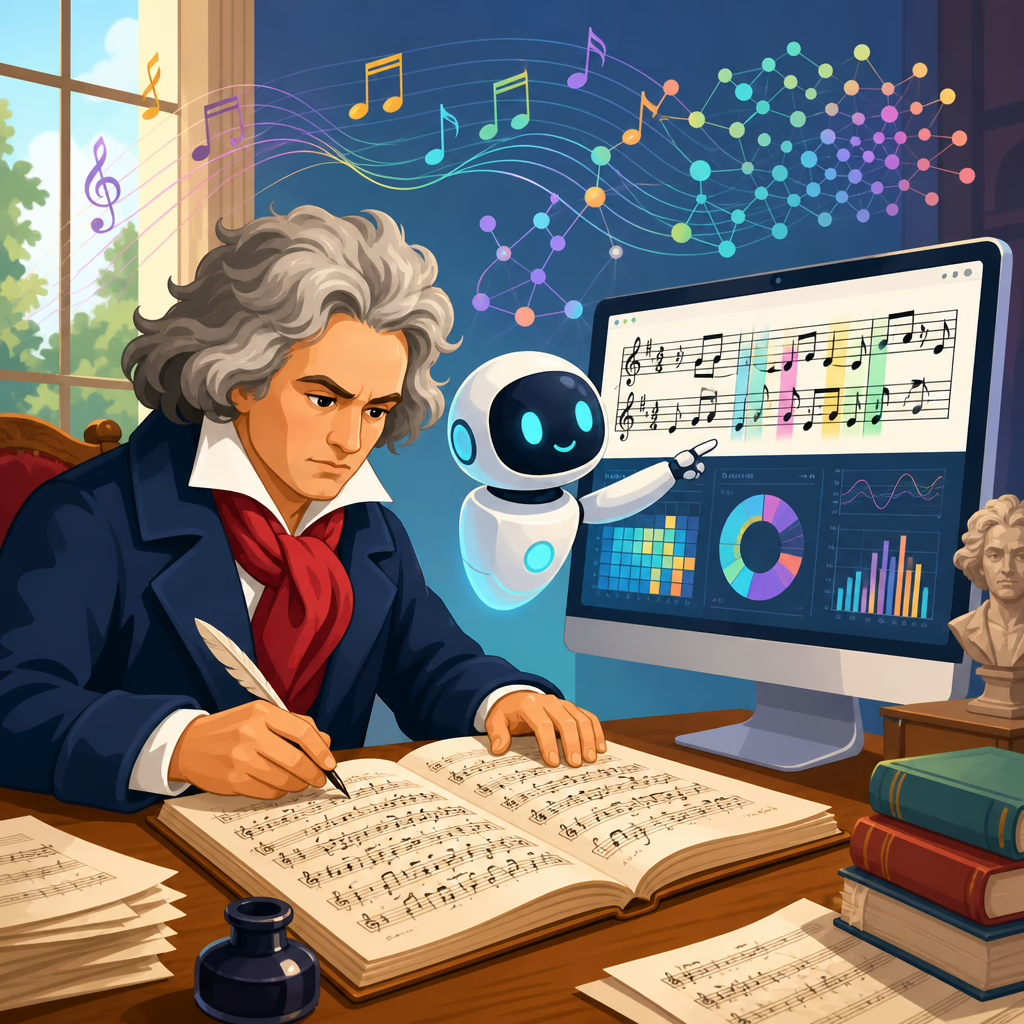
How AI Tools Can Help Analyze Beethoven Scores
Beethoven’s scores reward close study because they compress form, drama, harmony, rhythm, and instrumental thinking into notation that still challenges performers, teachers, and scholars two centuries later. Today, AI tools can help analyze Beethoven scores by accelerating pattern discovery, testing interpretive hypotheses, comparing sources, and surfacing structural details that human readers might miss on a first pass. In this context, AI means computational systems that identify relationships in musical data, from optical music recognition software that converts printed pages into machine-readable notation to machine learning models that classify motifs, estimate harmonic function, or compare performances. Score analysis means more than labeling chords. It includes phrase structure, motivic development, voice leading, orchestration, formal design, tempo relationships, articulation patterns, editorial variants, and links between notation and sound. For anyone working on Beethoven and technology, this matters because the central problem is not whether software replaces musical judgment. It does not. The real question is how digital tools extend expert listening and score reading without flattening the complexity of Beethoven’s art.
I have used notation software, corpus analysis platforms, and audio-to-score alignment tools in practical research and rehearsal settings, and the lesson is consistent: the best results come when AI handles scale and repetition while musicians handle meaning. Beethoven is an especially strong test case because his music combines recurrence and surprise. A human analyst can sense the tension of a dominant arrival in the “Eroica” or the destabilizing effect of a displaced accent in a late piano sonata. An AI system can scan a large corpus of Beethoven movements, count related rhythmic cells, compare interval profiles, and highlight places where his treatment diverges from his norm. That combination turns analysis into a richer process. It helps a conservatory student learning sonata form, a conductor planning rehearsals, a musicologist collating editions, or an interested listener wanting clearer entry points into difficult works.
The topic also matters because digital access has changed the basic workflow of musical study. Scores from IMSLP, the Beethoven-Haus Bonn digital archive, and major scholarly editions can now sit beside synchronized recordings, spectrograms, and symbolic analysis tools on the same screen. Instead of moving manually between facsimile, urtext, marked parts, and reference recordings, a researcher can build a linked environment where each claim about a score is checked against notation, manuscript evidence, and sound. AI adds another layer by making those connections searchable and partially automated. If you want to know how often Beethoven begins a development section with fragmentation, whether he favors certain registral expansions at recapitulations, or where a motive returns in augmentation across a sonata, AI-supported workflows can produce a defensible answer faster than unaided manual review. That speed is useful not because scholarship should be rushed, but because more time can be spent evaluating significance.
A comprehensive page on how AI tools can help analyze Beethoven scores must therefore cover practical uses, limitations, and methods. It should explain which tools are useful, what kinds of questions they answer well, how to prepare source material, and where results can mislead. It should also connect broad technology questions to Beethoven’s specific compositional habits: motivic economy, tonal drama, cyclic recall, dense sketch processes, and the unusual editorial challenges of his manuscripts and first editions. The sections below provide that framework, starting with a table of contents and moving from foundational concepts to score preparation, harmonic and formal analysis, motif tracking, performance comparison, source criticism, and ethical boundaries.
Table of Contents
1. Why Beethoven is ideal for AI-assisted score analysis. 2. Preparing Beethoven scores for reliable digital study. 3. Harmonic and formal analysis with AI support. 4. Tracking motifs, rhythm, and texture across works. 5. Comparing performances to the written score. 6. Source criticism, editions, and sketch study. 7. Limits, risks, and best practices. 8. Final takeaways for musicians, teachers, and researchers.
Why Beethoven Is Ideal for AI-Assisted Score Analysis
Beethoven is ideal for AI-assisted score analysis because his music is both highly structured and highly variable. Models perform best when repertory contains recurring features that can be encoded, compared, and measured. Beethoven gives them that in abundance: concise motivic cells, strong tonal functions, rhetorically marked cadences, recurring formal procedures, and clear relationships between local gestures and large-scale architecture. At the same time, he constantly bends those conventions. That tension makes his scores perfect for computational analysis because the machine can map regularities while the analyst studies expressive deviations. In the first movement of Symphony No. 5, for example, a system can identify the famous short-short-short-long rhythmic pattern and search for related intervallic or durational variants across the movement. The useful analytical question is not simply where the motive appears. It is how Beethoven transforms it through sequence, orchestration, register, and harmonic pressure.
His piano sonatas offer a similarly rich laboratory. In teaching, I have found that students often hear the broad contrast between themes before they perceive the finer mechanics of continuity. AI can help by highlighting shared pitch-class content, rhythmic DNA, or contour relations between sections that seem unrelated on the surface. In the “Pathétique” Sonata, Op. 13, an algorithmic segmentation tool can suggest phrase boundaries and cadential zones, while harmonic analysis software tracks prolongation and modulation. The analyst can then test whether the Grave introduction behaves as a rhetorical frame, a source of later motives, or both. In late sonatas such as Op. 109, Op. 110, and Op. 111, AI can map recurrence patterns, voice-leading strands, and textural compression in ways that clarify how Beethoven sustains coherence across fragmented surfaces.
String quartets are another major opportunity. The late quartets challenge even experienced readers because their formal syntax can be unstable, their fugues dense, and their phrase rhythm deliberately ambiguous. AI tools can parse voice independence, count contrapuntal entries, and mark registral overlap more quickly than manual tallying. That does not solve interpretation, but it gives analysts a reliable first pass. When studying the Grosse Fuge, Op. 133, for instance, one can use symbolic music analysis to identify subject entries, inversional treatment, stretto density, and harmonic goal points, then compare those findings against performer choices in notable recordings. The result is a multi-layer view of the piece as notation, process, and sound.
Preparing Beethoven Scores for Reliable Digital Study
The quality of any AI analysis depends on the quality of the input. For Beethoven, score preparation is often the hardest step because sources are messy. Autograph manuscripts contain revisions, overwritten passages, missing dynamics, and notational shortcuts. First editions preserve valuable historical evidence but may include engraver errors. Later pedagogical editions often contain interpretive additions that are useful for performance history but risky for neutral analysis. Before asking software to analyze a Beethoven score, decide which source answers your question. If you are examining compositional process, consult autograph facsimiles and sketch materials from Beethoven-Haus Bonn. If you are comparing formal strategies across a corpus, a vetted urtext from Bärenreiter or Henle is usually safer because it regularizes notation enough for machine reading while staying close to source evidence.
Optical music recognition is the next bottleneck. Tools such as Audiveris, SmartScore, PlayScore, and the OMR features inside larger notation environments can convert scanned pages into MusicXML or MIDI, but Beethoven scores are not always easy for them. Dense orchestral systems, cue-sized notes, unusual beam groupings, slur overlaps, and editorial markings can produce errors. Even one misread accidental can distort a harmonic map; one missing tie can affect phrase segmentation; one incorrect voice assignment can spoil counterpoint analysis. In practice, every OMR result needs manual correction in software such as MuseScore, Dorico, Finale, or Sibelius before deeper analysis begins. For corpus work, build a validation checklist: pitches, rhythms, tuplets, key signatures, repeats, rehearsal letters, instrument labels, and measure numbering. This sounds basic, but it is the difference between credible results and polished nonsense.
Once the notation is clean, encode metadata. A useful Beethoven dataset includes opus number, movement, key, meter, tempo marking, source edition, measure numbers, section labels, and any editorial interventions. Metadata lets you filter intelligently. Suppose you want to compare slow introductions across symphonic first movements, or dominant preparation lengths before recapitulations in minor-key sonata movements. Without reliable metadata, those questions become difficult to operationalize. With it, AI can organize and visualize answers quickly.
| Task | Recommended Tools | Main Benefit | Common Risk |
|---|---|---|---|
| Scan printed score | Audiveris, SmartScore, PlayScore | Converts pages into machine-readable notation | Wrong accidentals, ties, voices, or tuplets |
| Edit notation | MuseScore, Dorico, Finale, Sibelius | Corrects OMR errors and standardizes layout | Manual edits may silently change source meaning |
| Symbolic analysis | music21, Humdrum, jSymbolic | Extracts intervals, rhythms, key areas, and motifs | Bad input produces misleading statistics |
| Audio alignment | Sonic Visualiser, Match, librosa workflows | Links score events to recorded sound | Rubato and balance can reduce alignment accuracy |
| Source comparison | Verovio, MEI workflows, digital collation tools | Tracks variants across editions and manuscripts | Notational differences may reflect encoding choices |
File format matters as well. MusicXML preserves notation detail better than MIDI, which is useful for playback and event timing but weak for articulations, slurs, beams, and editorial distinctions. MEI, the Music Encoding Initiative format, is even stronger for scholarly encoding because it can represent variants, layers, and source annotations with more precision. If the project concerns Beethoven’s revisions or conflicting readings among sources, MEI is often worth the extra setup. If the project concerns motivic recurrence or harmonic surveys, MusicXML may be sufficient. Good analysis starts by matching the format to the question.
Harmonic and Formal Analysis with AI Support
One of the clearest ways AI tools can help analyze Beethoven scores is by supporting harmonic and formal analysis at scale. Harmonic function in Beethoven is not merely a sequence of Roman numerals. It is a dynamic system of expectation, delay, contradiction, and release. Software can assist by estimating key areas, detecting cadence types, measuring phrase lengths, and visualizing modulation pathways. Libraries such as music21 and Humdrum allow analysts to parse scores into events, annotate chord candidates, and test tonal interpretations against large repertoires. These tools are particularly useful when comparing multiple works. For example, you can examine how Beethoven handles transition passages in first movements across piano sonatas, asking how often he modulates to the dominant in major-mode works, how often he redirects toward mediant or flat-side regions, and how extended the dominant lock becomes before the second theme.
In practical terms, AI-supported harmonic analysis speeds up the exploratory phase. Consider the first movement of the Piano Sonata in C minor, Op. 111. The opening diminished-seventh sonorities, registral extremes, and rhetorical silences make the harmonic surface look unstable even when the tonal direction is controlled. A computational pass can map likely roots, inversion patterns, and prolongational zones, giving the analyst a provisional overview. The human scholar then refines that map by considering voice leading, metric accent, and context. This division of labor works because Beethoven’s harmonic language is rule-governed but not mechanical. The software catches regularities; the musician hears function in motion.
Form benefits in similar ways. Segmentation models can estimate boundaries based on texture, cadence, repetition, and thematic return. In a Beethoven sonata form, they can flag the exposition, development, and recapitulation candidates, along with places where the coda behaves like a second development. This is helpful in works where the recap is disguised or delayed. In the first movement of the “Waldstein” Sonata, Op. 53, an AI system can track the persistence of accompanimental figuration, the tonal trajectory of the transition, and the altered return of the secondary material. The analyst can then ask the musically important question: how does Beethoven create a sense of inevitability while withholding simple thematic symmetry?
For orchestral works, visualization is especially powerful. A harmonic timeline layered with orchestration density and dynamic markings can show how Beethoven coordinates tonal arrival with sonic weight. In Symphony No. 7, the first movement’s long introduction becomes easier to explain when a visual model shows pedal persistence, brass entry points, and the eventual ignition of the Vivace. Students often understand this faster when they see harmony and instrumentation on the same map. AI does not replace close reading here; it clarifies it.
Another valuable use case is comparing Beethoven to near contemporaries such as Haydn, Mozart, Cherubini, or early Schubert. If a researcher wants to know whether Beethoven’s development sections are unusually modulatory, or whether his codas are statistically longer relative to exposition length, AI-assisted corpus analysis can answer with evidence instead of intuition. Those comparisons matter for Beethoven and technology because they move the discussion beyond novelty. They show where his style is conventional, where it is exceptional, and how those differences register in measurable terms.
Tracking Motifs, Rhythm, and Texture Across Works
Motivic development is one of the most discussed features of Beethoven’s style, and it is also one of the areas where AI tools can provide immediate value. A motive is not just an exact melodic repetition. In Beethoven, it often persists through rhythmic resemblance, contour similarity, interval reduction, harmonic framing, or registral emphasis. That makes manual tracking labor-intensive, especially across long movements or multiple works. AI can search for exact matches and approximate matches using n-gram analysis, contour algorithms, interval vectors, and rhythmic fingerprints. This allows analysts to ask better questions. Instead of arguing abstractly that the first movement of Symphony No. 5 is unified, you can identify every strong and weak return of the opening cell, classify transformations, and correlate them with formal zones.
The same applies to less obvious repertory. In the String Quartet in A minor, Op. 132, the “Heiliger Dankgesang” movement relies on texture, modality, and registral spacing as much as on memorable tune shapes. AI can quantify note density, duration distribution, contrapuntal independence, and spacing between voices across sections marked “Molto adagio” and “Andante.” Those measurements reveal how Beethoven stages contrast between archaic stillness and renewed motion. In teaching, this is useful because students often recognize emotional contrast before they can describe its technical basis. The data gives them vocabulary anchored in the score.
Rhythm analysis is another area where AI excels. Beethoven uses displacement, repetition, silence, syncopation, and accent patterns to create momentum and disruption. Software can catalog onset patterns, compare metric positions of sforzandi, and detect recurring accompaniment types. In the Scherzo of the Ninth Symphony, for instance, a rhythmic analysis can show how fugato writing, timpani punctuation, and metric ambiguity interact. In the Diabelli Variations, Op. 120, AI can compare each variation’s rhythmic profile against the waltz theme and identify which parameters Beethoven preserves, exaggerates, or overturns.
Texture is harder to discuss precisely without measurement, which is why digital methods help. Terms like homophonic, contrapuntal, chordal, or accompanimental are useful but often too coarse for Beethoven. A machine-readable score lets you count active voices, average simultaneities, register span, crossing frequency, and articulation density. This is valuable in late style analysis, where Beethoven’s textures can thin dramatically just before reaching extraordinary expressive intensity. In Op. 110, the move from recitative-like writing to fugue is not only a formal shift. It is a change in textural logic that can be modeled and heard.
Comparing Performances to the Written Score
Beethoven score analysis should not stop at the page because notation becomes meaningful in sound. AI tools can align recordings to symbolic scores and measure tempo, dynamics, articulation timing, and ensemble coordination. This opens a major field of study: how performers realize, resist, or reinterpret Beethoven’s instructions. Programs such as Sonic Visualiser, score-following systems, and custom Python workflows using librosa or pretty_midi can align bar numbers to audio, estimate beat locations, and compare several recordings against the same score map. For a pianist studying the “Appassionata,” this makes it possible to compare how Artur Schnabel, Maurizio Pollini, Mitsuko Uchida, Igor Levit, or Sviatoslav Richter pace the transition into a climactic cadence. The score shows the same notes; the timing curves reveal very different conceptions of tension.
This is not merely performance trivia. It can sharpen score analysis itself. If many strong interpreters broaden at the same place, underplay a written accent, or rebalance voices in similar ways, that recurring choice may point to a structural pressure in the score. Conversely, if recordings diverge radically, the passage may be genuinely open. In the slow movement of the Seventh Symphony, AI-assisted comparison can track ostinato steadiness, phrase-end stretching, and crescendo shapes across conductors. The analyst can then relate those choices to orchestration, harmonic pacing, and phrase structure. The result is a more complete understanding of Beethoven’s notation as a performance script rather than a static object.
For ensembles, audio alignment is practical. A quartet can rehearse with a synchronized score that highlights intonation hotspots, staggered attacks, or tempo drift relative to a chosen benchmark. In Beethoven, where off-beat entries and exposed transitions are frequent, such feedback is useful when applied carefully. The danger is over-standardization. Great Beethoven playing cannot be reduced to matching a graph. The graphs are diagnostic tools, not artistic verdicts. They are best used to focus rehearsal questions: Are we compressing this crescendo too early? Does the fugue subject lose clarity at this tempo? Are we maintaining the written hierarchy between inner voices and melody?
Source Criticism, Editions, and Sketch Study
No account of Beethoven and technology is complete without source criticism. Beethoven’s compositional process survives in sketchbooks, autograph manuscripts, copyists’ scores, corrected proofs, and first editions, and these sources often disagree. AI tools can help analyze Beethoven scores by making variant comparison faster and more systematic. Digital collation platforms can align multiple encodings of the same passage and flag differences in pitch, rhythm, articulation, dynamics, text underlay, or layout. This is valuable because not all differences mean the same thing. Some reflect compositional revision. Others are engraver mistakes, house-style normalization, or later editorial intervention. The machine identifies variance; the scholar determines significance.
Take the opening of a piano sonata where one edition shows a staccato mark and another does not. A raw comparison tool notes a discrepancy. A better workflow links that discrepancy to source images, publication dates, and editorial notes. If the mark appears only in a late pedagogical edition, it should not carry the same weight as a correction entered in Beethoven’s proof copy. This is where structured digital editions matter. Encoding standards developed through MEI and related scholarly practices allow each reading to be attributed and documented. For researchers, that means claims about Beethoven’s text can be made with far greater transparency than older citation habits allowed.
Sketch study may be the most intellectually exciting application. Beethoven’s sketches reveal discarded ideas, alternate continuations, compression of long-range plans, and the gradual shaping of motivic networks. AI can cluster related sketch fragments, identify intervallic resemblance to final versions, and estimate which drafts belong to the same work or phase. It can also assist with handwriting and symbol recognition, though that remains difficult because Beethoven’s manuscripts are visually challenging. Even partial success is useful. When a system groups related motivic fragments across notebook pages, a scholar can reconstruct stages of compositional decision-making with less manual searching. This does not solve every attribution problem, but it expands what is feasible in large sketch corpora.
For performers, source-critical tools have a direct benefit. They expose where the score is stable and where it is contested. If a conductor knows that a slur in a symphony part comes from a later editorial tradition rather than primary sources, rehearsal decisions can be more intentional. If a pianist sees that pedal suggestions belong to nineteenth-century editors rather than Beethoven, those markings can be treated as interpretive commentary instead of command. Technology is most helpful here when it separates evidence from habit.
Limits, Risks, and Best Practices
AI is powerful in Beethoven analysis, but it has clear limits. First, most models inherit assumptions from the data and annotations used to train them. A harmonic classifier built on common-practice examples may struggle with enharmonic reinterpretation, ambiguity, or elision in late Beethoven. A phrase detector may misread expansions and false recapitulations because it expects textbook regularity. Second, symbolic scores are abstractions. They do not fully capture pedaling, timbre, hall acoustics, instrument design, or the embodied difficulty of execution. Third, Beethoven’s notational practice itself includes ambiguity. Sometimes the right analytical answer is not a cleaner label but a more honest description of competing possibilities.
Best practice begins with question design. Ask narrow, testable questions before broad interpretive ones. Instead of “What makes the late quartets complex,” ask “How does voice-entry density change across fugue sections in Op. 133?” or “How often does Beethoven restate a motive at a different metrical position in selected middle-period sonata movements?” Narrow questions produce cleaner data and clearer insight. Next, validate every automated result against score reading and listening. If a model claims a recapitulation begins at a certain measure, inspect the harmonic, thematic, and rhetorical evidence yourself. If an OMR pipeline generates a surprising modulation, confirm the accidentals in the source.
Use multiple representations whenever possible: facsimile, corrected symbolic score, analytical annotation, and aligned audio. Beethoven’s music becomes easier to understand when notation and sound are checked against each other. Document your workflow as well. Record the edition used, the corrections made, the software version, and the thresholds chosen for motif matching or segmentation. Reproducibility is not only for scientists. It improves musical scholarship because it lets others test the same claims on the same materials.
It is also important to keep the interpretive center of gravity in the music rather than the dashboard. A beautiful heat map of motivic recurrence does not explain why a return feels triumphant, anxious, ironic, or suspended. Those judgments require style knowledge, historical context, and listening imagination. Beethoven wrote for instruments with specific capabilities and audiences with specific expectations. The meaning of a horn call, a sudden sf, or a shock modulation cannot be exhausted by counts alone. Good AI use strengthens musicianship because it makes evidence easier to inspect. Bad AI use weakens musicianship because it mistakes measurement for understanding.
Final Takeaways for Musicians, Teachers, and Researchers
AI tools can help analyze Beethoven scores most effectively when they are used as disciplined extensions of human expertise. They are excellent for converting scores into searchable data, checking harmonic and formal patterns across many works, tracing motives and rhythms, aligning recordings to notation, and comparing editions or sketch sources. They are especially valuable in Beethoven because his music combines strong internal logic with expressive deviation, making it ideal for a workflow in which software identifies recurring structures and people evaluate their significance. The practical gains are real: students grasp form faster, performers rehearse with sharper diagnostic feedback, editors compare variants more transparently, and researchers test stylistic claims with broader evidence.
The central caution is just as important. Beethoven analysis cannot be delegated to an algorithm. Every tool depends on source quality, encoding accuracy, and the assumptions built into its models. OMR errors distort harmony. Segmentation models can misread formal rhetoric. Performance graphs can tempt users into treating interpretive diversity as error. The answer is not to avoid technology, but to use it with methodological discipline. Start from a clear musical question. Choose the right source and file format. Correct the score carefully. Cross-check automated outputs against listening and historical knowledge. When the data and the ear disagree, investigate the disagreement rather than forcing consensus.
For anyone building a serious practice around Beethoven and technology, the path forward is straightforward. Assemble a small toolkit that covers notation correction, symbolic analysis, audio alignment, and source comparison. Begin with one work you know well, such as the Fifth Symphony, the “Pathétique,” or Op. 110, and test a focused question about form, motive, or performance. As your confidence grows, expand to corpus-level comparisons and source-critical projects. The payoff is not just efficiency. It is a deeper, more evidence-based encounter with Beethoven’s scores. Use the tools, keep your judgment active, and let the music stay larger than the method.
Frequently Asked Questions
How can AI tools actually help analyze Beethoven scores?
AI tools can help analyze Beethoven scores by making large, complex musical relationships easier to detect, compare, and test. Beethoven’s notation often packs multiple layers of information into a single passage: motivic development, harmonic tension, rhythmic disruption, formal balance, and instrumental character may all be unfolding at once. An AI-assisted workflow can scan a score and quickly identify recurring motives, interval patterns, rhythmic cells, phrase lengths, cadential types, modulatory routes, and voice-leading tendencies across a movement or even across multiple works. That speed matters because it allows performers, teachers, and scholars to move beyond basic counting and indexing into deeper interpretation.
For example, a tool might highlight where a small rhythmic figure from the opening returns in altered form later in the exposition, development, or coda. It may also reveal how Beethoven transforms a motive through inversion, fragmentation, sequence, metric displacement, or orchestral redistribution. In harmonic analysis, AI can assist by mapping tonal centers, pivot chords, chromatic intensification, and unusual modulations, helping users see not just where Beethoven goes, but how he gets there. In formal analysis, computational models can flag likely section boundaries, recapitulatory adjustments, false reprises, and developmental hotspots where thematic compression becomes especially intense.
Just as importantly, AI can support hypothesis testing. If a musician suspects that a passage should be shaped toward a hidden structural arrival rather than a local climax, analytical software may help confirm that by showing parallel phrase design, registral ascent, harmonic prolongation, or dynamic patterning elsewhere in the movement. Used well, AI does not replace musicianship; it extends close reading. It helps the user notice more, compare more systematically, and connect details that would otherwise take many hours to gather by hand.
Can AI find patterns in Beethoven’s music that human readers might miss?
Yes, especially when the patterns are distributed across long spans, disguised through variation, or buried in dense textures. Human readers are excellent at interpreting musical meaning, but even experienced analysts can overlook distant recurrences when Beethoven reshapes material in subtle ways. AI systems are particularly useful for pattern discovery because they can compare many passages at once and measure similarity under different conditions. A tool can be trained or configured to recognize not only exact repetitions, but also transformed versions of themes and motives that preserve interval structure, contour, rhythm, or harmonic function while changing surface details.
This is valuable in Beethoven because his music often works through organic growth rather than obvious restatement. A tiny cell introduced at the beginning of a movement may later control accompaniment texture, transition energy, developmental sequencing, or cadential drive. AI can expose these hidden continuities by tracing where related figures appear, how they are altered, and how frequently they cluster around structurally important moments. In a piano sonata, for instance, it may reveal that a seemingly decorative accompanimental figure is actually linked to the principal theme. In a symphonic score, it may show that a brass outburst and a string tremolo share a common rhythmic engine, even though they sound very different on the surface.
That said, “finding” a pattern is not the same as understanding its significance. A computational system can point to recurrence, proximity, or transformation, but a human analyst still decides whether the relationship is musically meaningful, historically plausible, and interpretively useful. The best results come when AI-generated observations lead to better musical questions: Why does Beethoven restate this idea here? Why disguise the motive in inner voices? Why intensify the rhythm just before a formal break? In that sense, AI becomes less a source of final answers and more a catalyst for more disciplined and imaginative listening.
Is AI reliable for harmonic and formal analysis of Beethoven’s scores?
AI can be very helpful for harmonic and formal analysis, but its reliability depends on the quality of the score data, the analytical model being used, and the complexity of the musical passage. Beethoven often challenges rule-based categorization. He uses ambiguity, delayed resolution, enharmonic reinterpretation, phrase overlap, developmental compression, and unconventional transitions in ways that can confuse automated systems. A model may correctly identify broad tonal areas or likely cadences, yet struggle with tonicizations, prolonged dominant fields, or passages where surface sonority does not align neatly with deeper harmonic function. Formal analysis presents similar issues: a tool may detect probable exposition, development, and recapitulation zones, but Beethoven’s habit of reworking returns and destabilizing expectations means that formal boundaries are not always clear-cut.
For that reason, AI should be treated as an analytical assistant, not an unquestionable authority. It is often very reliable at repetitive or time-intensive tasks, such as cataloging cadences, measuring phrase lengths, identifying key areas, aligning parallel passages, and marking thematic returns. It can produce excellent first-pass visualizations of harmonic rhythm, sectional proportion, and thematic distribution. These outputs are extremely useful because they give the human analyst a structured overview before deeper interpretive work begins.
However, final judgment still belongs to the musician or scholar. If an AI tool labels a passage as a half cadence, for example, the user should still consider voice leading, metrical emphasis, dynamic shaping, and larger formal function. If it marks the onset of the recapitulation, one should ask whether Beethoven is presenting a literal return, a telescoped restatement, or a rhetorically delayed confirmation. In short, AI is reliable enough to accelerate analysis and sharpen attention, but the richest Beethoven readings still come from combining computational output with style knowledge, score study, historical awareness, and a trained ear.
How can performers and teachers use AI analysis without losing musical intuition?
Performers and teachers can use AI most effectively when they treat it as a support for musicianship rather than a substitute for it. In practical terms, that means using computational analysis to illuminate structure, pacing, motivic relationships, harmonic goals, and textural priorities, then translating those findings into sound, touch, timing, articulation, and rehearsal strategy. For a performer, an AI-generated map of thematic return or harmonic tension can clarify where to build intensity, where to release, and where an inner voice deserves prominence. For a teacher, it can make abstract structural ideas more concrete by showing students exactly how a motive reappears, how a transition gains momentum, or how a coda rewrites material heard earlier.
This can be especially helpful in Beethoven, where interpretive decisions often hinge on long-range structure. A player may instinctively shape a phrase beautifully at the local level but miss the broader dramatic arc. AI can help by revealing that a passage functions as preparation, not culmination; that a sforzando marks destabilization rather than closure; or that a repeated pattern is part of a larger process of intensification. Teachers can also use AI visualizations to compare editions, discuss editorial choices, and demonstrate how notation, texture, and form interact. Students who struggle to see connections across pages may benefit from analytical summaries that condense the movement into patterns they can hear and follow.
The key is not to let data flatten artistry. Beethoven’s scores demand imagination, character, and rhetorical sensitivity. No graph or annotation can dictate the exact weight of a chord, the bite of an accent, or the timing of a silence. Those choices emerge from listening, physical technique, historical style, and artistic judgment. AI is most valuable when it strengthens intuition by giving it evidence. Instead of replacing musical instinct, it gives instinct a clearer map.
What are the limitations of using AI to analyze Beethoven scores?
The main limitation is that AI can detect relationships without fully grasping musical meaning. Beethoven’s music is not just a collection of patterns; it is a dramatic, expressive, and stylistic language shaped by genre conventions, performance practice, notation habits, and historical context. An AI system may identify repeated intervals, classify chords, or segment formal units, but it does not experience tension, wit, struggle, irony, lyric expansion, or heroic rhetoric in the human sense. Those interpretive dimensions are central to Beethoven analysis, and they remain the domain of informed musical judgment.
Another major limitation is data quality. If the score input contains transcription errors, inconsistent encoding, or editorial distortions, the resulting analysis may be misleading. This matters especially when comparing sources or studying works that exist in multiple editions, sketches, or revised versions. AI systems can also overstate precision. A passage with harmonic ambiguity may be forced into a single label, or a fluid formal transition may be assigned a rigid boundary that obscures Beethoven’s actual compositional strategy. Dense contrapuntal writing, ornamental figuration, and orchestral reductions can create additional problems, causing a system to misread foreground activity as structural content or vice versa.
There is also the risk of narrowing inquiry to what software can easily measure. If users focus only on what can be counted, color-coded, or graphed, they may neglect timbre, rhetoric, instrument-specific writing, silence, articulation nuance, and expressive pacing. Beethoven’s scores often communicate through precisely those hard-to-quantify details. The best way to handle these limitations is to use AI critically: compare outputs with the printed score, test conclusions against listening, consult historical and theoretical scholarship, and remain open to multiple interpretations. AI is powerful for surfacing evidence and organizing complexity, but Beethoven still requires a human reader to decide what that evidence means.