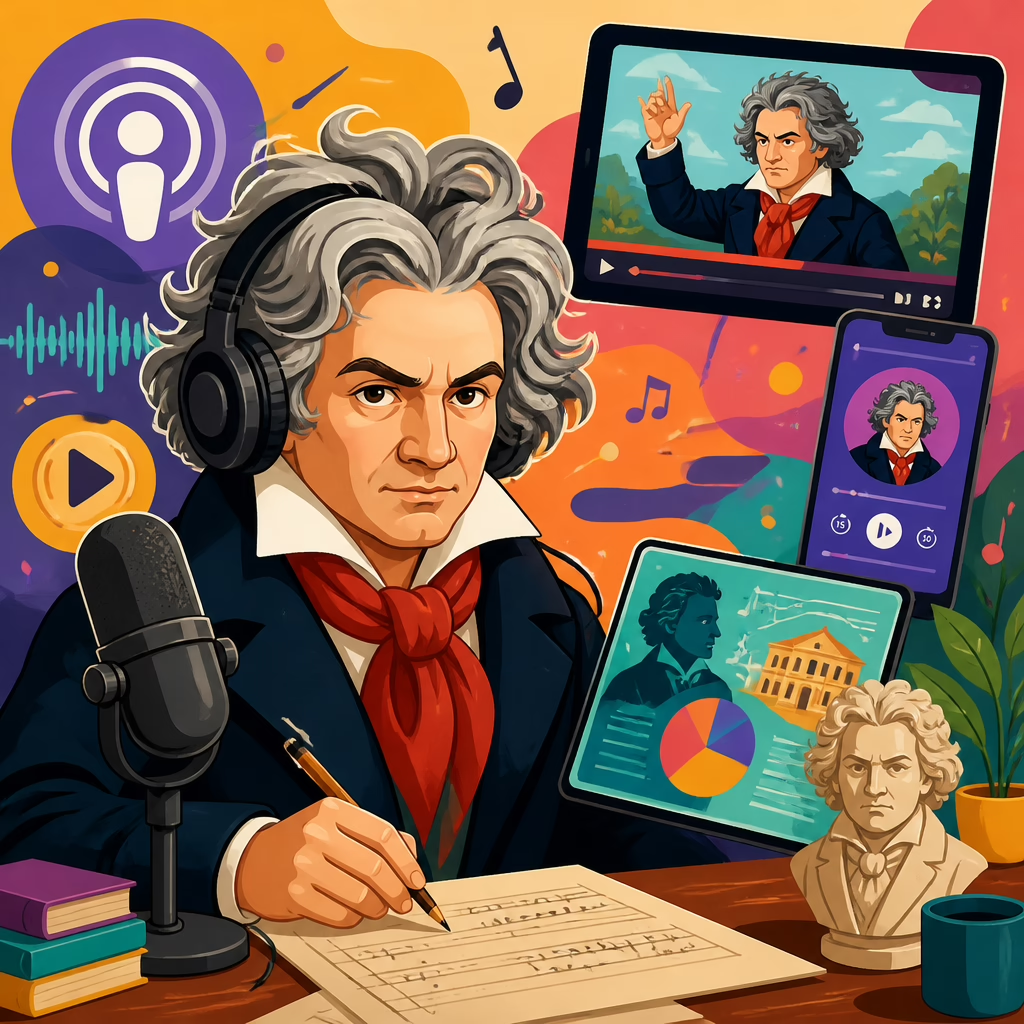
Beethoven Podcasts Video Essays and New Media Formats
Beethoven podcasts, video essays, and new media formats have changed how audiences encounter a composer once filtered mainly through concert halls, record liners, and academic books. In this context, podcasts are serialized audio programs, video essays are argument-driven audiovisual analyses, and new media formats include interactive apps, short-form clips, annotated streams, newsletters with embedded audio, and hybrid educational experiences built for phones and social platforms. The shift matters because Beethoven’s music is structurally dense, historically documented, and culturally overexposed at the same time: listeners know the name, but many do not know the works beyond a few motifs. I have worked on classical music editorial projects where the central challenge was not finding information about Beethoven, but choosing a format that could turn that information into sustained attention. Different formats solve different access problems. A podcast can guide a commute-length listen through the “Eroica” funeral march; a video essay can show the rhythmic compression in the opening of the Fifth Symphony; an interactive score clip can let a student replay a single cadence until the pattern clicks. For institutions, educators, and independent creators, the real question is not whether digital formats can cover Beethoven. It is which format best matches the listener’s curiosity, device habits, and tolerance for complexity without flattening the music into trivia or prestige branding.
That question has become more urgent as audience behavior has fragmented. Long-form listening still exists, but discovery now often begins with a recommendation engine, a social share, or a search for one narrow question such as why Beethoven wrote so many variations or whether he intended the “Moonlight” nickname. Strong Beethoven media therefore has to combine narrative clarity, musicological accuracy, and production choices that help non-specialists hear what experts mean. The best examples do not merely celebrate genius. They teach listening. They make formal development, motivic transformation, historical reception, sketch studies, performance practice, and instrument technology understandable in plain language. They also respect uncertainty. Beethoven left extensive evidence, but not every popular claim survives scrutiny. New media formats are valuable precisely because they can present evidence with texture: spoken explanation, score excerpts, waveform visuals, pianist demonstrations, archival images, and chaptered navigation. Used well, these formats create a bridge between scholarship and public listening, giving Beethoven renewed relevance without forcing the music into shallow modern analogies.
Why podcasts work especially well for Beethoven
Podcasts suit Beethoven because his music rewards sequential explanation. A host can establish context, isolate a motif, compare two recordings, and return to the same example later in the episode, creating a guided hearing experience closer to a seminar than a radio documentary. Audio also mirrors the primary object of discussion: sound. When I have helped outline classical audio features, the most effective episodes followed one disciplined question, such as how the late quartets challenged first listeners or why the “Waldstein” sonata sounds so propulsive. That focus prevents the common failure mode of Beethoven coverage, where biography overwhelms listening.
The strongest Beethoven podcasts use format conventions borrowed from journalism and teaching. They open with a hook, define the problem quickly, then alternate between narration and carefully edited excerpts. For example, an episode on the Third Symphony can begin with the shocking E-flat major chord and move directly to the work’s scale, political associations, and unprecedented development procedures. A good host explains terms like recapitulation or scherzo once, then uses them consistently. Chapter markers matter. So does rights management: many creators rely on public-domain scores but still must license specific recordings. That legal and editorial discipline often distinguishes durable educational podcasts from enthusiastic but unsustainable hobby projects.
How video essays make musical structure visible
Video essays solve a problem audio alone cannot fully address: many Beethoven ideas are easier to understand when listeners can see patterns while hearing them. A well-made essay can animate a score, highlight an ostinato in color, place two performances side by side, and freeze on a pivotal harmonic turn long enough for the viewer to register what changed. In practical terms, video turns abstraction into evidence. Instead of saying Beethoven fragments a theme, the essay can show each fragment arriving in sequence across the strings, then connect that process to dramatic tension.
This is especially useful for form. Sonata form, variation technique, fugue writing, and large-scale tonal planning can intimidate general audiences when explained only verbally. On screen, however, creators can map exposition, development, and recapitulation with simple visual lanes. The “Pathétique” Sonata’s Grave introduction, for instance, gains clarity when the viewer sees how Beethoven stages contrast before the Allegro begins. The same applies to rhythm. Syncopation in the Seventh Symphony or obsessive pulse in the final movement of the Eighth becomes easier to grasp when beat grids or subtitle cues reinforce the ear. The most persuasive essays avoid clutter. They do not cover the screen with jargon; they give the viewer one listening task at a time.
What each new media format does best
No single format dominates every Beethoven use case. The right choice depends on whether the goal is discovery, retention, classroom adoption, donor engagement, or conversion to long-form listening. Short clips can spark interest, but they rarely sustain a nuanced argument. Newsletters can build loyalty, but they need embedded media to demonstrate musical claims. Interactive modules are excellent for education, though expensive to produce. The practical strengths and limitations become clear when formats are compared directly.
| Format | Best use | Strength | Main limitation |
|---|---|---|---|
| Podcast episode | Guided listening and storytelling | Builds intimacy and sustained attention | Harder to show notation and form visually |
| Video essay | Structural analysis and performance comparison | Makes patterns visible while audio plays | Higher production time and rights complexity |
| Short-form clip | Discovery and social sharing | Fast reach for a single insight | Encourages oversimplification |
| Interactive lesson | Teaching themes, form, and motifs | User controls pace and repetition | Costly design and maintenance |
| Email newsletter with embeds | Audience retention and repeat visits | Strong direct relationship with readers | Depends on compelling curation |
For Beethoven, the most effective strategy is often a ladder rather than a single channel. A short clip introduces the opening fate motif of the Fifth Symphony, a video essay expands on development and orchestration, and a podcast episode later examines interpretation across Furtwängler, Toscanini, and Gardiner. This sequence respects how modern audiences move from casual discovery to deeper commitment. It also creates reusable editorial assets. A producer who scripts one clear argument can adapt it across audio, video, and text with surprisingly little conceptual waste.
Editorial standards that keep Beethoven content credible
Beethoven attracts myths, and new media can spread them quickly. The common examples are familiar: simplistic claims about total isolation after deafness, tidy stories about romantic dedication, or deterministic readings of political intent. Credible creators verify biographical details against established scholarship, consult critical editions, and distinguish between documented evidence and later anecdote. The New Beethoven Complete Edition, Bärenreiter and Henle editions, the Beethoven-Haus Bonn archives, and standard reference works provide firmer ground than recycled internet summaries.
Accuracy also involves musical examples. If a video essay says a passage is unprecedented, the creator should explain in what sense: orchestral scale, harmonic boldness, motivic economy, or reception history. If a podcast compares period instruments with modern instruments, it should identify the ensemble or instrument type, not wave generally at authenticity. I have found that audiences do not object to nuance when it is delivered cleanly. They object to vagueness. A sentence such as “Beethoven expands the coda into a second development, intensifying closure by delaying it” teaches more than broad praise ever will. For readers wanting a related technical perspective on digital analysis, this pillar guide offers useful context: How AI Tools Can Help Analyze Beethoven Scores.
Production choices that shape audience trust and retention
Format alone does not make Beethoven accessible; production choices do. In podcasts, microphone quality, pacing, excerpt length, and loudness consistency directly affect whether listeners stay. Classical examples require careful mastering because dynamic range can punish earbud users if narration and music are not balanced. In video essays, subtitle accuracy matters more than many creators realize. Names, opus numbers, key signatures, and movement labels need to be correct every time. A single mislabeled quartet can undermine confidence among informed viewers.
Pacing is equally important. Beethoven analysis benefits from repetition, but repetition must feel purposeful. The best creators preview a motif, let it play once uninterrupted, then replay shorter segments while explaining exactly what to hear. On-screen graphics should support the ear, not compete with it. I have seen retention improve markedly when complex score pages were replaced by cropped systems with one highlighted line. Mobile viewing also changes design. Thin notation and dense captions disappear on phones, so high-contrast annotations and concise labels are essential. Accessibility is part of quality, not an optional extra. Captions, transcripts, chapter timestamps, and alt-aware visual planning widen reach and improve comprehension.
Where audiences actually engage with Beethoven now
Audience behavior around Beethoven is more segmented than many arts organizations assume. Conservatory students may watch a twenty-minute harmonic analysis on YouTube, while general audiences often first encounter the same work through a sixty-second social clip, a streaming service recommendation, or a podcast feed tied to a public radio brand. Younger listeners do not necessarily resist complexity; they resist friction. If the title, thumbnail, and opening thirty seconds promise clarity, they will stay longer than marketers expect. This is one reason channels that combine plain language with serious analysis outperform institutions that post concert excerpts with minimal explanation.
Platform differences matter. YouTube favors searchable, evergreen topics such as “Why Beethoven’s Fifth still sounds modern” or “How the ‘Moonlight’ Sonata creates tension.” Podcast platforms reward consistency and subscriptions. TikTok, Instagram Reels, and Shorts are best used as doorways rather than endpoints. A clip demonstrating the hammering sforzandi in the “Appassionata” can drive viewers toward a fuller essay. Newsletters remain underrated because they are not dependent on volatile recommendations; they allow a creator to package one Beethoven idea, one example, and one next step in a controlled environment. Institutions that treat every platform identically usually underperform because each platform rewards different listening behavior.
How creators can avoid flattening Beethoven into content
The risk of all modern packaging is reduction. Beethoven becomes either a bundle of famous hooks or a moralized story about triumph over adversity. Both frames leave out what actually makes the work durable: compositional craft, formal imagination, and the tension between convention and disruption. Responsible new media keeps the music central. That means fewer empty superlatives and more demonstrations. Show how a tiny rhythmic cell can govern an entire movement. Let viewers hear how a performer handles tempo relationships. Explain why the late style can sound discontinuous on first hearing and coherent after guided repetition.
It also means acknowledging limits. Not every movement yields to a sixty-second explanation. Not every listener wants analysis before first exposure. Some Beethoven experiences should remain largely unmediated, especially in performance contexts where surprise matters. New media is strongest when it prepares the ear rather than replacing the encounter. Used judiciously, podcasts, video essays, and adjacent formats can turn passive recognition into active listening. That is the real opportunity. They help audiences move from “I know this tune” to “I understand why this passage works, why this interpretation differs, and why Beethoven still commands attention.” Creators, educators, and arts organizations should choose the format that best serves that transformation, then build with rigor, clarity, and respect for the music.
Frequently Asked Questions
How have podcasts, video essays, and new media formats changed the way people learn about Beethoven?
Podcasts, video essays, and newer digital formats have fundamentally expanded access to Beethoven by moving his story and music beyond traditional gatekeepers such as concert programs, CD liner notes, and scholarly biographies. A listener no longer needs to attend a formal performance or read a dense academic text to begin understanding Beethoven’s symphonies, piano sonatas, or cultural significance. Podcasts make his life, works, and historical context available in serialized, approachable episodes that can be heard during a commute or while exercising. Video essays add a visual layer, allowing creators to synchronize commentary with scores, performance footage, manuscript images, harmonic diagrams, and historical references. That combination can make complex musical ideas feel far more intuitive.
New media formats go even further by reshaping not just where Beethoven is encountered, but how. Interactive apps can let users compare interpretations of the same movement, annotated streams can pause to explain formal developments in real time, and short-form clips can introduce a key motif or historical anecdote in under a minute. Newsletters with embedded audio create a direct relationship between educator and audience, while phone-first educational content meets users where they already spend time. The result is a less intimidating entry point into Beethoven, one that supports casual curiosity, deeper study, and repeated engagement across multiple platforms.
Just as important, these formats encourage a more active kind of listening. Instead of treating Beethoven as a remote monument of “great music,” they often present him as a living subject of interpretation, debate, and rediscovery. That shift matters because it broadens the audience. Students, first-time classical listeners, lifelong concertgoers, and even people who primarily consume digital culture can all find accessible ways into the repertoire. In practical terms, new media has not replaced traditional Beethoven scholarship or performance culture, but it has dramatically widened the pathways through which people can connect with both.
What makes Beethoven especially well suited to podcasts and video essays?
Beethoven is especially well suited to podcasts and video essays because his music, biography, and historical legacy all lend themselves to narrative storytelling and close analysis. His life includes powerful themes that are naturally compelling in audio and visual media: artistic struggle, deafness, reinvention, political upheaval, public reception, and the mythology of genius. These elements make it easy for podcast hosts and video essay creators to build episodes around dramatic turning points, individual works, or larger questions such as how Beethoven came to symbolize artistic freedom and seriousness in Western music.
Musically, Beethoven’s works are also ideal for explanation because they often feature memorable motifs, clear formal tension, and audible transformation. A creator can take a short rhythmic idea from the Fifth Symphony, for example, and show how it develops across a movement, making the listener hear structure rather than just sound. Video essays are especially effective here because they can visually highlight score excerpts, trace recurring motives, compare performances, and align analysis with the exact moment in the music. Podcasts, meanwhile, can use carefully selected audio clips and narrative pacing to help audiences focus on what they are hearing without overwhelming them with technical jargon.
Another reason Beethoven works so well in these formats is that there is always more than one angle to explore. One episode might focus on the “Eroica” as a political work, another on tempo debates in historically informed performance, another on Beethoven’s sketchbooks, and another on his role in film, advertising, or contemporary culture. This flexibility supports both broad introductory content and advanced specialist discussion. In short, Beethoven translates well to new media because he is both iconic and analytically rich: familiar enough to attract interest, but complex enough to reward sustained exploration.
Are podcasts and video essays reliable ways to understand Beethoven, or do they oversimplify the music?
They can be highly reliable and genuinely illuminating, but their value depends on the creator’s method, sources, and editorial standards. The best Beethoven podcasts and video essays combine clarity with rigor. They cite scholarship, distinguish fact from interpretation, use musical examples responsibly, and avoid sensationalizing familiar stories such as the image of the “tormented genius.” Strong creators often consult primary materials, established biographies, critical editions, and performance history, then translate that knowledge into accessible language. When done well, these formats do not cheapen the subject; they make serious ideas available to a larger public.
That said, oversimplification is a real risk. Short-form platforms in particular reward speed, compression, and emotional framing, which can flatten historical complexity. Beethoven’s personality, politics, hearing loss, and compositional process are all areas where myths can spread easily if creators prioritize virality over accuracy. Even longer podcasts and polished video essays can selectively frame evidence to support a strong narrative. For that reason, listeners and viewers should treat digital content the way they would any secondary source: as useful, but worth evaluating. Good signs include transparent sourcing, nuanced language, musical specificity, and a willingness to acknowledge uncertainty or disagreement among scholars and performers.
In practice, podcasts and video essays are often best understood as part of a broader learning ecosystem. They can spark interest, clarify difficult concepts, and guide listening in ways that books alone may not. But they are most powerful when paired with direct listening, score study where possible, and exposure to multiple viewpoints. If a video essay claims a movement is revolutionary, it helps to listen to the work yourself and compare performances. If a podcast presents a biographical argument, it is useful to see whether other reputable sources support it. So yes, these formats can be excellent ways to understand Beethoven, provided audiences approach them with curiosity and a basic media literacy that distinguishes persuasive storytelling from settled fact.
What kinds of new media formats are shaping Beethoven education and audience engagement today?
Today’s Beethoven media ecosystem extends far beyond the traditional long-form documentary or lecture recording. Podcasts remain central because they offer portable, serialized learning that can cover everything from beginner introductions to highly specialized topics. Video essays have become equally influential because they merge interpretation with audiovisual demonstration, making them well suited to explaining form, orchestration, thematic development, and performance choices. But the most significant shift is the diversity of formats now available around these core forms.
Interactive apps are one important development. These tools can allow users to isolate instrumental lines, follow annotated scores, compare recordings side by side, or explore timelines linking Beethoven’s works to historical events. Annotated streaming experiences are another strong example: instead of simply presenting a performance, they add synchronized commentary, contextual notes, or chapter markers that help listeners navigate large works. Newsletters with embedded audio clips and links create a hybrid format that combines editorial curation with direct listening. Short-form clips on social platforms can introduce core ideas quickly, such as what a scherzo is, why the late quartets sound unusual, or how one conductor’s interpretation differs from another’s.
There are also hybrid educational experiences built specifically for mobile and social environments. These might include course modules broken into short segments, interactive polls that test listening recognition, live Q&A sessions with musicians, or swipe-based explainers that combine text, image, and sound. What unites these formats is not just their digital delivery, but their design philosophy: they are often built for attention patterns shaped by phones, social feeds, and on-demand consumption. When used thoughtfully, these tools do more than market Beethoven to modern audiences. They create repeated points of contact, lower the threshold for engagement, and help transform passive exposure into active participation.
Why does the rise of new media matter for Beethoven’s long-term cultural relevance?
The rise of new media matters because cultural relevance is not preserved automatically; it has to be renewed through forms that people actually use. Beethoven’s music remains central to concert life, education, and recording culture, but if encounters with his work were limited to formal institutions alone, the audience would likely narrow over time. Podcasts, video essays, and digital-first educational formats help keep Beethoven present in everyday cultural circulation. They allow his music to appear not only in the concert hall or classroom, but also in earbuds, recommendation feeds, inboxes, and phone screens. That shift increases the odds that new generations will encounter Beethoven early, often, and in personally meaningful ways.
This matters not because Beethoven needs to be simplified into content, but because every era re-mediates the art it wants to preserve. In earlier generations, that mediation happened through sheet music editions, public lectures, radio broadcasts, LP box sets, and television documentaries. Today it happens through serialized audio, visual analysis, interactive interfaces, and socially distributed clips. Each format changes what gets emphasized. A podcast may foreground biography and listening guidance; a video essay may foreground argument and formal analysis; an app may foreground experimentation and user control. Together, these approaches make Beethoven less static and more discussable, which is essential for sustaining relevance in a crowded media environment.
There is also a deeper educational significance. New media allows Beethoven to be framed not just as a historical monument, but as a case study in listening, creativity, interpretation, disability history, political context, and cultural memory. That broader framing invites richer conversations and keeps the music connected to contemporary concerns. If used carefully, these formats can preserve depth while expanding reach. In that sense, the importance of new media is not merely promotional. It lies in creating living pathways through which Beethoven can continue to be heard, questioned, taught, and understood by audiences far beyond the traditional boundaries of classical music culture.</p