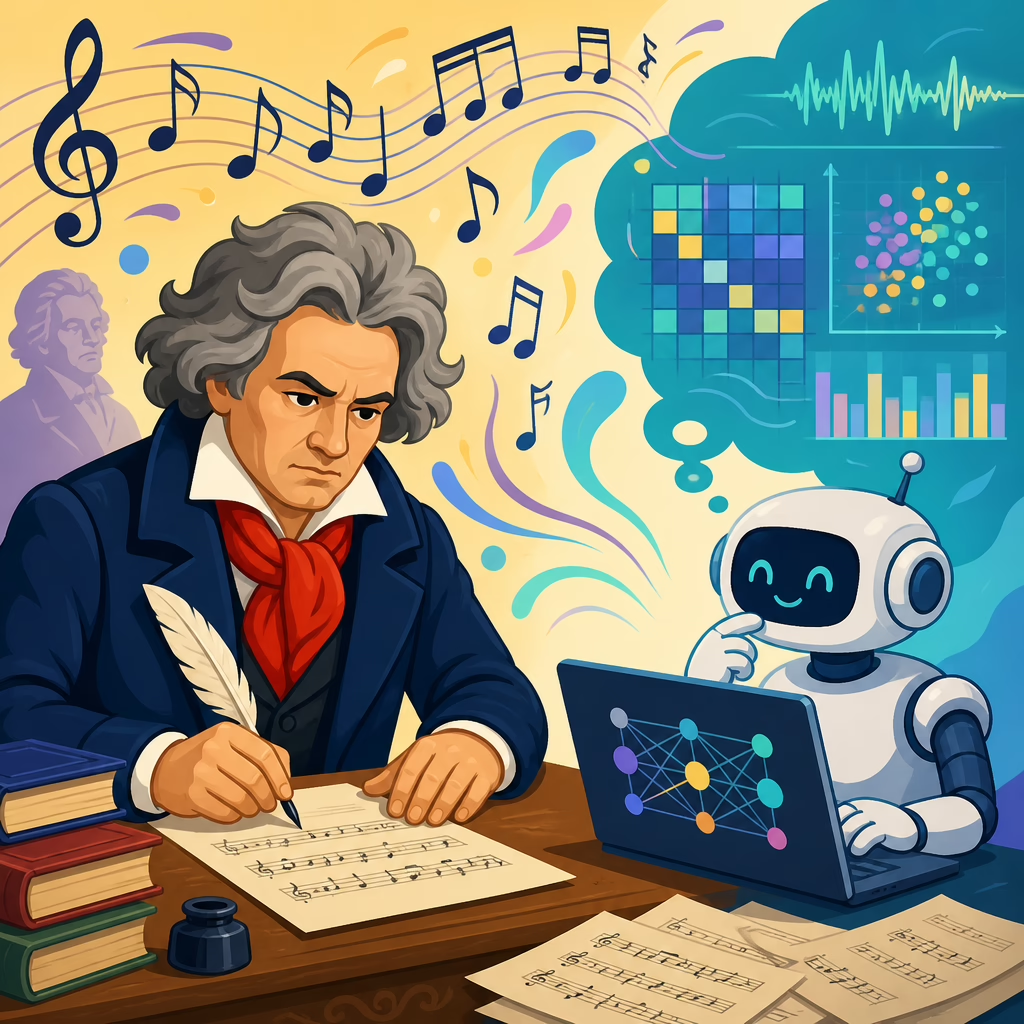
Can Computers Identify Beethoven’s Style
Can computers identify Beethoven’s style? Yes, but only when style is defined carefully and measured through musical features that software can actually detect. In practice, researchers and musicians use computers to recognize recurring patterns in Beethoven’s melodies, harmonies, rhythms, textures, and formal designs, then compare those patterns with other composers or with disputed works. The result is not a mystical machine judgment about genius. It is a structured analysis of evidence embedded in the score.
That distinction matters because “style” in music can mean several things at once. It can mean surface traits, such as favorite rhythmic figures or dynamic markings. It can also mean deeper habits: how a composer develops a motive, delays a cadence, handles modulation, balances phrase lengths, or writes for a particular ensemble. Beethoven’s style is especially challenging because it evolved dramatically from his early Vienna years through the middle “heroic” period and into the late works. A useful computer model must therefore capture both stable signatures and historical change.
I have worked with score-analysis tools on Beethoven repertory, and the first lesson is always the same: computers are excellent at counting, comparing, and classifying, but they only recognize what has been translated into data. If a score is encoded in MusicXML, MEI, or MIDI, software can extract interval patterns, note durations, chord distributions, registral spans, articulation density, and formal cues. Those measurements can then feed statistical models, rule-based systems, or machine-learning classifiers. The computer does not “hear” Beethoven as a human listener does; it identifies regularities that correlate with what trained musicians describe as Beethovenian writing.
This matters for three practical reasons. First, style identification helps scholars test attribution, especially when manuscripts are incomplete, copied by others, or disputed. Second, it supports music education by showing students concrete fingerprints of Beethoven’s technique rather than vague labels. Third, it enables digital humanities work at scale, allowing hundreds of movements to be compared in ways that no single analyst could perform manually with the same speed and consistency. The strongest results come when computational evidence and close reading of the score support each other rather than compete.
What a computer can actually measure in Beethoven’s music
A computer can identify Beethoven’s style only through features that can be formalized. In symbolic score analysis, the most useful features typically include pitch intervals, melodic contour, rhythmic ratios, metrical stress, harmonic function, cadence types, texture, voice-leading patterns, phrase length, motivic repetition, instrumentation, and dynamic or articulation markings when encoded reliably. These categories may sound technical, but they map directly onto familiar Beethoven habits.
Take motivic economy, one of Beethoven’s clearest signatures. In the Fifth Symphony, the famous short-short-short-long figure is not just an opening gesture. It drives accompaniment patterns, transitions, sequenced passages, and structural climaxes. A computer can detect repeated rhythmic cells, intervallic variants, transpositions, and fragmentation across an entire movement. That makes it possible to quantify how insistently a small motive governs large spans of music. Beethoven is not the only composer who develops motives, but he often does so with unusual concentration and structural force.
Harmony offers another measurable layer. Beethoven frequently intensifies form through dominant preparation, deceptive motion, abrupt mediant shifts, and strategic delays of expected cadences. Software such as music21, Humdrum, and the Spiral Array tools can estimate key areas, parse chord successions, and track modulation pathways. These tools are imperfect, especially in chromatic late works, yet they reveal tendencies: how long Beethoven sustains tonal tension, how often he destabilizes phrase endings, and where he pivots by common tones or enharmonic reinterpretation.
Rhythm and meter are equally important. Beethoven’s style often depends on syncopation, sforzando accents against the bar line, hemiola-like displacement, and obsessive repetition of simple values that accumulate pressure. Computers can measure note-onset distributions, offbeat accent rates, and duration entropy. In plain terms, they can show whether a passage behaves with regular symmetry or with the kind of friction Beethoven often uses to create momentum.
How researchers train systems to recognize Beethovenian patterns
Most successful systems begin with a corpus: a cleaned, encoded set of Beethoven scores, often paired with works by Haydn, Mozart, Schubert, or later Romantic composers as comparison material. The quality of the encoding matters enormously. Optical music recognition can introduce errors in slurs, tuplets, accidentals, and voices, so serious projects usually verify files by hand. Once the corpus is stable, analysts extract features movement by movement or phrase by phrase and build a model that looks for statistical separation between composers, periods, or genres.
Two broad approaches dominate. Rule-based analysis uses explicit musical criteria, such as cadence profiles, motivic recurrence thresholds, or phrase asymmetry. Machine learning, by contrast, lets algorithms discover patterns from labeled examples. A support vector machine might classify string quartet movements by composer using interval n-grams and rhythmic tokens. A random forest could weigh instrumentation, texture, and harmonic rhythm. Neural models can learn higher-dimensional representations, but they demand larger datasets than the Beethoven canon alone usually provides.
The most reliable studies combine both strategies. I have found that pure black-box prediction rarely satisfies musicologists, because a model may classify accurately without telling us why. Interpretable features are essential. If a system labels a disputed movement “likely Beethoven,” the useful question is not only whether the label is correct, but which features drove the decision: compressed motives, irregular phrase expansion, a specific cadence vocabulary, or characteristic use of registral contrast.
| Method | What it examines | Strength for Beethoven study | Main limitation |
|---|---|---|---|
| Rule-based analysis | Cadences, phrase lengths, motivic recurrence, formal markers | Musically interpretable and transparent | Can miss subtle interactions across many features |
| Statistical feature models | Intervals, rhythms, chord frequencies, texture counts | Good for comparison across large corpora | Depends heavily on feature design |
| Machine-learning classifiers | Weighted combinations of many extracted features | Often strong composer identification accuracy | May be difficult to interpret musically |
| Deep learning sequence models | Longer symbolic patterns across time | Can capture complex dependencies | Needs substantial data and careful validation |
Validation is crucial. A credible study separates training data from test data, balances genres where possible, and avoids letting the model “cheat” by identifying editorial conventions rather than composition style. For example, if all Beethoven files come from one edition and all Mozart files from another, differences in notation practice can distort the result. Cross-validation, feature ablation, and genre-controlled tests help prevent false confidence.
Where computers succeed, and where they fail
Computers are strongest when the question is narrow and the evidence is symbolic. They can classify short passages by composer better than chance, detect recurring motives over large forms, and compare stylistic fingerprints across Beethoven’s early, middle, and late periods. They are also useful for spotting outliers. If one movement attributed to Beethoven has unusually regular phrase symmetry, weak motivic integration, and harmonic behavior closer to a contemporary copyist or student, the score deserves closer scrutiny.
They are weaker when style depends on expressive context, performance practice, or culturally informed listening. Beethoven’s identity is not only in note patterns. It also lives in the dramatic timing of silence, the rhetorical weight of fermatas, the interaction between notation and period instruments, and the expectations of listeners around 1800. A symbolic model may detect a diminished seventh chord, but it cannot fully capture why that sonority feels explosive at a specific formal hinge unless analysts relate the data back to musical context.
Another limitation is internal diversity. Beethoven did not write one style. The Op. 18 quartets, the Eroica, the late bagatelles, and the final piano sonatas differ sharply in texture, proportion, and harmonic language. A model trained only on middle-period orchestral works may misread late keyboard writing as anomalous rather than characteristic. Good research therefore builds sub-models by genre and date, then tests which features remain stable across the canon.
There is also the problem of influence and overlap. Haydn, Mozart, and Beethoven share Classical syntax. Schubert sometimes overlaps with Beethoven in dramatic harmonic turns. Early Beethoven can resemble late Mozart in ways that confuse shallow models. That is not a failure of scholarship; it reflects historical reality. Attribution is probabilistic, not absolute.
Real uses: attribution, pedagogy, and digital analysis
One practical use of computational style analysis is attribution. When a sketch, fragment, or doubtful work surfaces, scholars can compare its measurable traits with authenticated Beethoven pieces from the same period and genre. No serious editor would publish a conclusion from software alone, but computational evidence can strengthen or weaken an attribution case alongside paper type, handwriting, provenance, and traditional analysis.
A second use is pedagogy. Students often hear that Beethoven is a master of development, but that phrase can remain abstract until software maps how a four-note cell recurs, mutates, and anchors form. In seminars, I have seen students grasp sonata-process thinking more quickly when visualized feature data is paired with score study. The machine does not replace listening; it sharpens attention.
A third use is large-scale comparison. Scholars can ask how Beethoven’s cadence timing changes between piano sonatas and string quartets, or how often he expands phrase groups beyond normative four-bar units. Projects built with music21, jSymbolic, Humdrum, and MEI workflows make these questions tractable. For readers wanting a broader framework for score-analysis methods, the main guide on how AI tools can help analyze Beethoven scores provides useful context, but the core issue here remains specific: identifying style requires turning musical intuition into testable features.
The best current answer is therefore balanced. Computers can identify Beethoven’s style to a meaningful degree when the task is well defined, the corpus is clean, and the model is interpreted musically. They can reveal fingerprints that are difficult to track manually across dozens of works. They cannot replace historically informed judgment, nor can they reduce Beethoven’s art to a single statistical profile.
The key takeaway is that computational style recognition works not by “understanding genius” in a romantic sense, but by detecting recurrent structures in encoded scores. For Beethoven, those structures often include tight motivic development, purposeful rhythmic tension, bold harmonic strategy, and distinctive formal pressure. When these signals are measured carefully, software becomes a valuable analytical partner.
For musicians, scholars, and serious listeners, the benefit is clarity. Computers can test claims about Beethoven’s style, expose patterns hidden by scale, and support attribution or teaching with concrete evidence. Their findings are strongest when checked against close reading, source criticism, and stylistic history. If you want to study Beethoven more precisely, start with a reliable digital score set, choose a transparent analytical tool, and let the data deepen, not replace, your musical judgment.
Frequently Asked Questions
Can computers really identify Beethoven’s style?
Yes, but only in a specific and evidence-based sense. Computers do not “hear genius” or intuit Beethoven’s personality the way a human listener might describe it. What they can do is analyze measurable musical traits that appear repeatedly in Beethoven’s works and compare those traits across large bodies of music. Researchers typically convert scores or performances into data, then examine features such as melodic contour, interval patterns, harmonic movement, rhythmic fingerprints, texture, motivic repetition, phrase structure, and formal organization. If those patterns appear consistently in Beethoven’s authenticated works and differ in meaningful ways from those of Haydn, Mozart, Schubert, or other composers, software can help identify what is statistically characteristic of Beethoven’s style.
That means the answer depends on how “style” is defined. If style is treated as a collection of observable musical behaviors, computers can be very useful. If style is treated as a purely subjective feeling or a mystical artistic aura, then no machine can truly identify it. In real music research, the goal is usually not to replace human judgment but to organize musical evidence more systematically. Computers are especially valuable because they can compare hundreds or thousands of passages consistently, uncovering patterns that a scholar might miss or struggle to quantify by hand.
What musical features do computers look for when analyzing Beethoven’s music?
Computers look for features that can be represented clearly in symbolic or audio data. In score-based analysis, that often includes pitch patterns, melodic intervals, rhythmic durations, meter, harmonic progressions, chord frequency, voice-leading behavior, motivic development, cadence types, key relationships, and larger formal shapes such as sonata form or variation structure. Beethoven is especially interesting in this context because his music often combines memorable motives with strong developmental procedures, dramatic rhythmic energy, and distinctive harmonic pacing. Software can track how small motives recur, transform, fragment, and reappear across movements or within a single section.
Texture is another important area. A computer can detect whether the music is mostly homophonic, contrapuntal, chordal, or based on layered accompanimental patterns. It can also measure density, register usage, dynamic markings when available, and even aspects of articulation in performance data. Some projects focus on very local details, such as how often Beethoven uses certain interval successions or syncopated rhythmic cells. Others examine broader architectural habits, such as how themes are introduced, developed, and recapitulated. The key point is that computers do not identify “Beethoven-ness” as a single magical trait. They identify many small, detectable features that together form a profile.
How accurate is computer analysis when comparing Beethoven to other composers?
It can be surprisingly accurate when the task is well defined and the dataset is carefully prepared. For example, if software is asked to distinguish Beethoven piano sonatas from those of other Classical and early Romantic composers using symbolic score features, it may achieve strong classification results, especially when the selected features capture meaningful stylistic differences. However, accuracy depends heavily on the quality of the source material, the time period being compared, the genre, and the exact analytical method. Beethoven’s early works may overlap more with Haydn and Mozart, while later works may look more distinctive in certain respects. A model trained on symphonies may not perform equally well on string quartets or bagatelles.
It is also important to understand what accuracy means in this setting. A computer may correctly classify works at a high rate without “understanding” them in a humanistic sense. It is identifying statistical regularities, not making aesthetic judgments. In addition, some models may latch onto superficial cues if the training data is biased. That is why responsible researchers validate their methods, test them on unseen material, and examine which features are driving the result. The strongest studies combine computational accuracy with musical interpretability, so the outcome is not just a number but a clearer explanation of what truly distinguishes Beethoven’s writing.
Can computers help determine whether a disputed piece was written by Beethoven?
Yes, computational analysis can be very helpful in authorship questions, though it is rarely used alone. When a work has uncertain attribution, researchers can compare its musical fingerprints with those found in Beethoven’s authenticated compositions and with works by likely alternative composers. The computer may reveal whether the disputed piece shares Beethoven-like tendencies in harmony, rhythm, motivic development, phrase structure, or formal planning. If the piece consistently falls outside Beethoven’s normal range across multiple features, that may weaken the case for his authorship. If it aligns closely with Beethoven and not with peers, it may strengthen the case.
Still, attribution is rarely settled by software alone. Historical context matters just as much as style. Scholars also look at manuscripts, paper types, handwriting, publication history, correspondence, performance records, and the broader chronology of Beethoven’s output. A disputed work might resemble Beethoven in some ways because it was written by a close contemporary working in the same style, or because it comes from an early period before Beethoven’s mature language fully emerged. Computational evidence is strongest when it supports and sharpens traditional musicological research rather than trying to replace it. In that role, it can be a powerful tool for weighing probabilities and making stylistic arguments more precise.
Does computer analysis reduce Beethoven’s music to numbers and miss what makes it great?
Not necessarily. Good computational analysis does not aim to flatten Beethoven’s music into mere statistics. Instead, it provides another way to study how the music is built and why it has such a strong identity. Numbers, in this context, are simply a structured way of describing patterns that musicians already recognize: the force of a rhythmic motive, the tension of a harmonic delay, the persistence of developmental logic, or the way a formal design creates expectation and release. When used thoughtfully, computation can deepen musical understanding rather than diminish it.
That said, there are limits. Not every meaningful aspect of Beethoven’s style is easy to measure. Emotional impact, historical significance, interpretive nuance, and listener experience cannot be fully captured by feature extraction alone. Even highly advanced models may detect stylistic signatures without explaining their artistic significance in satisfying human terms. The best approach is a balanced one: let computers do what they do well—process large amounts of musical data consistently, test hypotheses, and reveal hidden patterns—while letting scholars, performers, and listeners interpret the results in a broader artistic and historical framework. In that sense, computer analysis does not replace Beethoven’s humanity; it helps illuminate the craft through which that humanity reaches us.