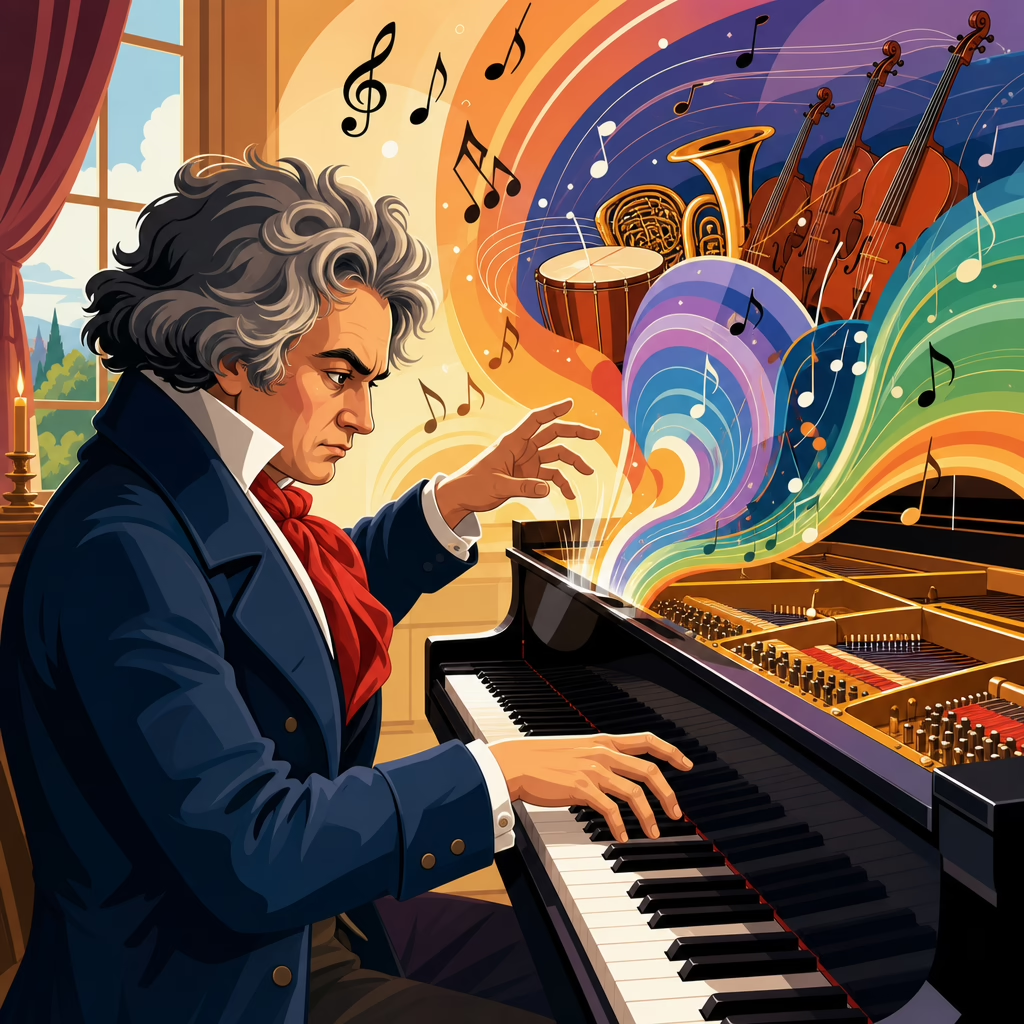
Beethoven and the Expansion of Keyboard Sonority
Beethoven transformed keyboard writing by treating the piano not as a polite salon instrument but as an expanding acoustic world capable of orchestral weight, vocal intimacy, percussive attack, and architectural breadth. In this context, keyboard sonority means the total character of sound available at the instrument: register, touch, pedal resonance, dynamic range, articulation, texture, and the way tones interact in time. Before Beethoven, Haydn and Mozart had already enlarged expressive keyboard language, yet much of their writing still reflected the lighter response and narrower sustaining power of late eighteenth-century Viennese instruments. Beethoven pushed beyond those inherited limits. He wrote for the piano he had, imagined the piano he wanted, and in doing so changed how composers, builders, and performers understood what keyboard sound could be.
I have worked through these sonatas at the keyboard on both modern pianos and period-style fortepianos, and the difference is instructive. Passages that can seem merely loud on a concert grand often reveal on historical action a sharper profile of color and attack; conversely, textures that look simple on the page become daring studies in resonance when the sustaining resources are limited. This is why Beethoven’s keyboard sonority matters. His scores sit at the meeting point of composition, instrument technology, and performance practice. To understand his achievement, you have to hear sonority not as decoration added after the notes, but as part of the musical argument itself. In Beethoven, sound is structure.
The expansion happened through several connected moves. He widened extremes of register, making bass and treble function as dramatic poles. He thickened textures with tremolos, octave doubling, dense chords, and sustained pedal effects. He treated silence, sforzando attack, and abrupt dynamic contrast as sonic materials. He also exploited the evolving capabilities of makers such as Stein, Walter, Érard, and especially Broadwood, whose stronger English instruments offered more power and sustain than many Viennese models. The result was a new keyboard rhetoric in which sonority could suggest symphonic mass, psychological disturbance, sacred stillness, or improvisatory freedom without ceasing to be idiomatic piano writing.
This article stays tightly focused on that sonic expansion. Rather than surveying Beethoven’s entire innovation, it examines how specific keyboard techniques in selected sonatas and variations enlarged the instrument’s palette. The central point is straightforward: Beethoven did not simply write louder, thicker, or harder music. He reconceived the piano as a medium in which color, resonance, and physical energy carry meaning equal to melody and harmony. That reconception shaped nineteenth-century pianism from Schubert and Chopin to Liszt and Brahms, and it still governs how serious players think about touch, pedaling, voicing, and scale.
Instrument technology and the new sound ideal
Beethoven’s sonority cannot be separated from the pianos available to him between the 1790s and the 1820s. Early Viennese instruments were prized for clarity, quick decay, and a light action that rewarded articulation. English pianos, especially those by Broadwood, had a heavier action, fuller bass, and longer sustain. When Broadwood sent Beethoven a grand in 1818, the gift mattered because it aligned with tendencies already present in his music: broader dynamic planning, more emphatic bass writing, and textures that benefited from tonal depth. He did not wait for new technology to inspire him; rather, he wrote in a way that pressured technology to catch up.
You can trace this pressure in his notation. Beethoven’s scores increasingly specify fp, sf, sff, long crescendos, sudden subito pianos, wide registral spacing, and pedal indications that create deliberate blurring. These are not accidental excesses. They are signs of a composer using every controllable variable of the keyboard to shape drama. In the “Pathétique” Sonata, Op. 13, the Grave introduction juxtaposes massive chordal declamation with charged silence. The effect depends on attack, decay, and resonance. On a fortepiano, each chord speaks with a grainy immediacy; on a modern piano, the same writing requires disciplined pedaling so the harmonic tension does not thicken into mud. In either case, sonority is the message.
Beethoven also expanded expectations of endurance. Repeated octaves, long trills against moving harmonies, tremolando basses, and thick chordal spans demand a body engaged with the instrument differently from the elegant finger-centered style of much earlier repertory. This physicality is central to sonority. A Beethoven crescendo is rarely just louder repetition. It is often a cumulative increase in density, register, and kinetic force. That is why his keyboard writing sounds inevitable when performed with structural awareness and merely noisy when treated as an excuse for volume.
Register, resonance, and the drama of space
One of Beethoven’s most decisive innovations was to turn register into drama. Earlier composers certainly used contrast between high and low, but Beethoven made the distance itself expressive. In the Sonata in C minor, Op. 10 No. 1, abrupt leaps and sharply profiled bass gestures create an almost theatrical sense of space. In the “Waldstein” Sonata, Op. 53, the opening movement projects brilliance through repeated chord patterns and transparent spacing, but the real breakthrough lies in how treble radiance and bass propulsion generate a field of resonance larger than the notation initially suggests. The keyboard becomes a stage where energy travels across distance.
The slow introduction and fugue of the “Hammerklavier” Sonata, Op. 106, take this farther. Beethoven writes sonorities that test the limits of register and continuity, from granitic bass statements to disembodied treble lines. On modern instruments, the temptation is to bind everything together with sustaining pedal. Yet the sonoric power of this music comes from differentiated layers. The bass must retain weight without swallowing inner voices; the top must glow without turning brittle. When these balances are right, you hear Beethoven composing in planes of sound, almost as if orchestrating for strings, winds, and timpani within a single keyboard texture.
The best-known example of resonance as compositional substance is the first movement of the “Moonlight” Sonata, Op. 27 No. 2. Its continuous triplet texture is often sentimentalized, but the movement is really a study in controlled harmonic halo. Beethoven’s pedal direction implies a wash of sound unimaginable in conventional Classical keyboard decorum. Historically informed performers debate the exact execution because modern pianos sustain longer than period instruments, yet the principle is clear: harmony is heard through resonance, not despite it. The sonority is intentionally veiled, and that veil carries the movement’s emotional ambiguity.
For a broader view of how Beethoven’s sonic imagination connects to his large-scale thinking, see the main guide on how Beethoven reinvented the symphony. The same instinct for expanding acoustic space appears there in orchestral form, but at the keyboard he had to invent that breadth with ten fingers, two pedals, and a rapidly evolving mechanism.
Texture, pedal, and the orchestral piano
Beethoven’s expansion of keyboard sonority is often described as orchestral, but that term needs precision. He did not simply imitate orchestral timbres. Instead, he built piano textures that function like orchestral masses: layered, directional, and coloristically contrasted. In the finale of the “Waldstein,” the long trill and shimmering repeated harmonies create a luminous surface over which melodic and harmonic events emerge like instrumental lines crossing a sustained background. The effect is not reducible to finger dexterity. It depends on pedaling strategy, voicing discipline, and an ear for blend.
The “Appassionata” Sonata, Op. 57, provides a darker example. The opening’s hushed broken chords must sound compressed, almost withheld, so that later eruptions have room to expand. In performance, I find that the sonority works only when the left hand is voiced as a restless undertow rather than an accompaniment. Beethoven then intensifies the palette through registral compression and release, obsessive rhythmic cells, and devastating fortissimo unisons. By the finale, the keyboard seems to exceed its own mechanism. The sonoric design mirrors the harmonic one: pressure accumulates until release becomes destructive rather than consoling.
Pedal is crucial across these works. Beethoven’s notation shows that he conceived resonance positively, not merely as a corrective for legato. Yet he also relied on contemporary listeners understanding local context. Some pedal marks invite literal execution on period instruments but require adaptation on modern grands because string length and sustaining capacity have changed dramatically. Good performers preserve the harmonic intention rather than obeying mechanically. This is not license; it is fidelity to sonority as Beethoven heard it in relation to his tools.
| Work | Sonoric device | Musical effect |
|---|---|---|
| Op. 27 No. 2 “Moonlight,” I | Continuous pedal resonance with triplet texture | Creates harmonic haze and suspended time |
| Op. 53 “Waldstein,” III | Trills, repeated harmonies, high register brilliance | Produces luminous, orchestral shimmer |
| Op. 57 “Appassionata,” I–III | Compressed bass energy, sudden dynamic shocks, unisons | Builds cumulative tension and catastrophic release |
| Op. 106 “Hammerklavier,” IV | Extreme register contrast and dense contrapuntal layering | Turns the piano into a multi-plane sonic architecture |
Form shaped by sound: from sonata rhetoric to sonic architecture
Beethoven did not add sonority onto preexisting forms; he often let sound help generate form. In the “Pathétique,” the return of the Grave material is memorable not only because of thematic recurrence but because its sonoric identity is unmistakable: heavy dotted rhythms, charged rests, and dark chordal spacing. In Op. 31 No. 2, the so-called “Tempest,” recitative-like passages interrupt the flow with a striking change of texture and resonance, as if the piano suddenly shifts from public declaration to inward speech. These moments are formal pivots because they alter the sound world, not just the thematic inventory.
The late sonatas intensify this integration. In Op. 109, the theme of the final movement gains meaning through each variation’s changed touch, spacing, and resonance. One variation glitters with delicacy; another drives with stronger rhythmic insistence; still another suspends time through trills and sustained sonority. The architecture is built from transformations of sound as much as from harmonic plan. Op. 111 makes the point even more strongly. The Arietta and its variations unfold as a progressive reimagining of what a keyboard tone can become: song, dance, pulse, and finally near-weightless vibration. The closing pages do not merely get quieter. They redefine presence through thinning texture and evaporating resonance.
This is why Beethoven stands at the center of later pianistic thought. Schubert learned from his spacious registers and sustained lyric fields. Chopin inherited the idea that pedaled sonority can articulate form. Liszt absorbed the orchestral conception of the piano and magnified it. Brahms took from Beethoven the principle that deep sonority can coexist with contrapuntal rigor. None of these composers copied his sound directly, because the instrument kept changing. But all accepted his premise that keyboard color and resonance are structural forces.
Performance implications and enduring influence
For performers today, Beethoven’s sonority poses a practical question: how do you realize music conceived for transitional instruments on a modern concert grand without flattening its contrasts? The answer begins with touch. Not every forte is the same. Some require compact, vertical attack; others need breadth without hardness. Voicing is equally important. Beethoven’s textures often hide the main line inside chordal writing or distribute it across hands. If everything is given equal weight, the sonority becomes thick and anonymous. If the layers are balanced, the music speaks with astonishing clarity even at high volume.
Pedaling demands similar judgment. Half-pedal, flutter-pedal, and selective clearing can approximate the resonance patterns Beethoven expected while respecting modern sustain. Tempi also shape sonority. The opening of the “Moonlight” loses its harmonic aura if played too slowly, because each change becomes isolated instead of fused. The fugue of Op. 106 can sound merely percussive if driven without enough tonal differentiation. In masterclasses, the most common correction is not “play louder” but “make the listener hear what kind of sound this is.” That is a distinctly Beethovenian problem.
His influence endures because he permanently enlarged the performer’s sonic imagination. After Beethoven, the keyboard could no longer be understood mainly as a vehicle for elegant line supported by harmony. It had become a space for collisions of register, long-range resonance, sculpted attack, and sound masses unfolding over time. Even on instruments he never knew, that conception remains valid. Modern pianists, instrument builders, recording engineers, and informed listeners all work inside the horizon he opened.
Beethoven expanded keyboard sonority by uniting compositional daring with a relentless ear for the instrument’s changing possibilities. He widened register, intensified texture, exploited pedal resonance, and made dynamic contrast and attack carry structural meaning. In works from the “Pathétique” and “Moonlight” to the “Appassionata,” “Waldstein,” and late sonatas, the piano becomes more than a keyboard instrument. It becomes an arena where sound itself argues, remembers, threatens, consoles, and transcends. That is the core achievement: he turned sonority into thought.
For anyone studying Beethoven and innovation, this focus on sound is indispensable. It explains why his sonatas continue to challenge advanced players, why period and modern performances can illuminate different truths, and why later composers treated the piano as an instrument of vast expressive range. Listen again to how his basses rumble, how his treble lines blaze, how his pedals blur and clarify, and how his textures reshape form. The more closely you hear those choices, the more fully Beethoven’s originality comes into view. Start with one sonata, follow the sonority measure by measure, and the expansion becomes unmistakable.
Frequently Asked Questions
What does “keyboard sonority” mean in the context of Beethoven’s music?
In Beethoven’s music, “keyboard sonority” refers to the full sonic identity of the piano rather than just the notes being played. It includes register, dynamic range, touch, articulation, pedaling, texture, resonance, and the way sounds linger and interact over time. In other words, sonority is not simply volume or tone color in isolation; it is the total acoustic effect created by the performer and imagined by the composer.
This idea matters especially in Beethoven because he wrote for the keyboard as though it were capable of many different expressive personalities. At one moment, the instrument can sound intimate and vocal, almost like a singer shaping a melodic line. At another, it can become sharply percussive, weighty, and orchestral, with thick chords and dramatic bass writing suggesting the force of an ensemble. Beethoven’s keyboard writing often depends on contrast between these worlds, and that contrast is one of the main reasons his piano music feels so expansive.
When discussing Beethoven and the expansion of keyboard sonority, scholars and performers are really pointing to the way he reimagined the piano as a larger acoustic space. Sound could be layered across registers, projected in broad architectural spans, intensified through pedal resonance, or broken into stark, exposed textures. Beethoven did not treat the keyboard as a merely elegant medium for balanced phrases; he explored it as an instrument capable of drama, psychological tension, and unprecedented sonic depth.
How did Beethoven expand keyboard sonority beyond what Haydn and Mozart had already achieved?
Haydn and Mozart had already greatly enriched keyboard expression, enlarging the instrument’s emotional vocabulary and exploiting contrasts of character, texture, and register. Beethoven inherited that tradition, but he pushed it further in scale, intensity, and structural importance. Instead of using sonority mainly as a means of refinement, color, or graceful contrast, he made sound itself a central dramatic force within the composition.
One of the clearest ways he did this was through the widening of extremes. Beethoven frequently stretches the keyboard across its registers, placing deep bass sonorities against high treble writing in ways that create breadth and tension. He also intensifies dynamic contrasts, moving from hushed intimacy to explosive power with a sense of physical impact that feels new. Chordal writing becomes denser, accents become more charged, and textures often carry a larger, more symphonic weight than earlier Classical keyboard style typically sustained.
He also expanded sonority through time. In Beethoven’s hands, resonance is not incidental; it can shape the musical argument. Sustained harmonies, pedal effects, repeated-note textures, tremolos, and registral echoes all contribute to a sense that the piano is generating an acoustic environment rather than simply presenting a sequence of pitches. This is a major shift. The keyboard becomes a field of resonance and energy, capable of long-range buildup and release.
Just as importantly, Beethoven linked sonority to form. A sudden thinning of texture, a monumental chordal arrival, or a newly illuminated register can function as a structural event, not just a coloristic detail. That integration of sound and architecture is one of the hallmarks of his style and a major reason his piano writing marks such a decisive moment in the history of the instrument.
Why is Beethoven often described as treating the piano like an orchestra?
Beethoven is often described this way because his keyboard writing frequently suggests multiple instrumental functions happening at once. He can place a singing melody above an accompanying texture that resembles strings, support it with bass lines of almost orchestral gravity, and punctuate the whole with powerful chordal attacks that evoke brass or timpani-like force. The result is not literal orchestration, of course, but a pianistic style that seeks layered breadth and color rather than a single uniform sonority.
This orchestral quality comes partly from texture. Beethoven often builds sound in blocks, masses, and strata, allowing different registers to behave as though they were separate sections of an ensemble. A low-register figure may act as a foundation, middle voices may fill out the harmonic body, and the treble may project a distinctive melodic identity. On the piano, all of this is played by one performer, yet the musical imagination behind it is often larger than the instrument’s traditional social role as a drawing-room keyboard.
It also comes from his use of dynamic and registral drama. Beethoven thinks in terms of projection, contrast, and spatial breadth. Sudden fortissimo outbursts, wide leaps, sharply profiled accents, and sustained resonances can make the piano feel less like a compact domestic instrument and more like a vehicle for public, large-scale expression. Even in lyrical passages, there is often a sense that the sound could expand beyond the keyboard’s immediate physical limits.
Still, the phrase should not be misunderstood. Beethoven did not merely imitate orchestral effects at the piano. Rather, he discovered in the piano itself the ability to imply orchestral scope while preserving the instrument’s own unique strengths: immediacy of attack, clarity of contrapuntal detail, and the intimate connection between gesture and sound. That balance between orchestral ambition and pianistic identity is central to his achievement.
What role do touch, pedaling, and register play in Beethoven’s expansion of sonority?
Touch, pedaling, and register are absolutely fundamental to Beethoven’s keyboard sound world. Touch determines whether a passage speaks with tenderness, brilliance, bite, or mass. Beethoven’s music often asks for a highly varied physical approach: legato lines that sing, sharply etched accents that strike with rhetorical urgency, chordal passages that require depth and solidity, and delicate transitions where tone must seem to emerge almost from silence. These contrasts are not decorative; they are part of the music’s expressive logic.
Pedaling is equally important because it shapes resonance and harmonic atmosphere. In Beethoven, pedal can deepen bass sonority, blend harmonies into a glowing field of sound, or heighten dramatic ambiguity when tones overlap. His writing often assumes an active awareness of how sound persists after attack. That means performers must think not only about what is struck, but about what continues to vibrate and how those vibrations color the musical space. In this sense, Beethoven’s sonority is inseparable from the temporal life of sound.
Register is one of his most powerful tools. Low bass writing can create an impression of gravity, menace, or grandeur; high treble textures can sound remote, ethereal, or piercingly exposed. Middle-register writing can provide warmth, density, or concentrated lyricism. Beethoven often exploits the emotional symbolism of these areas while also using them architecturally, spacing material across the keyboard to enlarge the listener’s sense of scale. A wide registral gap can make a texture feel monumental, while a compressed middle range can create pressure and intensity.
Taken together, touch, pedal, and register show that Beethoven’s expansion of keyboard sonority was not just about playing louder or writing bigger chords. It was about enlarging the expressive physics of the instrument. He understood that the piano’s meaning changes depending on where sound is placed, how it is produced, and how it is allowed to resonate. That insight helped redefine what composers and performers believed the keyboard could do.
Why is Beethoven’s approach to keyboard sonority still important for pianists and listeners today?
Beethoven’s approach remains essential because it changed the expectations surrounding piano music. After him, composers could think of the keyboard as a medium for vast structural thinking, radical contrasts, and highly individualized sound worlds. The Romantic piano tradition in particular owes a great deal to Beethoven’s example: the idea that the instrument could encompass intimacy and monumentality, song and thunder, introspection and public drama.
For pianists, Beethoven remains a central test of artistic maturity because his music demands more than technical control. It requires an understanding of sound as structure. A performer must shape resonance, balance registers, differentiate textures, and project long spans of tension and release. Simply playing the right notes is never enough. The pianist has to make audible the changing character of the instrument itself, allowing the music to move from chamber-like transparency to orchestral fullness without losing coherence.
For listeners, Beethoven’s keyboard sonority still feels modern because it engages the ear in a vivid, physical way. His piano writing invites us to hear sound as space, force, gesture, and drama. We are not only following melody and harmony; we are experiencing the transformation of the instrument’s acoustic identity from moment to moment. That is one reason his sonatas and other keyboard works continue to feel so compelling in performance.
Ultimately, Beethoven’s importance lies in the fact that he widened the imaginative horizon of the piano. He showed that keyboard music could be architecturally grand without sacrificing emotional immediacy, and sonically daring without losing formal discipline. That legacy continues to shape performance, scholarship, and listening culture, making his expansion of keyboard sonority one of the defining achievements in Western music history.