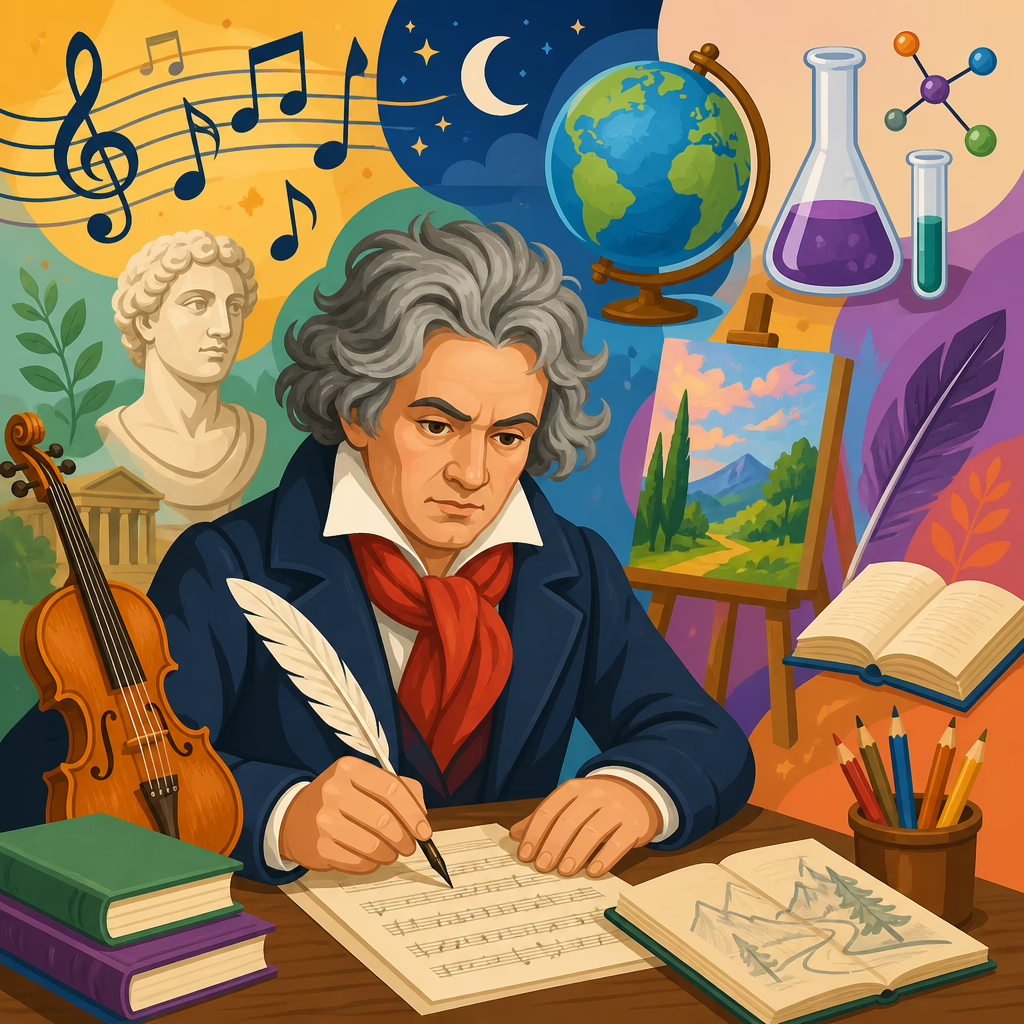
Beethoven Writing Prompts for Interdisciplinary Classes
Beethoven writing prompts for interdisciplinary classes give teachers a practical way to connect music, language arts, history, art, and social-emotional learning through one compelling figure. In this context, a writing prompt is a structured question or scenario that guides student thinking, while interdisciplinary teaching means using one topic to build understanding across multiple subjects instead of teaching each area in isolation. Ludwig van Beethoven works especially well for this approach because his life sits at the intersection of composition, European history, disability studies, persistence, creativity, and cultural legacy. I have used composer-based writing tasks in mixed elementary and middle-grade settings, and Beethoven consistently produces stronger discussion than students expect. They respond not only to famous melodies, but also to the human story behind the music.
The value of these prompts is straightforward: they help students move from passive listening to active interpretation. A child who hears the opening of Symphony No. 5 may describe it as dramatic, but a strong prompt pushes that child to explain why, connect the feeling to historical events, compare it to a poem, or imagine Beethoven’s intentions. That process develops vocabulary, evidence-based writing, and critical thinking at the same time. It also supports differentiated instruction. Emerging writers can respond with sentence frames, while advanced students can cite musical details such as tempo changes, motif development, dynamics, and instrumentation. For interdisciplinary classes, this flexibility matters because teachers often need one activity that can serve multiple learning targets in a limited block of time.
Beethoven also matters because his story raises questions students can handle at many levels: How does adversity affect creative work? What can we infer from music without lyrics? How do historical conditions shape art? Why do some works remain culturally important for centuries? These are not abstract questions reserved for specialists. They are entry points for writing that is personal, analytical, and grounded in observable evidence. When prompts are designed well, students learn to connect listening with reasoning. That is the central goal of Beethoven writing prompts for interdisciplinary classes: using music as a source text that students can analyze, interpret, and transform into thoughtful written work.
How to Design Beethoven Writing Prompts That Work Across Subjects
Effective Beethoven writing prompts start with a clear anchor: a short listening excerpt, an image, a historical fact, a quotation from a letter, or a brief classroom discussion. Without an anchor, student responses drift into unsupported opinion. With an anchor, writing becomes more precise. For example, after hearing the first movement of Symphony No. 5, students can answer, “How does Beethoven create tension in the opening, and what words best match that sound?” In language arts, this builds descriptive writing. In music, it teaches motif recognition. In social studies, the teacher can connect tension and uncertainty to the political climate of early nineteenth-century Europe, including the Napoleonic era. The same prompt serves several standards because the evidence source is shared.
A second design principle is to match the prompt type to the instructional goal. Narrative prompts work well when students imagine Beethoven’s point of view after noticing early hearing loss. Explanatory prompts fit lessons on orchestra sections, sonata form, or the role of patrons in classical music. Argument prompts are especially useful in upper elementary and middle school: “Was Beethoven more revolutionary because of his musical style or because of his personal perseverance?” Students can support claims with listening notes, biographical details, and class readings. In my experience, argument writing often produces the richest cross-curricular work because students must synthesize music and context rather than repeating facts.
Teachers should also decide what counts as evidence before assigning the task. In an interdisciplinary Beethoven lesson, evidence may include musical features, historical details, visual art comparisons, and emotional interpretation tied to specific moments in a piece. This clarity prevents the common problem of students making broad claims like “the music is sad” with no explanation. Instead, they learn to write, “The slow tempo, lower register, and sustained phrases make the excerpt feel reflective.” That sentence is stronger because it links a judgment to audible elements. If you need a broader planning framework for integrating composer study into elementary instruction, the main guide at Beethoven lesson plans for elementary music classes provides a useful foundation.
Prompt Types for Music, Language Arts, History, and Art Integration
The most effective Beethoven writing prompts for interdisciplinary classes usually fall into four categories: sensory, historical, personal, and analytical. Sensory prompts ask students to turn sound into language. A teacher might play “Moonlight Sonata” and ask students to describe the scene the music suggests, using three sensory details and two emotion words. Historical prompts ask students to place music in context. After a mini-lesson on Vienna, patrons, or Napoleon, students might explain how Beethoven lived within a rapidly changing Europe. Personal prompts encourage reflection, such as writing about a challenge students have faced and comparing perseverance in their lives to Beethoven’s determination to compose while losing his hearing. Analytical prompts ask for interpretation based on evidence, such as comparing Symphony No. 5 and Symphony No. 6 in mood, structure, and imagery.
These categories are useful because they align naturally with classroom goals. Sensory prompts support figurative language and adjective choice. Historical prompts support chronology, cause and effect, and contextual reading. Personal prompts build relevance and social-emotional connections, which often increase engagement for reluctant writers. Analytical prompts move students toward formal academic writing. In practice, a unit works best when teachers sequence the categories instead of choosing only one. I usually begin with sensory writing because every student can hear and react. Then I shift to context and finally to analysis. That progression mirrors strong instruction: observation first, interpretation next, and argument last.
| Prompt Type | Best Subject Link | Sample Beethoven Prompt | Primary Skill Built |
|---|---|---|---|
| Sensory | Language Arts | Listen to “Moonlight Sonata.” What setting does the music create, and which musical details support your description? | Descriptive writing |
| Historical | Social Studies | How might political change in Beethoven’s Europe have influenced the emotional intensity of his music? | Contextual reasoning |
| Personal | SEL/Advisory | Write about a time you kept working during a challenge. How is your experience similar to or different from Beethoven’s? | Reflective writing |
| Analytical | Music and ELA | Compare Symphony No. 5 and Symphony No. 6. Which piece tells a clearer story without words? | Evidence-based argument |
One practical note: keep excerpts short. Thirty to ninety seconds is usually enough for one writing response, especially in elementary and mixed-grade classrooms. Long listening segments often reduce writing quality because students forget details or lose focus. Short excerpts invite repetition, and repeated listening improves the specificity of student language. That is where interdisciplinary teaching becomes most effective: students are not simply “doing a music activity,” but using repeated evidence gathering in the same way they would analyze a text, painting, or historical source.
Classroom-Ready Beethoven Writing Prompts by Learning Goal
Teachers often need prompts they can use immediately, so it helps to organize them by outcome rather than by piece alone. For descriptive writing, try: “Listen to the opening of Symphony No. 6, ‘Pastoral.’ Describe the environment you imagine and explain which sounds suggest weather, movement, or landscape.” This works because the music gives students concrete cues while still allowing imagination. For narrative writing: “Write a diary entry from Beethoven on the day he realizes his hearing is changing. What emotions, fears, and hopes would he record?” This prompt encourages empathy but should be paired with factual background so students avoid inventing a caricature. For expository writing: “Explain how a motif works in Symphony No. 5 and why repeating a short idea can make music memorable.” Even younger students can understand motif when teachers model it through clapping or chanting the famous four-note opening.
For argument writing, use prompts that require judgment. “Which reveals Beethoven more clearly: his public music or his private struggle?” or “Should Beethoven’s hearing loss be treated as central to his legacy, or should the music itself stay the main focus?” These are productive questions because they resist easy answers. Students must weigh biography against art, and that tension produces stronger claims. In interdisciplinary settings, these prompts also open ethical discussions about how society talks about disability, genius, and resilience. Teachers should guide students toward respectful language and remind them that hearing loss is one part of Beethoven’s life, not the entirety of his identity.
Cross-arts prompts are particularly effective. Show students a Romantic landscape painting and ask, “Which Beethoven piece best matches this image, and why?” Or have them compare the emotional arc of a poem to the progression of a Beethoven movement. These tasks teach transfer, the ability to apply understanding from one medium to another. In curriculum planning, transfer is often the hardest outcome to achieve, but Beethoven helps because his music contains strong contrasts, recognizable motifs, and vivid emotional shifts. Students can hear structure, then write about structure in another art form. That is a powerful interdisciplinary move, and it works with both general education and enrichment groups.
Scaffolding, Assessment, and Differentiation for Better Student Writing
Strong prompts are only half the work. Students also need scaffolds that turn listening into writing. The most useful support I have found is a simple evidence chart with three columns: what I heard, what I think it means, and what words I can use in my writing. This keeps students from jumping too quickly to unsupported conclusions. Sentence stems also help without lowering rigor. Examples include “The music sounds ___ because Beethoven uses ___” and “This excerpt suggests ___, especially when ___.” For multilingual learners and younger students, a word bank with terms like tempo, rhythm, sudden, smooth, tense, peaceful, and dramatic improves precision. For older students, require at least one direct reference to musical technique in every paragraph.
Assessment should measure both content understanding and writing quality. A practical rubric can include four categories: accuracy of Beethoven-related content, use of evidence, organization, and language control. If the assignment is interdisciplinary, build the rubric so no single subject dominates unfairly. For instance, students should not be penalized heavily for lacking advanced music terminology if the main target is historical reasoning. At the same time, they should be expected to mention audible features, not just feelings. Balanced rubrics produce more valid results because they reflect the task’s actual complexity. Teachers can also use quick formative checks such as exit slips, one-sentence claims, or partner discussion before independent writing.
Differentiation matters because Beethoven prompts can stretch across a wide age range. In elementary classes, students can draw while listening and then write two evidence-based sentences. In middle school, they can compare two performances of the same excerpt and discuss interpretation. Advanced learners can examine primary sources such as excerpts from the Heiligenstadt Testament and consider how self-perception appears in later works. Digital tools can help as well. Shared slides, audio timestamps, and classroom platforms like Google Classroom or Seesaw make it easier to replay excerpts and collect responses. The key is to preserve rigor while adjusting the path. A well-scaffolded Beethoven writing prompt should challenge every student to observe carefully, think across disciplines, and communicate clearly.
Why Beethoven Prompts Deepen Interdisciplinary Learning
Beethoven writing prompts for interdisciplinary classes work because they turn one composer into a rich study of sound, language, history, and human experience. Students are not just memorizing that Beethoven wrote nine symphonies or lived from 1770 to 1827. They are learning how to build a claim from evidence, how to describe sound precisely, how to connect art to historical context, and how to reflect on perseverance without reducing a person to a simple inspirational story. That combination is rare. Few classroom topics offer such direct access to emotion and analysis at the same time, which is why Beethoven remains so useful in integrated instruction.
The strongest approach is focused and intentional. Choose a short excerpt, define the writing goal, provide background, and require students to support every idea with something they heard, read, or observed. Use sensory prompts to open the door, historical prompts to build context, personal prompts to create relevance, and analytical prompts to deepen thinking. Keep excerpts manageable, model evidence-based language, and assess both the writing and the interdisciplinary understanding. When teachers do this consistently, student responses become more detailed, more accurate, and more meaningful.
If you are planning a composer unit, start with two or three Beethoven writing prompts tied to one clear learning objective and build from there. A single well-designed prompt can connect music listening, close reading, historical reasoning, and student voice in one lesson, giving interdisciplinary classes a structure that is both practical and memorable.
Frequently Asked Questions
1. What are Beethoven writing prompts for interdisciplinary classes?
Beethoven writing prompts for interdisciplinary classes are structured questions, scenarios, or short assignments that use Ludwig van Beethoven as the central theme for learning across several subject areas at once. Instead of discussing Beethoven only in music class, teachers can use carefully designed prompts to connect his life, work, and historical context to language arts, history, art, and social-emotional learning. For example, students might write a journal entry from Beethoven’s perspective during a turning point in his career, analyze how a symphony reflects the political climate of his time, or compare the emotions in one of his compositions with the mood of a painting they create. The prompt gives students a clear direction for thinking and writing, while the interdisciplinary approach helps them see how ideas connect across subjects. This makes learning more meaningful, because students are not studying isolated facts; they are exploring one influential figure through multiple lenses.
2. Why is Beethoven a strong subject for interdisciplinary writing activities?
Beethoven is especially effective for interdisciplinary writing activities because his life and music naturally open the door to many academic and personal themes. In music, students can explore rhythm, dynamics, mood, and form through his compositions. In history, they can examine the social and political changes of Europe during the late eighteenth and early nineteenth centuries, including revolution, class structures, and cultural change. In language arts, they can practice narrative, persuasive, descriptive, and analytical writing using Beethoven’s experiences and works as inspiration. In art, students can respond visually to the energy, tension, or beauty they hear in his music. In social-emotional learning, Beethoven’s perseverance through deafness, frustration, ambition, and personal struggle can lead to meaningful reflection on resilience, identity, and self-expression. Because his story includes both artistic brilliance and human challenge, students often find him engaging and relatable, which makes the writing more authentic and the classroom discussion richer.
3. How can teachers use Beethoven writing prompts across different subjects without making lessons feel disconnected?
The most successful way to use Beethoven writing prompts across multiple subjects is to build them around a shared essential question or central theme. A teacher might choose a theme such as perseverance, creativity, emotion, revolution, or the relationship between art and society. Each subject can then approach that theme in a way that fits its standards while still connecting back to the same core idea. For instance, in music class, students might listen to a Beethoven piece and describe how specific musical choices create emotional impact. In history, they could investigate what was happening in Europe when that piece was written and discuss how historical events may have influenced artistic expression. In language arts, they might write an argumentative response about whether personal struggle can strengthen creative work. In art, they could create visual interpretations of a symphony’s movement or mood. In social-emotional learning, they could reflect on a time they faced a challenge and compare their response to Beethoven’s determination. When prompts are organized around a common theme, students experience the unit as connected and purposeful rather than as separate lessons loosely tied to the same name.
4. What are some effective examples of Beethoven writing prompts for students?
Effective Beethoven writing prompts are clear, engaging, and flexible enough to support different grade levels and learning goals. A narrative prompt might ask students to imagine they are Beethoven on the day he realizes his hearing is fading and write a personal letter expressing fear, hope, and determination. An analytical prompt could ask students to listen to a selected piece and explain how the music communicates conflict, triumph, or sadness using evidence from what they hear. A history-based prompt might invite students to connect Beethoven’s era to larger political or cultural shifts and explain how artists are shaped by their times. A creative prompt could ask students to invent a modern interview with Beethoven, including questions about his creative process, setbacks, and legacy. A social-emotional prompt might ask students to reflect on how Beethoven responded to obstacles and what that example teaches about resilience today. Teachers can also adapt prompts for younger learners by simplifying language and focusing on observation and feeling, while older students can handle more complex interpretation, historical reasoning, and evidence-based writing. The best prompts do more than ask for facts; they encourage students to think, connect, imagine, and communicate in depth.
5. How do Beethoven writing prompts support student engagement and deeper learning?
Beethoven writing prompts support engagement and deeper learning because they combine content knowledge with personal response, critical thinking, and creative expression. Students are more likely to invest in writing when the topic has emotional depth, historical relevance, and artistic power, and Beethoven offers all three. His music creates opportunities for sensory and emotional entry points, which can help even reluctant writers begin with what they hear, feel, or imagine. At the same time, his biography and historical context encourage students to move beyond opinion into analysis and interpretation. Writing about Beethoven also allows students to practice transferable skills such as close listening, evidence-based reasoning, empathy, comparison, reflection, and cross-curricular synthesis. Instead of memorizing isolated details about a composer, students build understanding by asking larger questions about creativity, hardship, culture, and human expression. That kind of learning tends to last longer because students are actively making meaning. For teachers, this approach is practical as well, since one well-designed set of prompts can support multiple standards, varied learner needs, and richer classroom conversations across disciplines.