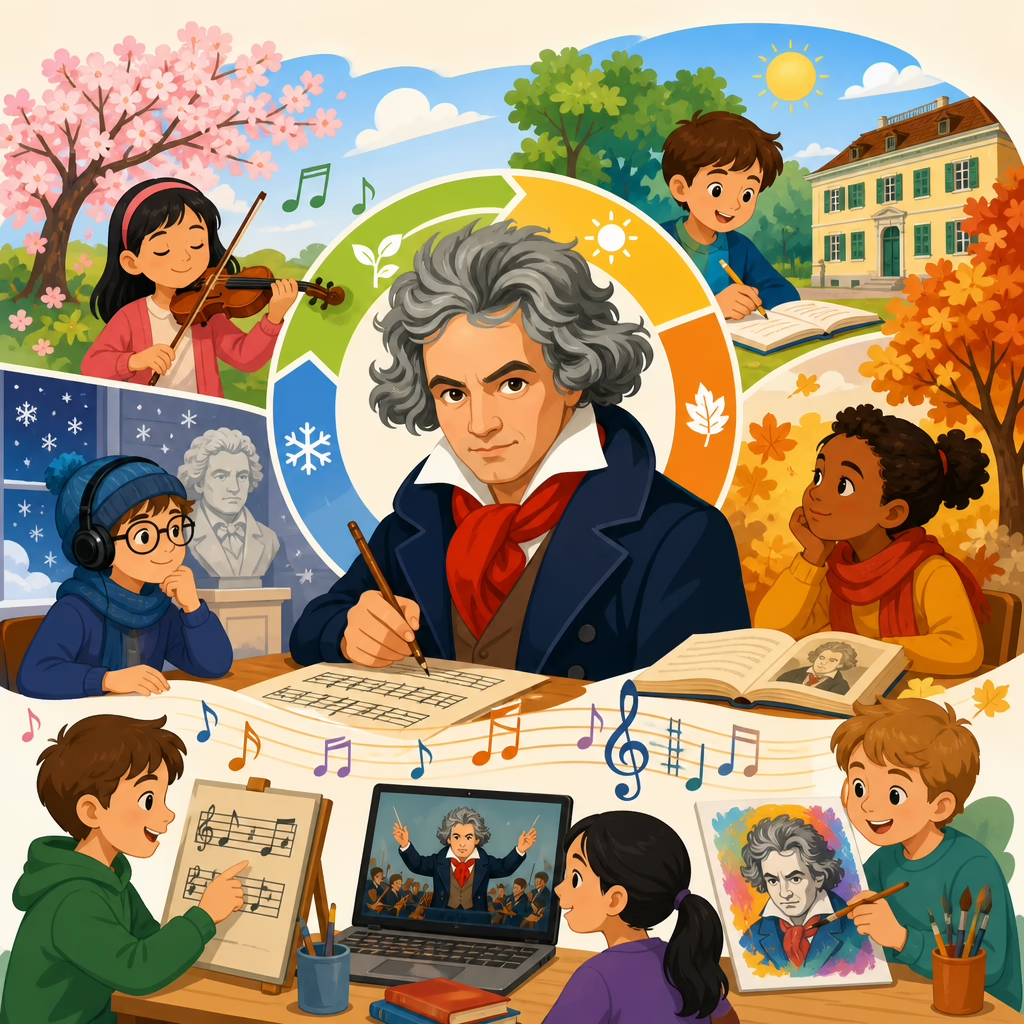
Building a Yearlong Beethoven Curriculum for Schools
Building a yearlong Beethoven curriculum for schools requires more than assembling famous pieces and composer facts. A strong plan turns Beethoven into a framework for teaching listening, rhythm, form, emotion, history, creativity, and ensemble habits across an entire academic year. In practical terms, a yearlong Beethoven curriculum is a sequenced set of lessons, projects, assessments, and performance experiences that uses Beethoven’s life and music as the organizing thread for student learning. Schools choose this approach because Beethoven offers unusual range: accessible melodies for younger students, rich structural ideas for older learners, and direct connections to social studies, literacy, and visual art. I have built composer-based units for elementary and middle school music programs, and Beethoven consistently works because students recognize the intensity of the music quickly, then stay engaged as they uncover how it is made. When the curriculum is designed carefully, Beethoven stops being a portrait on a timeline and becomes a living case study in musical decision-making. That matters for schools under pressure to justify instructional time. A yearlong sequence makes standards alignment clearer, improves retention through recurring themes, and gives concerts, writing tasks, and creative work a coherent center that families can understand.
For schools, the key terms matter. Curriculum means the full scope and sequence, not isolated activities. Yearlong means planned pacing from opening term to final assessment, with room for review and performance cycles. Beethoven curriculum means students learn through Beethoven’s repertoire, biography, historical context, and compositional techniques, not simply about him. This distinction is essential. A poster assignment on the composer’s life is not enough. Students should sing motives from Symphony No. 5, map phrase structure in “Ode to Joy,” compare tempo choices in recordings, discuss hearing loss and resilience with care, and create their own variations using Beethoven-inspired patterns. Because the material spirals, each return should deepen understanding. Younger students may identify steady beat and mood in fall, then revisit the same music in spring to discuss dynamics, instrumentation, or theme and variation. Done well, the curriculum supports musical literacy and cultural knowledge at the same time.
Start with outcomes, standards, and grade-band design
The best Beethoven curriculum begins with outcomes, not repertoire lists. Ask what students should know and be able to do by year’s end. In most schools, that means aligning to state arts standards or the National Core Arts Standards: create, perform, respond, and connect. Beethoven fits all four. Students can perform excerpts vocally or instrumentally, respond through listening analysis, connect music to historical change, and create original works using motives, sequences, and contrast. I recommend writing outcomes by grade band, even if the school serves multiple levels. For kindergarten through grade two, outcomes might include recognizing high and low, loud and soft, steady beat, and simple ABA form through Beethoven excerpts. Grades three through five can add notation reading, instrument families, simple conducting cues, and discussion of form, theme, and variation. Middle school students can handle harmonic tension, sonata principles in simplified language, historical patronage, and comparative listening across recordings.
Pacing should also reflect the school calendar. Many programs have nine-month schedules broken by concerts, testing windows, assemblies, and holidays. A practical sequence uses four arcs: introduction and sound world, forms and motives, context and creativity, then synthesis and performance. This is where a reliable planning hub helps. Teachers who want adaptable starter materials can connect one body section to the broader framework in Beethoven lesson plans for elementary music classes, then scale those materials across the year with assessments and cross-curricular tasks. Keep the yearly design realistic. If a class meets once a week for forty minutes, six major anchor works are often enough. If students meet more frequently, eight to ten works may be feasible. Depth beats coverage. Students remember recurring listening rituals, core repertoire, and projects far better than a rapid march through every symphony.
Choose anchor works that grow with students
Anchor works are the backbone of the curriculum. Choose music that is musically distinctive, age-appropriate, and flexible enough to revisit. In elementary settings, I have seen the strongest results with Symphony No. 5 first movement for motive and dynamics, Symphony No. 6 “Pastoral” for imagery and orchestral color, “Ode to Joy” from Symphony No. 9 for melody and community singing, Für Elise for keyboard texture and form, and selected variations for invention. For middle school, add Symphony No. 3 “Eroica,” the Moonlight Sonata first movement, and excerpts from the Violin Concerto or String Quartets to broaden style and texture. The point is not prestige. The point is what each selection teaches. Symphony No. 5 offers the clearest demonstration that a tiny rhythmic cell can unify a movement. The Pastoral Symphony makes programmatic thinking tangible. Für Elise lets students hear contrast between familiar opening material and less familiar middle sections.
A useful way to plan anchor works is to map each one to a recurring concept, an activity type, and an assessment. That creates consistency for students and makes differentiation easier for teachers.
| Anchor work | Primary concept | Classroom activity | Assessment idea |
|---|---|---|---|
| Symphony No. 5, Movement 1 | Motive, dynamics, rhythm | Body percussion and motive identification | Exit slip labeling repeated rhythmic idea |
| Symphony No. 6, “Pastoral” | Tone color, imagery, mood | Listening map with weather and landscape cues | Short reflection using music vocabulary |
| “Ode to Joy” | Melody, phrase, community singing | Sing and play on barred instruments or recorders | Performance rubric for pitch and phrasing |
| Für Elise | Form, texture, contrast | Section cards and movement mapping | Student diagram of returning themes |
| Theme and variations excerpt | Variation technique | Compose class variations on a four-note theme | Original variation with written explanation |
When selecting recordings, use at least two interpretations for older students. Comparing Carlos Kleiber and Herbert von Karajan in Symphony No. 5, for example, opens discussion about tempo, articulation, and intensity. Students learn that notation guides performance but does not erase interpretive choice. For younger students, one clear recording is usually enough at first, but live teacher modeling, singing, and movement can make the music more immediate than speakers alone.
Build monthly units around recurring questions
A yearlong Beethoven curriculum works best when each month revolves around a question students can answer plainly. Questions focus attention and help every lesson contribute to a larger purpose. September might ask, “How can four notes become a whole piece?” October could ask, “How does music paint a scene?” November may explore, “What makes a melody memorable?” December can center on performance preparation through “How do musicians show expression together?” After winter break, questions can deepen: “How do composers change a theme without losing it?” “How does history shape musical choices?” “What can we learn from different performances of the same piece?” “How do we create our own Beethoven-inspired music?” Students remember inquiry-driven units because each activity feels connected rather than random.
Recurring lesson structures are equally important. I recommend a five-part format: brief warm-up, focused listening, active response, concept explanation, and reflection. In a forty-minute class, that might mean three minutes of pulse work, seven minutes of guided listening, ten minutes of movement or singing, ten minutes of teacher-led analysis, and five minutes of writing or discussion, leaving transition time. This format gives security to younger learners and efficiency to teachers. It also supports classroom management, which matters in yearlong composer study. Beethoven’s music is dramatic, and high-energy excerpts can overstimulate classes if lessons lack routines. Clear starts, predictable transitions, and short reflection tasks keep engagement high without chaos.
Cross-curricular planning should be selective, not forced. The best links are natural. In language arts, students can write sensory descriptions of the Pastoral Symphony or persuasive paragraphs about which recording communicates strongest emotion. In social studies, they can place Beethoven in the context of Vienna, the Napoleonic era, and shifting ideas about the artist’s role in society. In visual art, they can create abstract line drawings responding to dynamics and contour. Avoid thin connections, like generic word searches that use the composer’s name without deepening musical understanding. Every non-music task should still reinforce music learning.
Teach Beethoven’s life with accuracy and care
Biography motivates students, but it should serve music study rather than replace it. The most important biographical themes for school use are Beethoven’s training, his career in Vienna, his changing public reputation, and his hearing loss. Present these with accuracy. He was born in Bonn in 1770, studied in a demanding musical environment, moved to Vienna, and became one of the central figures in Western art music. His hearing loss developed gradually, not overnight, and discussing it requires maturity. I frame it as one part of his life story, connected to adaptation, frustration, and persistence, while avoiding simplistic hero narratives. Students should not leave believing disability exists to produce inspiration for others. They should understand that Beethoven used notebooks for conversation later in life and continued composing through changing circumstances.
Historical context also clarifies why the music sounds the way it does. Beethoven stands between the Classical style associated with Haydn and Mozart and the expanded emotional and structural ambitions later linked with Romanticism. That sentence alone can anchor multiple lessons. Students can hear the balanced phrasing of earlier Classical practice and then notice Beethoven stretching drama, contrast, orchestral force, and motivic development. Even elementary students can grasp that he often takes a small idea and presses it farther than expected. For older students, introduce precise but manageable vocabulary: coda, motif or motive, development, variation, scherzo, and sonata form in simplified terms. Use the terms consistently, and always attach them to listening evidence. Vocabulary without sound becomes trivia.
Assessment should measure musical thinking, not just recall
Assessment in a yearlong Beethoven curriculum should be frequent, short, and varied. If every measure of learning is a written quiz on dates and titles, the curriculum misses its purpose. Instead, combine performance tasks, listening checks, composition prompts, and reflective writing. A second grader might circle whether an excerpt is loud or soft, then show the beat with movement. A fourth grader can identify AB or ABA form from a listening map. A sixth grader can explain how a motive returns in a new dynamic or register. Performance rubrics should be simple and transparent, focusing on pulse, pitch accuracy where appropriate, expressive contrast, and ensemble behavior. Listening assessments should play short excerpts and ask students to identify concepts already practiced in class.
Composition is especially valuable because it reveals understanding. After studying variation, ask students to transform a four-note class theme by changing rhythm, dynamics, tempo, or instrumentation. After studying Beethoven’s use of contrast, have them compose two short phrases with clearly different characters. Digital tools can help. Chrome Music Lab, Noteflight, Flat, Soundtrap, and classroom keyboards all support quick creative tasks without requiring advanced notation skills. The important point is that students explain their choices. A one-sentence reflection such as “I kept the melody but changed the rhythm to make it sound more urgent” demonstrates real transfer.
Data collection should be manageable. I favor single-point rubrics and teacher checklists over elaborate grading systems that consume planning time. Record one or two observable indicators per lesson, then use larger projects each quarter to show growth. This approach gives administrators clear evidence of progress while keeping the music room centered on music-making.
Performance, family engagement, and sustainable implementation
A yearlong Beethoven curriculum becomes memorable when students share it publicly. Concerts, informal demonstrations, hallway listening stations, and student-curated displays can all serve as culminating events. The strongest school concerts do not simply string together Beethoven excerpts. They show learning. One grade might perform “Ode to Joy” on instruments, another may narrate the journey of the four-note motive from Symphony No. 5, and older students might present contrasting recordings or original variations. Families understand the curriculum better when programs include short explanatory notes in plain language: what students studied, what they are demonstrating, and why the repertoire was chosen. This builds support for music instruction and helps the year feel intentional rather than episodic.
Sustainability depends on materials, training, and scope control. Teachers need reliable recordings, projected listening maps, age-appropriate scores or excerpts, instrument arrangements, and a pacing guide that survives schedule disruptions. Build a shared folder by month, not by random resource type. Include essential slides, links, worksheets, and audio files in one place. If multiple teachers deliver the curriculum across a district, agree on anchor works and common assessments, then allow room for individual teaching style. This balance preserves consistency without making lessons mechanical. Also be honest about limitations. Some Beethoven works are too long or complex to function well in young grades without careful excerpting. Some classes need more movement and less lecture. Some communities may need stronger background framing if students have little prior exposure to orchestral music.
The central benefit of building a yearlong Beethoven curriculum for schools is coherence. Students encounter the same musical ideas across months in new forms, which strengthens memory, vocabulary, listening skill, and creative confidence. Teachers gain a structure that supports standards, concerts, and assessment without reducing music to fact collection. Schools gain a story they can communicate clearly: students are not merely learning about a famous composer; they are learning how music works through one of the most powerful bodies of repertoire in the classroom canon. Start with a few anchor works, map them to clear outcomes, and revisit them with increasing depth. If the sequence is deliberate, Beethoven can carry a full year of meaningful music learning.
Frequently Asked Questions
What should a yearlong Beethoven curriculum for schools include?
A strong yearlong Beethoven curriculum should include much more than a biography unit and a playlist of famous works. The most effective plans are structured around clear learning goals that unfold across the school year. At a minimum, the curriculum should include sequenced listening lessons, rhythm and melody activities, form analysis, historical context, composition or improvisation tasks, movement or conducting experiences, ensemble rehearsal connections, and regular opportunities for reflection and assessment. Beethoven becomes the central thread, but the actual educational outcomes should cover broad musical skills students can transfer to other repertoire.
In practical classroom terms, that means dividing the year into manageable units. One section might introduce Beethoven’s life, major historical events, and the sound world of the Classical era. Another might focus on listening for musical form through short excerpts from symphonies, sonatas, and chamber works. Later units can explore emotional expression, motif development, variation, dynamics, tempo, and the relationship between personal struggle and artistic voice. Teachers can also build in student projects such as composer journals, listening maps, group presentations, original compositions based on a short motive, and performance tasks tied to Beethoven-inspired repertoire.
It is also important to include differentiated materials for different grade levels and classroom settings. Elementary students may respond best to storytelling, movement, call-and-response rhythm work, and guided listening. Middle school students can handle deeper discussion of form, historical change, and thematic development. High school students can engage with score study, analysis, aesthetics, and debates about interpretation. A complete curriculum should also include pacing guides, essential questions, standards alignment, formative checks, summative assessments, and performance or showcase moments that help students demonstrate what they have learned over time.
How can teachers make Beethoven relevant and engaging for students across an entire academic year?
Keeping Beethoven engaging all year depends on variety, relevance, and active participation. Students do not stay invested simply by hearing the same familiar works repeated in a traditional lecture format. The curriculum should present Beethoven as a living entry point into big musical ideas: how composers build tension, how emotion is communicated without words, how small musical motives can shape entire pieces, and how artists respond to challenge, change, and public expectations. When students experience Beethoven through listening, performing, composing, discussing, and creating, the subject feels dynamic rather than distant.
One of the best ways to maintain engagement is to connect Beethoven’s music to recurring classroom routines and student-centered tasks. For example, a short “motif of the week” activity can help students identify patterns and track how musical ideas develop. Students might compare different recordings of the same excerpt and discuss interpretive choices. They can create movement sequences to show phrasing, build visual listening maps, or compose short pieces using contrast, repetition, and variation inspired by Beethoven’s techniques. Ensemble teachers can connect rehearsal concepts such as articulation, balance, pulse, and dynamic contrast directly to Beethoven excerpts, making the curriculum feel relevant to students’ own music-making.
Historical and personal context also help sustain interest, but it should be handled thoughtfully. Beethoven’s hearing loss, changing social world, and role in the transition from the Classical to Romantic eras can open meaningful discussion without reducing him to a single narrative. Teachers can frame him as a complex artist working within changing musical, political, and cultural conditions. Pairing Beethoven with creative prompts, technology-based projects, student choice assignments, and cross-curricular connections to history, literature, or visual art can make the year feel fresh while still maintaining a coherent central focus.
How do you sequence Beethoven units so that student learning builds over the course of the year?
Sequencing is what turns a collection of lessons into a true yearlong curriculum. The strongest approach begins with foundational concepts and gradually moves toward deeper analysis, independent thinking, and more sophisticated performance or creative work. Early in the year, students need orientation: who Beethoven was, what period he belongs to, what instruments and ensembles were central to his music, and how to listen for basic musical features such as tempo, dynamics, mood, and recurring themes. These opening units should establish common vocabulary and confidence so that all students have an entry point.
Once that foundation is in place, the curriculum can progress into more focused musical concepts. A first quarter might center on pulse, rhythm, and motif using short, memorable examples. A second quarter could explore form, phrase structure, and contrast through selected sonata movements, symphonic openings, or theme-and-variation works. A third quarter might shift toward expression, orchestration, historical context, and the idea of musical narrative. By the final stretch of the year, students should be ready for synthesis: comparing works from different periods of Beethoven’s output, analyzing how compositional techniques support expression, creating original music inspired by his methods, and presenting projects or performances that demonstrate cumulative understanding.
Good sequencing also means revisiting important ideas in increasingly advanced ways. Students may first identify a motive by ear, then later trace how it changes across a movement, and eventually use that same strategy in their own composition. They may begin by describing music in everyday language, then move toward formal terminology and evidence-based discussion. In this way, each unit builds naturally on the previous one. The curriculum becomes coherent because concepts recur with greater depth rather than appearing once and disappearing.
What kinds of assessments work best in a yearlong Beethoven curriculum?
The best assessments are varied, ongoing, and closely tied to the musical skills the curriculum is designed to teach. Because a Beethoven curriculum typically covers listening, analysis, creativity, performance, and historical understanding, assessment should not rely only on written quizzes. Teachers should use a balanced mix of formative and summative measures that capture how students think, hear, perform, and create. Short listening checks, exit tickets, rhythm demonstrations, discussion prompts, and reflection journals are excellent formative tools because they reveal progress without interrupting instruction.
For larger assessments, teachers can assign listening analyses, comparative response essays, student presentations, performance tasks, composition projects, or portfolio-based work. For example, students might listen to an excerpt and identify the motive, describe the form, explain how dynamics shape expression, and connect the music to a broader stylistic or historical idea. They might perform a rhythm pattern derived from a Beethoven theme, create a variation on a melodic fragment, or present a group project comparing Beethoven’s early, middle, and late style. These kinds of assessments measure musical understanding in richer and more authentic ways than memorization alone.
Rubrics are especially helpful in a yearlong curriculum because they make expectations transparent and support growth over time. Teachers can assess criteria such as accuracy, vocabulary use, listening evidence, creativity, historical understanding, and expressive intent. It is also wise to include self-assessment and peer feedback, particularly for performance and composition tasks. When students reflect on how their listening, analysis, and musicianship have evolved through the year, the curriculum becomes more meaningful. Assessment then serves not just as evaluation, but as part of the learning process itself.
How can schools adapt a Beethoven curriculum for different grade levels, class formats, and school resources?
A yearlong Beethoven curriculum should be flexible enough to work in general music, choir, band, orchestra, music appreciation, or interdisciplinary humanities settings. The key is to preserve the core goals while adjusting the complexity of the materials and activities. In elementary classrooms, teachers may focus on beat, contrast, mood, movement, storytelling, and simple musical patterns using short excerpts and highly interactive routines. In middle school, students can begin to work more directly with form, thematic development, historical context, and small creative projects. High school students are ready for deeper analytical listening, score reading, aesthetic discussion, and research-based or performance-centered assignments.
Adaptation also depends on time and resources. A school with limited rehearsal time or few instruments can still teach Beethoven effectively through singing, body percussion, guided listening, visual organizers, classroom percussion, and digital tools. Schools with stronger ensemble programs may connect the curriculum more directly to concert literature, chamber music coaching, or student conducting opportunities. If technology is available, students can use notation software, recording tools, and interactive listening platforms to compose, annotate, and compare performances. If resources are minimal, teachers can still achieve strong results through carefully chosen excerpts, active listening strategies, and discussion-based lessons.
The most important principle is alignment. Whether the school meets daily, weekly, by semester, or in rotating blocks, the curriculum should remain focused on a clear sequence of skills and understandings. Teachers do not need to cover every Beethoven work or every biographical detail. Instead, they should select representative pieces and design lessons that fit their students’ developmental level and learning environment. When the curriculum is adapted thoughtfully, Beethoven becomes a flexible and powerful framework for teaching musicianship, creativity, history, and expressive understanding in almost any school context.